Markets
 BTC
BTC ETH
ETH BNB
BNB XRP
XRP SOL
SOL ZEC
ZEC HYPE
HYPE DOGE
DOGE LINK
LINK TON
TON AVAX
AVAX SUI
SUI TAO
TAO AAVE
AAVE PUMP
PUMP MORPHO
 ARB
ARB LIT
LIT--:-- UTC
The best crypto exchanges in Europe, all MiCA licensed and scored on euro Bitcoin prices, complaint rights and SEPA deposits.
Find the best exchange for
Europe
Americas
Asia Pacific
Nothing matches yet. Try a country or a region.
 By Alpha Finance Editorial Team
 Data maintained by Vince Dioquino
Each fee, licence and EU fine behind a score links to the page it came from. We read the exchanges' EU pages and ESMA's register again every quarter, and sooner when a fee, licence or set of terms changes.
How we score → Editorial policy Report an errorSince July 2026 every crypto exchange serving Europeans has needed a MiCA licence, and one licence reaches all 30 countries of the European Economic Area. Above that floor, exchanges still differ on euro prices, market depth, what their terms allow with your coins and where a complaint can go.
These are the ten licensed exchanges Europeans look for most, seven from our worldwide ranking and three built in Europe. Volume and futures, which drive the worldwide list, earn nothing here.
Every fee and clause comes from the exchange's EU pages. Each name in the table leads to its full review further down.
One winner per category, shown with the measurement it won on.
 BitstampFull marks for EU regulation.9.0 out of 10
 Revolut€1,000 of Bitcoin cost €0.76 over the market price, the least of the six we could price.7.5 out of 10
 Kraken€6.4M of Bitcoin near the market price, the most of the ten, and open in all 30 EEA countries.7.7 out of 10
 BitvavoAn audited Merkle tree of client balances, so you can look yours up. Level with Bybit EU, Kraken and OKX on this, and ranked higher.9.0 out of 10
10 of 10 on ESMA's MiCA register7 of 10 name an out-of-court complaints bodyEuro prices read 8 Oct 2026
| # | Exchange | Score | Feestaker / maker | EUR deposits | Proof of reserveslatest published | |
|---|---|---|---|---|---|---|
| 1 | BitstampNot on worldwide list | 9.0 | 0.40% / 0.30%BTC/EUR | SEPA freeCard 4% | Audited accountsNo per-user proof | Visit |
| 2 | Bitvavo#13 worldwide | 9.0 | 0.25% / 0.15%BTC/EUR | SEPA freeCard 1% | Audited Merkle | Visit |
| 3 |  Bybit EU#5 worldwide Bybit EU#5 worldwide | 8.4 | 0.25% / 0.25%BTC/EUR, one rate since 5 Oct 2026 | SEPA Instant freeCard free | Audited Merkle | Visit |
| 4 | Kraken#6 worldwide | 7.7 | 0.80% / 0.40%Kraken Pro (BTC/EUR) | SEPA Instant freeCard 3.75% | Audited Merkle | Visit |
| 5 | RevolutNot on worldwide list | 7.5 | 0.09% / 0.00%Revolut X (BTC/EUR) | SEPA freeFunded from your Revolut account | None | Visit |
| 6 |  OKX#1 worldwide OKX#1 worldwide | 7.5 | 0.20% / 0.10%BTC/EUR, spot-only account | SEPA Instant freeCard fee not published | Merkle + zk | Visit |
| 7 |  Coinbase#4 worldwide Coinbase#4 worldwide | 7.3 | Not publishedShown after sign-in | SEPA freeCard fee not published | Audited accountsNo per-user proof | Visit |
| 8 |  Gate#3 worldwide Gate#3 worldwide | 6.6 | 0.10% / 0.10%BTC/EUR | SEPA freeCard fees not published | Merkle + zk | Visit |
| 9 |  BitpandaNot on worldwide list BitpandaNot on worldwide list | 5.9 | 0.25% / 0.25%Fusion; Bitpanda is the counterparty | SEPA Instant freeCard free | None | Visit |
| 10 |  Crypto.com#14 worldwide Crypto.com#14 worldwide | 5.4 | 0.80% + spreadApp; no EUR order book | SEPA freeCard 3.99% | Out of dateLast Dec 2022 | Visit |
Score applies to people living in the EEA. It comes from six fixed checks, and the leader's total is scaled to 9, so hovering a score shows each part. The rank under a name is its place on our worldwide ranking. No rank means the exchange isn't on that list, where volume and futures carry weight. Fees are the EU rates at the entry tier on the euro market, which can differ from the same exchange's global rates. Taker means your order fills straight away and maker means it rests on the book until someone takes it. Apps that quote a single buy price build a spread into it, which the cost chart includes. No exchange can buy a place here, and this is general information only. See how we're funded.
Revolut X was the cheapest place to buy €1,000 of Bitcoin, at €0.76 more than the market price, and Kraken Pro the dearest at €8.13. Each bar is that extra cost, made up of the EU trading fee and how far the price sat above the market price. The market price is the middle of Europe's public BTC/EUR prices, all read in the same minute.
Extra you pay to buy €1,000 of BitcoinHow far each exchange’s best public euro price ran over Europe’s market price
Revolut X0.08%€0.76Order bookOKX0.22%€2.16Order bookBitvavo0.25%€2.47Order bookBybit EU0.33%€3.34Order bookBitstamp0.40%€4.04Order bookKraken Pro0.81%€8.13Order bookLeft out because their euro price can’t be read before you buy: Coinbase, Gate, Bitpanda and Crypto.com. Their scores use the dearest cost on this chart.
Europe's euro markets vary a lot in depth. Within 0.5% of the market price, Kraken had €6.4M of Bitcoin for sale and Revolut had €81k, so on a thin market a large order climbs to dearer offers. Switch the amount to €50k to see which bars grow.
One-tap buys in an app usually cost more than the same exchange's order book, because the price includes a spread. Crypto.com’s app charges 0.8% plus a spread, and Revolut’s main app 1.49% on Standard plans, while Revolut X charges 0.09%.
Every finding here comes from our own digging through each exchange's EU terms, complaints policy, ESMA register entry and live BTC/EUR order book. Each review names the company you contract with, its home regulator and its countries, and the arrows open each source.
Top score · Not on worldwide list
Best for buyers who want a Luxembourg exchange with complaints that can go to the CSSF, whose decision binds and no incidents in five years. Its 0.40% taker fee and €3 SEPA withdrawals cost more than most.
Good for
Incidents in the last five years
NoneNo hacks, fines or market failures in the last five years.
Best for Dutch and Belgian buyers: free iDEAL and Bancontact deposits, 426 euro markets and coins held in a separate foundation. It keeps up to 80% of flexible staking rewards.
Good for
Incidents in the last five years
Dutch media reported that managers and owners could freely view customer data until spring 2024.
A cloud provider fault locked every customer out for about five hours during a bitcoin rally.
EUR 280M Bitvavo had lent to Genesis froze; withdrawals stayed open, the founders put money in, and customers were repaid.
and 1 earlier
Best for Austrian residents and euro traders who want a deep book and free SEPA Instant deposits. Its terms name no out-of-court complaints body, and its group lost US$1.5B in a 2025 hack.
Good for
Best for active traders who want euro pairs on 488 coins, the deepest BTC/EUR book we measured and a free ombudsman in Ireland. Its Pro taker fee of 0.80% is the highest published here.
Good for
Incidents in the last five years
Disclosed an extortion attempt after support staff viewed limited data on about 2,000 client accounts. Kraken says there was no breach of its systems and no client funds were at risk.
Ordered by Australia's Federal Court to pay A$8M after ASIC action over its margin product.
The Dutch central bank put an order subject to penalty on Payward International Markets (Kraken) for serving the Netherlands without registration. It owed €4M in penalties.
and 2 more
Cheapest to buy · Not on worldwide list
Best for Revolut customers who switch to Revolut X: 0.09% taker and 0% maker on BTC/EUR, the lowest fees here. The main app charges up to 1.49%, and no proof of reserves is published.
Good for
Incidents in the last five years
NoneNo hacks, fines or market failures in the last five years.
Best for traders who want a low BTC/EUR fee, free SEPA Instant and free access to Malta's arbiter. Two EU fines in 2025, and terms that pool coins and send disputes to arbitration, hold it back.
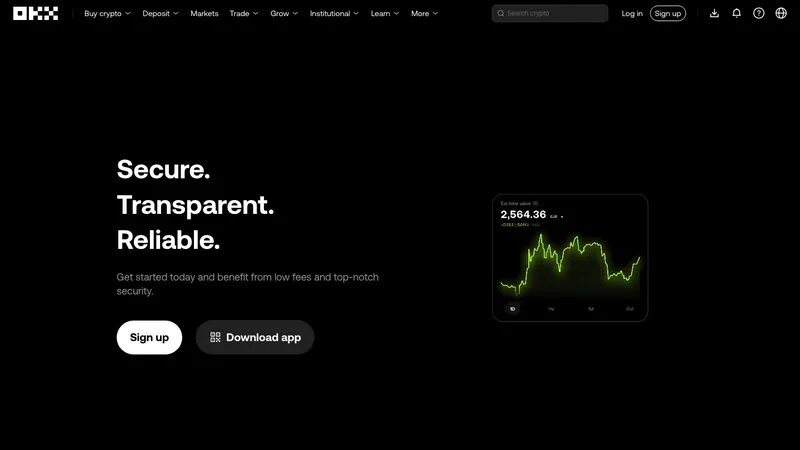
Good for
Incidents in the last five years
Best for buyers who want a deep BTC/EUR book, free SEPA both ways and one Luxembourg licence for all 30 EEA countries. Its trading fees sit behind sign-in, and Ireland fined it €21.5M in 2025.
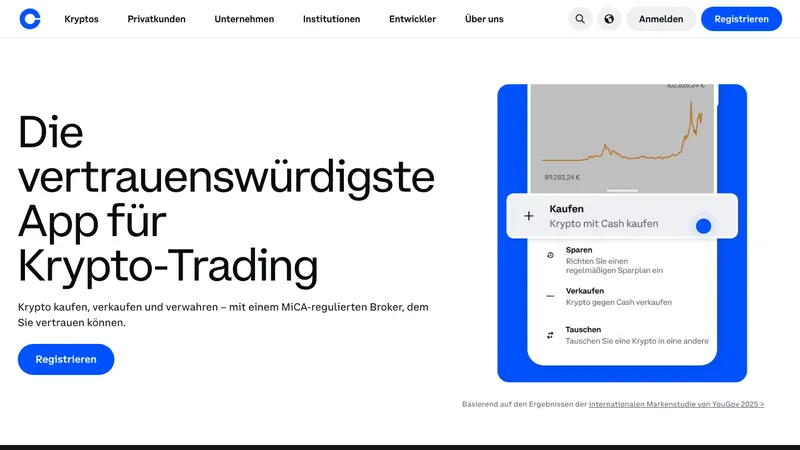
Good for
Incidents in the last five years
A faulty update took down transfers and trading for about 50 minutes.
Fined EUR 21.5M by the Central Bank of Ireland for transaction-monitoring failures.
The Dutch central bank fined Coinbase Europe €3.3M for serving the Netherlands without registration from 2020 to 2022.
and 2 more
Best for altcoin traders who want a 0.1% fee and free access to Malta's arbiter. Its BTC/EUR market is very thin, and euro withdrawals cost 0.06% plus €0.50.
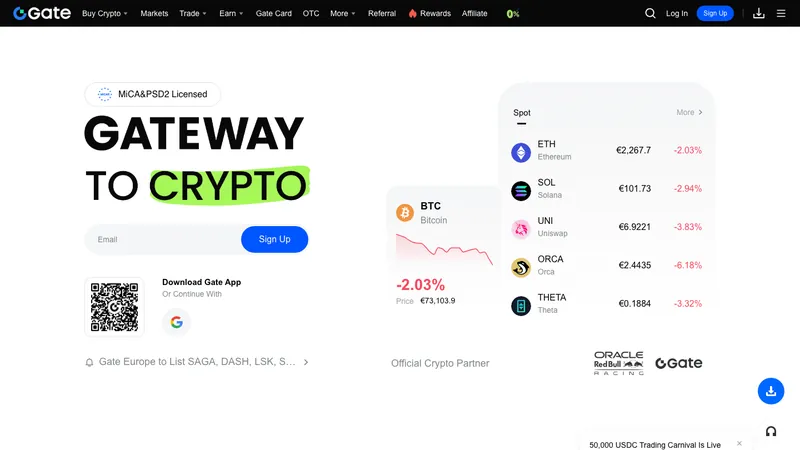
Good for
Since 2014 · Not on worldwide list
Best for buyers who want a European broker with 650+ coins and free SEPA deposits and withdrawals. Bitpanda is the counterparty to every trade, and it publishes no proof of reserves.
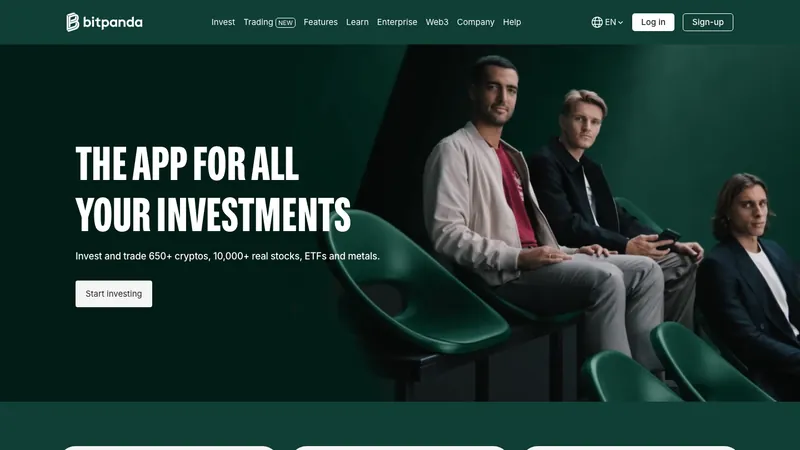
Good for
Best for app users who want 400+ coins and free access to Malta's arbiter. Every buy costs 0.8% plus a spread, and it hasn't published a proof of reserves since one in December 2022.
Good for
Incidents in the last five years
A US judge let Nevada's cease-and-desist stand, so sports event contracts were pulled for Nevada residents.
The Dutch central bank fined Foris DAX MT EUR 2.85M for serving Dutch users while unregistered.
Attackers bypassed 2FA and drained 483 accounts of about US$34M; Crypto.com reimbursed the affected users.
and 1 more
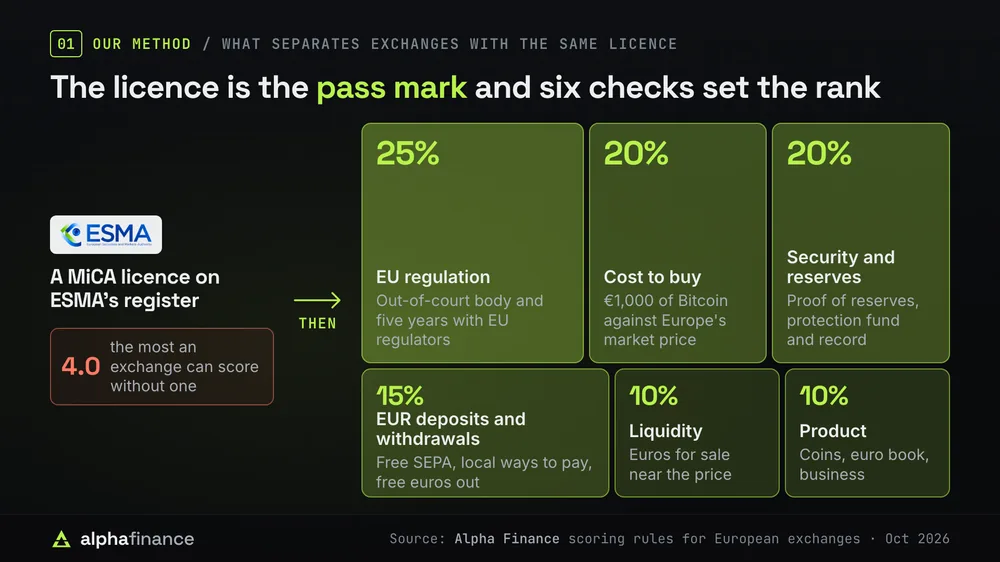
The licence is a pass mark, so the checks separate exchanges on what MiCA leaves open: price, euro market depth, complaint rights, their record with EU regulators, euro banking and product. None of the marks rest on figures an exchange handed us.
| Check | Weight | How it is marked |
|---|---|---|
| Cost to buy | 20% | We read every public BTC/EUR order book in the same minute on 8 Oct 2026 and take the middle of their prices as the European market price. An exchange's mark comes from what €1,000 of Bitcoin cost on its cheapest published euro market, fee included: 10 at 0.2% above the market or less, and 0.8 off for every further 0.1%. If the euro price stays hidden until checkout, we use the day's highest measured cost instead, or the exchange's own published fee when that is higher. |
| EU regulation | 25% | 5 for a MiCA licence on ESMA's register. 2 when an unresolved complaint can go to an ombudsman, arbiter or regulator's out-of-court procedure in the exchange's home country. Up to 3 for its record with EU regulators over five years: 3 if clean, 1.5 after a warning or reprimand, 0 after a fine. |
| Security and reserves | 20% | Reserves count for up to 4. Full marks need a proof that lets you find your own balance in it, or audited company accounts in public SEC filings, whether the exchange's own or those of the group that owns it. An audit of the reserves on their own earns 3 and an accountant's attestation 2. Up to 2 for a protection fund or insurance for customers, 2 if its size is published. Up to 4 for the five-year record: a hack or insolvency takes 3 off until customers are confirmed repaid and 1 after, a data breach or regulator's action takes 1, and market failures take 1 each up to 2. These are the worldwide list's rules. |
| Liquidity | 10% | Depth decides what a large order really pays. We count the euros of Bitcoin offered within 0.5% of the market on the exchange's own BTC/EUR book, read in the same minute as the prices. €10,000 or less scores 0, €10 million or more scores 10, and every tenfold step in between adds about 3.3. Where we can't read a public BTC/EUR book for an exchange, its depth mark is 0. |
| EUR deposits and withdrawals | 15% | 4 when a SEPA deposit is free, since every euro-area bank now sends instant payments (1 if SEPA carries a fee). 1 for card deposits and 1 for a second instant way to pay, such as iDEAL, Bancontact, BLIK or PayPal. 2 when euro withdrawals are free, and 2 when no bank has cut the exchange off in two years. |
| Product | 10% | Coins: 3 for 300 or more, 2 for 100, 1 for 30. A euro order book adds 2 and business accounts 2. Tax reports, staking and an OTC desk for large trades add 1 each. |
MiCA status, recent hacks and EU fines can each put a ceiling on the score. Without a MiCA licence the ceiling is 4.0. A hack in the past year sets it at 6.0 until customers are confirmed repaid, and a fine from any EU regulator in the past two years sets it at 7.5, since EU regulators impose fines directly.
Every mark here dates from 8 Oct 2026. Fresh marks follow each quarter, or straight away if an exchange rewrites its EU fees or terms, wins or loses MiCA authorisation, or is fined by an EU regulator.
In Europe the first step is checking the licence, because platforms without one still advertise to Europeans even though they may no longer serve them.
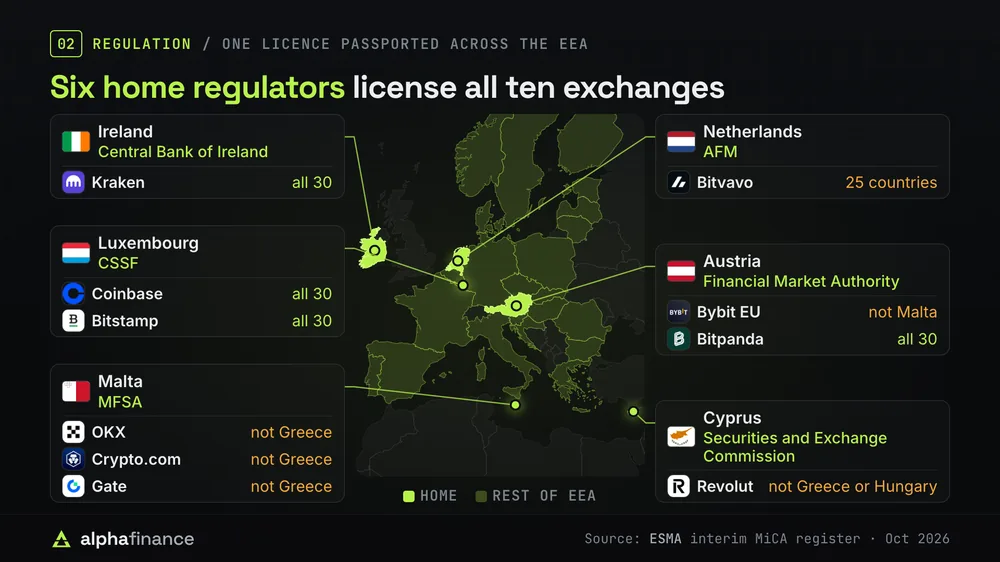
Every crypto exchange that serves people in the EU now needs a licence under MiCA, the Markets in Crypto-Assets Regulation, and one licence covers the whole European Economic Area.
MiCA's rules for exchanges have applied since 30 December 2024, after its stablecoin rules on 30 June 2024, according to Article 149 of the regulation. Firms already operating could carry on until 1 July 2026 at the latest, and each country could shorten that. The Netherlands gave six months and Germany's period ended on 31 December 2025, while France ran the full period to 1 July 2026.
That period is over everywhere. An exchange that isn't on ESMA's register can no longer serve EU residents, which is why Binance and Bitget are not ranked here.
Each exchange is licensed by one national regulator, such as Malta's MFSA or Ireland's central bank, and then passports into other countries. The register lists every country an exchange has notified, so an exchange can be authorised and still not serve yours. Bitvavo serves 25 countries, while Bybit EU serves every EEA country except Malta.
National rules still matter. Hungary's 2025 law requiring crypto conversions to be validated clashed with MiCA and led exchanges to pause there, until Hungary repealed it in 2026 and Bitvavo reopened to new Hungarian customers on 7 September 2026.
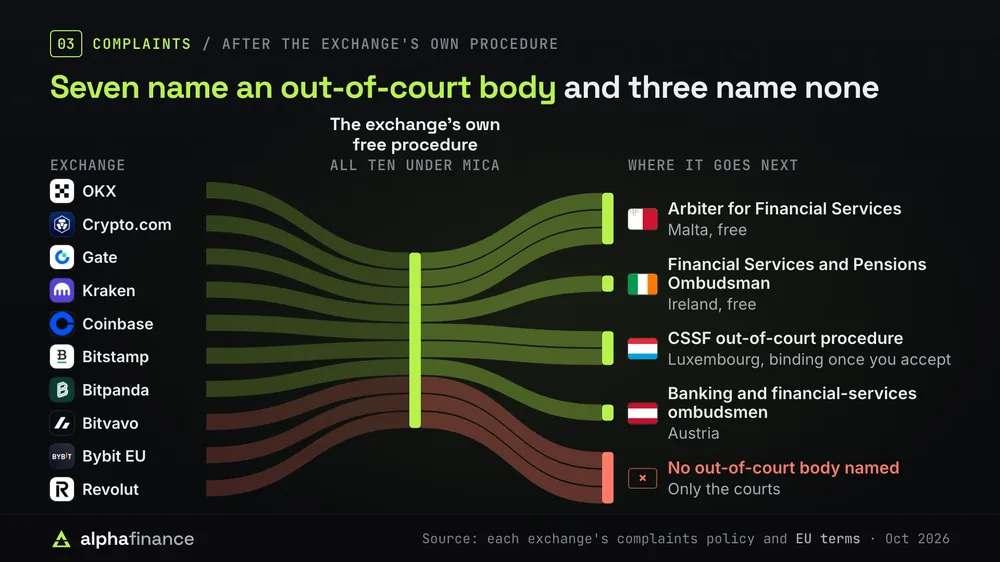
There is no EU-wide crypto ombudsman. MiCA makes every exchange run a free complaints procedure, and what happens after that depends on the exchange's home country.
7 of the 10 exchanges here name an out-of-court body you can take an unresolved complaint to, such as Malta's Arbiter for Financial Services or Ireland's Financial Services and Pensions Ombudsman. Bitvavo, Bybit EU and Revolut name none, which leaves the courts. Each review's Complaints line says where yours would go.
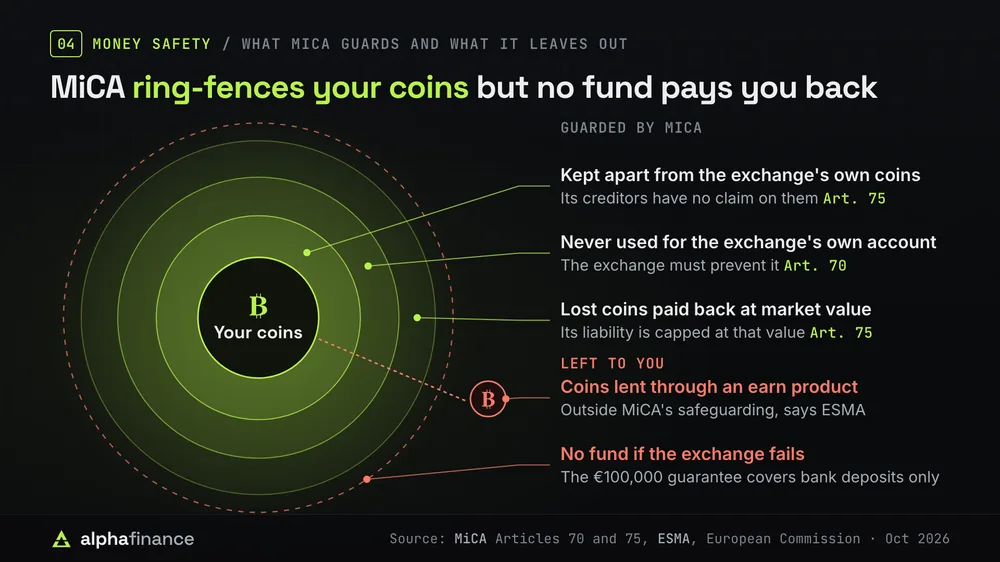
MiCA gives coins held by an exchange real legal protection, but no fund pays you back if the exchange fails, so its terms matter as much as its licence.
EU deposit guarantee schemes protect bank deposits up to €100,000 per depositor at each bank. Crypto held for you by an exchange is not a bank deposit, and euros held by an exchange's e-money company are safeguarded rather than guaranteed.
MiCA does set floors. Under Article 70 an exchange must prevent the use of your crypto for its own account and place your euros with a bank or central bank by the end of the next business day. Article 75 keeps your coins legally apart from the exchange's own, so its creditors have no claim on them, and caps its liability for coins it loses at their market value.
Lending is the gap. ESMA says MiCA's safeguarding doesn't apply to coins in lending programmes, so an "earn" product that lends your coins out leaves you exposed to the borrower.
When FTX collapsed in November 2022, its Cyprus-licensed arm FTX EU froze European accounts. Its buyer Backpack now pays former customers their claims in euros, at the value their positions had when the platform shut down.
Most exchanges here hold customers' coins together in shared wallets, and their terms say what happens if those wallets come up short.
| Exchange | What its terms say |
|---|---|
| OKX | Pools your coins with other clients'. In a shortfall you share the loss pro rata, and disputes go to arbitration in Malta. |
| Bitstamp | Holds coins in omnibus wallets and euros pooled at its banks. A shortfall is shared pro rata. |
| Bybit EU | Holds coins in omnibus wallets, kept apart from its own, with you as their legal owner under Austrian law. |
| Bitvavo | Holds coins and euros in a separate foundation. If you opt into Lending, Bitvavo Custody may borrow all your coins. |
| Kraken | Won't lend or pledge coins it holds for you, but may keep them on shared addresses. Staking runs through a BVI company. |
On the day it is taken, a proof of reserves shows wallets holding at least what customers have on deposit. Some of the ten publish one often, others once or never, so check the date in the table's Proof of reserves column. A snapshot can't reveal debts or borrowed coins, a limit the US SEC's chief accountant has also pointed to.
Not investment advice
This page is general information. Nothing on it is a recommendation to buy, sell or trade any asset or to use any exchange, and it does not take your situation into account. Digital assets are volatile and you can lose everything you put in. See the affiliate disclosure for how the site is funded.
You can't buy Tether's USDT on an EU-authorised exchange, because its issuer has no authorisation under MiCA, and euro and dollar stablecoins from authorised issuers have taken its place.
ESMA and the European Commission told national regulators to bring exchanges into line on unauthorised stablecoins no later than the end of March 2025. Exchanges handled it differently. OKX says USDT sent to an EEA account arrives frozen, Kraken lets you deposit and withdraw it without trading, and Bitstamp converted leftover balances to USDC in May 2025.
ESMA's register of authorised e-money tokens lists 50 tokens from 25 issuers, including Circle's USDC and EURC and Société Générale-Forge's EURCV, and Tether is not among them. You can download the list from ESMA's MiCA page.
A SEPA transfer is the cheapest way to fund a European exchange, and new EU payment rules have made instant transfers both standard and no dearer than regular ones.
Since 9 October 2025, banks in the euro area must let you send instant euro payments, having had to receive them since 9 January 2025, according to the ECB. Banks outside the euro area follow from 9 January 2027. The European Commission says your bank can't charge more for an instant payment than a standard one.
Your bank now also checks the recipient's name against the account before an instant or standard transfer. If the name doesn't match, it warns you and the payer decides whether to continue, so read the exchange's name and reference carefully.
Pay from an account in your own name, since most exchanges return euros sent from anyone else. A small test transfer first also shows whether your bank pauses payments to a new exchange for a fraud check.
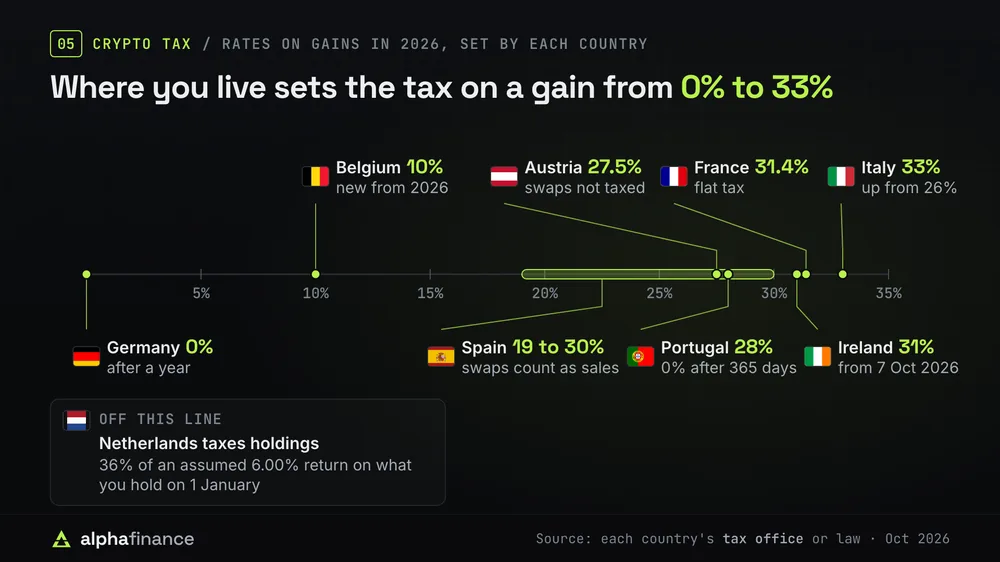
Crypto tax in Europe is set by each country, so the same sale can be tax-free in one country and taxed at 33% in another.
| Country | How crypto gains are taxed in 2026 |
|---|---|
| Germany | Tax-free after a year. Gains on coins held a year or less are taxed at your income tax rate unless the year's total gains from private sales stay under €1,000. |
| France | A 31.4% flat tax, 12.8% income tax plus 18.6% social charges. Sales of €305 or less a year are exempt. |
| Netherlands | No tax on gains. Your holdings on 1 January are taxed at 36% of an assumed 6.00% return. |
| Italy | 33% on gains from 1 January 2026, up from 26%. |
| Spain | Savings rates from 19% to 30%. Swapping one coin for another counts as a sale. |
| Austria | 27.5%. Swapping one coin for another is not taxed. |
| Belgium | A new 10% tax on gains from 1 January 2026, measured from the value on 31 December 2025. |
| Portugal | 28% on coins held less than 365 days. Coins held longer are exempt. |
| Ireland | 31% capital gains tax from 7 October 2026, down from 33%, with the first €1,270 of gains each year exempt. |
Tax offices are also getting more data. Under DAC8, exchanges have collected details of EU residents' crypto transactions since 1 January 2026, and tax authorities exchange the first year's data by 30 September 2027. A coin-for-coin swap is taxed in Spain and not in Austria, so log each swap's euro value even when no euros changed hands.
Withdrawing to your own wallet trades MiCA's custody rules for your own security. No exchange can lend, freeze or lose coins that only you control, and no one can restore them if you lose the recovery phrase.
For a large holding, a hardware wallet that signs transactions on an offline device is far harder to steal from than a wallet app on your phone. Write the recovery phrase on paper, keep it away from screens, and never type it into a website.
The EU's travel rule now follows every crypto transfer, so exchanges record who sends and who receives. Expect to prove a wallet is yours before a withdrawal or deposit goes through. Bitvavo asks you to sign a message from the wallet or upload a screenshot of its address, holds deposits from an unverified wallet until you do, and won't send coins to anyone but you.
Verify your wallet address with the exchange before you need it, then move a small amount first on the network the exchange names. Our Bitcoin exchange flows page charts the BTC withdrawn from exchanges worldwide each day, a running count of coins moving into self-custody.
MiCA gives Europeans a simple test for any crypto offer. If the firm isn't on ESMA's register under its own name, it can't serve you, whatever its website claims.
The EU's three financial supervisors warned in October 2025 that interest in crypto is rising partly through aggressive promotion on social media by finfluencers, and told consumers to check that a provider is authorised in the EU. ESMA also warns that fraudsters use its name and logo, pose as its staff and send counterfeit certificates.
Payment fraud in the European Economic Area reached €4.2 billion in 2024, up from €3.5 billion in 2023, according to the ECB and EBA. National regulators keep their own blacklists too, and France's AMF added 23 crypto names to its list in the first months of 2026. Signs that recur:
Crypto ATMs fall under the same rules. Germany's BaFin seized 13 unlicensed machines at 35 sites in August 2024, along with almost €250,000 in cash. Being told to feed cash into one is a mark of fraud, so stop and ring your bank before you pay anything.
Bitstamp leads our European ranking with 9.0 out of 10. Among the others, Revolut is the cheapest to buy, Kraken has the deepest Bitcoin market and Bitvavo has the best proof of reserves. Where you live changes the answer, because exchanges serve different countries and accept different local payment methods, such as iDEAL in the Netherlands or Bancontact in Belgium. Check that the exchange serves your country and that a complaint can go to an ombudsman before you compare fees.
Pay in by a free SEPA transfer, then buy on a euro order book with a maker or taker fee. When we read every BTC/EUR market on 8 Oct 2026, €1,000 of Bitcoin cost €0.76 more than the market price on Revolut X, the least of any exchange we read.
Search the company's name on ESMA's interim register of crypto-asset service providers, which ESMA updates weekly, and check that your country is among those it serves. Every exchange serving EU residents has needed an authorisation since the last transition periods ended on 1 July 2026. All 10 exchanges ranked here are on the register.
Binance is not on ESMA's register of authorised crypto-asset service providers, and an exchange without a MiCA authorisation can't serve EU residents now that the transition periods have ended. In June 2026 Binance said it had withdrawn its application in Greece and would seek authorisation in another member state.
Bank deposit guarantees stop at bank deposits, so crypto has none. What MiCA adds is separation. Coins held for you must sit outside the exchange's estate, beyond its creditors' reach, and your euros must reach a bank by the next business day. Coins you lend through an earn product fall outside that protection.
Yes, under your own country's rules. Germany and Portugal exempt gains on coins held long enough, France charges a 31.4% flat tax, Italy 33% and Belgium a new 10% tax from 2026, while the Netherlands taxes holdings instead of gains. Exchanges have reported EU residents' transactions to tax offices under DAC8 since 2026.