Markets
 BTC
BTC ETH
ETH BNB
BNB XRP
XRP SOL
SOL ZEC
ZEC HYPE
HYPE DOGE
DOGE LINK
LINK TON
TON AVAX
AVAX SUI
SUI TAO
TAO AAVE
AAVE PUMP
PUMP MORPHO
 ARB
ARB LIT
LIT--:-- UTC
Best crypto exchanges in the US, compared on dollar Bitcoin prices, the states they serve, New York licensing and ACH holds.
Find the best exchange for
Europe
Americas
Asia Pacific
Nothing matches yet. Try a country or a region.
 By Alpha Finance Editorial Team
 Data maintained by Vince Dioquino
Every fee, license and US penalty behind a score links to the page we read it on. We go back through the exchanges' US pages, NMLS and the regulators' records every quarter, and straight away when a fee, license or state list changes.
How we score → Editorial policy Report an errorThere's no federal license for a US crypto exchange. Each registers with FinCEN, then needs a license in every state it serves, so your address decides your options, and New York's own license keeps half of them out. Prices split as sharply: an order book can cost a fraction of an app's one-tap buy.
These ten draw the most US searches, with five of them also appearing in our worldwide ranking. Futures and global volume earn nothing here. New York access, US penalties and dollar banking do.
We checked each exchange's US terms, fees, states and FinCEN entry, and every row of the table opens that research.
The leader in each category, with the figure behind it.
 BitstampFull marks for US regulation and liquidity. Also our pick for New Yorkers.9.0 out of 10
 Binance.US$1,000 of Bitcoin cost $0.32 over the market price, the least of the six we could price.6.4 out of 10
 Coinbase$17.0M of Bitcoin near the market price, the most of the ten, and open in all 50 states.7.0 out of 10
 Kraken554 coins for US accounts, and an audited proof you can check your own balance in.7.3 out of 10
10 of 10 on FinCEN's MSB register5 of 10 open to New YorkersDollar prices read 8 Oct 2026
| # | Exchange | Score | Feestaker / maker | USD deposits | Proof of reserveslatest published | |
|---|---|---|---|---|---|---|
| 1 | BitstampNot on worldwide list | 9.0 | 0.40% / 0.30%Bitstamp (BTC/USD) | ACH freeCard 4% | Audited accountsNo per-user proof | Visit |
| 2 |  Crypto.com#14 worldwide Crypto.com#14 worldwide | 7.3 | 0.50% / 0.25%Crypto.com Exchange (BTC/USD) | ACH freeCard 1.49% | Out of dateLast Dec 2022 | Visit |
| 3 | Kraken#6 worldwide | 7.3 | 0.80% / 0.40%Kraken Pro (BTC/USD) | ACH freeCard 3.75% | Audited Merkle | Visit |
| 4 | Coinbase#4 worldwide | 7.0 | 0.90% / 0.50%Coinbase Advanced (BTC/USD) | ACH fee not publishedCard fee not published | Audited accountsNo per-user proof | Visit |
| 5 | Binance.USNot on worldwide list | 6.4 | 0.02% / 0.00%Advanced trading (BTC/USD) | ACH freeCard 3.99% | None | Visit |
| 6 |  Gemini#16 worldwide Gemini#16 worldwide | 6.2 | 1.20% / 0.60%ActiveTrader (BTC/USD) | ACH freeCard 3.49% | Audited accountsNo per-user proof | Visit |
| 7 |  RobinhoodNot on worldwide list RobinhoodNot on worldwide list | 5.3 | 0.95% / 0.50%Exchange routing (Robinhood Legend) | ACH freeCard free | Audited accountsNo per-user proof | Visit |
| 8 |  eToroNot on worldwide list eToroNot on worldwide list | 4.9 | 1.00% / 1.00%eToro platform (flat fee, no order book) | ACH fee not publishedCard fee not published | Audited accountsNo per-user proof | Visit |
| 9 |  OKX#1 worldwide OKX#1 worldwide | 4.6 | 0.35% / 0.20%OKX US (BTC/USDT or BTC/USDC) | ACH freeCard 2.49% | Merkle + zk | Visit |
| 10 |  UpholdNot on worldwide list UpholdNot on worldwide list | 4.6 | 2.05% + spreadUphold app (no order book) | ACH freeCard 3.99% | None | Visit |
Score: our mark out of 10 for someone living in the US, built from six checks with the top exchange set to 9. Hover it to see the parts. The small rank beneath a name links to its spot on our worldwide list, a ranking driven partly by futures and global volume, and US-only names carry none. Fees: what a new US account pays on the order book, often more than the same exchange charges overseas. A market order pays the taker rate, and a limit order that waits in the book pays the maker rate. One-price apps hide a markup in the price, which the cost chart counts. Placement here isn't for sale, and nothing on this page is advice. See how we're funded.
Spending $1,000 on Bitcoin put you $0.32 above the market price on Binance.US Advanced and $12.08 above it on Gemini ActiveTrader. Our market price is the midpoint of every public BTC/USD order book, captured together, and each bar adds the US fee to how far the best offer sat above it.
Extra you pay to buy $1,000 of BitcoinOver the market price, on each exchange’s cheapest public dollar price
Binance.US Advanced0.03%$0.32Order bookBitstamp0.40%$3.96Order bookCrypto.com Exchange0.53%$5.26Order bookKraken Pro0.80%$7.97Order bookCoinbase Advanced0.89%$8.93Order bookGemini ActiveTrader1.21%$12.08Order bookNot on the chart because they show no dollar price until you sign in: Robinhood, eToro, OKX and Uphold. Each is scored at the dearest cost on this chart, or at its own published fee where that is higher.
Depth is where US dollar markets part ways. Coinbase had $17.0M of Bitcoin for sale within 0.5% of the market price, and Binance.US only $691k, so a large order on a thin book climbs to dearer offers. The $50k button shows the effect.
One-tap buying is where Americans overpay most, because the markup sits inside the price. Robinhood's default orders pay it $0.95 per $100 through the price, Coinbase's user agreement lets a simple buy's fee reach 6%, and Uphold publishes 2.05% to 2.2% on Bitcoin.
We built each review from the exchange's own US user agreement, fee pages and state list, its entry on FinCEN's register and a live read of its dollar order book. Every review says which company signs your contract, which states it leaves out and how a dispute is settled, with an arrow to each source.
Top score · Not on worldwide list
Best for buyers who want a deep, long-running dollar order book with a New York BitLicense and a 0.40% taker fee. Robinhood has owned it since June 2025. US customers get no staking, and there's no proof of reserves to check.
Good for
Incidents in the last five years
NoneNo hacks, fines or market failures in the last five years.
Best for savers who want crypto inside a Roth or traditional IRA in the same app. New Yorkers can't use it, and Mazars' December 2022 snapshot is still its only proof of reserves.
Good for
Incidents in the last five years
A US judge let Nevada's cease-and-desist stand, so sports event contracts were pulled for Nevada residents.
The Dutch central bank fined Foris DAX MT EUR 2.85M for serving Dutch users while unregistered.
Attackers bypassed 2FA and drained 483 accounts of about US$34M; Crypto.com reimbursed the affected users.
and 1 more
Best for active traders outside New York and Maine who want 554 coins and IRA or trust accounts on the same platform. Kraken Pro's 0.80% entry taker fee is steep for small orders.
Good for
Watch out for
Incidents in the last five years
Disclosed an extortion attempt after support staff viewed limited data on about 2,000 client accounts. Kraken says there was no breach of its systems and no client funds were at risk.
Paid US$30M to settle SEC charges over its US staking programme.
Paid US$362,158.70 to settle US Treasury (OFAC) findings that it processed trades for users in Iran.
and 2 more
Best for buyers anywhere in the US, New York included, who want the deepest dollar market we measured. Coinbase Advanced charges US accounts 0.90% taker, nearly twice its EU rate.
Good for
Watch out for
Incidents in the last five years
A faulty update took down transfers and trading for about 50 minutes.
Oregon's Attorney General sued Coinbase, alleging it helped sell unregistered crypto securities to Oregonians; the case is pending.
Paid US$50M to settle New York regulator findings over compliance failures.
and 2 more
Cheapest to buy · Not on worldwide list
Best for traders in the 38 states it serves who want 0% maker and 0.02% taker on BTC/USD. Texas, New York and ten other states can't sign up, and only $0.7M of Bitcoin sat near the market on its dollar book.
Good for
Watch out for
Incidents in the last five years
Connecticut's banking regulator fined BAM Trading US$60,000 and ordered it to wind down in the state and surrender its license.
Went crypto-only after the SEC suit; dollar deposits and withdrawals returned on 19 February 2025.
The SEC sued Binance.US's operator; the case was dismissed with prejudice in May 2025.
Best for New Yorkers and Texans who want a state trust company holding their coins, with Gemini open in all 50 states. ActiveTrader's entry fee of 1.20% taker is the dearest order book here.
Good for
Watch out for
Incidents in the last five years
Paid a US$5M CFTC penalty over misleading 2017 statements about its bitcoin futures contract.
New York's financial regulator fined Gemini US$37M over Earn due-diligence failures.
Gemini Earn froze when lending partner Genesis halted withdrawals; users got all their coins back in kind by June 2024.
and 3 more
Since 2018 · Not on worldwide list
Best for Robinhood stock investors who want crypto beside their shares in every state. Default buys carry about 0.95% in the price, and IRA or joint accounts can't hold crypto.
Good for
Incidents in the last five years
Paid US$3.9M to settle California's Attorney General over stopping customers withdrawing crypto from 2018 to 2022.
New York's financial regulator fined Robinhood Crypto US$30M over anti-money-laundering, cybersecurity and consumer protection failures.
A support worker was tricked into giving access, exposing about 5 million customers' email addresses.
Since 2007 · Not on worldwide list
Best for stock investors who want crypto in the same app, now in 48 states including New York. A flat 1% each way makes round trips dear, and moving Bitcoin out costs 2%.
Good for
Best for OKX users who want the same brand in every state but New York. Its US platform has no Bitcoin-to-dollar market, and its parent pleaded guilty in 2025 to serving Americans unlicensed.
Good for
Watch out for
Incidents in the last five years
Since 2015 · Not on worldwide list
Best for buyers who want PayPal or Venmo funding and many coins in one simple app. Bitcoin carries a published fee of 2.05% to 2.2% in the price, and New York isn't served.
Good for
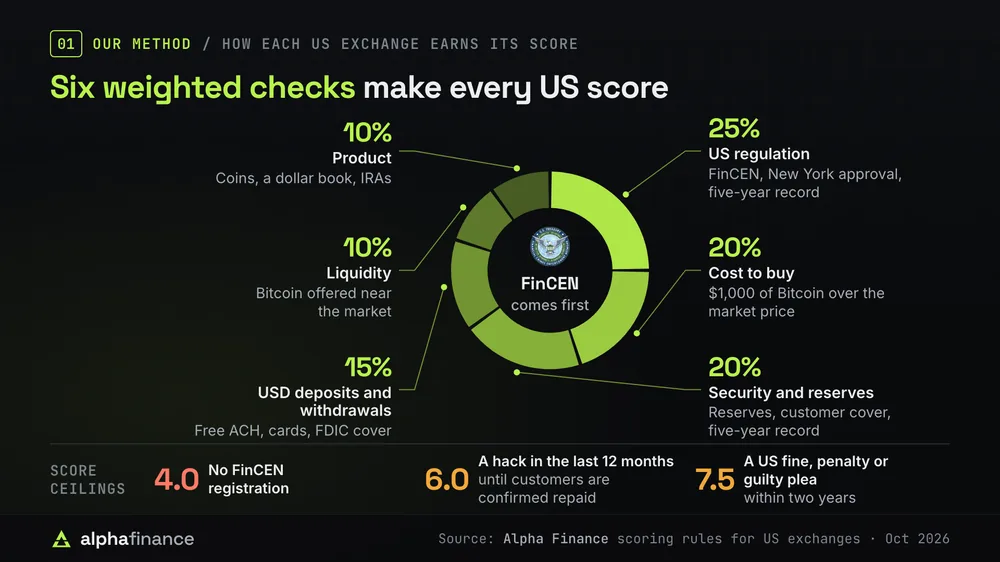
We looked up every exchange on FinCEN's register ourselves and priced its Bitcoin off live order books, so no mark rests on a figure an exchange gave us. The checks reward what US law leaves to each exchange: price, depth, New York approval, its record with US authorities, dollar banking and product.
| Check | Weight | How it is marked |
|---|---|---|
| Cost to buy | 20% | The yardstick is a single US market price for 8 Oct 2026: halfway between the best bid and ask, taken as the median across every public BTC/USD book captured at once. We then price a $1,000 Bitcoin buy on each exchange's cheapest published way to buy, fee included. Landing within 0.2% of the market earns 10, and every extra 0.1% knocks off 0.8. Brokers that reveal a price only once you've signed in are charged the costliest figure we saw that day, or their own stated fee if it's steeper. |
| US regulation | 25% | FinCEN registration as a money services business: 5. Approval in New York, by BitLicense or a state trust charter: 2. Five years without trouble from US regulators or prosecutors: 3, falling to 1.5 after an order with no money paid and to 0 after a fine, penalty or guilty plea. |
| Security and reserves | 20% | Judged as on the worldwide list. Reserves: the full 4 when a published proof shows your own balance, or when audited financial statements in SEC filings cover it, its own or a parent's (Bitstamp's sit inside Robinhood's); 3 for an audit of the reserves alone, 2 for an accountant's letter alone. Customer insurance or a protection fund: 1, rising to 2 with a stated dollar amount. Track record: 4, minus 3 for a hack or failure in five years with customers still owed (minus 1 once repaid), minus 1 for a data breach, minus 1 for a regulator's action, and up to 2 off for botched market events. |
| Liquidity | 10% | Depth shows whether a big order moves the price. We total the dollars of Bitcoin listed for sale no more than 0.5% above the market on the exchange's own BTC/USD book on 8 Oct 2026. The scale is logarithmic: nothing up to $10,000, the full 10 from $10 million, and roughly 3.3 more for every tenfold jump between those. Brokers without a public dollar book get nothing here. |
| USD deposits and withdrawals | 15% | Most Americans pay in from a bank. Free ACH deposits are worth 4, or 1 when ACH costs money. A debit card option is worth 1, and so is a same-day way in by wire, RTP, FedNow or PayPal. Free ACH withdrawals are worth 2, and so is FDIC pass-through eligibility for cash. Losing a banking partner within two years takes 2 away. |
| Product | 10% | Breadth of coins tops out at 3, for 300-plus listings (100-plus earns 2, 30-plus earns 1). A public BTC/USD order book is worth 2, as is the option to hold crypto in an IRA. One point each goes to companies being able to open an account, to staking, and to an OTC desk that fills large orders privately. |
Some problems override the arithmetic. No FinCEN registration means 4.0 at most. A hack within the last 12 months holds a score at 6.0 or below until customers are confirmed repaid, and a fine, penalty or guilty plea from a US authority within two years holds it at 7.5, because US regulators and prosecutors punish exchanges themselves.
Marks shown were set on 9 Oct 2026 and are redone every three months, or sooner if an exchange's fees, terms, states served or record with US authorities change.
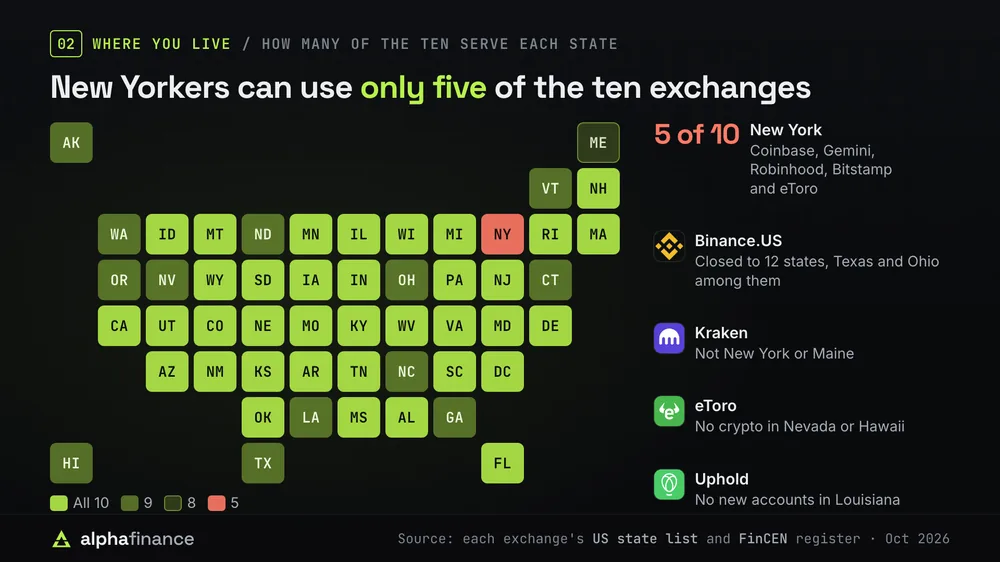
Start with your state, since an exchange that advertises nationally can still be closed where you live.
A US exchange answers to Washington on money laundering and to each state for the right to hold your money. No federal law yet covers crypto markets as a whole.
FinCEN's 2013 guidance treats an exchange as a money transmitter, so it must register and follow the Bank Secrecy Act.
States license money transmitters one by one, and 31 have adopted all or part of a common model law, according to CSBS. New York has required its own BitLicense, or a state trust charter, since 24 June 2015, and 5 of the 10 here hold one. California now asks for a license under its Digital Financial Assets Law, and Kraken says it may keep serving Californians while its application is reviewed.
Federal law is arriving in pieces. The GENIUS Act, signed on 18 July 2025, covers payment stablecoins. The CLARITY Act would divide oversight of crypto markets between the SEC and the CFTC. It passed the House 294 to 134, then lost a Senate procedural vote 49 to 50 on 15 September 2026. The SEC dropped its Coinbase case in February 2025, and its Kraken and Binance.US cases soon after.
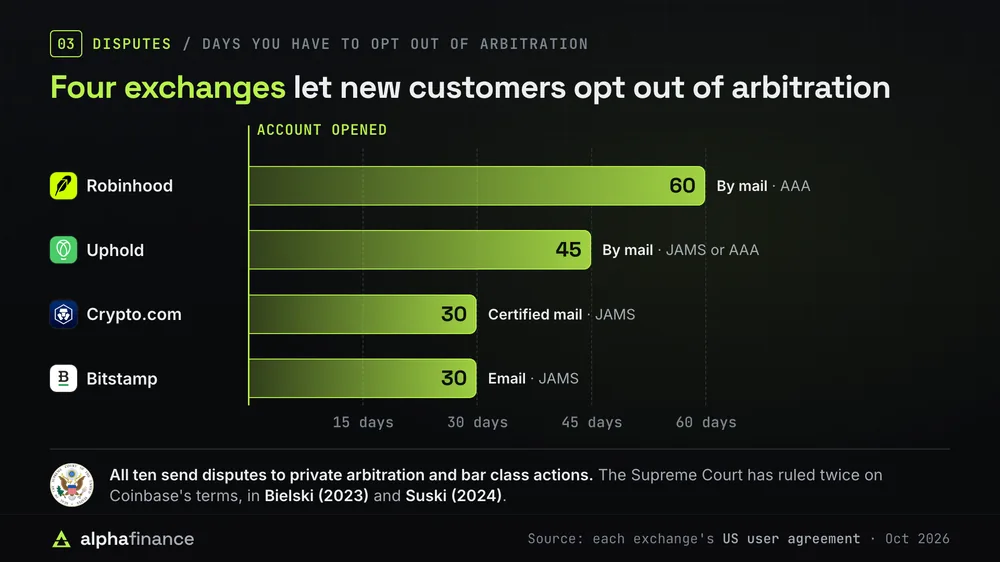
The US has no free ombudsman for crypto. All ten exchanges here send disputes to private arbitration and bar class actions.
The Supreme Court has ruled twice on Coinbase's terms: courts must pause a case while an appeal over arbitration runs (Bielski, 2023), and a court decides which of two clashing contracts governs (Suski, 2024).
Some terms let new customers opt out: within 60 days at Robinhood and 45 at Uphold, by mail, and 30 days at Crypto.com (certified mail) and Bitstamp (email). You can also complain to the CFPB, which takes complaints about virtual currency, or with your state's financial regulator.
No US insurance scheme covers crypto held on an exchange, so if the exchange fails, its terms decide what happens to your coins.
SIPC, which protects brokerage customers, doesn't protect crypto that isn't a registered security. FDIC cover reaches only cash, up to $250,000, if the bank holding it fails. In August 2022 the FDIC sent cease-and-desist letters to five companies, FTX US among them, over misleading claims of deposit insurance.
The test came with Celsius. On 4 January 2023 a federal bankruptcy judge ruled that coins in its Earn accounts had become Celsius's property under its terms, so they belonged to its bankruptcy estate. Coinbase's own annual report warns that its customers could be treated as general unsecured creditors in a bankruptcy.
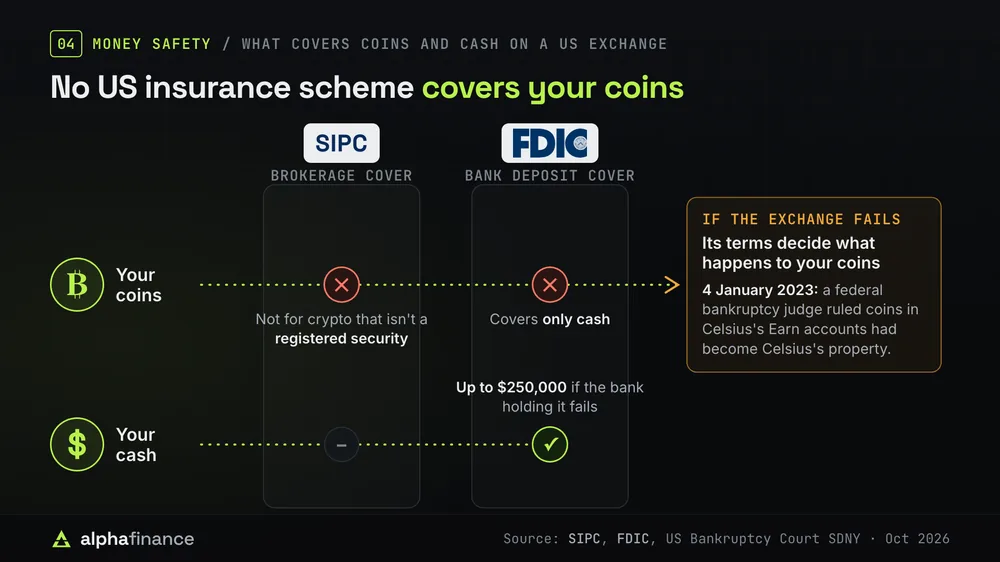
The clauses below decide whether your coins sit outside an exchange's estate if it fails.
| Exchange | What its US terms say |
|---|---|
| Robinhood | Holds coins as a securities intermediary, outside its creditors' reach, and won't lend or pledge them. |
| Binance.US | Your coins are beneficially yours, held as financial assets under California's commercial code. |
| Bitstamp | Title stays with you under New York's Article 8, though your coins may share blockchain addresses with other customers'. |
| Kraken | Title stays with you and Kraken won't lend your coins, but it warns a court may disagree and let its creditors claim them. |
| Crypto.com | Promises nothing in an insolvency, which could mean the total loss of coins it holds for you. |
| Uphold | Your claim on its coins may rank as an unsecured creditor's if it fails. |
| eToro | Lets eToro use your crypto "in any manner" as your agent. |
A reserve snapshot proves the wallets covered customer balances on the day it was taken, but it can't show debts. Only 2 of the ten let you find your own balance in theirs. Bitstamp, Coinbase, Gemini, Robinhood and eToro rely instead on audited accounts in SEC filings, Bitstamp's inside its owner Robinhood's.
Not investment advice
This page is general information. Nothing on it is a recommendation to buy, sell or trade any asset or to use any exchange, and it does not take your situation into account. Digital assets are volatile and you can lose everything you put in. See the affiliate disclosure for how the site is funded.
ACH is the cheapest way to fund a US exchange and the slowest to clear, so exchanges hold your deposit until the payment can't be pulled back.
Under Nacha's rules a consumer has 60 days to return an unauthorized debit, so exchanges lock both the cash and the crypto bought with it: 7 days at Kraken and Binance.US, and 10 calendar days at Bitstamp, whose terms say 7. Coinbase sets each hold itself and says the hold time cannot be altered.
Cards cost more, from 1.49% at Crypto.com to 3.99% at Binance.US and Uphold, and $0.25 plus 3.75% at Kraken. Robinhood is the one exchange here that publishes free debit card deposits.
Fast cash-outs cost extra. Instant withdrawals by RTP or FedNow cost 1.50% at Kraken, capped at $50, and 1.75% at Robinhood and Uphold. The Federal Reserve's FedNow service has run since July 2023.
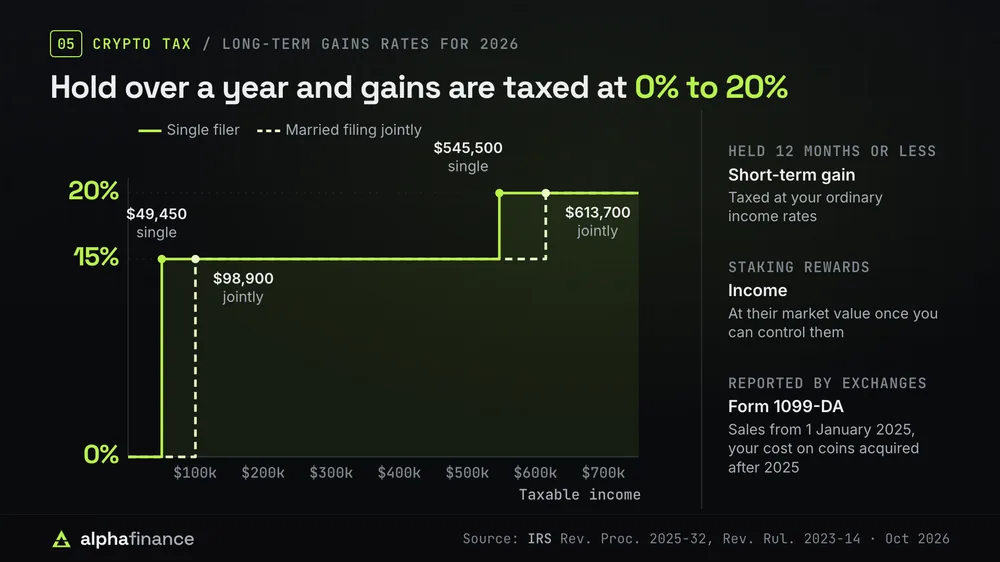
For tax, the IRS treats crypto as property, so selling, swapping or spending it can create a capital gain, and staking rewards count as income.
Exchanges now report to the IRS. Form 1099-DA covers sales from 1 January 2025, and it also carries your cost for coins acquired after 2025 in the same account. Older coins arrive without one. Since 1 January 2025 your cost has to be tracked separately for each account or wallet.
| What you did | How it is taxed for 2026 |
|---|---|
| A sale within 12 months of buying | Short-term gain, taxed at your ordinary income rates. |
| A sale after owning it over 12 months | Long-term gain: 0% up to $49,450 of taxable income for a single filer ($98,900 married filing jointly), 15% up to $545,500 ($613,700 jointly), 20% above, under Rev. Proc. 2025-32. |
| Earned staking rewards | Income at their market value once you can control them, under Rev. Rul. 2023-14. |
The wash-sale rule, which disallows a loss when you buy the same holding within 30 days before or after the sale, applies by statute to stock or securities. A bill to extend it to crypto cleared the House Ways and Means Committee 38 to 5 on 16 September 2026 but is not law.
Few exchanges open a retirement account for crypto themselves.
Of the ten, Crypto.com and Kraken do. Crypto.com offers traditional and Roth IRAs in its app, and Kraken opens 401(k) and IRA accounts as business accounts. Robinhood's IRAs can't hold crypto. IRS rules bar IRAs from collectibles such as art, gems and coins, a list that doesn't name digital assets.
For workplace plans, the Labor Department withdrew its 2022 warning about crypto in 401(k)s on 28 May 2025, and an August 2025 executive order pushed 401(k)s toward digital assets and other alternatives. A brokerage IRA can also hold spot Bitcoin ETFs, which the SEC approved on 10 January 2024, and our Bitcoin ETF flows page tracks them.
Your own wallet removes the exchange's failure risk and leaves the keys to you alone.
Check the cost first. Robinhood charges nothing beyond the network fee and Uphold charges 0.00004 BTC, but eToro takes 2%, up to $100, to move Bitcoin into its own wallet before it can leave. Coins bought with an ACH deposit stay locked until the hold ends.
Money transmitters must pass on sender and recipient details for transfers of $3,000 or more, so expect questions about a new wallet, and send a small test first. To see whether coins are leaving exchanges overall, our Bitcoin exchange flows page charts the daily net.
Check any crypto offer against FinCEN's register and your state's license list, though a listing alone proves little.
FinCEN warns that fraudsters use its register to look legitimate and that it doesn't approve or endorse anyone listed. The Justice Department's Operation Level Up has contacted 8,935 victims of crypto investment fraud, and 77% of them didn't know they were being scammed.
Many of these scams finish at a crypto kiosk. The FBI's IC3 logged 13,460 complaints involving crypto kiosks in 2025, with $388,981,267 lost. The FTC found people 60 and over were more than three times as likely as younger adults to report losing money at one.
States now cap kiosk payments: new customers can put in $2,000 a day in Arizona and Minnesota and $2,500 in Illinois, which also caps kiosk fees at 18%. Signs to stop at:
If it has happened, report it to the FBI at ic3.gov and your state's financial regulator, and call your bank about any pending payment.
Our scores put Bitstamp first for US residents, at 9.0 out of 10. By need, Binance.US is the cheapest to buy, Coinbase has the deepest Bitcoin market and Kraken lists the most coins. Your state matters as much: Binance.US doesn't serve 12 states, and only 5 of the ten take New Yorkers. Confirm it serves your state, then compare order-book fees.
Move dollars in by ACH, which most exchanges here don't charge for, then place an order on the order book rather than tapping buy in the app. In our 8 Oct 2026 reading, Binance.US Advanced charged the least: $0.32 over the market price on $1,000 of Bitcoin.
5 of the ten: Coinbase, Bitstamp, Robinhood and eToro under New York virtual currency licenses, and Gemini as a New York trust company. Kraken, Crypto.com, OKX, Binance.US and Uphold don't serve the state.
No. SIPC skips crypto that isn't a registered security, and FDIC cover reaches only cash, up to $250,000, if the bank fails. If the exchange fails, its terms decide your coins' fate, as Celsius's Earn customers learned.
Yes. The IRS taxes crypto as property, so a sale, swap or purchase with crypto can create a capital gain, and staking rewards are income. Coins held more than a year qualify for long-term rates of 0%, 15% or 20%, and exchanges report sales on Form 1099-DA.
Binance.com doesn't accept US residents. Binance.US is a separate company, BAM Trading Services, that licenses the Binance brand and shares majority owners with it. It serves 38 states and isn't open in Texas, New York and ten others.