Markets
 BTC
BTC ETH
ETH BNB
BNB XRP
XRP SOL
SOL ZEC
ZEC HYPE
HYPE DOGE
DOGE LINK
LINK TON
TON AVAX
AVAX SUI
SUI TAO
TAO AAVE
AAVE PUMP
PUMP MORPHO
 ARB
ARB LIT
LIT--:-- UTC
The largest crypto exchanges scored on security, fees, liquidity, licences and products, with every score broken down.
Loading
Ranking 16 exchanges
 Maintained by Vince Dioquino · updated 7 Oct 2026
48 licences checked on 18 regulators' registers58 incidents trackedHow we score →
| # | Exchange | Score | Spot feetaker | Perp feetaker | Spot volume | BTC OI (Bitcoin open interest) | Reserves | Licences | Latest incident | |
|---|---|---|---|---|---|---|---|---|---|---|
| 1 |  OKXTop score OKXTop score | 9.0 | 0.10% | 0.05% | $2.74B | $3.22B | Merkle + zk | MiCA, VARA, MAS, ASIC and FSA | RegulatorSep 2025: Fined EUR 2.25M in the Netherlands for serving Dutch users without registration. | Visit |
Good for
Incidents in the last five years Score breakdownTop score
Weighted total 7.7, scaled to 9.0 against the leading exchange Who you deal with: Its terms name the operating company in each region, such as OKX Europe Limited (Malta) and OKX INC. (Delaware)Fees: OKX fee scheduleFacts checked: 7 Oct 2026 Visit OKX | ||||||||||
| 2 |  BinanceDeepest liquidity BinanceDeepest liquidity | 8.6 | 0.10% | 0.05% | $10.8B | $11.3B | Merkle + zk | VARA, AUSTRAC and FSA | MarketOct 2025: USDe, wBETH and BNSOL lost their pegs on Binance's own order books in the 10 Oct crash; Binance paid about $283M to users liquidated as a result. | Visit |
Good for Watch out for
Incidents in the last five years
Score breakdownDeepest liquidity
Weighted total 7.4, scaled to 8.6 against the leading exchange Who you deal with: Its terms name Nest Exchange, Nest Clearing and Custody and Nest Trading, registered in Abu DhabiFees: Binance fee scheduleFacts checked: 7 Oct 2026 Visit Binance | ||||||||||
| 3 |  GateFounded 2013 GateFounded 2013 | 8.5 | 0.20% | 0.05% | $1.84B | $4.35B | Merkle + zk | MiCA, VARA, FSA, AUSTRAC and CySEC | RegulatorDec 2021: Italy's securities regulator ordered gate.io blocked for offering crypto futures to Italians without authorisation. | Visit |
Good for
Incidents in the last five years Score breakdown
Weighted total 7.3, scaled to 8.5 against the leading exchange Who you deal with: Its user agreement names no company, only "Gate and its affiliates"Fees: Gate fee scheduleFacts checked: 7 Oct 2026 Visit Gate | ||||||||||
| 4 |  CoinbaseMost licences CoinbaseMost licences | 8.4 | 0.90% | 0.04% | $1.83B | – | Audited | MiCA, BitLicense, FCA, MiFID II, ASIC, FSA and AUSTRAC | OutageJul 2026: A faulty update took down transfers and trading for about 50 minutes. | Visit |
Good for Watch out for
Incidents in the last five years
and 1 earlier Score breakdownMost licences
Weighted total 7.2, scaled to 8.4 against the leading exchange Who you deal with: Coinbase Global, Inc. is listed on the Nasdaq and files audited accounts with the SECFees: Coinbase fee scheduleFacts checked: 7 Oct 2026 Visit Coinbase | ||||||||||
| 5 |  BybitFounded 2018 BybitFounded 2018 | 8.3 | 0.10% | 0.055% | $1.87B | $5.59B | Audited Merkle | MiCA, SCA and AFSA | HackFeb 2025: About $1.5B in ETH was stolen from a cold wallet; the FBI attributed it to North Korea. Bybit restored its reserves within about 72 hours. | Visit |
Good for Watch out for
Incidents in the last five years Score breakdown
Weighted total 7.1, scaled to 8.3 against the leading exchange Who you deal with: Its global terms name no operating company; only its EU arm, Bybit EU GmbH, is namedFees: Bybit fee scheduleFacts checked: 7 Oct 2026 Visit Bybit | ||||||||||
| 6 |  KrakenFounded 2011 KrakenFounded 2011 | 8.3 | 0.80% | 0.05% | $1.62B | $188.2M | Audited Merkle | MiCA, CFTC, FCA, MiFID II, AUSTRAC, Canada and ASIC | OtherApr 2026: Disclosed an extortion attempt after support staff viewed limited data on about 2,000 client accounts. Kraken says there was no breach of its systems and no client funds were at risk. | Visit |
Good for
Incidents in the last five years
and 1 earlier Score breakdown
Weighted total 7.1, scaled to 8.3 against the leading exchange Who you deal with: Its licence page names the Payward company that serves each regionFees: Kraken fee scheduleFacts checked: 7 Oct 2026 Visit Kraken | ||||||||||
| 7 |  DeribitFounded 2016 DeribitFounded 2016 | 7.8 | 0.00% | 0.035% | – | $1.48B | Not public | VARA | HackNov 2022: About $28M was stolen from hot wallets; Deribit covered the loss from its own reserves. | Visit |
Good for Watch out for
Incidents in the last five years Score breakdown
Weighted total 6.7, scaled to 7.8 against the leading exchange Who you deal with: Deribit FZE, owned by Nasdaq-listed Coinbase, whose audited accounts include itFees: Deribit fee scheduleFacts checked: 7 Oct 2026 Visit Deribit | ||||||||||
| 8 |  MEXCFounded 2018 MEXCFounded 2018 | 7.5 | 0.05% | 0.04% | $1.30B | $4.90B | Audited Merkle | None | RegulatorJun 2026: Dubai's regulator fined MEXC's operator for serving Dubai customers without a licence and ordered it to stop. | Visit |
Good for
Incidents in the last five years
and 1 earlier Score breakdown
Weighted total 6.4, scaled to 7.5 against the leading exchange Who you deal with: Its terms name no operating companyFees: MEXC fee scheduleFacts checked: 7 Oct 2026 Visit MEXC | ||||||||||
| 9 |  BitgetFounded 2018 BitgetFounded 2018 | 7.1 | 0.10% | 0.06% | $713.8M | $1.83B | Merkle | AUSTRAC | HackSep 2026: About $388M was taken from hot and warm wallets on 24 Sep 2026. Its protection fund covered the loss and user balances were untouched; withdrawals were paused until 28 Sep for BTC and 2 Oct for everything. | Visit |
Good for
Incidents in the last five years
Score breakdown
Weighted total 6.1, scaled to 7.1 against the leading exchange Who you deal with: Its terms name BTG Technology Holdings Limited, with no registered addressFees: Bitget fee scheduleFacts checked: 7 Oct 2026 Visit Bitget | ||||||||||
| 10 |  LighterLowest fees LighterLowest fees | 6.9 | 0.00% | 0.00% | $5.5M | $339.3M | Onchain | None | MarketFeb 2026: A whale's ARC long was liquidated for $8.2M; auto-deleveraging partly closed profitable shorts. | Visit |
Good for Watch out for
Incidents in the last five years
Score breakdownLowest fees
Weighted total 5.9, scaled to 6.9 against the leading exchange Who you deal with: Its terms name Elliot Technologies, Inc. as operator, under Florida law, with no stated place of registrationFees: Lighter fee scheduleFacts checked: 7 Oct 2026 Visit Lighter | ||||||||||
| 11 |  KuCoinFounded 2017 KuCoinFounded 2017 | 6.8 | 0.10% | 0.06% | $1.22B | $1.07B | Audited Merkle | AUSTRAC | RegulatorMar 2026: Dubai's regulator ordered it to stop serving Dubai residents, and Japan's regulator sent a warning letter. | Visit |
Good for
Incidents in the last five years
and 4 earlier Score breakdown
Weighted total 5.8, scaled to 6.8 against the leading exchange Who you deal with: Its terms and privacy policy name no company; US court records name Peken Global Limited in Turks and Caicos, where it is not authorisedFees: KuCoin fee scheduleFacts checked: 7 Oct 2026 Visit KuCoin | ||||||||||
| 12 |  HyperliquidOnchain since 2023 HyperliquidOnchain since 2023 | 6.8 | 0.07% | 0.045% | $143.4M | $3.41B | Onchain | None | MarketApr 2026: A $145M FARTCOIN long was liquidated in a 50% crash, and profitable shorts were auto-deleveraged. | Visit |
Good for Watch out for
Incidents in the last five years
and 2 earlier Score breakdown
Weighted total 5.8, scaled to 6.8 against the leading exchange Who you deal with: Its terms name Hyperliquid Corp., with no addressFees: Hyperliquid fee scheduleFacts checked: 7 Oct 2026 Visit Hyperliquid | ||||||||||
| 13 |  BitvavoFounded 2018 BitvavoFounded 2018 | 6.5 | 0.25% | – | $286.0M | – | Audited Merkle | MiCA and DNB | Data breachOct 2025: Dutch media reported that managers and owners could freely view customer data until spring 2024. | Visit |
Good for
Incidents in the last five years
and 1 earlier Score breakdown
Weighted total 5.6, scaled to 6.5 against the leading exchange Who you deal with: You deal with Bitvavo B.V., a private Dutch company in Amsterdam supervised by the AFM and DNBFees: Bitvavo fee scheduleFacts checked: 7 Oct 2026 Visit Bitvavo | ||||||||||
| 14 |  Crypto.comFounded 2016 Crypto.comFounded 2016 | 6.2 | 0.50% | 0.04% | $773.0M | $962.3M | Audited MerkleLast Dec 2022 | MiCA, FCA, VARA, MAS, Canada and AUSTRAC | RegulatorOct 2025: A US judge let Nevada's cease-and-desist stand, so sports event contracts were pulled for Nevada residents. | Visit |
Good for
Incidents in the last five years
and 1 earlier Score breakdown
Weighted total 5.3, scaled to 6.2 against the leading exchange Who you deal with: EEA customers deal with Foris DAX MT Limited (Malta) and US customers with Foris DAX, Inc.; the group is privateFees: Crypto.com fee scheduleFacts checked: 7 Oct 2026 Visit Crypto.com | ||||||||||
| 15 |  BitfinexFounded 2012 BitfinexFounded 2012 | 5.4 | 0.00% | 0.00% | $1.03B | $763.6M | Wallet listLast Dec 2022 | CNAD | OutageMar 2024: Reduced platform performance forced a trading halt of about 2 hours. | Visit |
Good for
Incidents in the last five years
and 2 earlier Score breakdown
Weighted total 4.6, scaled to 5.4 against the leading exchange Who you deal with: Its terms name BFXWW Inc. (BFXNA Inc. for US persons) under British Virgin Islands law; derivatives are with Bitfinex Derivatives El SalvadorFees: Bitfinex fee scheduleFacts checked: 7 Oct 2026 Visit Bitfinex | ||||||||||
| 16 |  GeminiFounded 2014 GeminiFounded 2014 | 5.3 | 1.20% | 0.07% | $31.6M | – | Not public | NYDFS, CFTC DCM and MAS | Market exitFeb 2026: Announced it was leaving the UK, EU and Australia; accounts closed on 6 April 2026. | Visit |
Good for
Incidents in the last five years
and 3 earlier Score breakdown
Weighted total 4.5, scaled to 5.3 against the leading exchange Who you deal with: Gemini Space Station, Inc. has been listed on Nasdaq (GEMI) since September 2025 and files audited accounts with the SECFees: Gemini fee scheduleFacts checked: 7 Oct 2026 Visit Gemini | ||||||||||
Score is out of 10 from five checks with fixed rules, scaled so the leading exchange is 9: green is Strong (8.5 or more), teal is Fair (7.0 or more). Fees are the taker fee a market order pays at the entry tier; hover one for the maker fee. Spot volume and BTC OI (open interest) are live. Reserves is how the exchange proves it holds users' coins. Hover a score for its breakdown, and click a row for its strengths, weaknesses, facts and incidents. Exchanges can't pay for a place or a score, and nothing here is financial advice. See how we're funded.
Last 24 hours, the exchanges ranked here
Reading spot volume.
Last 24 hours, the exchanges ranked here
Reading futures volume.
From each exchange's list of restricted countries, checked 7 Oct 2026
| Exchange |  US US |  UK UK |  EU EU |  Canada Canada |  Australia Australia |  Japan Japan |  Singapore Singapore | Open in |
|---|---|---|---|---|---|---|---|---|
| OKX | Limited | Spot only | Available | Not offered | Available | Not offered | Available | 5 of 7 |
| Binance | Not offered | Available | Not offered | Available | Available | Available | Available | 5 of 7 |
| Gate | Not offered | Not offered | Limited | Not offered | Available | Not offered | Not offered | 2 of 7 |
| Coinbase | Available | Spot only | Available | Available | Spot only | Available | Available | 7 of 7 |
| Bybit | Not offered | Limited | Limited | Not offered | Available | Limited | Not offered | 4 of 7 |
| Kraken | Limited | Spot only | Available | Spot only | Spot only | Not offered | Available | 6 of 7 |
| Deribit | Not offered | Not offered | Available | Not offered | Available | Not offered | Available | 3 of 7 |
| MEXC | Not offered | Not offered | Available | Not offered | Available | Available | Not offered | 3 of 7 |
| Bitget | Not offered | Available | Limited | Not offered | Available | Not offered | Not offered | 3 of 7 |
| Lighter | Not offered | Not offered | Available | Not offered | Available | Available | Available | 4 of 7 |
| KuCoin | Not offered | Available | Limited | Limited | Available | Limited | Not offered | 5 of 7 |
| Hyperliquid | Not offered | Available | Available | Limited | Available | Available | Available | 6 of 7 |
| Bitvavo | Not offered | Not offered | Limited | Not offered | Not offered | Not offered | Not offered | 1 of 7 |
| Crypto.com | Limited | Limited | Spot only | Limited | Spot only | Spot only | Spot only | 7 of 7 |
| Bitfinex | Not offered | Not offered | Limited | Not offered | Available | Not offered | Available | 3 of 7 |
| Gemini | Spot only | Not offered | Not offered | Not offered | Not offered | Not offered | Available | 2 of 7 |
| Open to sign-ups | 5 of 16 | 9 of 16 | 14 of 16 | 6 of 16 | 14 of 16 | 8 of 16 | 10 of 16 |
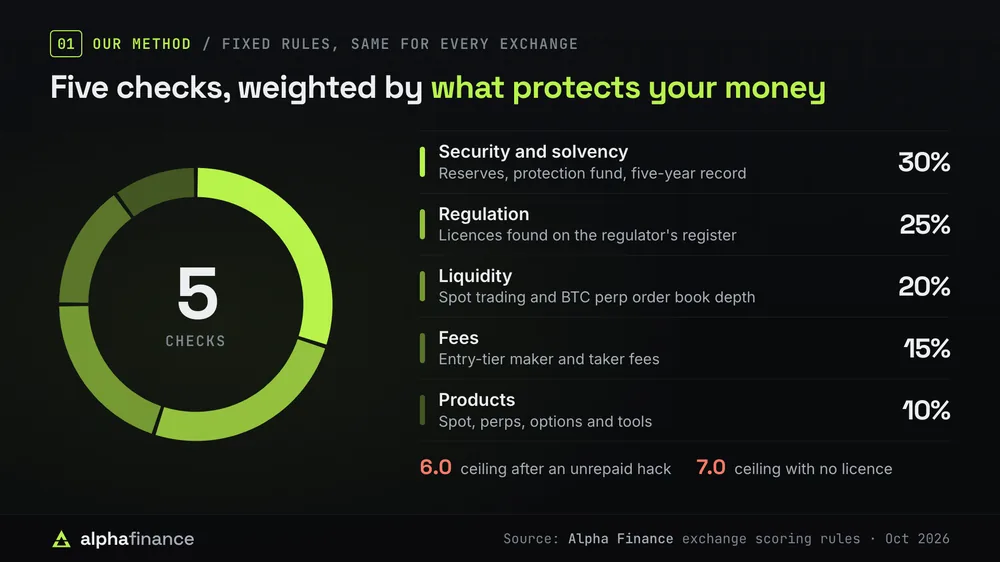
Every exchange here is scored out of 10 by the same five checks, each with a fixed rule published below. Security and regulation carry 55% of the weight because they decide what happens to your money when something goes wrong. Liquidity, fees and products carry the other 45% because they decide what each trade costs and what you can trade.
The ranking covers 16 exchanges. They include the largest global venues for spot trading and perpetual futures (futures contracts with no expiry date) and the largest regulated exchanges in the US and Europe. Two onchain perpetual exchanges, whose trades settle on a blockchain, and the largest crypto options exchange complete the list. An exchange joins at a quarterly marking when its trading volume puts it among the leaders.
| Check | Weight | How it is marked |
|---|---|---|
| Security and solvency | 30% | Reserves up to 4: a proof of reserves you can check your own balance against, or audited accounts that also show what the exchange owes (3 for a Merkle proof without an outside check). A proof last published more than 12 months before the marking date counts as not public (1). A protection fund of stated size that covers users 2 (1 if it only covers liquidations). A clean five-year record 4, less 3 for a hack or insolvency until users are repaid (1 after), 1 each for a data breach or a regulator's action, and 1 per market failure up to 2. |
| Regulation and accountability | 25% | Licences up to 8: MiCA 2.5, the US 1.5, the UK 1, and 1 for each other country, up to 3. An anti-money-laundering registration alone counts for half a licence. A licence only counts when it is in force, on the regulator's own register, and in use: one held for a market the exchange no longer serves earns nothing. Accountability up to 2: a listed company, or one owned by a listed company, 2; an exchange whose terms name the company you deal with 1. |
| Liquidity | 20% | 24 hours of spot trading, from 500 BTC (3) to 150,000 BTC (10), and the BTC perp order book within 0.1% of the price, from $1M (3) to $100M (10). Measured on 7 Oct 2026. |
| Fees | 15% | Entry-tier maker and taker fees, spot and perps averaged. Spot at 0.05% or less earns 10, perps at 0.01% or less earns 10, and marks fall as fees rise. Where fees differ by region, the exchange's home market rate is used. |
| Products | 10% | Spot 2.5, perps 2.5, options 2, copy trading 1, demo trading 1, and portfolio or multi-asset margin 1. |
Scores are relative to the exchanges ranked here. The leading exchange's weighted total (7.7 at this marking) is set to 9, and every other score is multiplied by the same factor, so the gaps between exchanges keep their proportions. A 9 marks the strongest exchange on this list, which is different from a perfect one. Caps apply before scaling, and each opened row shows both figures.
Every licence, reserve report, protection fund, restriction, fee and incident in an opened row links to its source. A licence counts only when we find the exchange on the regulator's own register.
| Register checked | Where | Licences found |
|---|---|---|
| ESMA interim MiCA register (CSV) | EU | 8 |
| AUSTRAC virtual asset service provider register | Australia | 7 |
| VARA public register | UAE | 5 |
| Japan FSA crypto-asset exchange register (PDF) | Japan | 4 |
| ASIC financial services licensees | Australia | 3 |
| CySEC investment firms register | Cyprus | 3 |
| FCA Financial Services Register | UK | 3 |
| MAS Financial Institutions Directory | Singapore | 3 |
| CNAD public registry of digital asset service providers | El Salvador | 2 |
| NYDFS regulated entities list | US | 2 |
| AFM register of crypto-asset service providers (spreadsheet) | Netherlands | 1 |
| AFSA public register | Kazakhstan | 1 |
| CFTC designated contract markets | US | 1 |
| CSA National Registration Search | Canada | 1 |
| DNB public register (payment institutions) | Netherlands | 1 |
| FCNB registered crypto asset trading platforms | Canada | 1 |
| NFA BASIC | US | 1 |
| UAE Capital Market Authority licensed companies | UAE | 1 |
The 58 incidents on record are 27 regulator actions, 7 market failures, 7 outages, 6 data breaches, 4 hacks, 2 account disputes, 2 insolvencies, 1 market exit and 2 other, each dated and linked to a regulator's notice, the exchange's own statement or a named publication. Hacks, insolvencies, data breaches, regulator actions and market failures cost security marks. Outages, disputes and other events are listed but not marked.
Facts were last checked on 7 Oct 2026 and liquidity was measured on 7 Oct 2026. Scores are re-marked every quarter, and sooner when an exchange is hacked, gains or loses a licence, or changes its fees. Live figures in the table, such as volume and open interest, are context and never move a score.
If a fact on this page is wrong, send us a correction with a source. We check it, fix the page and update the review date. Our editorial policy and affiliate disclosure apply to every ranking.
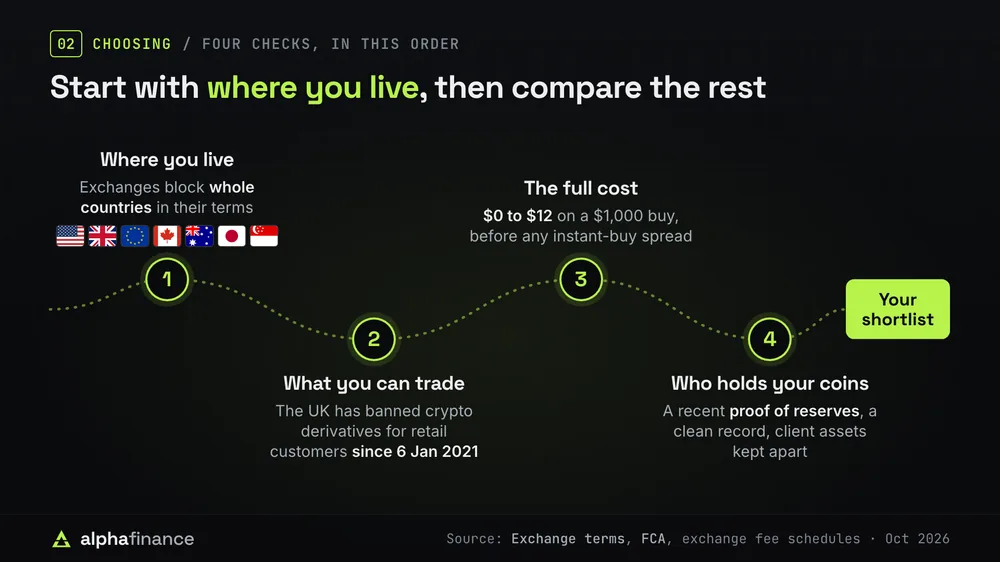
The best crypto exchange for you is one that is licensed where you live, sells what you want to trade and shows you what it costs. An exchange that cannot legally serve your country is no use to you however well it ranks.
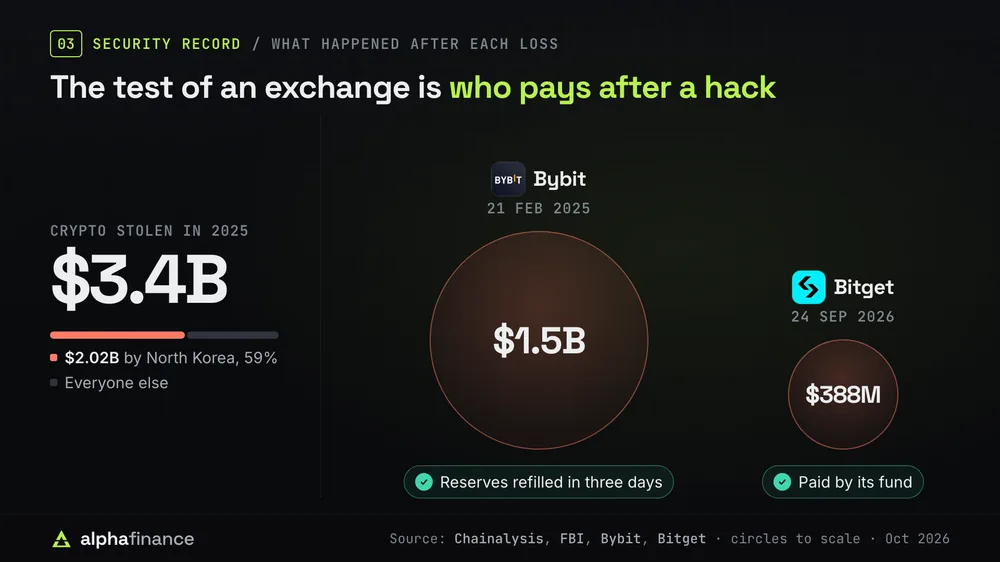
A safe crypto exchange is one that has kept customer money whole through its worst incident and can show its reserves today. Any exchange can be hacked, so who paid after a loss tells you more than any security claim.
More than $3.4 billion of crypto was stolen in 2025, and North Korea-linked hackers took $2.02 billion of it, according to Chainalysis. The largest single theft was about $1.5 billion of ETH taken from Bybit on 21 Feb 2025, which the FBI attributed to North Korea.
Bybit replaced the missing ETH with loans and purchases and said the gap was closed three days later. When about $388 million was taken from Bitget's hot wallets on 24 Sep 2026, its protection fund covered the loss and withdrawals reopened in stages by 2 Oct.
Stolen customer data matters too, because it feeds targeted scams. In May 2025 Coinbase disclosed that criminals had paid overseas support staff for customer records, and it told the SEC it expected $180 million to $400 million in costs, including reimbursing customers.
Our security check marks three things. Reserves earn up to 4 points. A protection fund of published size that covers users earns 2, such as Binance's SAFU fund, now held as 15,000 BTC. A fund that only absorbs losses from liquidations, the forced closing of leveraged positions, earns 1. A clean five-year record earns 4, and a hack or insolvency costs 3 until users are repaid.
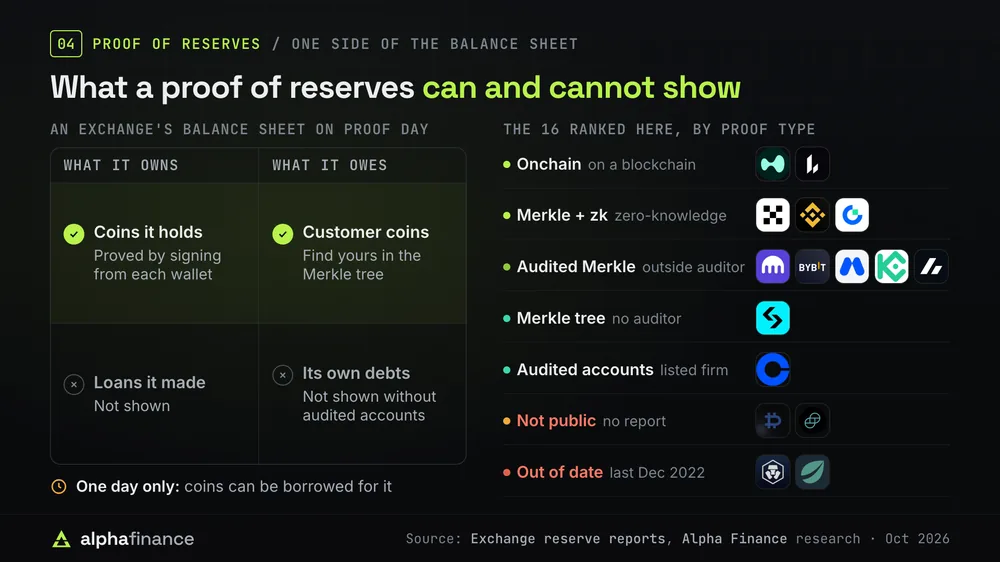
A proof of reserves shows that an exchange held at least as much of each coin as its customers had deposited on one day. The strongest versions let you confirm that your own balance was counted.
Most proofs use a Merkle tree, which combines every customer balance into one fingerprint. You find your record with an ID from your account, and the tree shows it was included in the total. Zero-knowledge proofs add a check that no balance was negative, without revealing anyone's holdings. Some exchanges add an accountant's review. Kraken's review dated 30 Jun 2026 showed reserves of 102.9% for BTC and 100.5% for ETH.
A proof only covers half of the balance sheet. It counts coins the exchange controls and what it owes customers, but it says nothing about loans it has made or its other debts. Coins can also be borrowed for the snapshot day and returned the next. The US audit regulator, the PCAOB, warned investors in March 2023 that these reports are not audits.
Of the 16 exchanges ranked here, Hyperliquid and Lighter hold every balance on a public blockchain. OKX, Binance and Gate publish Merkle proofs with zero-knowledge checks, Kraken, Bybit, MEXC, KuCoin and Bitvavo publish Merkle proofs checked by an outside firm, and Bitget publishes one without that check. Coinbase is a listed company with audited accounts. Deribit stopped publishing its proof on 1 Sep 2026, and the latest proofs from Crypto.com and Bitfinex date from December 2022, so they no longer count under our 12-month rule.
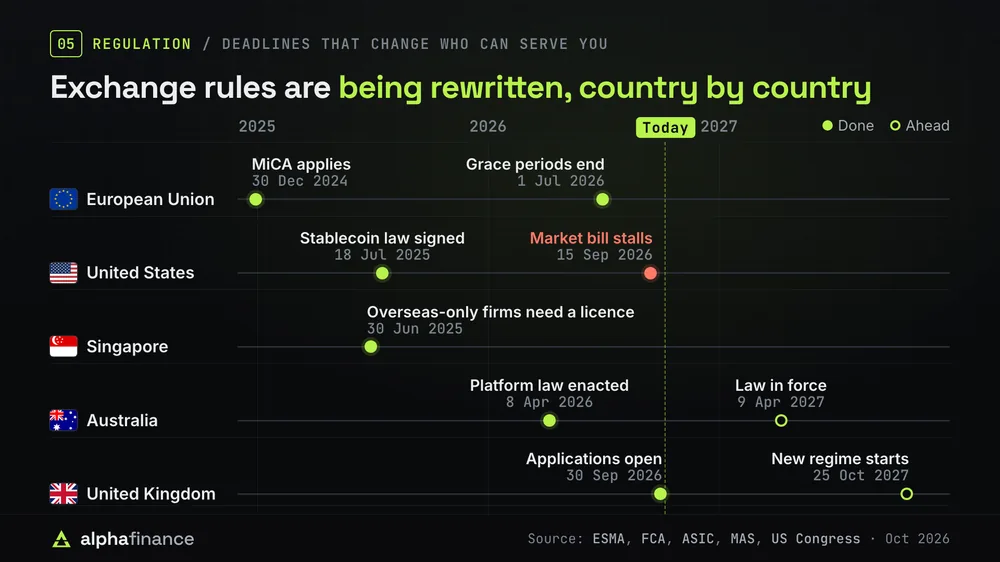
A licence from your own regulator means a local authority checks how the exchange holds your money and can act if it fails. The rules deciding which exchanges can serve you are changing fast.
Exchanges often list licences held by sister companies or applications still pending. We count a licence only when we find it on the regulator's own register and the exchange is using it, and an exchange with none on any register is capped at 7.0.
The cost of a crypto trade is the exchange fee plus any spread built into the price. Comparing headline fees alone can make an expensive exchange look cheap.
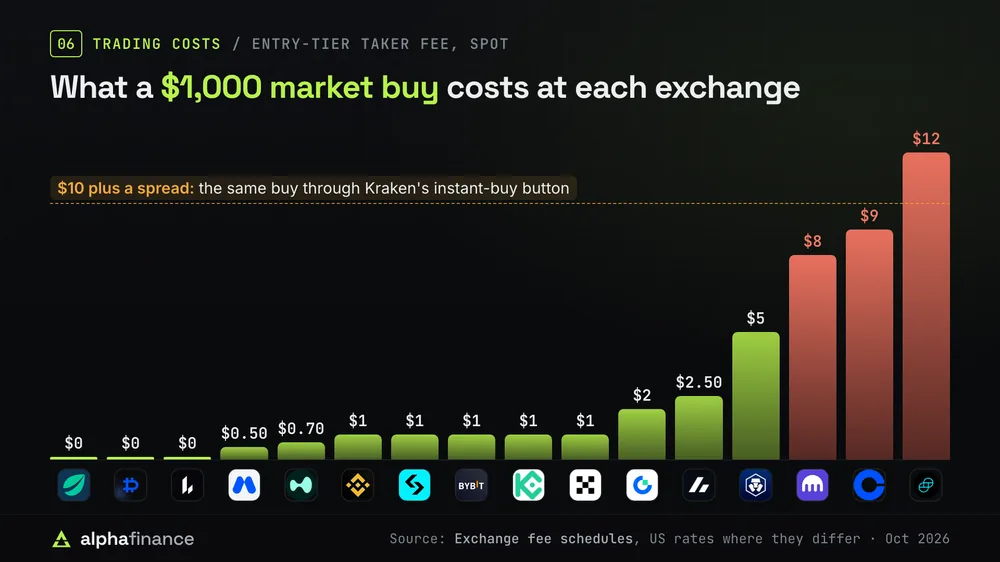
A taker order fills straight away at the best price on the order book, the list of buy and sell orders waiting at each price. A maker order waits on the book at a price you set, and most exchanges charge it less. At entry-level taker fees, a $1,000 market buy costs $1 on Binance, OKX or Bybit, $8 on Kraken, $9 on Coinbase in the US and $12 on Gemini. Lighter charges no fees on standard accounts.
Fees depend on where you live. Coinbase's entry tier since 16 Sep 2026 is 0.90% for a taker in the US and 0.50% in the EU and UK. Instant-buy buttons in apps usually cost more again. Kraken charges 1% on instant buys plus a spread.
Perpetual futures cost less per trade. Binance charges 0.02% for makers and 0.05% for takers, and most large exchanges charge close to that. Holding a position also costs or earns a funding payment every few hours, which you can compare in our live funding rates.
Liquidity decides how far a large order moves the price. Reported trading volume is a weak guide because related accounts can trade with each other to inflate it. We measure the dollar value of Bitcoin perpetual orders waiting within 0.1% of the price instead, a narrow band that Kaiko's research found harder to game than wider ones.
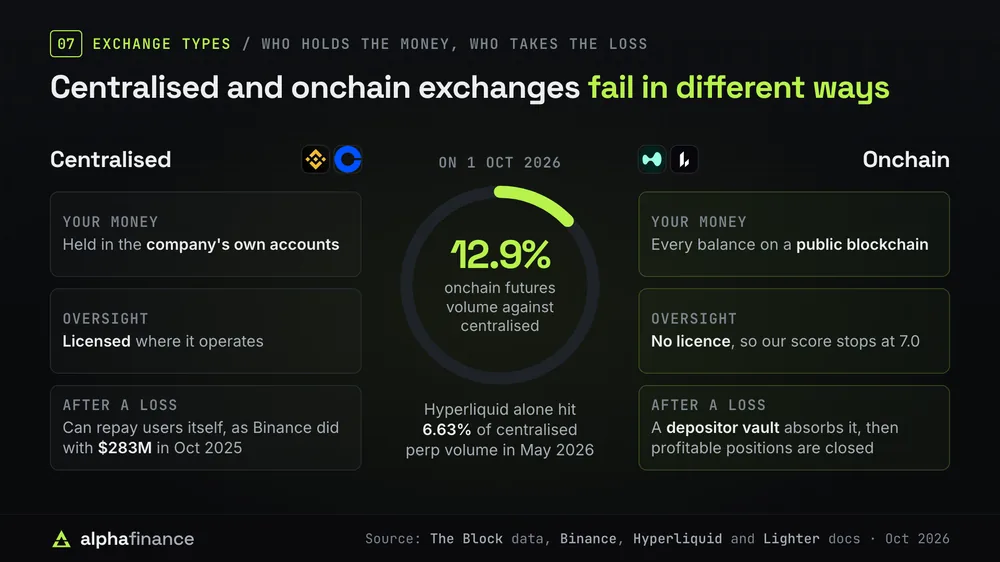
An onchain exchange records every trade and balance on a public blockchain, so anyone can see what it holds, but no regulator licenses it and losses are shared by its users. A centralised exchange holds your money in its own accounts under a licence, so you rely on the company and its regulator instead.
Futures volume on onchain exchanges equalled 12.9% of centralised futures volume on 1 Oct 2026, according to The Block's data. Hyperliquid alone traded 6.63% as much as all centralised exchanges combined in May 2026, a record share. Our Hyperliquid statistics track how it grew.
On Hyperliquid and Lighter, a vault funded by depositors takes over failed positions, and when it cannot absorb a loss the exchange closes profitable positions to cover it, a process called auto-deleveraging. That happened on Hyperliquid when a $145 million FARTCOIN long collapsed in April 2026. A centralised exchange can choose to pay from its own funds. Binance paid about $283 million to users hurt when collateral tokens lost their pegs in the October 2025 crash.
Our rules treat both kinds the same. Onchain balances earn full marks for reserves, and the lack of a licence caps both Hyperliquid and Lighter at 7.0.
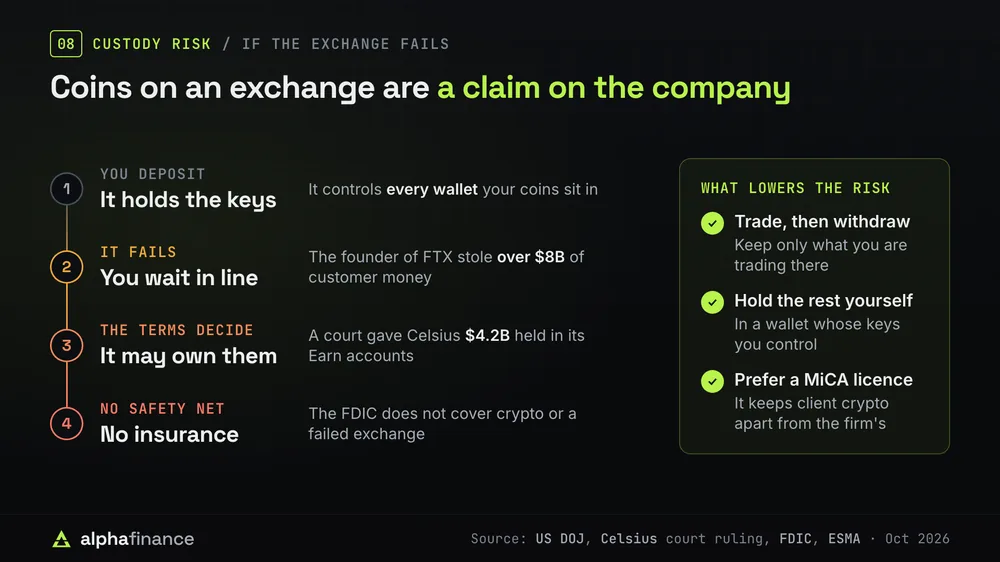
Crypto held on an exchange is a claim on that company, and if the company fails you may wait years to recover it or lose part of it. The exchange controls the keys, so its solvency becomes your risk.
The founder of FTX stole over $8 billion of customer money and was sentenced to 25 years on 28 Mar 2024. The terms of service matter as well. A US court ruled on 4 Jan 2023 that about $4.2 billion in Celsius Earn accounts belonged to Celsius, which left those customers as unsecured creditors.
The FDIC does not insure crypto or cover the failure of a crypto exchange, and the SEC's custody guide for retail investors warns that you may lose access if a custodian is hacked, shuts down or goes bankrupt.
Many traders keep only what they are trading on an exchange and move the rest to a wallet whose keys they control. You can watch how much Bitcoin sits on each venue in our Bitcoin exchange reserves tracker. A score here also has limits you should know:
Not investment advice
This page is general information. Nothing on it is a recommendation to buy, sell or trade any asset or to use any exchange, and it does not take your situation into account. Digital assets are volatile and you can lose everything you put in.
OKX scores highest on our method, at 9.0 out of 10. The best crypto exchange for you is the highest-ranked one that is licensed where you live and offers what you want to trade. Open any row to see how its score breaks down.
By five checks with fixed weights: security and solvency 30%, regulation 25%, liquidity 20%, fees 15% and products 10%. A hack in the last year caps a score at 6.0 until users are repaid, and having no licence on any regulator's register caps it at 7.0. Scores are re-marked every quarter, and the facts were last checked on 7 Oct 2026.
Lighter has the lowest base fees on this list, counting maker and taker fees on spot and perps together. Every exchange here lowers its fees as your monthly trading volume grows, and instant-buy buttons in apps usually charge more than the trading screen.
It carries the risk that the exchange is hacked or fails, and crypto on an exchange has no deposit insurance like a bank account. A recent proof of reserves, a protection fund that covers users and a licence that requires client assets to be held separately all lower that risk. Many traders keep only what they are trading on an exchange.
Of the exchanges ranked here, OKX, Gate, Coinbase, Bybit, Kraken, KuCoin, Bitvavo, Crypto.com and Gemini hold a MiCA licence. A licence from one EU country lets an exchange serve customers across the EU, and since the grace periods ended on 1 Jul 2026 an exchange without one cannot take new EU customers.
When a Visit button is an affiliate link, the exchange pays us if you sign up. That never changes a score, because every mark comes from the fixed rules under How we rank crypto exchanges. The affiliate disclosure explains the details.