Markets
 BTC
BTC ETH
ETH BNB
BNB XRP
XRP SOL
SOL ZEC
ZEC HYPE
HYPE DOGE
DOGE LINK
LINK TON
TON AVAX
AVAX SUI
SUI TAO
TAO AAVE
AAVE PUMP
PUMP MORPHO
 ARB
ARB LIT
LIT--:-- UTC
Research/Market structure
Hyperliquid statistics on trading volume, revenue, HYPE holders and regulation, each dated and sourced, and why two trackers can show different numbers for the same metric.

 By Alpha Finance Editorial Team
 Fact-checked by Vince Dioquino
Every figure, platform detail and regulatory claim on this page was traced to a primary source by the named fact checker before publication, and is re-checked when those facts change. The review date moves only when a person has re-read the page.
The editorial policy → Editorial policy Report an errorHyperliquid traded about $200 billion of perpetual futures in the 30 days to 6 Oct 2026, exceeding the next three decentralised exchanges combined on DefiLlama's perpetual exchange rankings. These contracts track an asset's price and never expire.
Running on its own public blockchain, the exchange uses almost every dollar of trading fees to buy its HYPE token. On 6 Oct 2026, HYPE traded at $92.71, giving the circulating supply a market value of $20.6 billion on CoinGecko's Hyperliquid page.
Outside teams now list stock, oil and gold contracts and retain up to half the fees. One fifth of gross revenue consequently passes to partners. Meanwhile, a US congressional committee has requested records on the platform's trading surveillance.
The table dates each headline Hyperliquid statistic.
| Metric | Figure | Date |
|---|---|---|
| Perpetual futures volume, 30 days | $197.5B | 6 Oct 2026 |
| Perpetual futures volume, lifetime | $5.44T | 6 Oct 2026 |
| Open interest | $8.4B | 6 Oct 2026 |
| Share of decentralised perpetual volume | 33% | 6 Oct 2026 |
| Revenue, 30 days | $71.3M | 6 Oct 2026 |
| Gross revenue, third quarter | $224.2M | Jul to Sep 2026 |
| Deposits held on the platform | $7.3B | 6 Oct 2026 |
| HYPE price | $92.71 | 6 Oct 2026 |
| HYPE market value | $20.6B, 11th largest | 6 Oct 2026 |
| HYPE circulating supply | 222.4M of 955.3M | 6 Oct 2026 |
| US spot ETF net assets | $478M | 2 Oct 2026 |
| HYPE held by listed companies | 31.4M | 6 Oct 2026 |
| Users, by Hyperliquid's count | 2.5M | 3 Sep 2026 |
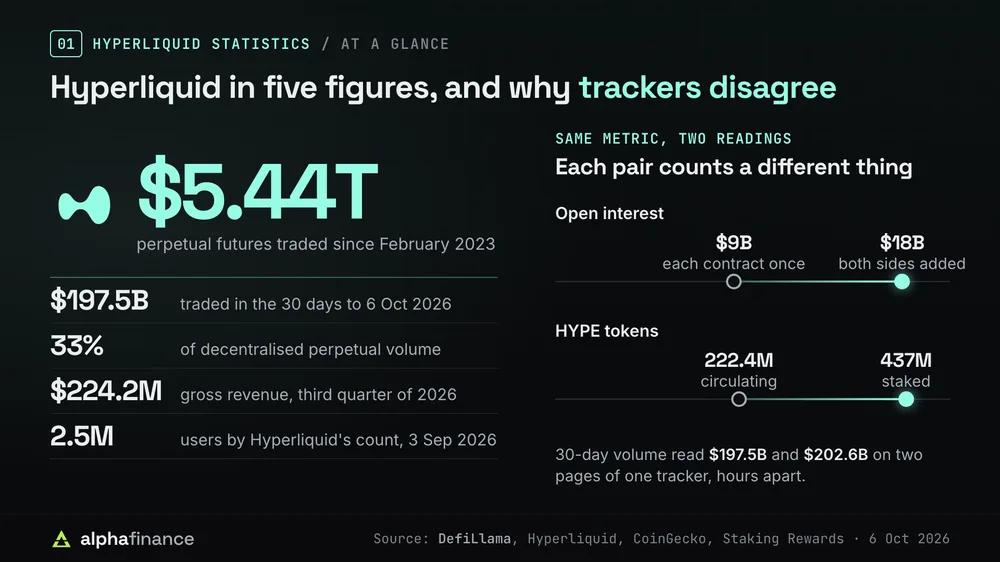
Sources can report different figures for the same Hyperliquid metric because their counting methods differ.
Since opening in February 2023, Hyperliquid has processed more than $5.4 trillion of trades, almost all using leverage. Leverage provides borrowed exposure, allowing traders to hold positions larger than the money they put up, known as margin.
DefiLlama's Hyperliquid dashboard recorded $197.5 billion of perpetual futures volume in the 30 days to 6 Oct 2026, including $41.5 billion in the final seven days. Lifetime volume stood at $5.44 trillion.
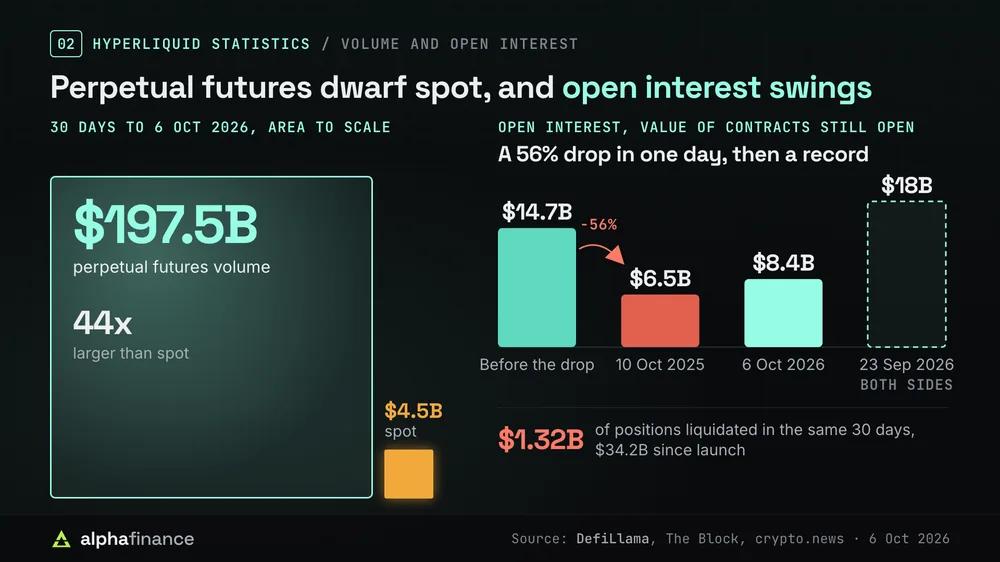
Over the same 30 days, spot markets, where the token itself changes hands, traded $4.5 billion. Perpetual futures volume was about 44 times larger.
Open interest, the total value of futures contracts still open, was $8.4 billion on 6 Oct 2026. Using its own method of adding both sides, the exchange reported a record $18 billion on 23 Sep 2026.
On 10 Oct 2025, open interest fell about 56% in a single day, from $14.7 billion to $6.5 billion, according to The Block's September 2026 analysis. That analysis attributed part of the 2026 recovery to Coinbase directing Base App users to Hyperliquid from mid-August.
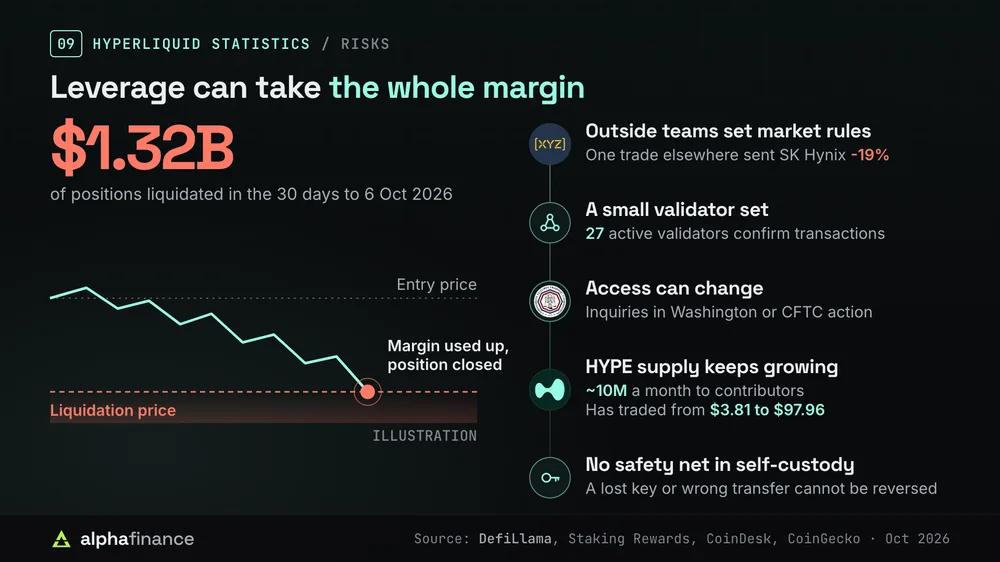
When losses exhaust a trader's margin, the exchange automatically closes the position through liquidation. Hyperliquid liquidated $1.32 billion of positions in the 30 days to 6 Oct 2026 and $34.2 billion over its lifetime. Our crypto liquidations dashboard tracks totals across every major futures exchange.
Deposits on the platform reached $7.3 billion on 6 Oct 2026, a measure called total value locked (TVL). Because every order is public, our tracker can list all Hyperliquid positions above $1 million, including entry prices and leverage.
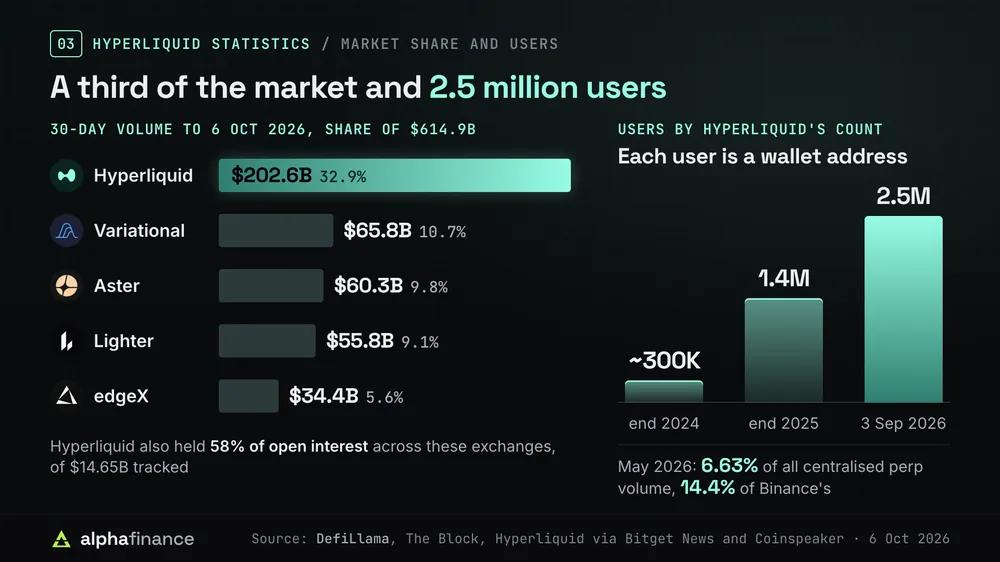
Hyperliquid leads decentralised perpetual futures exchanges by a wide margin, although it remains small beside Binance. A decentralised exchange settles trades on a public blockchain while users keep custody of their own funds.
Of the $614.9 billion in decentralised perpetual futures volume tracked by DefiLlama's rankings in the 30 days to 6 Oct 2026, Hyperliquid accounted for $202.6 billion, or 33%.
| Exchange | 30-day volume | Volume share | Open interest |
|---|---|---|---|
| Hyperliquid | $202.6B | 32.9% | $8.56B |
| Variational | $65.8B | 10.7% | $1.14B |
| Aster | $60.3B | 9.8% | $1.43B |
| Lighter | $55.8B | 9.1% | $836M |
| edgeX | $34.4B | 5.6% | $224M |
Its open interest share was higher, at 58% of the $14.65 billion tracked. We consider this measure harder to inflate because an open position ties up margin for its duration.
In May 2026, Hyperliquid's monthly perpetual futures volume reached a record 6.63% of centralised exchanges' combined total and 14.4% of Binance's, according to The Block's market share analysis.
The exchange counted 2.5 million users on 3 Sep 2026, according to its X post as relayed by Bitget News. At the end of 2025, that count was 1.4 million, up from about 300,000 a year earlier, based on Hyperliquid's 2025 recap as reported by Coinspeaker.
Professional investors gained access to Hyperliquid's perpetual futures quotes on their existing screens when Bloomberg Terminal added them on 5 Oct 2026, crypto.news reported.
Hyperliquid earned $71.3 million in the 30 days to 6 Oct 2026 and used that money to buy HYPE. Revenue and earnings are identical in DefiLlama's records because it records no token incentives paid to traders.
Fees paid by users totalled $87.5 million over those 30 days. DefiLlama's income statement for Hyperliquid put lifetime revenue at $1.32 billion.
Where the fees go
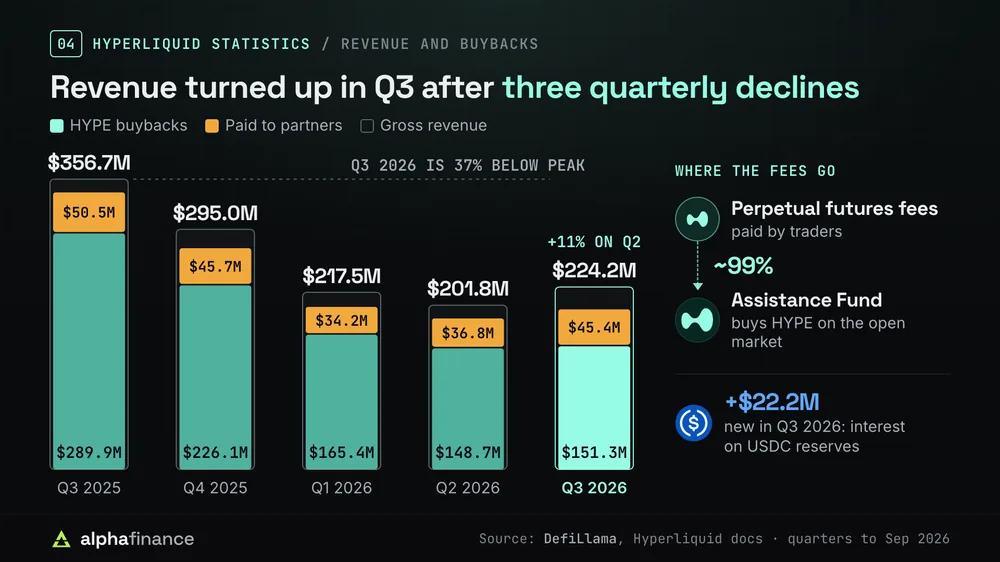
About 99% of Hyperliquid's perpetual futures fees pass to its Assistance Fund, which buys HYPE on the open market. Buybacks rise and fall with trading revenue.
| Quarter | Gross revenue | HYPE buybacks | Paid to partners |
|---|---|---|---|
| Q3 2025 | $356.7M | $289.9M | $50.5M |
| Q4 2025 | $295.0M | $226.1M | $45.7M |
| Q1 2026 | $217.5M | $165.4M | $34.2M |
| Q2 2026 | $201.8M | $148.7M | $36.8M |
| Q3 2026 | $224.2M | $151.3M | $45.4M |
An 11% rise in third-quarter gross revenue ended three consecutive quarterly declines. Revenue nevertheless remained 37% below its third-quarter 2025 peak.
Perpetual futures fees slipped to $171.7 million, 45% below the same quarter a year earlier. The rebound instead came from a new revenue source. Interest on USDC reserves contributed $22.2 million.
USDC is a stablecoin designed to maintain a value of one US dollar. Hyperliquid's aligned quote asset rules provide for most of the interest earned on dollars backing USDC held on the platform to be shared with Hyperliquid. The first payment, $14.58 million, arrived on 3 Oct 2026, FXStreet reported.
Payments to market deployers, referring apps and the exchange's own vault, along with market makers that continuously quote buy and sell prices, amounted to 20% of gross revenue in the third quarter of 2026. That compares with 6% in the second quarter of 2025.
At DefiLlama's annualised earnings estimate of $710.8 million on 6 Oct 2026, HYPE's $20.7 billion market value equalled about 29 years of earnings. Our ranking of the highest-earning crypto projects compares Hyperliquid with other protocols.
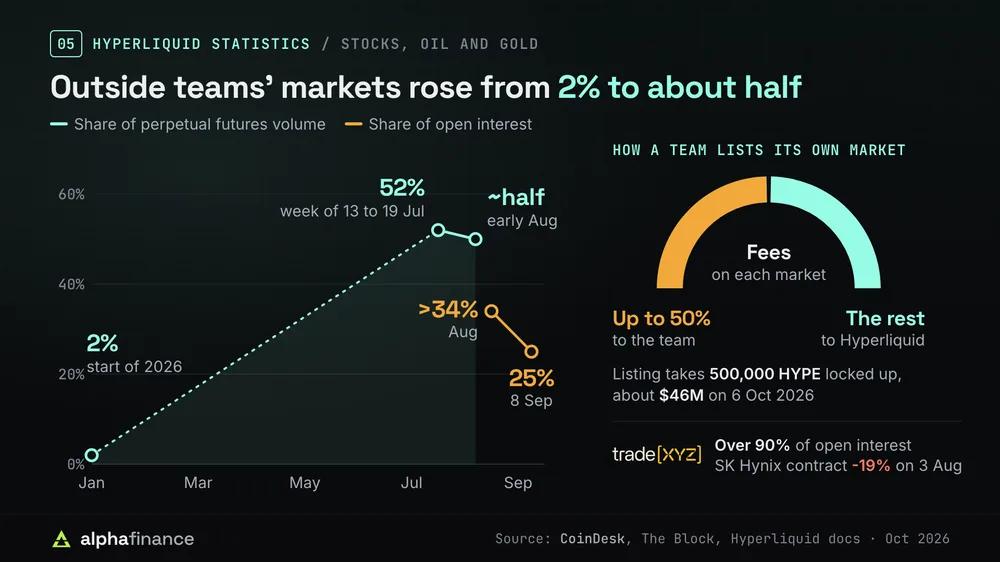
Much of Hyperliquid's trading now involves assets outside crypto, and the exchange earns less on those trades. Since October 2025, HIP-3 has allowed any team that locks up 500,000 HYPE to deploy its own perpetual futures markets and retain up to half the fees. That stake was worth about $46 million on 6 Oct 2026.
These markets grew from about 2% of Hyperliquid's perpetual futures volume at the start of 2026 to roughly half by early August, CoinDesk reported on 9 Aug 2026. Stock and commodity contracts traded $25 billion in the week of 13 to 19 Jul 2026, accounting for 52% of the weekly total.
As traders returned to crypto contracts, outside teams' share of open interest fell from more than 34% in August 2026 to 25% by 8 Sep 2026, The Block found.
One outside team, Trade.xyz, accounted for more than 90% of open interest in these markets. On 3 Aug 2026, a single trade on a Korean venue pushed its SK Hynix contract down 19%. CoinDesk reported that the firm agreed to reimburse the liquidated traders.
Our stock, gold and oil perpetuals dashboard lists volume and open interest for each market.
Under HIP-4, outcome markets went live on 2 May 2026. They carry no leverage and pay out according to whether an event happens.
Loris Tools' HIP-4 dashboard showed $65.2 million of 30-day trading volume among 5,105 traders at the start of October 2026, with $5.2 million of open interest. That volume was about 0.03% of Hyperliquid's perpetual futures volume. Our prediction markets board displays odds from the larger venues.
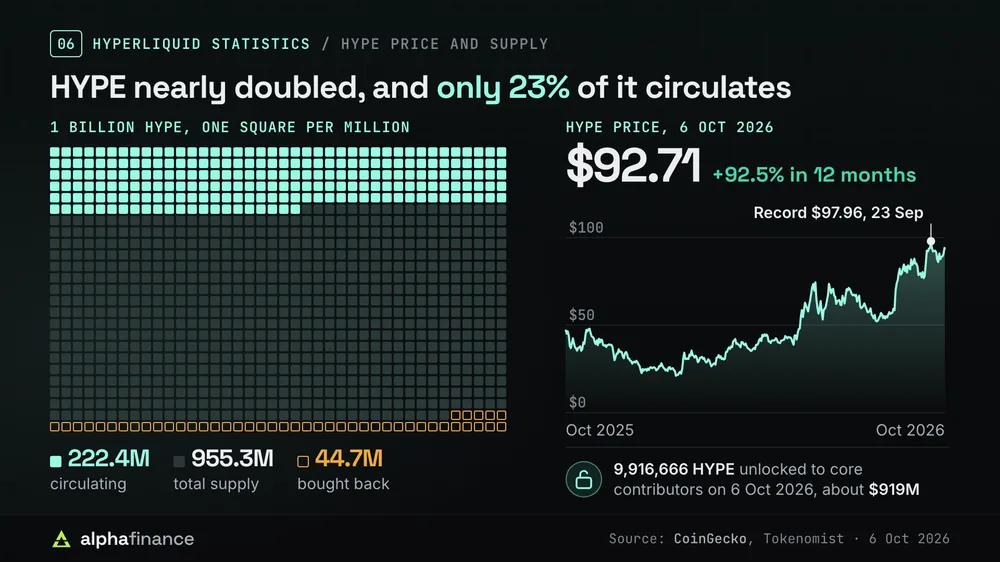
HYPE nearly doubled in price over a year, although most of its supply has yet to reach the market. CoinGecko recorded a price of $92.71 on 6 Oct 2026, up 92.5% over twelve months and 5% below the $97.96 record set on 23 Sep 2026.
Multiplying the price by circulating supply gave a market value of $20.6 billion, ranking HYPE eleventh among crypto assets. Valuing all 1 billion possible tokens at that price gives $88.6 billion. Our live crypto prices board tracks HYPE alongside the 100 largest coins.
A token unlock marks the date when locked tokens become available to sell. Core contributors' tokens are released gradually through vesting. Tokenomist's Hyperliquid schedule listed 9,916,666 HYPE unlocking to those contributors on 6 Oct 2026, a batch worth about $919 million and equal to 2.09% of released supply.
The releases run monthly through 2027, according to CoinDesk's August report. Our token unlock calendar lists the upcoming dates.
Hyperliquid Labs withdrew 3.75 million HYPE from staking, worth about $329 million, for a private sale to one institution on 7 Oct 2026, BeInCrypto reported via Yahoo Finance. Neither the buyer's name nor a lock-up was disclosed.
Staking involves locking tokens with a validator, an operator that verifies transactions, to earn rewards. In early October 2026, Staking Rewards listed 437 million HYPE staked across 27 active validators. Our staking rewards calculator estimates returns at current rates.
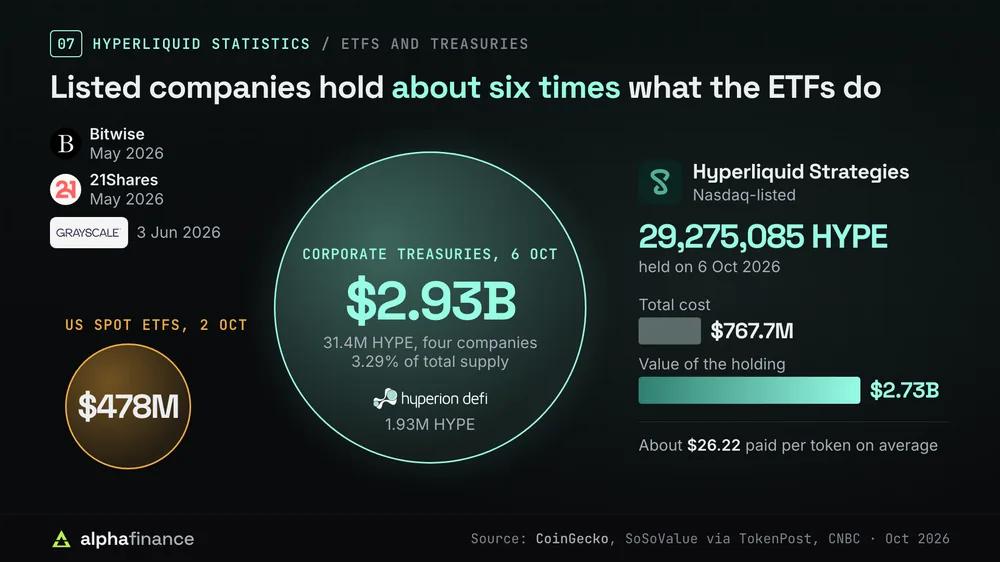
Investors can hold HYPE through brokerage accounts, though listed companies own far more of the token than the funds do. An exchange-traded fund (ETF) holds HYPE and issues shares that trade on a stock exchange.
US spot HYPE ETFs launched from Bitwise and 21Shares in May 2026, followed by Grayscale on 3 Jun 2026, CNBC reported.
According to SoSoValue figures reported by TokenPost, the three funds held $478 million in net assets on 2 Oct 2026, equivalent to 2.48% of HYPE's market value. Since launch, net inflows, or money added minus withdrawals, totalled $346 million. Price gains explain the difference.
Our dashboard tracks daily HYPE ETF inflows and outflows for each fund.
Corporate treasuries were about six times larger. On 6 Oct 2026, CoinGecko's Hyperliquid treasury table listed four institutions holding 31.4 million HYPE, worth $2.93 billion and representing 3.29% of total supply.
Nasdaq-listed Hyperliquid Strategies owned 29,275,085 of those tokens. Its $767.7 million total cost, as recorded by CoinGecko, averaged about $26.22 per token, compared with a holding value of $2.73 billion. Hyperion DeFi held another 1.93 million HYPE.
Each listed holder and its purchase cost appear on our Hyperliquid corporate treasuries page.
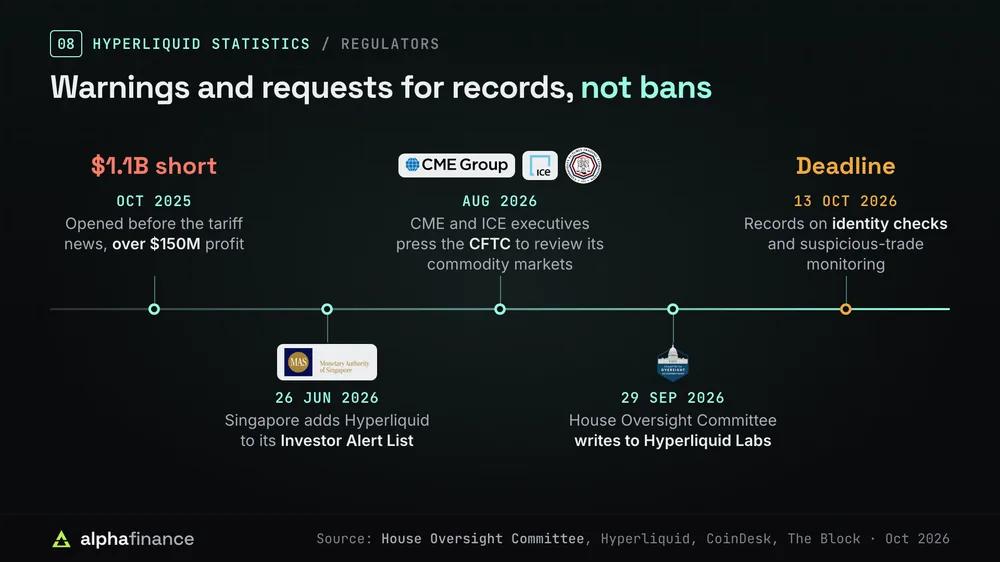
Anyone with a crypto wallet can trade on Hyperliquid without proving their identity. Authorities in three countries responded during 2026. So far their steps are limited to warnings and requests for records.
The committee's letter cites a reported $1.1 billion short position opened on Hyperliquid before the October 2025 tariff announcement. That bet on falling prices closed with a profit exceeding $150 million.
The Block's September analysis also cited President Trump's statement that the CFTC was working to bring Hyperliquid into the United States under federal rules.
For country rules, see our guide to where Hyperliquid is restricted. Our profile of Hyperliquid co-founder Jeff Yan explains his response to the scrutiny.
Most Hyperliquid activity uses leverage, which can cost a trader the entire amount committed as margin. The $1.32 billion of positions liquidated in the 30 days to 6 Oct 2026 illustrates how often this happens.
Prices that would force large groups of leveraged HYPE positions to close appear on the HYPE liquidation heatmap. To calculate that price for an individual position, use our liquidation price calculator.
Not investment advice
This article explains market data. Nothing on this page is a recommendation to buy, sell or leverage any asset. Digital assets are volatile and you can lose everything you put in. If you are unsure whether a trade is appropriate for you, a licensed adviser in your jurisdiction is the right next step.


Fact checked by
Verifies every figure against primary sources before publication. Meet the team
Perpetual futures volume reached $197.5 billion in the 30 days to 6 Oct 2026 and $5.44 trillion since Hyperliquid opened in February 2023. Spot markets traded another $4.5 billion over those 30 days. Its share of decentralised perpetual futures volume was about a third.
Hyperliquid earned $71.3 million in the 30 days to 6 Oct 2026. Gross revenue in the third quarter of 2026 was $224.2 million. About 99% of perpetual futures fees go to a fund that buys HYPE on the open market. Lifetime revenue stood at $1.32 billion.
The exchange counted 2.5 million users on 3 Sep 2026, compared with 1.4 million at the end of 2025. With no sign-up process, it counts wallet addresses as users. People can control multiple addresses, so the number of individuals is lower.
On 6 Oct 2026, about 222.4 million HYPE were counted as circulating, against a total supply of 955.3 million and a maximum of 1 billion. Buybacks have removed roughly 44.7 million tokens. Under the release schedule, core contributors receive about 9.92 million more each month.
Outside teams list perpetual futures tracking stocks, stock indices, gold and oil under Hyperliquid's HIP-3 rules. These contracts track prices without conveying ownership of the shares or commodities. In early August 2026, they accounted for roughly half the exchange's perpetual futures volume.
Hyperliquid describes itself as permissionless infrastructure and has stated that it is not licensed by Singapore's financial regulator. That regulator added it to an investor alert list on 26 Jun 2026. A US House committee subsequently requested records from Hyperliquid Labs on 29 Sep 2026. Neither step constitutes a ban or an enforcement action.