Every figure, platform detail and regulatory claim on this page was traced to a
primary source by the named fact checker before publication, and is re-checked each
quarter. The review date moves only when a person has re-read the page.
Jeff Yan co-founded Hyperliquid and leads its core team: He runs Hyperliquid Labs with a Harvard classmate known only as iliensinc. The exchange opened in February 2023, in the months after FTX collapsed.
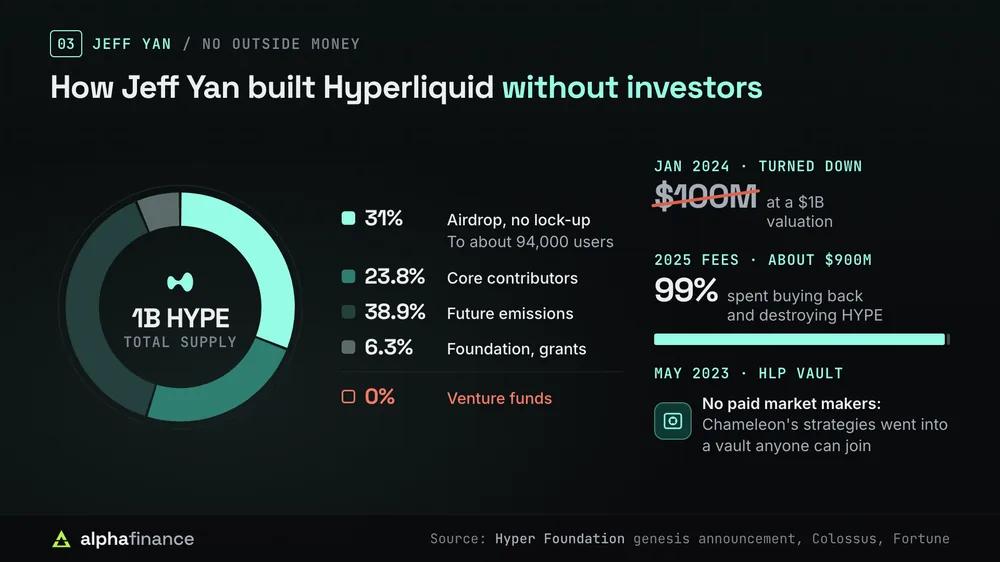
He built it without investors: Profits from Yan's trading firm covered development costs. He declined a venture offer of about $100 million in January 2024, and venture funds received no tokens at launch.
Users received 31% of the HYPE token: About 94,000 early users received tokens on 29 Nov 2024 without a lock-up. The team's 23.8% allocation is released gradually. Yan's personal share has never been published.
Hyperliquid now trades far more than crypto: Outside teams list perpetual futures on oil, gold, stock indices and private companies. Prediction-style outcome markets went live in May 2026.
Scrutiny is growing in Washington: The House Oversight Committee asked Yan on 29 Sep 2026 for records on identity checks and suspicious trades, with a deadline of 13 Oct 2026.
Jeff Yan is the co-founder of Hyperliquid, a perpetual futures exchange built on its own blockchain. The former high-frequency trader funded its development with his own trading profits, turning down venture capital before distributing 31% of the HYPE token to early users.
He now leads a team of about a dozen behind a platform that has processed trillions of dollars in trades. That growth has brought scrutiny from Congress and rival exchanges over how Hyperliquid monitors trading without requiring users to verify their identities.
Who Jeff Yan is and what he built
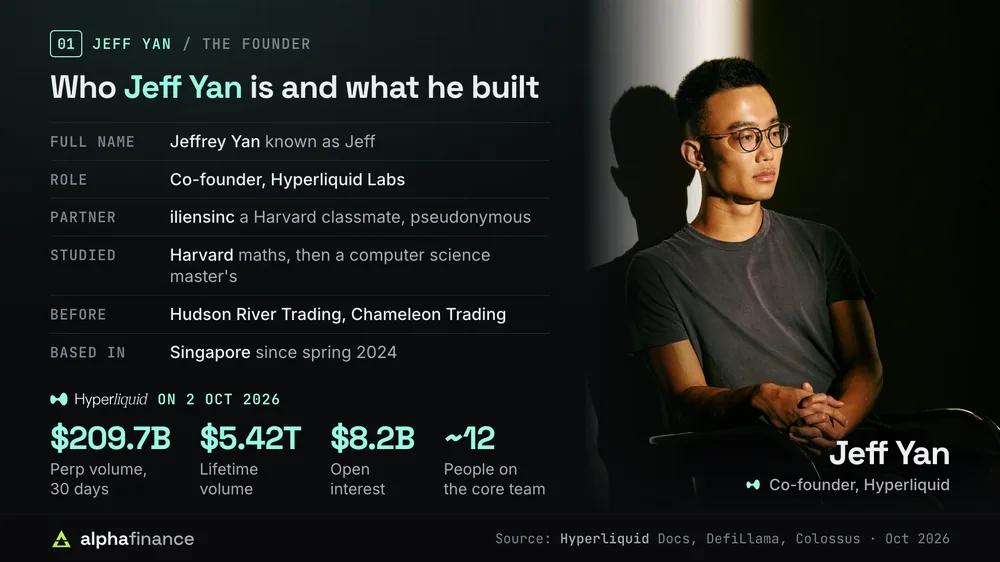
Jeff Yan, also written Jeffrey Yan, is the person most responsible for Hyperliquid. He is also the only core team member working under his real name. According to the project's documentation, Hyperliquid Labs is led by Jeff and iliensinc, classmates from Harvard, and has taken no outside capital.
Traders on Hyperliquid retain custody of their money. A public ledger records every order and trade, including liquidations, when a position is forcibly closed because its collateral has run out. Collateral is the money posted to back a position.
About a dozen people build the platform. DefiLlama's Hyperliquid dashboard showed $209.7 billion in perpetual futures volume over 30 days on 2 Oct 2026, with lifetime volume at $5.42 trillion. Open interest, the total value of positions still open, was $8.2 billion.
Full name: Jeffrey Yan, known as Jeff
Role: Co-founder of Hyperliquid Labs, the core developer of Hyperliquid
Education: Bachelor's degree in mathematics and master's degree in computer science, Harvard University
Earlier work: Hudson River Trading, then his own firm, Chameleon Trading
Based in: Singapore since spring 2024
Jeff Yan's education and early career
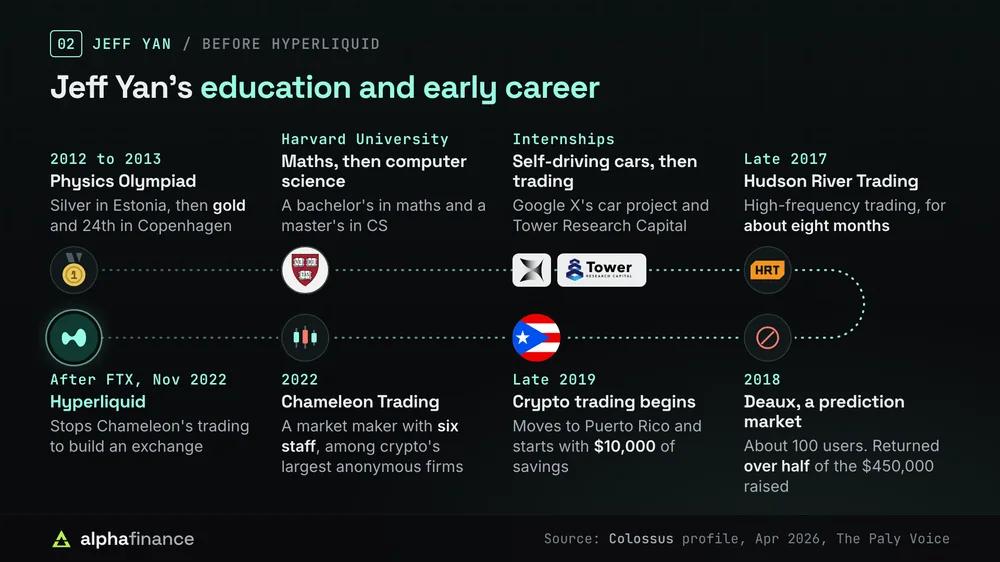
Competitive maths and physics, followed by high-speed trading, shaped Yan's approach to engineering Hyperliquid. His parents were Chinese immigrants who divorced. He grew up in Redwood Shores, California, with his mother, an accountant, according to Colossus magazine's April 2026 profile.
Yan taught himself physics through textbooks and Richard Feynman's lectures. After taking silver at the International Physics Olympiad in Estonia in 2012, he won gold and placed 24th in Copenhagen in July 2013. The Paly Voice, the student newspaper of Palo Alto High School, where he studied, reported the result.
While at Harvard, he interned on Google X's self-driving car project and at Tower Research Capital. In late 2017 he joined Hudson River Trading, where software places and cancels orders in fractions of a second. He left the high-frequency trading firm about eight months later.
His first company failed. Yan and a college roommate built Deaux in 2018, a prediction market for bets on elections, sport or the weather. Only about 100 users joined before it closed. Of the $450,000 raised, Yan returned more than half.
A move to Puerto Rico in late 2019 marked his start in crypto trading, using $10,000 of savings. That operation became Chameleon Trading, a market maker that continuously offers to buy and sell so other traders have someone to deal with. It employed six people by 2022. Colossus described Chameleon as one of the largest anonymous trading operations in crypto.
How Jeff Yan built Hyperliquid without investors
FTX's failure prompted Yan to build Hyperliquid. Then the third-largest crypto exchange, FTX collapsed in November 2022 after lending out customer deposits. Yan shut down Chameleon's trading and told his team they would build an exchange where customers retained their own funds. He later refused outside investment.
The team wrote its own blockchain because none was fast enough to run an order book, the live list of buy and sell orders used by most exchanges. Hyperliquid opened at the end of February 2023. Its launch departed from the usual crypto model.
No paid market makers: New exchanges usually pay trading firms to supply orders. Yan instead put Chameleon's strategies into a public vault called HLP in May 2023. Any user could deposit money and share its profit or loss.
No venture capital: A fund offered about $100 million at a $1 billion valuation in January 2024. After considering it over a weekend, Yan declined. On 28 Jan 2024 he posted that the project had no investors, no paid market makers, no fees to the developers and no insiders.
Tokens to users first: The Hyper Foundation distributed 31% of the 1 billion HYPE supply to early users on 29 Nov 2024 through an airdrop, a free token distribution. None was locked, according to the foundation's genesis announcement. Colossus counted about 94,000 recipients and put the opening value above $1 billion.
Fees to the token: Of the roughly $900 million earned in 2025, 99% went towards buying and destroying HYPE, Colossus reported. None was paid to the team.
For Yan, neutrality explained those decisions. He told Fortune in January 2026 that for a platform others can build on, "a really important principle is to sort of not have insiders".
Jeff Yan and Hyperliquid timeline
Date
Event
What it changed
Feb 2023
Hyperliquid opens for trading
A self-funded exchange runs on its own blockchain
Jan 2024
Yan declines about $100M of venture funding
No investor holds a preferential stake
Nov 2024
HYPE token is distributed
31% of supply goes to about 94,000 users
Oct 2025
Builder-deployed markets go live
Outside teams can list new perpetual futures
Feb 2026
Hyperliquid Policy Center opens
The project gains a voice in Washington
May 2026
Outcome markets and US spot HYPE funds launch
Event contracts and brokerage access arrive
Sep 2026
House Oversight Committee writes to Yan
Congress asks for identity and surveillance records
What Hyperliquid has become under Jeff Yan
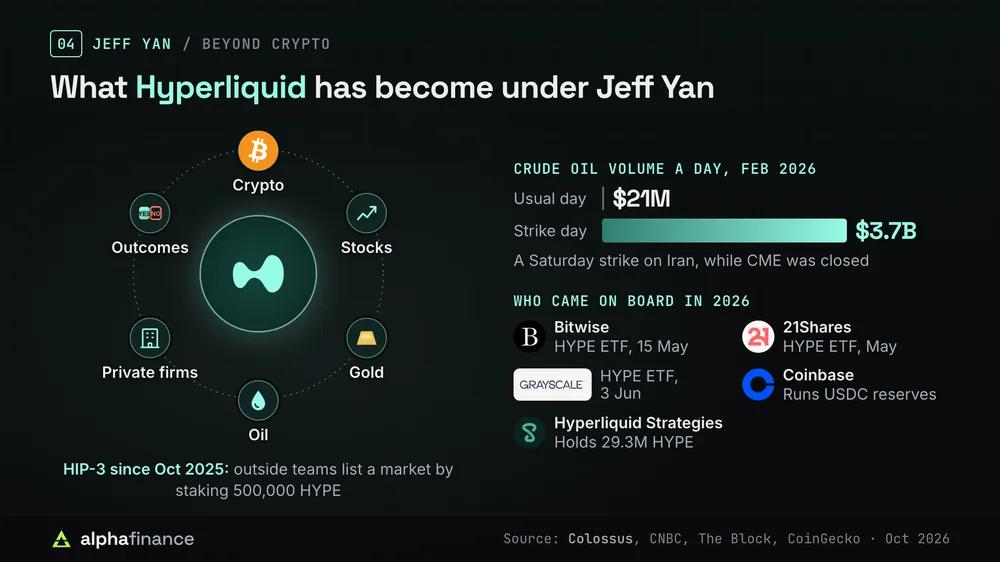
Outside teams can now list markets on almost anything with a price, extending Hyperliquid beyond crypto derivatives. A rule change introduced in October 2025, Hyperliquid Improvement Proposal 3 (HIP-3), allows teams to deploy their own perpetual futures markets. They must stake 500,000 HYPE, locking it up as a bond, and can keep up to half the fees.
Those markets support round-the-clock trading in perpetuals on stocks, gold and oil. The Chicago Mercantile Exchange was closed when the US and Israel struck Iran on a Saturday in February 2026. Daily crude oil volume on Hyperliquid rose from $21 million to $3.7 billion, according to Colossus.
HIP-4, a second proposal, introduced outcome markets. These fully collateralised contracts pay out based on whether an event happens and went live on 2 May 2026. They work like the contracts behind prediction market odds, with no leverage, or borrowed exposure, and no liquidations.
Growth comes at a cost to HYPE holders because deploying teams retain a share of fees. Quarterly revenue had fallen about 43% from its 2025 peak even as open interest reached a 2026 high, CoinDesk reported on 9 Aug 2026. DefiLlama still showed annualised revenue of $685.9 million on 2 Oct 2026. Our ranking of the highest-earning crypto projects puts that figure in context.
US fund managers also offer HYPE exposure through exchange-traded funds (ETFs), which hold the token and trade on a stock exchange. Bitwise listed its fund on the New York Stock Exchange on 15 May 2026, days after 21Shares. Grayscale followed on 3 Jun 2026, according to CNBC. Daily money flowing in and out of the spot Hyperliquid ETFs appears on our dashboard.
Coinbase became the manager of USDC reserves on Hyperliquid on 14 May 2026, The Block reported. USDC is a stablecoin designed to hold a value of one US dollar.
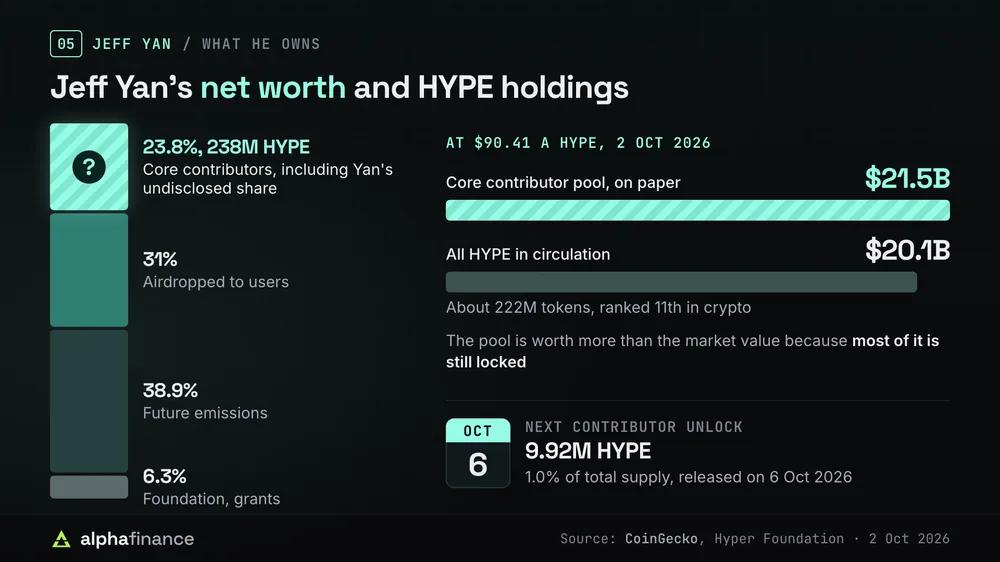
Jeff Yan's token allocation has never been published, so nobody outside Hyperliquid knows his net worth. Any figure quoted for it is an estimate.
His allocation comes from a public pool of 238 million HYPE, or 23.8% of supply, reserved for current and future core contributors. Those tokens were locked for a year after launch and are then released gradually through a process called vesting. At CoinGecko's price of $90.41 on 2 Oct 2026, the pool was worth about $21.5 billion on paper.
The pool's value exceeded HYPE's $20.1 billion market value that day, when it ranked eleventh among crypto assets. Market value counts only the roughly 222 million tokens already circulating. Most contributor tokens remain locked.
CoinGecko listed the next core contributor release as 9.92 million HYPE on 6 Oct 2026, equal to 1.0% of total supply. These releases are called token unlocks, the dates when locked tokens become available to sell. Our token unlock calendar lists subsequent dates.
Already wealthy before Hyperliquid, Yan shows little interest in spending. Colossus found him wearing the same shorts and T-shirt each day while still covering many team costs himself. He moved home and hired a bodyguard after a stranger followed him into his apartment building's lift. He now travels with two security guards.
Why regulators are questioning Jeff Yan
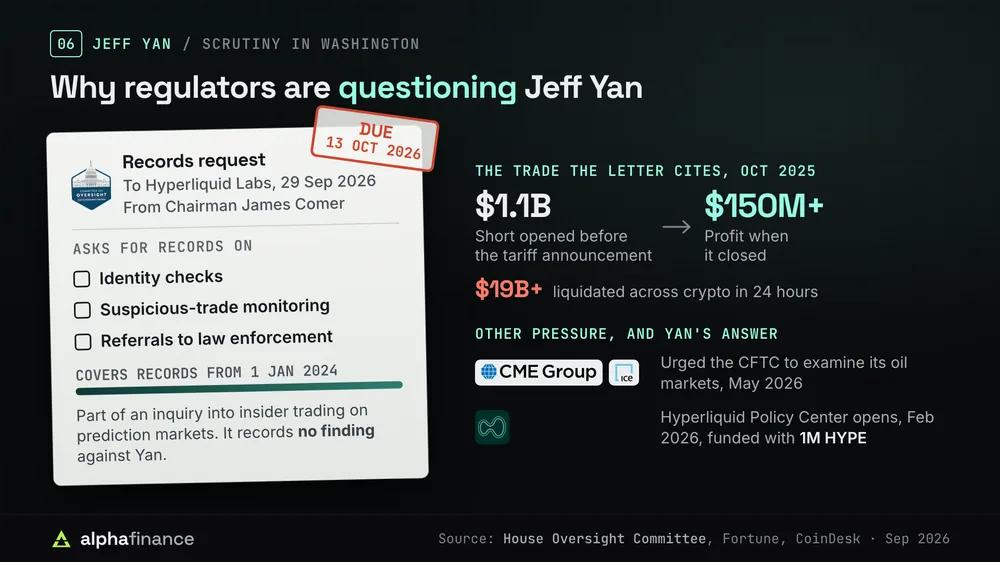
Trading on Hyperliquid requires no proof of identity, a feature that has become a political problem for Yan. On 29 Sep 2026 James Comer, chairman of the US House Committee on Oversight and Government Reform, sent letters to Hyperliquid Labs, Crypto.com and the owner of PredictIt as part of an inquiry into insider trading on prediction markets.
The committee's letter to Yan cites a reported $1.1 billion short position opened on Hyperliquid before President Trump's October 2025 tariff announcement. The bet on falling prices closed for a profit above $150 million. Describing a platform with "apparently no identity verification", the letter requests records on identity checks and suspicious-trade monitoring, along with referrals to law enforcement, by 13 Oct 2026.
The request covers documents dating from 1 Jan 2024. It records no finding against Yan or Hyperliquid Labs.
Fortune reported that the tariff announcement triggered the largest day of crypto liquidations on record. More than $19 billion of leveraged positions were forcibly closed within 24 hours. Hyperliquid's public ledger brought attention to the trade. Anyone can inspect every open Hyperliquid position above $1 million, including entry price and leverage, though traders are identified only by wallet address.
Pressure also comes from established exchanges. CME Group and Intercontinental Exchange urged the Commodity Futures Trading Commission (CFTC), the US derivatives regulator, to examine manipulation and sanctions risks in Hyperliquid's oil markets. CoinDesk reported their concerns on 15 May 2026, citing Bloomberg. A Hyperliquid Labs spokesperson told Fortune that the website screens traders and enforces sanctions rules. It also blocks addresses confirmed as high risk.
Yan has responded by funding advocacy at arm's length. Led by crypto lawyer Jake Chervinsky, the Hyperliquid Policy Center opened in Washington on 18 Feb 2026. It received 1 million HYPE from the Hyper Foundation, worth about $28 million at the time, Fortune reported. The centre pressed the European Union on perpetual futures on 1 Oct 2026 during its review of MiCA, the bloc's crypto rulebook.
The degree of decentralisation is another point of criticism. In March 2025 roughly two dozen validators, the operators who verify transactions, voted within minutes to delist a small token called Jelly Jelly and settle positions at an earlier price. A trader had tried to push losses onto the HLP vault. Users were made whole. Yan told Colossus that the small validator set was a deliberate design choice.
What Jeff Yan says comes next for Hyperliquid
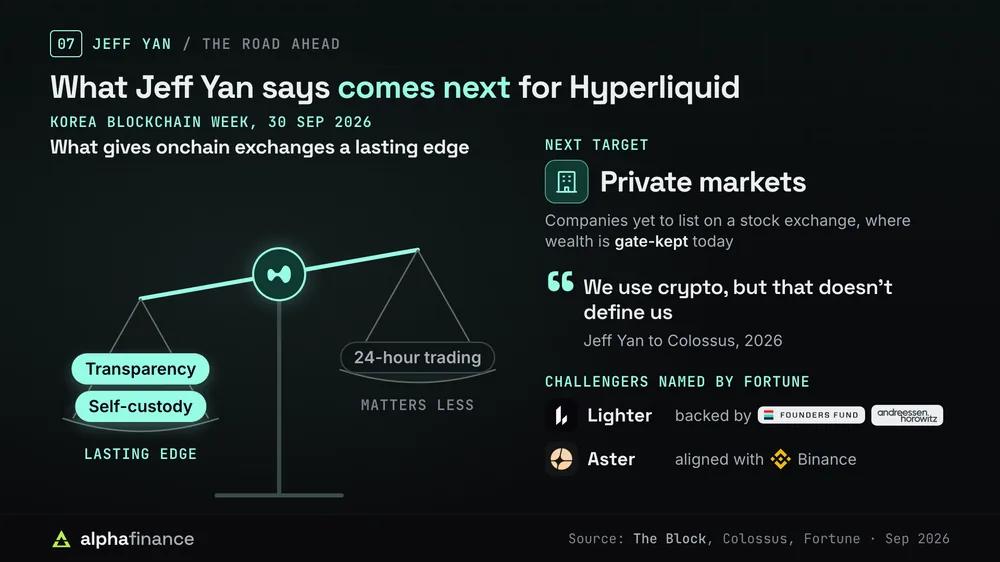
Yan wants Hyperliquid to hold every kind of financial market. His latest target is private companies. Speaking at Korea Blockchain Week on 30 Sep 2026, he described private markets as a big opportunity because wealth there is "being created in a way that is really gate-kept", The Block reported. Outside deployers already offer perpetuals on Hyperliquid for companies that have yet to list on a stock exchange.
In that talk, he placed self-custody and transparency about the system's operation above 24-hour trading as the lasting advantages of exchanges on public blockchains. Self-custody means users hold their own funds.
Hyperliquid is infrastructure in Yan's view, and he does not consider it a crypto company. "We use crypto, but that doesn't define us," he told Colossus. The core team builds the underlying system. Independent teams develop most consumer products and earn fees for bringing in users.
Fortune identified two direct challengers. Lighter was founded by a fellow Harvard graduate and has backing from Founders Fund and a16z crypto. Aster is closely aligned with Binance. Yan acknowledges that his ambition to house all of finance will be measured in decades.
The risks of trading on Hyperliquid
A founder's reputation cannot protect a trader's money. Most Hyperliquid activity involves leverage, which lets traders hold positions larger than the collateral, or margin, they put up. Fast price moves can wipe out that entire margin within minutes.
Prices at which groups of leveraged HYPE positions would be forced to close appear on the HYPE liquidation heatmap. The platform carries other specific risks.
Builder-deployed markets depend on their deployer: Each outside team controls its price feed and sets leverage limits and settlement rules. CoinDesk found that one deployer accounted for more than 90% of open interest in these markets in August 2026.
Validators can intervene: The March 2025 delisting demonstrated that a small group of operators can override a market price. That power protected users then, but it could work against a trader in another dispute.
The rules may change: US residents cannot legally trade derivatives on Hyperliquid today. Congressional inquiries or CFTC action could change who can use the platform and how.
HYPE is volatile and supply is growing: The token's trading range has spanned a low of $3.81 and a high of $97.96. Contributor tokens continue to unlock.
Not investment advice
This article explains market data. Nothing on this page is a recommendation to buy, sell
or leverage any asset. Digital assets are volatile and you can lose everything you put
in. If you are unsure whether a trade is appropriate for you, a licensed adviser in your
jurisdiction is the right next step.
Written by
Alpha Finance Editorial Team
Part of the Alpha Finance research team. Meet the team
Fact checked by
Vince Dioquino
Verifies every figure against primary sources before publication. Meet the team
Questions
Who is Jeff Yan?
Jeff Yan co-founded Hyperliquid and leads Hyperliquid Labs, the company developing it. A Harvard graduate and International Physics Olympiad gold medallist, he previously traded at Hudson River Trading. He later ran Chameleon Trading, his own crypto market-making firm, before building Hyperliquid.
Who founded Hyperliquid?
Jeff Yan founded Hyperliquid with a Harvard classmate known by the pseudonym iliensinc. They lead Hyperliquid Labs, described as self-funded in the project's documentation. Trading began in February 2023.
What is Jeff Yan's net worth?
His net worth is not public, and published figures are estimates. Yan's portion of the 23.8% of HYPE reserved for core contributors remains undisclosed. At the token's price on 2 Oct 2026, that entire pool was worth about $21.5 billion on paper.
Did Jeff Yan take venture capital for Hyperliquid?
Hyperliquid has never raised outside money. Yan paid for development with trading profits, turning down about $100 million at a $1 billion valuation in January 2024. Venture funds seeking HYPE had to buy on the open market.
How old is Jeff Yan and where is he based?
Colossus reported that Yan was 31 in its April 2026 profile. Raised in the San Francisco Bay Area, he later lived in Puerto Rico while running Chameleon Trading. Singapore has been his base since spring 2024.
 By Alpha Finance Editorial Team
 Fact-checked by Vince Dioquino