Markets
 BTC
 ETH
 BNB
 XRP
 SOL
 ZEC
 HYPE
 DOGE
 LINK
 TON
 AVAX
 SUI
 TAO
 AAVE
 PUMP
 MORPHO
 ARB
 LIT
--:-- UTC
Research/Platform guides
Hyperliquid restricted countries explained: who its terms exclude, how the block works, how UK and EU regulators view it, and how US access could open.

 By Alpha Finance Editorial Team
 Fact-checked by Vince Dioquino
Every figure, platform detail and regulatory claim on this page was traced to a primary source by the named fact checker before publication, and is re-checked when those facts change. The review date moves only when a person has re-read the page.
The editorial policy → Editorial policy Report an errorHyperliquid's app excludes anyone in the United States, Ontario or a sanctioned jurisdiction. Almost everyone else can use it without identity checks.
In 2025, it was the most active onchain market for perpetual futures, according to a CoinGecko ranking cited by Kraken's parent company, Payward. These leveraged contracts track an asset's price and never expire.
The short list of Hyperliquid restricted countries faces regulatory pressure. UK and EU authorities have warned about retail access to leveraged crypto products. In the US, regulators are working on a route to Hyperliquid markets through registered firms.
Hyperliquid's terms bar anyone who lives or is located in the United States, Ontario or a sanctioned place from using its app.
Every user must connect a non-custodial wallet, meaning they hold its keys. Hyperliquid's Terms of Use also exclude a class called Restricted Persons. This covers people and companies residing, located, incorporated or holding a registered office in the United States, Ontario or a jurisdiction subject to sanctions or export control laws. Citizens of those restricted territories are excluded wherever they live.
| Group | Who it covers | Named in the terms? |
|---|---|---|
| United States | Residents, people located there, companies incorporated or registered there | Yes |
| Ontario, Canada | Same test as the United States | Yes |
| Sanctioned or export-controlled jurisdictions | Same test as the United States | Described only |
| Citizens of restricted territories | Citizens, wherever they live | Yes |
The terms refer to "applicable" sanctions and export control laws without identifying whose laws apply. The jurisdictions covered therefore change with sanctions. According to Willkie Farr & Gallagher's US sanctions guide, comprehensive US sanctions cover Cuba, Iran, North Korea and the Crimea, Donetsk and Luhansk regions of Ukraine.
Citizenship can bring people living abroad within the restrictions. The defined term Restricted Territories is attached to the sanctions clause, but the wording leaves open whether it also includes the United States and Ontario. A US citizen in Sydney or Singapore cannot safely assume they fall outside it.
The one-sentence version
Hyperliquid's terms exclude the United States, Ontario, sanctioned jurisdictions and citizens of those places wherever they live.
The rest of Canada, the United Kingdom, the European Union and Australia are not named. Access from those places is allowed under the terms, subject to local rules.

Access depends on where you connect from and the declarations you make when accepting Hyperliquid's terms. The app never asks for identity documents.
Visitors connecting from a blocked location see a notice on Hyperliquid's site stating that access from their jurisdiction is prohibited. Everyone else can trade without the identity checks centralised exchanges conduct under know your customer (KYC) rules.
Country restrictions differ across wallet apps offering Hyperliquid markets. MetaMask's perps help page lists the US, the UK, Ontario, Belgium and countries on the US sanctions list as unavailable. Phantom's regional availability page excludes the US, the UK and regions under comprehensive US sanctions.
| Access point | United States | Ontario | United Kingdom | Belgium |
|---|---|---|---|---|
| Hyperliquid app | Restricted | Restricted | Not named | Not named |
| MetaMask Perps | Unavailable | Unavailable | Unavailable | Unavailable |
| Phantom Perps | Unavailable | Not excluded | Unavailable | Not excluded |
All three access points exclude sanctioned regions.

A virtual private network (VPN) changes the internet address visible to a website. Hyperliquid's terms instead assess residence, location and citizenship, so someone connecting through a VPN from a restricted place remains a Restricted Person under the contract they accepted.
For the bridge that brings Bitcoin, Ether and Solana onto Hyperliquid, Unit's terms of service address this explicitly. Users must confirm they are not accessing it from a prohibited jurisdiction through a VPN.
The United States and Ontario both require platforms offering leveraged derivatives to their residents to register with a regulator. Hyperliquid excludes both jurisdictions in its terms.
Before May 2026, the Commodity Futures Trading Commission (CFTC), the US derivatives regulator, treated crypto perpetual contracts as swaps. Its enforcement actions against BitMEX, KuCoin and the decentralised exchange Deridex reflected that position, according to a McDermott client alert on CME's lawsuit.
That classification kept perpetuals away from ordinary US traders. Treating some contracts as futures creates a route for retail customers through registered brokers, as a Troutman client note explains.
Payward describes the structure for its planned Hyperliquid markets. To serve Americans legally, a designated contract market (DCM) lists and administers the contracts, while a derivatives clearing organisation (DCO) clears and settles them. A futures commission merchant (FCM) carries customer accounts.
In Ontario, the Ontario Securities Commission (OSC), the province's securities regulator, expects offshore crypto platforms offering derivatives to Ontarians to register. It settled with Bybit and permanently banned KuCoin from Ontario's capital markets in June 2022 for operating unregistered crypto trading platforms. KuCoin was also ordered to pay a CAD $2 million penalty.
Users in the UK, EU and Australia can access Hyperliquid under its terms. Regulators in all three, however, limit how leveraged crypto products reach retail traders. The UK's regulator has named Hyperliquid directly.
Since 6 Jan 2021, the Financial Conduct Authority (FCA), the UK's financial regulator, has banned the sale, marketing and distribution of crypto derivatives to retail consumers by firms acting in or from the UK.
The FCA added Hyperliquid and the Hyper Foundation to its warning list on 21 May 2026, identifying them as firms that may be offering financial services without permission. As CryptoSlate's report on the warning notes, UK users of an unauthorised firm cannot complain to the Financial Ombudsman Service or claim from the Financial Services Compensation Scheme.
Derivatives marketed as perpetual futures are likely to fall under national restrictions on contracts for difference (CFDs), the European Securities and Markets Authority (ESMA) said on 24 Feb 2026. CFDs are leveraged contracts that pay the change in an asset's price. ESMA's public statement makes clear that a product's name does not determine its classification.
The restrictions originate in ESMA's 2018 measures. They cap retail leverage and require accounts to be closed out below a margin threshold. They also prevent losses from exceeding the deposit and prohibit trading incentives. Addressed to investment firms and national regulators, the statement gives them firmer grounds to act against anyone selling perpetuals to EU retail clients without those protections.
MiCA, the EU's crypto-asset law, leaves crypto derivatives to MiFID II, the rulebook for investment firms, as PwC Legal's summary of the statement explains.
Australia is not named in Hyperliquid's terms. For retail clients of Australian issuers, the Australian Securities and Investments Commission (ASIC) caps leverage on crypto-asset CFDs at 2:1. ASIC extended that order to 23 May 2027.
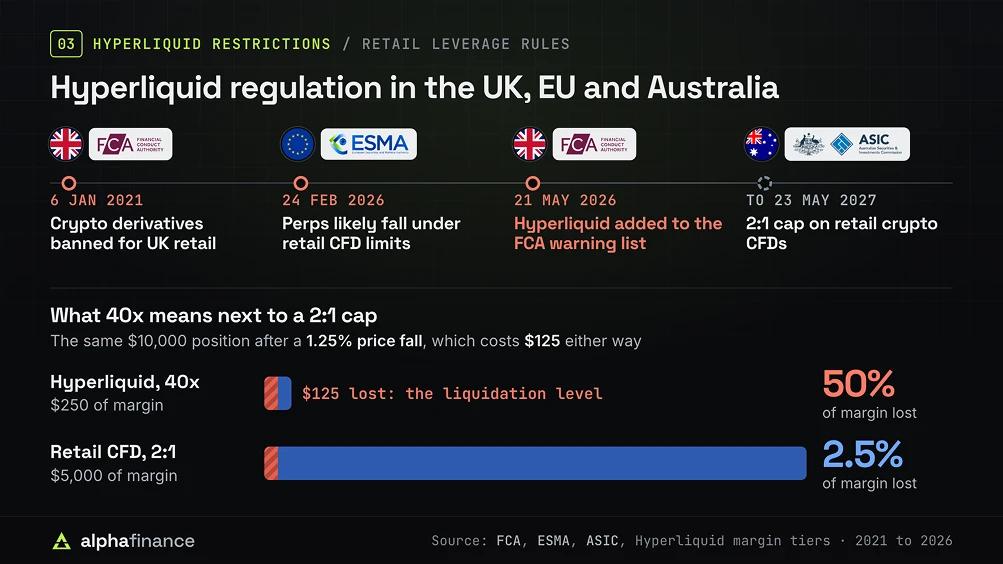
According to its margin tier documentation, Hyperliquid permits up to 40 times leverage on Bitcoin positions below $150 million.
Leverage divides the position size by its margin, the collateral posted to open it. The documentation sets maintenance margin, the minimum collateral needed to keep a position open, at half the initial margin required at maximum leverage. Falling below that level exposes the position to liquidation, a forced closing tracked in Alpha Finance's live crypto liquidations dashboard.
| Measure | Hyperliquid, 40x | Retail crypto CFD, 2:1 |
|---|---|---|
| Position size | $10,000 | $10,000 |
| Margin posted | $250 | $5,000 |
| Loss from a 1.25% price fall | $125 | $125 |
| That loss as a share of margin | 50%, reaching the liquidation level | 2.5% |
The figures exclude trading fees and funding payments. Traders on one side of a perpetual pay funding to the other side to keep the contract's price near the asset's price. You can compare funding rates across six exchanges.
Americans can now trade some perpetual futures on registered US exchanges. None of the approvals so far grants access to Hyperliquid's own app.
The CFTC approved Kalshi's BTCPERP contract, a Bitcoin perpetual, as a futures contract on 29 May 2026. It also issued a policy statement referring perpetuals on other asset classes for case-by-case review. Separately, CFTC staff allowed Coinbase Financial Markets to offer US customers perpetuals from its offshore affiliate Deribit as foreign futures, according to a Cahill Gordon alert.
CME, the Chicago futures exchange operator, sued the CFTC on 18 Jun 2026, arguing that perpetuals are swaps. The Hyperliquid Policy Center urged the court to dismiss CME's case in a brief filed on 9 Sep 2026. The lobby group launched in February under crypto lawyer Jake Chervinsky with 1 million HYPE from the Hyper Foundation. Its brief says the CFTC is working to bring onchain markets such as Hyperliquid onshore.
In May, CME and Intercontinental Exchange (ICE), which owns the New York Stock Exchange, had already urged the CFTC and lawmakers to scrutinise Hyperliquid. They warned that anonymous, round-the-clock oil trading could distort commodity benchmarks and facilitate sanctions evasion. Every Hyperliquid position is recorded on a public blockchain, allowing Alpha Finance to display every open Hyperliquid position over $1 million.
President Donald Trump said on 19 Aug 2026 that CFTC Chairman Michael Selig was working to bring Hyperliquid into the United States "in a fully compliant and legal fashion", Bloomberg reported. The wider rules remain unsettled in Congress. The CLARITY Act, the crypto market structure bill, failed a Senate procedural vote on 15 Sep 2026, as a Troutman analysis of the vote notes.

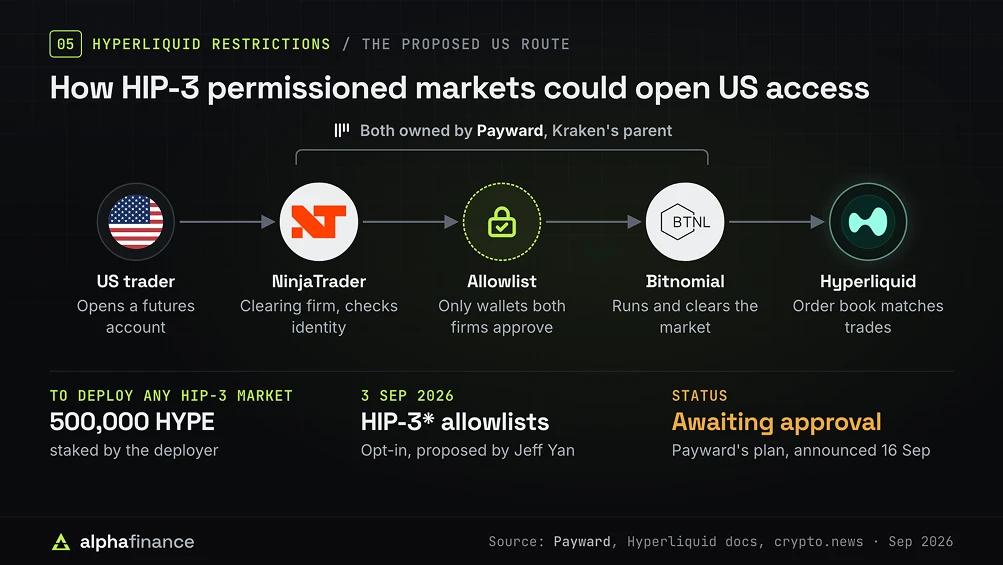
The most detailed proposal for American access would let a registered US firm run its own Hyperliquid market for customers it has checked.
HIP-3 is the upgrade that allows outside builders to launch perpetual markets on Hyperliquid. A deployer must stake 500,000 HYPE under Hyperliquid's HIP-3 documentation. The deployer defines the market and sets its price source and leverage limits, with responsibility for settling it if needed. Builders have used HIP-3 to list stock, gold, oil and currency perpetuals on Hyperliquid.
Co-founder Jeff Yan proposed HIP-3* on 3 Sep 2026, crypto.news reported. This optional feature lets a deployer maintain an onchain allowlist of wallets authorised to trade its markets. Existing HIP-3 markets remain unchanged because participation is opt-in.
In an announcement on 16 Sep 2026, Payward said it intends to become the first registered US firm to deploy such a market. Bitnomial, its exchange and clearing house, would run and clear the contracts. Its broker, NinjaTrader Clearing, would carry client accounts.
Regulatory approval is still required. Only accounts onboarded by NinjaTrader and included on both firms' allowlists would qualify, with trades matched on Hyperliquid's onchain order book. US traders would receive a futures account with identity checks and a short list of contracts. The main Hyperliquid app and its existing markets would remain closed to them.
Owning HYPE through a US brokerage account is already possible. It does not give the investor any right to trade on Hyperliquid.
In May, Bitwise launched its spot Hyperliquid exchange-traded fund (ETF), ticker BHYP, on the New York Stock Exchange. The firm stakes the fund's HYPE through its own staking business. Alpha Finance records daily money in and out of US HYPE ETFs.
Hyperliquid Strategies (Nasdaq: PURR), a listed company, describes its purpose as providing US and institutional investors with access to HYPE. Companies holding the token appear in our Hyperliquid corporate treasury tracker.
Robinhood began offering HYPE to UK customers while the Hyperliquid platform was on the FCA warning list, according to City AM. Those customers buy through Bitstamp UK without using Hyperliquid itself.
A leveraged Hyperliquid position can lose its entire margin. At high leverage, even a small price move can be enough.
For a 40x Bitcoin position, a fall of about 1.25% reaches the liquidation level before fees. Our liquidation price calculator lets you test entry, leverage and margin figures. Funding payments can also work against a position for as long as it remains open.
Outside deployers introduce additional risks. Their markets use isolated margin only, meaning each position relies on its own collateral, and charge users twice the usual fees, according to Hyperliquid's HIP-3 specification. Deployers control the price source and can settle the market.
Anyone trading from a restricted country breaches the terms they accepted and can be blocked by the app at any time. UK users dealing with a firm on the FCA warning list have no access to the ombudsman or compensation scheme.
Not investment advice
This article explains market data. Nothing on this page is a recommendation to buy, sell or leverage any asset. Digital assets are volatile and you can lose everything you put in. If you are unsure whether a trade is appropriate for you, a licensed adviser in your jurisdiction is the right next step.


Fact checked by
Verifies every figure against primary sources before publication. Meet the team