Markets
 BTC
 ETH
 BNB
 XRP
 SOL
 ZEC
 HYPE
 DOGE
 LINK
 TON
 AVAX
 SUI
 TAO
 AAVE
 PUMP
 MORPHO
 ARB
 LIT
--:-- UTC
Research/Platform guides
Crypto debit cards compared on fees, cashback caps, custody and where each one works, plus how stablecoins and new laws are changing what these cards cost.
 By Alpha Finance Editorial Team
 Fact-checked by Vince Dioquino
Every figure, platform detail and regulatory claim on this page was traced to a primary source by the named fact checker before publication, and is re-checked when those facts change. The review date moves only when a person has re-read the page.
The editorial policy → Editorial policy Report an errorThe best crypto debit cards in 2026 let you spend stablecoins wherever Visa or Mastercard is accepted. These crypto tokens track a currency such as the US dollar. In Sep 2026, monthly crypto card spending reached $1.23 billion across 11.8 million purchases, according to the Paymentscan card dashboard.
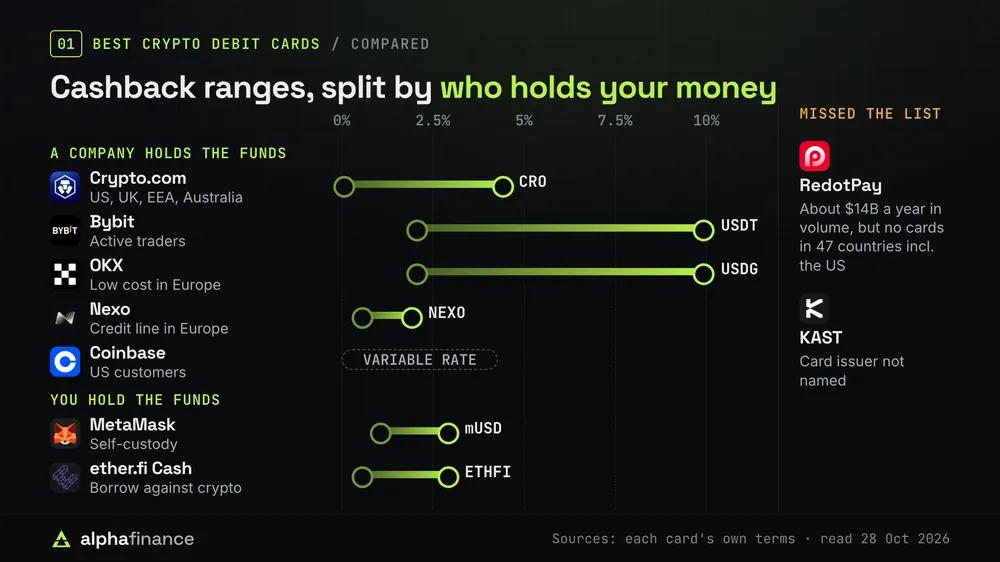
Conversion and currency fees usually determine what a card costs you. Headline cashback reveals little on its own. Bybit's entry tier, for example, advertises 2% but pays no more than $5 a month under its Card Rewards 2.0 terms, updated 2 Oct 2026.
Your location determines which cards you can get. The other main choice is whether to spend money held by a company or in your own wallet.
| Card | Best for | Who holds the funds | Cashback |
|---|---|---|---|
| Crypto.com Visa Card | US, UK, EEA and Australian residents | Crypto.com | 0% to 4.5% in CRO |
| Bybit Card | Active Bybit traders | Bybit | 2% to 10% in USDT |
| OKX Card | Low conversion cost in Europe | OKX | 2% to 10% in USDG |
| MetaMask Card | Self-custody spending | You | 1% to 3% in mUSD |
| ether.fi Cash | Borrowing against crypto | You | 3% stepping down, in ETHFI |
| Nexo Card | Crypto credit line in Europe | Nexo | 0.5% to 2% in NEXO |
| Coinbase Card | US Coinbase customers | Coinbase | Variable, in rotating coins |
On 28 Oct 2026, we read each card's fee schedule, rewards terms and cardholder agreement. Our selection favours cards that disclose fees and cashback caps, identify their issuer and accept new applicants in at least one major market.
Two of the largest programmes by volume, RedotPay and KAST, did not make the list. RedotPay reported about $14 billion in annualised payment volume on 20 Aug 2026, but its help centre lists 47 countries where it cannot issue cards, including the US. KAST does not identify its card issuer. Its terms of service place customers with a company registered in Anjouan, Comoros.
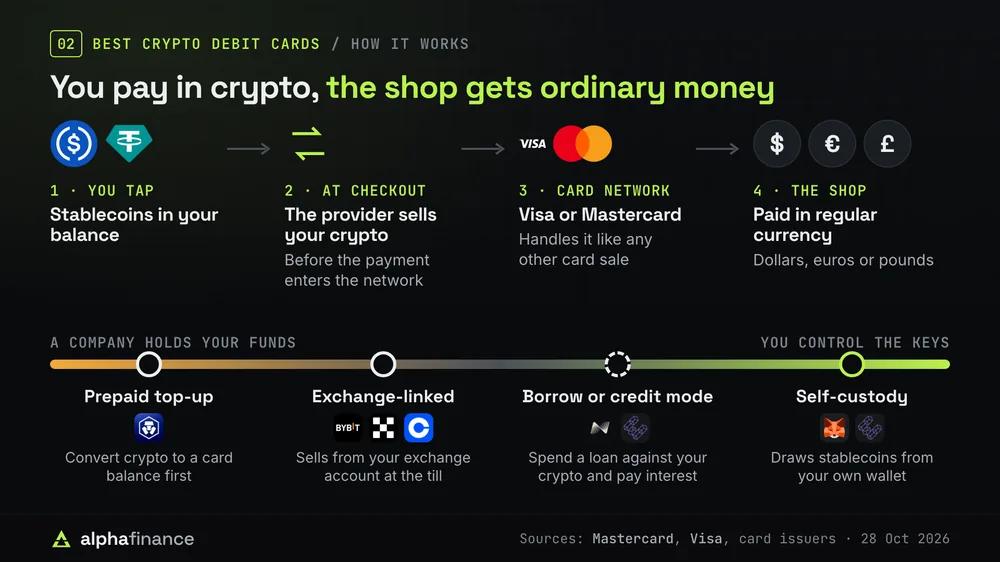
When you pay with a crypto debit card, the provider sells your crypto so the shop can receive dollars, euros or pounds. Mastercard says the conversion takes place before the payment enters its network, meaning merchants are always paid in regular currency.
Cards built on stablecoin payments company Bridge follow the same process. Visa explains that Bridge deducts the stablecoin from your balance and converts it to local currency. The merchant then receives payment as it would for any other card sale.
The funding method affects both costs and control of your money:
Custody refers to control of the private keys, the passwords that authorise crypto transfers. An exchange-linked card leaves your funds with the exchange, making its licence in your country relevant. Our comparison of crypto exchanges by country covers those differences.
Each card has trade-offs. The reviews below end with the drawback most likely to affect your choice.
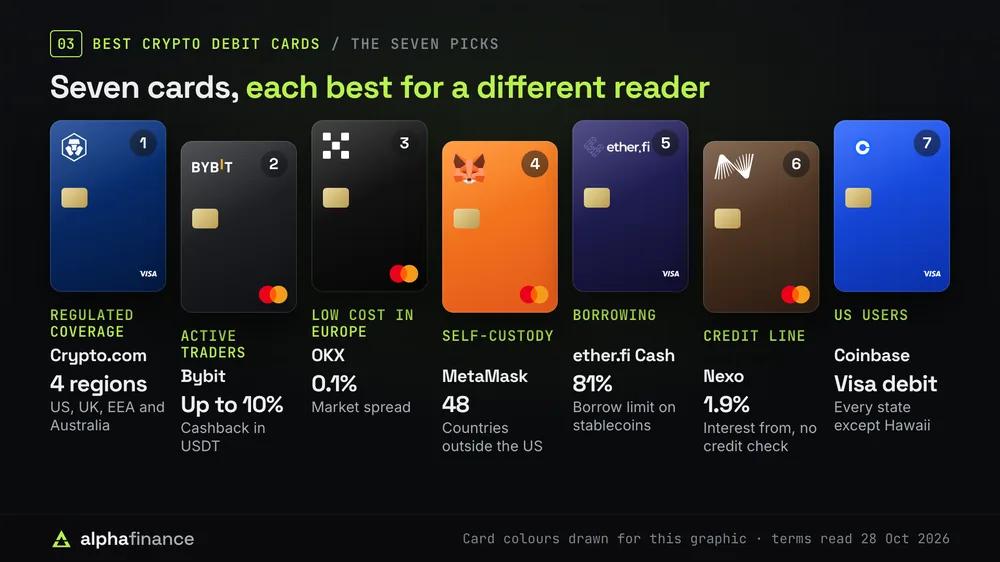
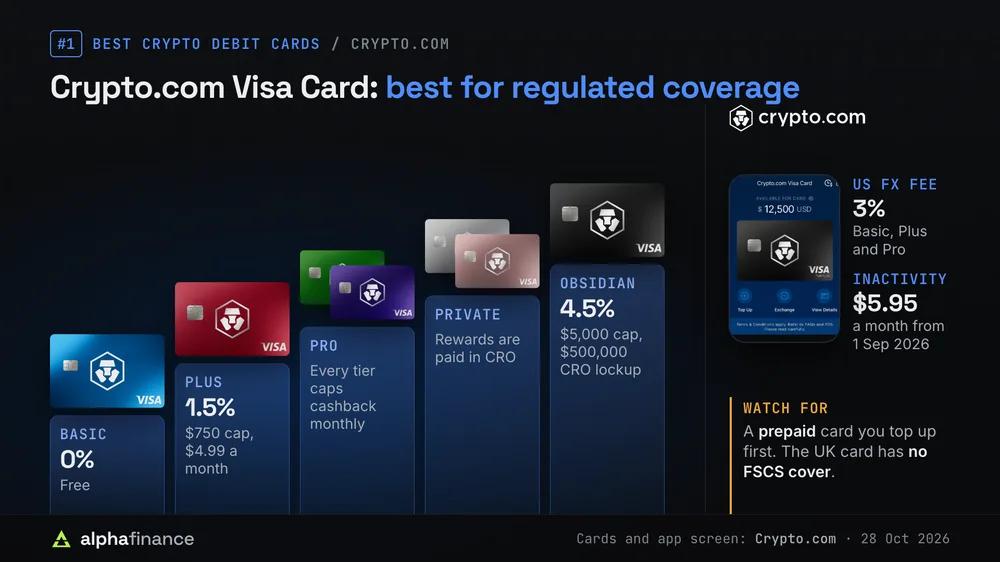
A separately regulated company issues Crypto.com's card in each region. Its fee and limit articles cover the US, EEA, UK, Australia, Canada and other markets.
Your Level Up tier determines rewards. You can pay a monthly subscription or lock CRO, Crypto.com's own token, for 365 days. US customers pay $4.99 a month for Plus, earning 1.5% in CRO on up to $750 of monthly spending. Obsidian requires a $500,000 CRO lockup and pays 4.5% on up to $5,000.
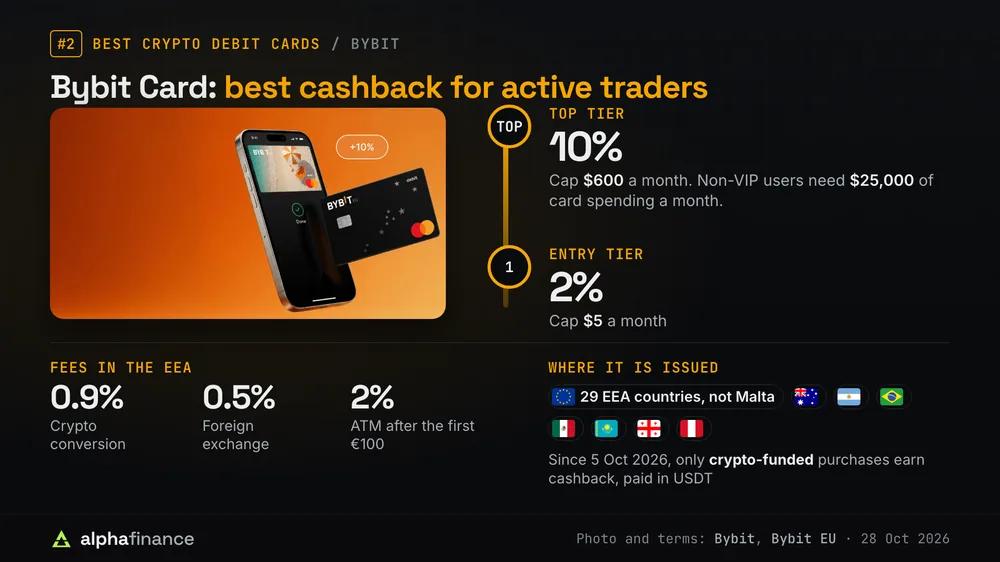
The highest published cashback ceiling among these seven cards belongs to Bybit, though reaching it requires heavy spending or high trading volume. Rates range from 2% to 10%, based on monthly card spending or your Bybit VIP level, the status awarded to its highest-volume traders. Non-VIP users need to spend $25,000 a month on the card to reach the top tier.
Monthly cashback caps run from $5 to $600, with rewards paid in USDT. Only crypto-funded purchases have earned rewards since 5 Oct 2026. Tier 3 and above also receive a 100% rebate on subscriptions to ChatGPT Plus, Claude Pro, Netflix, Spotify and TradingView. Those rebates count towards the cap.
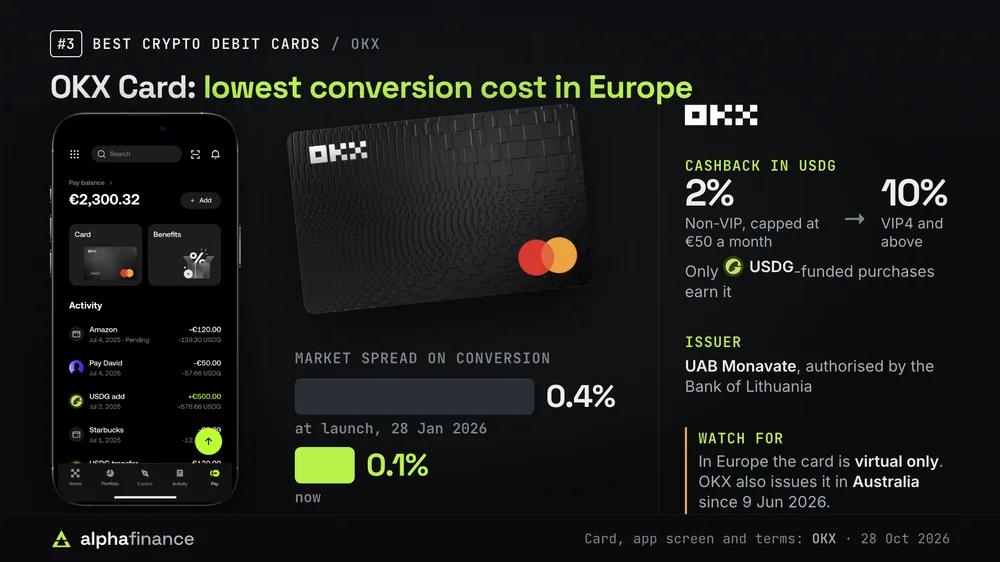
Of the exchange cards we checked, OKX publishes the lowest conversion cost. Converting to local currency carries no transaction or FX fees and a 0.1% market spread. The spread is the difference between the market price and the price you receive.
At its European launch on 28 Jan 2026, the spread was 0.4%. The card converts USDC or USDG, both dollar stablecoins held in an OKX Pay account, into euros.
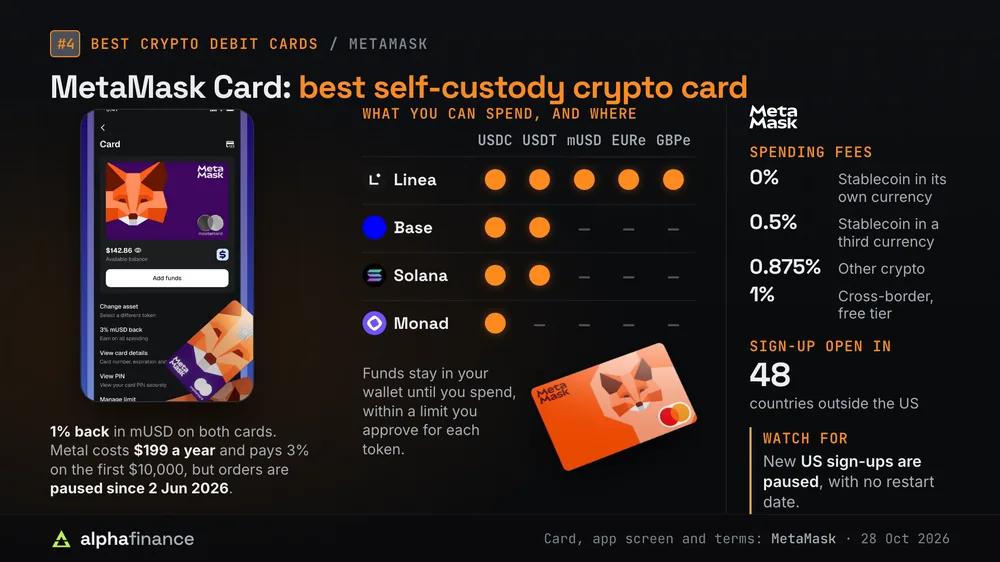
With MetaMask Card, stablecoins remain in your MetaMask wallet until you pay. No company holds the funds beforehand. You select a network and approve a spending limit for each token, while the funds stay in your wallet until spent.
Supported blockchains are Linea, Base, Solana and Monad. USDC works on all four, while USDT works on every network except Monad. On Linea, you can also spend mUSD, MetaMask's dollar stablecoin, alongside EURe and GBPe, which track the euro and pound. Other options for holding dollar stablecoins appear in our guide to the best USDT wallets.
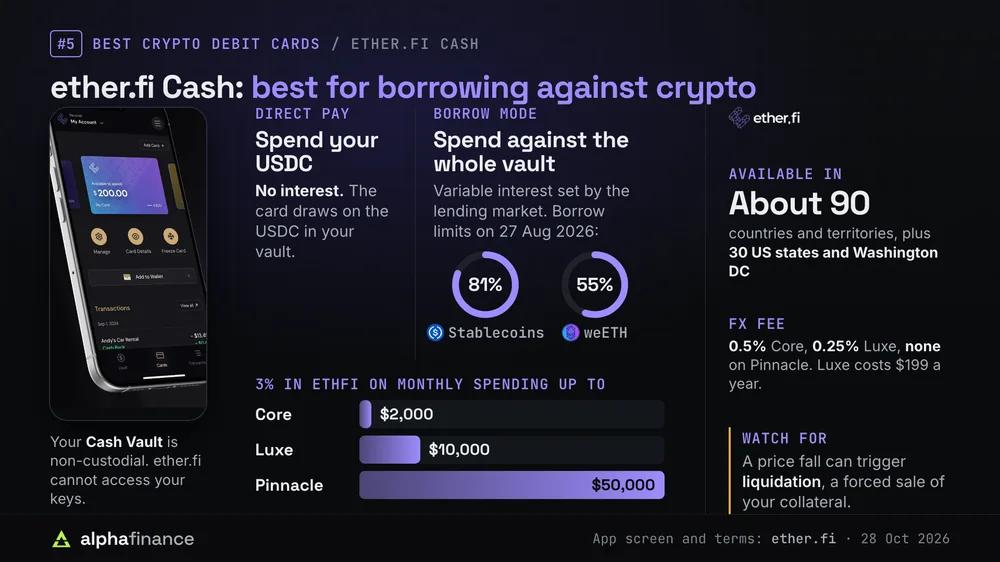
Borrow mode on ether.fi Cash uses decentralised lending markets to let you spend against crypto without selling it. The Cash Vault is non-custodial, meaning ether.fi cannot access your private keys.
You can instead use Direct Pay to spend USDC without interest. Borrow mode draws against everything in the vault at a variable annual interest rate determined by the lending market. As of 27 Aug 2026, borrowing limits were 81% of stablecoin value and 55% of weETH value. weETH is ether.fi's staked Ether token.
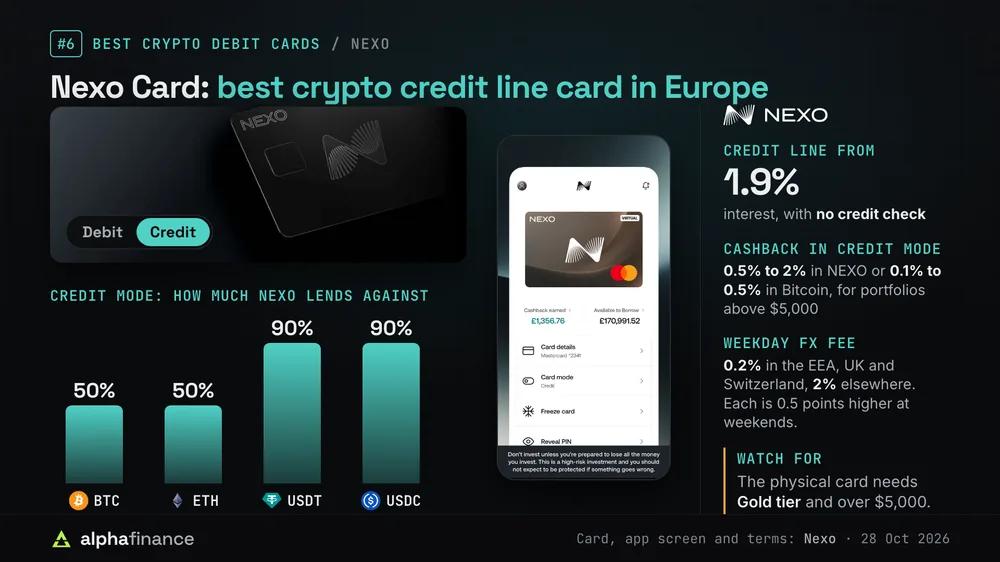
Nexo Card switches between debit and credit modes. In credit mode, purchases draw on a crypto-secured credit line rather than selling your holdings. Interest starts at 1.9%, with no credit check. You can borrow up to 50% of the value of Bitcoin and Ether, or 90% of USDT and USDC.
DiPocket UAB issues the Mastercard, which is available in the EEA, the UK and other eligible European countries. There are no annual, monthly or inactivity fees.
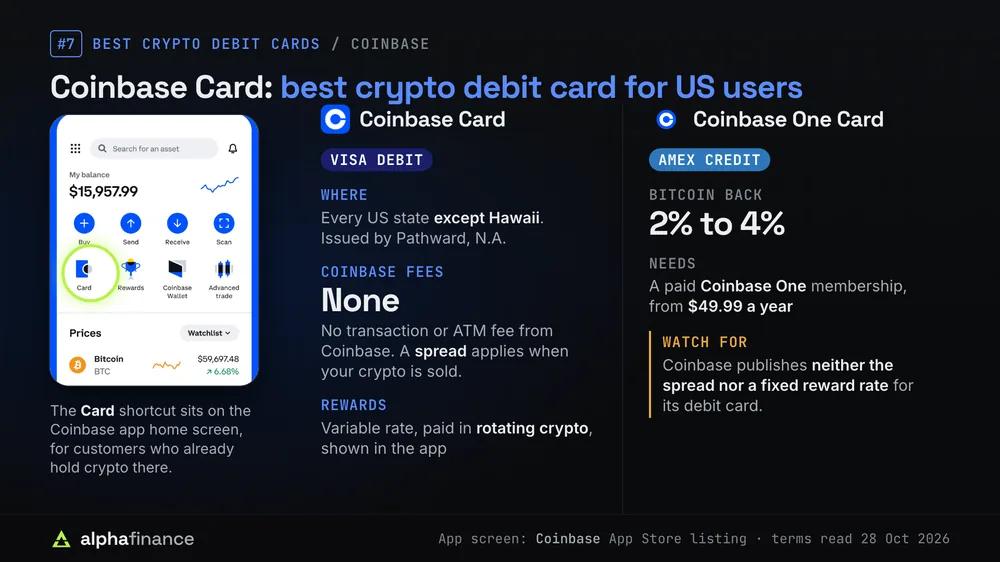
For US residents who already hold crypto on Coinbase, Coinbase Card is the simplest option. Pathward, N.A. issues the Visa debit card, available in every US state except Hawaii.
The card has no Coinbase transaction or ATM fees. Selling crypto still incurs a spread, and ATM operators can charge separately. The app displays the variable reward rate, paid in rotating cryptocurrencies.
Cashback often has less effect on your total cost than fees. Check these charges when comparing cards:
The one-sentence version
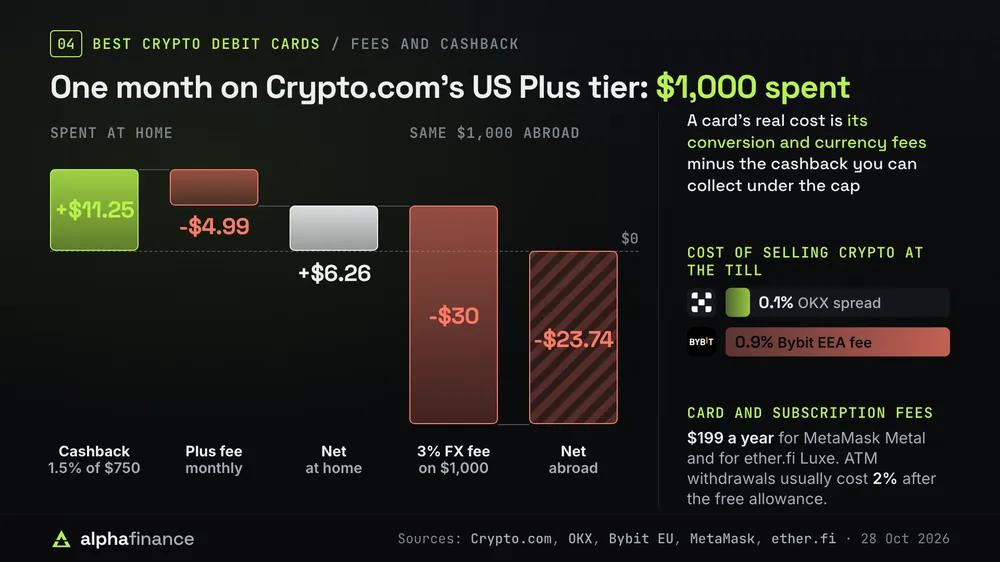
A card's real cost is its conversion and currency fees minus the cashback you can collect under the monthly cap.
A US Crypto.com Plus user spending $1,000 in a month earns 1.5% on the first $750, or $11.25 in CRO. Subtracting the $4.99 subscription leaves about $6.26. Spend that same $1,000 abroad and the 3% foreign transaction fee adds $30, resulting in a net monthly cost of about $23.74.
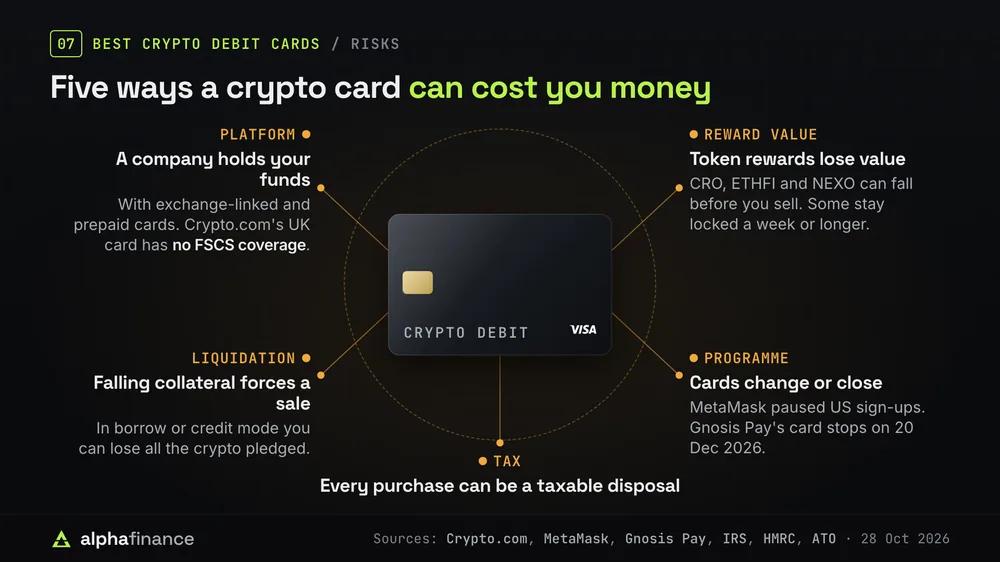
Rewards in a platform's own token change value with its price. That applies to CRO, ETHFI and NEXO, among others. Our live crypto prices board tracks prices for the 100 largest coins.
Dollar stablecoins have replaced volatile coins as the main source of crypto card spending. Card networks and regulators are developing the systems that support this shift.
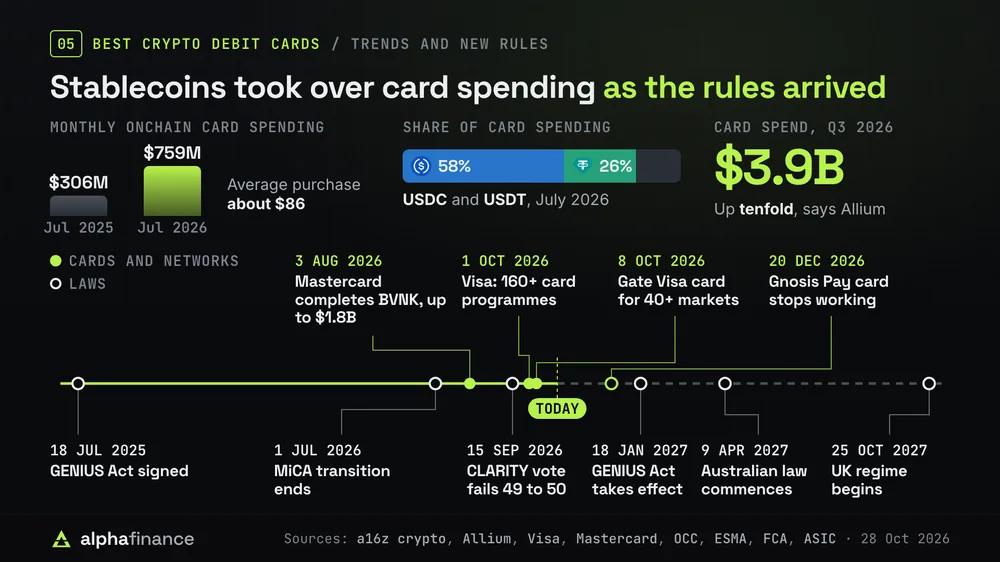
Purchases traceable on public blockchains, known as onchain card spending, totalled $759 million in July 2026, compared with $306 million a year earlier. a16z crypto's analysis puts USDC's share at about 58% and USDT's at about 26%. The average purchase was roughly $86.
In its Q3 2026 payments report, blockchain analytics firm Allium reported tenfold growth in stablecoin card spending to $3.9 billion. Totals vary because trackers cover different card programmes. Paymentscan, for example, includes RedotPay's self-reported volume, while a16z's onchain figure excludes it.
Both networks are investing as more card programmes adopt stablecoins. On 1 Oct 2026, Visa reported more than 160 stablecoin-linked card programmes, with payment volume up nearly 200% year on year.
Mastercard completed its acquisition of stablecoin payments company BVNK on 3 Aug 2026. The deal, agreed in March, was priced at up to $1.8 billion. Gate followed on 8 Oct 2026 with an announcement of a Visa card expected in more than 40 markets.
Regional rules will determine which companies can issue stablecoins and offer cards. Signed on 18 Jul 2025, the US GENIUS Act prohibits stablecoin issuers from paying interest or yield to holders. The Office of the Comptroller of the Currency (OCC), a US bank regulator, says it takes effect on 18 Jan 2027.
Progress on the wider US market structure bill has stalled. A Senate vote to begin debating the CLARITY Act failed 49 to 50 on 15 Sep 2026. Our explainer covers what the CLARITY Act would do.
Existing crypto firms in Europe had until 1 Jul 2026, when the MiCA transition period ended, according to the European Securities and Markets Authority (ESMA). Firms serving EU customers now require MiCA authorisation. Authorised platforms appear in our list of MiCA-licensed crypto exchanges.
The UK cryptoasset regime begins on 25 Oct 2027, with authorisation applications open until 28 Feb 2027. Australia's Digital Assets Framework Act received Royal Assent on 8 Apr 2026 and commences on 9 Apr 2027.
Changes in an issuer's plans can end rewards or close a card you rely on. Gnosis Pay stopped paying GNO token cashback on 30 Sep 2026. Its consumer card will stop working on 20 Dec 2026.
Other programmes have reduced benefits. Crypto.com lowered CRO lockup reward rates on 10 Sep 2026, while Bybit ended rewards on purchases funded with regular currency from 5 Oct 2026.
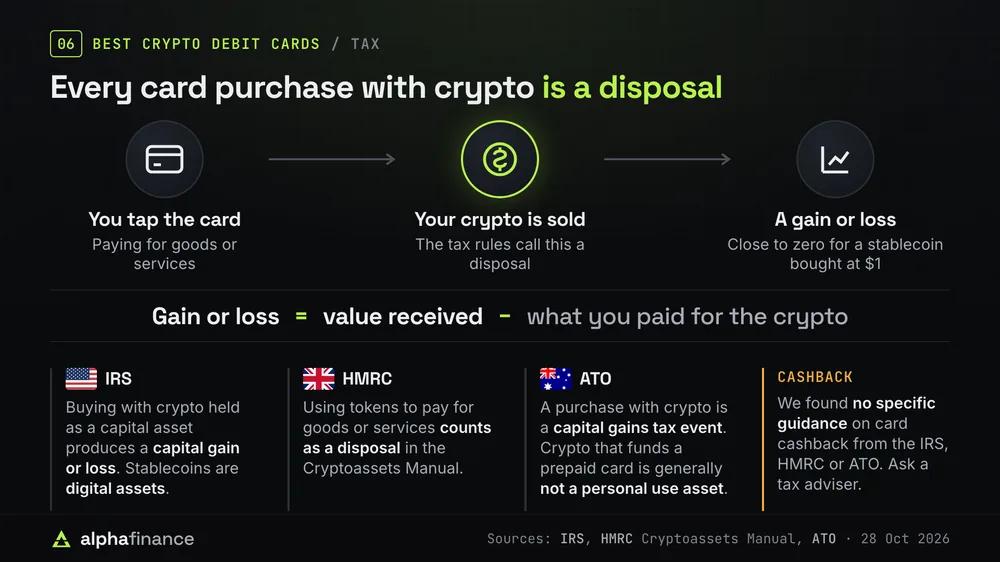
Paying with crypto through a card generally counts as disposing of it in the US, UK and Australia. Every purchase can therefore create a capital gain or loss.
Spending a dollar stablecoin bought at $1 usually results in a gain or loss close to zero under the IRS formula. Each purchase remains a disposal that needs recording. We found no IRS, HMRC or ATO guidance specifically addressing crypto card cashback. If you receive token rewards, ask a tax adviser how to report them.
Platform failure can put funds at risk, while falling collateral or reward token prices can cause losses. Bank account deposit protection may not extend to a crypto debit card.
Not investment advice
This article explains market data. Nothing on this page is a recommendation to buy, sell or leverage any asset. Digital assets are volatile and you can lose everything you put in. If you are unsure whether a trade is appropriate for you, a licensed adviser in your jurisdiction is the right next step.


Fact checked by
Verifies every figure against primary sources before publication. Meet the team
Location and custody preferences determine the best crypto debit card for you. Crypto.com covers the most regulated markets, including the US, UK, EEA and Australia. In Europe, OKX charges a 0.1% spread. MetaMask Card offers self-custody spending directly from your stablecoin wallet.
Safety depends on the provider and how the card is funded. Exchange and prepaid cards leave funds with a company. Crypto.com's UK card, for example, has no FSCS deposit protection. Self-custody cards remove that company risk, leaving you responsible for the wallet.
A conversion fee or spread applies to most crypto debit cards, often alongside FX and ATM charges. In the EEA, Bybit charges a 0.9% crypto conversion fee. Crypto.com's lower US tiers charge 3% on foreign purchases. Metal cards, subscriptions and inactivity can carry separate charges.
In the US, UK and Australia, crypto card spending generally counts as a taxable disposal. HMRC includes paying for goods or services with tokens, and the IRS and ATO follow the same approach. Stablecoin spending usually produces only a small gain or loss, but the disposal still counts.
US applicants can apply for Coinbase Card, the Crypto.com Visa Card and ether.fi Cash. Coverage for ether.fi Cash is limited to 30 US states and Washington DC. New US sign-ups for MetaMask Card remain paused.