Markets
 BTC
BTC ETH
ETH BNB
BNB XRP
XRP SOL
SOL ZEC
ZEC HYPE
HYPE DOGE
DOGE LINK
LINK TON
TON AVAX
AVAX SUI
SUI TAO
TAO AAVE
AAVE PUMP
PUMP MORPHO
 ARB
ARB LIT
LIT--:-- UTC
Research/Stablecoins
The best USDT wallets ranked on the Tether networks they support, how you pay each transfer's network fee and how your keys are stored, using each wallet's own published documentation.
 By Alpha Finance Editorial Team
 Fact-checked by Vince Dioquino
Every figure, platform detail and regulatory claim on this page was traced to a primary source by the named fact checker before publication, and is re-checked when those facts change. The review date moves only when a person has re-read the page.
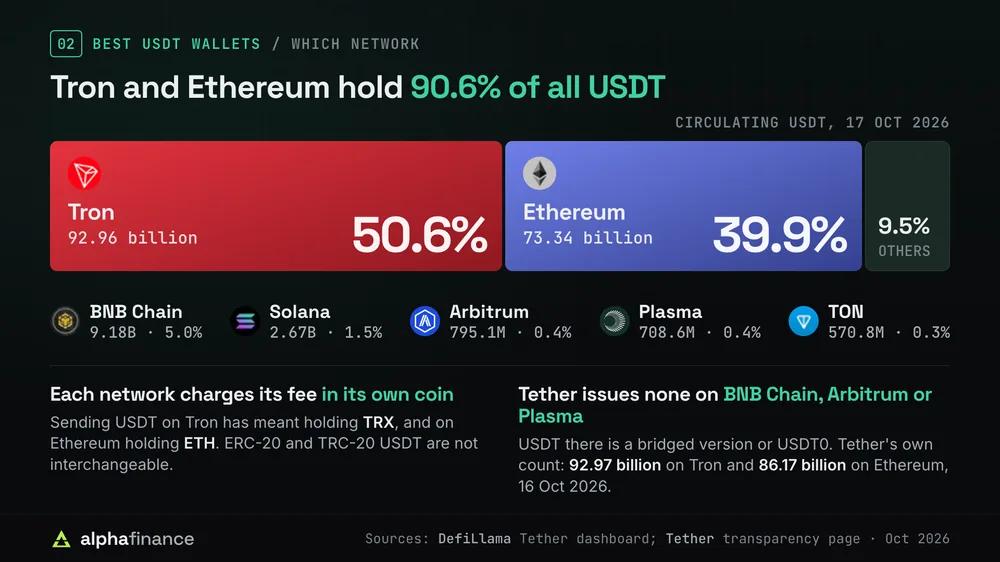
The editorial policy → Editorial policy Report an errorThe network is the first consideration when choosing among the best USDT wallets. USDT exists as a separate token on each blockchain, with 50.6% of its supply on Tron and 39.9% on Ethereum as of 17 Oct 2026, according to DefiLlama's Tether dashboard.
Each blockchain charges fees in its own coin. Sending USDT on Tron has therefore meant holding TRX, while Ethereum transfers require ETH. Without that second coin, a new user can receive USDT but remain unable to send it.
Several wallets removed that requirement in 2026 by accepting fees in USDT. Tether also released its own wallet, while blockchains built for stablecoins offer zero-fee USDT transfers on their networks.
A USDT wallet stores the private keys that control your tokens. The USDT itself is recorded on public blockchains. Also called Tether, USDT is a stablecoin designed to stay worth $1 and backed by reserves held by its issuer.
Tether issues USDT separately on each supported blockchain. Its list of supported protocols includes Ethereum, Tron, Solana, TON, Avalanche, Aptos, Near and several others. Ethereum tokens follow the ERC-20 standard, while Tron uses TRC-20, hence the exchange deposit labels USDT-ERC20 and USDT-TRC20.
Sending ERC-20 USDT to a TRC-20 address, or the reverse, results in permanent loss, warns Ledger's USDT guide.
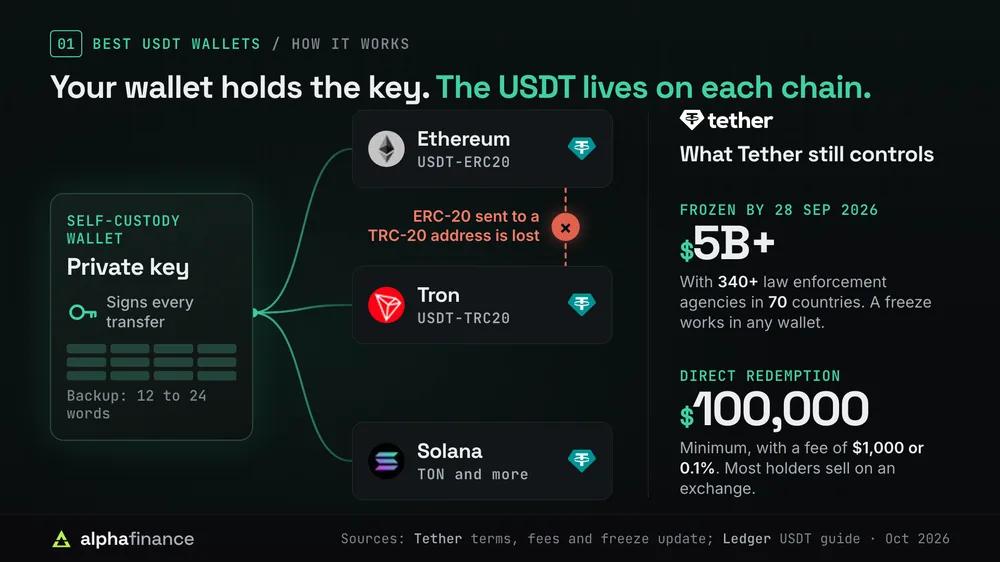
With a self-custody wallet, you alone hold the private key, usually backed up through a recovery phrase of 12 to 24 words. Nobody can restore the funds if you lose both the phrase and the device. An exchange account puts the keys in the exchange's hands and gives you a claim on it. Our ranking of crypto exchanges examines that trade-off.
Every transfer incurs a network fee, called gas, paid in the blockchain's own coin unless the wallet provides a workaround. A new Tron account must also receive TRX before it can send anything. Receiving USDT does not activate the account, as MetaMask's Tron guide explains.
Tether retains control over USDT even when you hold it in self-custody. Its terms of service allow token freezes and address blacklisting. By 28 Sep 2026, Tether had frozen more than $5 billion in assets while working with more than 340 law enforcement agencies across 70 countries, according to its latest freeze update.
Direct redemption with Tether is also beyond most holders. The fee schedule requires a minimum of $100,000 and charges $1,000 or 0.1%, whichever is greater. Individuals therefore usually sell USDT on an exchange.
Your chosen network determines transfer fees, wallet compatibility and which exchanges can accept a deposit. On 17 Oct 2026, Tron and Ethereum together held 90.6% of all USDT.
| Network | USDT supply | Share of all USDT | Fee coin |
|---|---|---|---|
| Tron | 92.96 billion | 50.6% | TRX |
| Ethereum | 73.34 billion | 39.9% | ETH |
| BNB Chain | 9.18 billion | 5.0% | BNB |
| Solana | 2.67 billion | 1.5% | SOL |
| Arbitrum | 795.1M | 0.4% | ETH |
| Plasma | 708.6M | 0.4% | XPL |
| TON | 570.8M | 0.3% | TON |
Figures show circulating USDT on 17 Oct 2026, from DefiLlama's Tether dashboard. Live stablecoin totals by chain are available on our blockchain data dashboard.
Tether counts only the tokens it issues directly. On 16 Oct 2026, its transparency page showed 92.97 billion USDT on Tron and 86.17 billion on Ethereum, with none issued on BNB Chain, Arbitrum or Plasma. Those networks use bridged USDT or USDT0, accounting for the difference between the two sources.
Cheap transfers have made Tron the leading network. Sending a TRC-20 token consumes energy, a resource earned by locking up, or staking, TRX. Users without enough energy pay by burning TRX.
On 29 Aug 2025, Tron reduced the energy price from 210 sun to 100 sun, roughly halving the TRX burned on a USDT transfer, according to Tron's Q1 2026 fee review. Sun is the smallest unit of TRX.
Ethereum transfers cost more, as Ledger's USDT guide notes, but the network hosts more decentralised finance (DeFi) apps. These provide lending and trading through smart contracts, programs that execute automatically on a blockchain. DeFi users can hold USDT on Ethereum or choose a cheaper Ethereum-compatible network such as Arbitrum.
Tether has stopped issuing and redeeming USDT on Omni, Bitcoin Cash SLP, Kusama, EOS and Algorand. It said in an update dated 29 Aug 2025 that it would not freeze those contracts, allowing existing tokens to keep moving. All five now appear on its supported protocols page as networks where Tether is no longer obligated to redeem.
USDT0 allows USDT to move between blockchains. The USDT0 documentation describes a system that locks USDT on Ethereum and creates an equal amount of USDT0 on the destination chain. That USDT0 is destroyed when it returns. The USDT0 site lists 29 chains, reports more than $3.2 billion in supply and identifies USDT0 as part of Everdawn Labs.
Wallets display USDT0 as a separate token. A transfer can fail or funds can be lost if the receiving wallet or exchange does not support it on the chosen network.
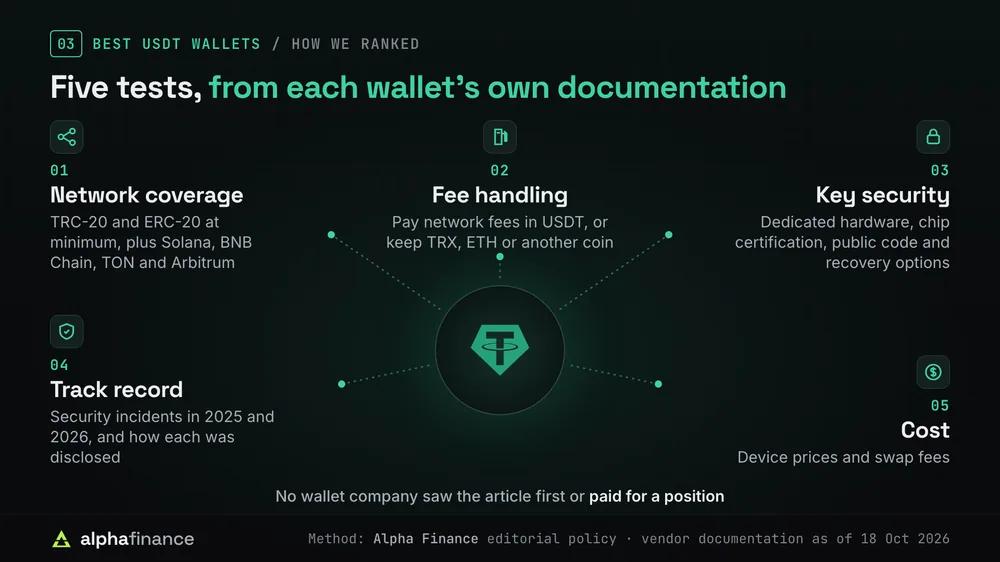
We scored each wallet on the features that affect everyday USDT use, drawing on vendor documentation published as of 18 Oct 2026.
No wallet company reviewed this article before publication or paid for its position, in line with our editorial policy.
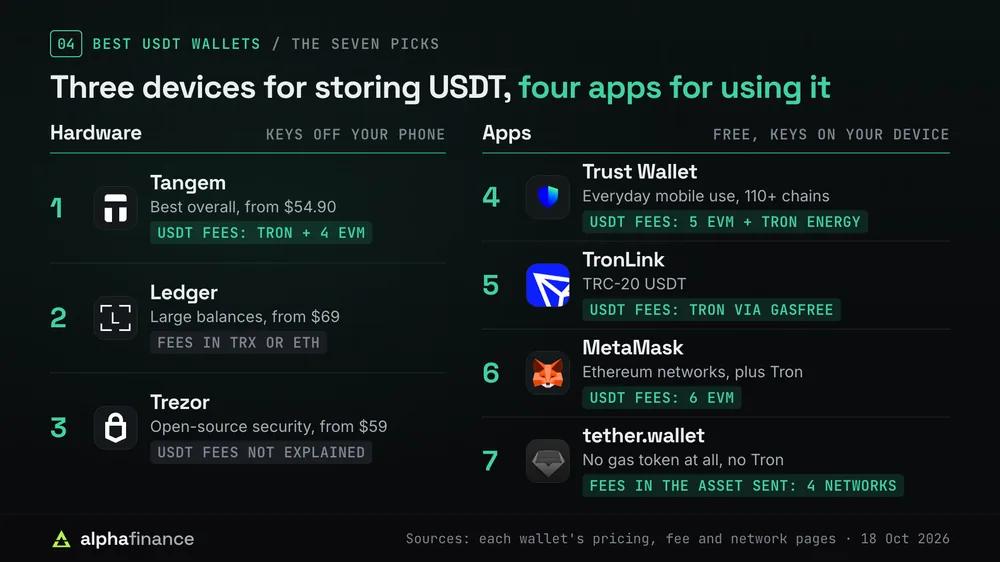
Tangem is our pick for most USDT holders, followed by Ledger and Trezor for larger balances. The remaining four apps suit particular networks and usage habits.
| Wallet | Type | Best for | USDT networks named | Fees payable in USDT |
|---|---|---|---|---|
| Tangem | Hardware card | Most USDT holders | Tron, Ethereum, Solana, TON, Avalanche | Tron and four EVM networks |
| Ledger | Hardware device | Large balances | Ethereum, Tron, Polygon, Solana | No |
| Trezor | Hardware device | Open-source security | Tron, Ethereum, Solana, BNB Chain and seven more | Not explained in Trezor Suite |
| Trust Wallet | Mobile app, extension | Everyday mobile use | 110+ chains | Five EVM networks, Tron energy |
| TronLink | Mobile app, extension | TRC-20 USDT | Tron | Tron, via GasFree |
| MetaMask | Mobile app, extension | Ethereum networks | Ethereum, BNB Chain, Polygon, Arbitrum, Base, Tron | Six EVM networks |
| tether.wallet | Mobile app | No gas token at all | Ethereum, Polygon, Plasma, Arbitrum | All four networks |
EVM networks, including BNB Chain, Arbitrum and Base, are compatible with the Ethereum Virtual Machine, the software that runs Ethereum's smart contracts.
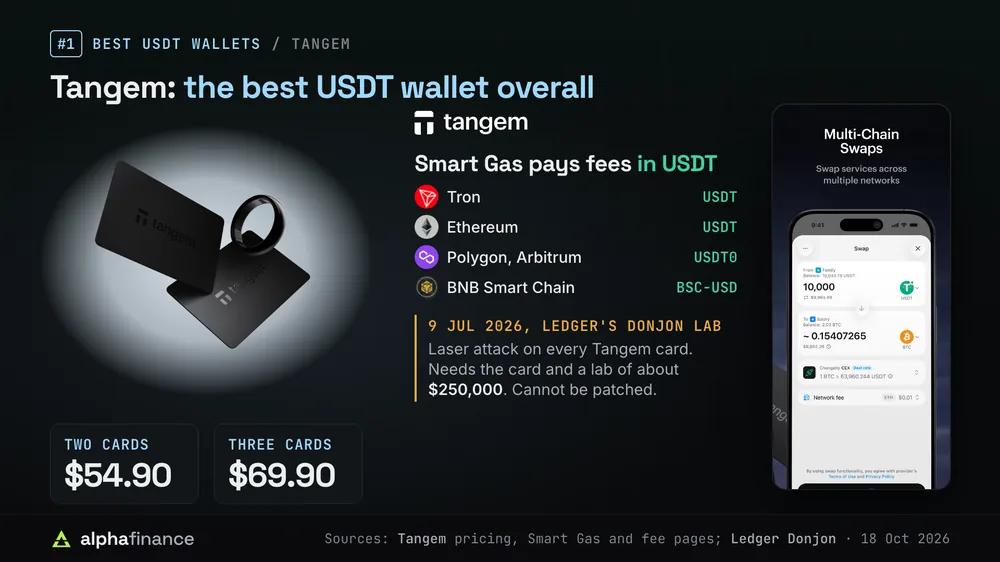
Tangem offers hardware key storage and the broadest USDT fee payment options among the hardware wallets here. Its card connects to a phone app through NFC, the contactless technology used for card payments. The Tangem pricing page listed a two-card set at $54.90 and a three-card set at $69.90 on 18 Oct 2026.
The buying guide lists USDT on Ethereum, Solana, Tron, Avalanche, TON, Kava and Shibarium. Smart Gas, announced on 11 Feb 2026, lets users pay network fees in USDT on Ethereum, USDT0 on Polygon and Arbitrum, and BSC-USD (USDT on BNB Smart Chain). Tangem's Smart Gas announcement cautions that these transfers may cost slightly more than paying in the native coin.
For Tron sends, Smart Gas takes the fee in USDT and automatically activates new addresses by adding the activation cost to the first transfer, according to Tangem's fee guide. TRX is still needed for swaps through decentralised exchanges, which match trades using smart contracts.
Fixed firmware means Tangem cannot patch flaws in cards already sold. On 9 Jul 2026, competitor Ledger's Donjon security lab published a laser attack that resets a card's password and takes its funds. The attack requires physical access and a lab costing about $250,000. It affects every Tangem card in circulation, according to Donjon's write-up.
Holders who want to inspect device code may prefer Trezor, which publishes it.
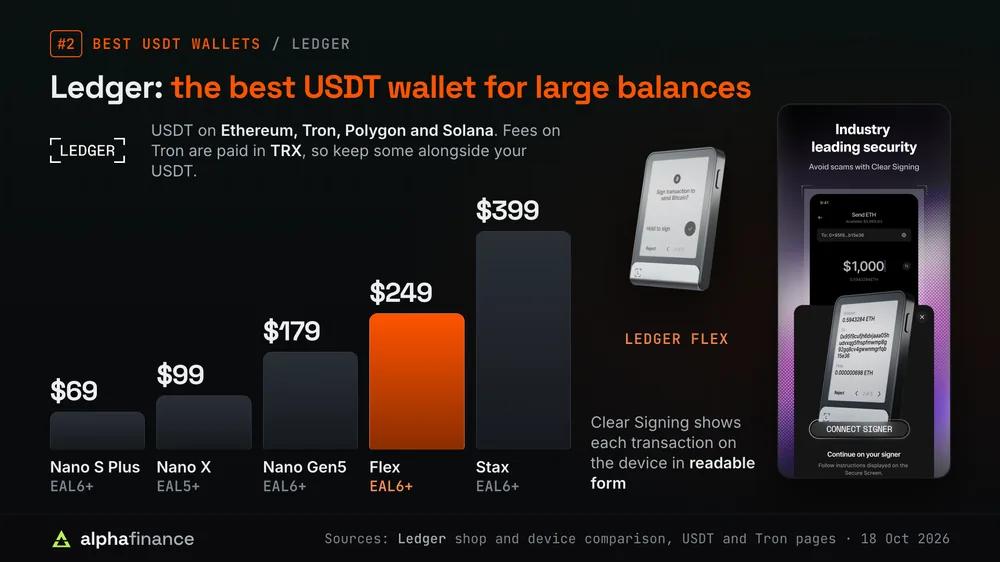
Ledger suits large USDT balances held over long periods, storing keys inside a certified secure element, a tamper-resistant chip. Its range includes the Nano S Plus, Nano X, Nano Gen5, Flex and Stax.
The Nano Gen5 launched at $179 on 23 Oct 2025. The same announcement renamed Ledger Live to Ledger Wallet. As of 18 Oct 2026, Ledger's shop priced the Nano S Plus at $69, Nano X at $99, Flex at $249 and Stax at $399.
Supported USDT networks include Ethereum, Tron and Polygon, according to Ledger's USDT page. The Solana token page also lists USDT. You must keep TRX or ETH alongside your USDT for fees. Ledger's Tron page confirms that Tron fees are paid in TRX.
A January 2026 breach at Ledger's e-commerce partner Global-e exposed customer names and contact details, The Block reported. Ledger said neither its own systems nor payment data were affected. The exposed details increase the risk of phishing messages impersonating Ledger.
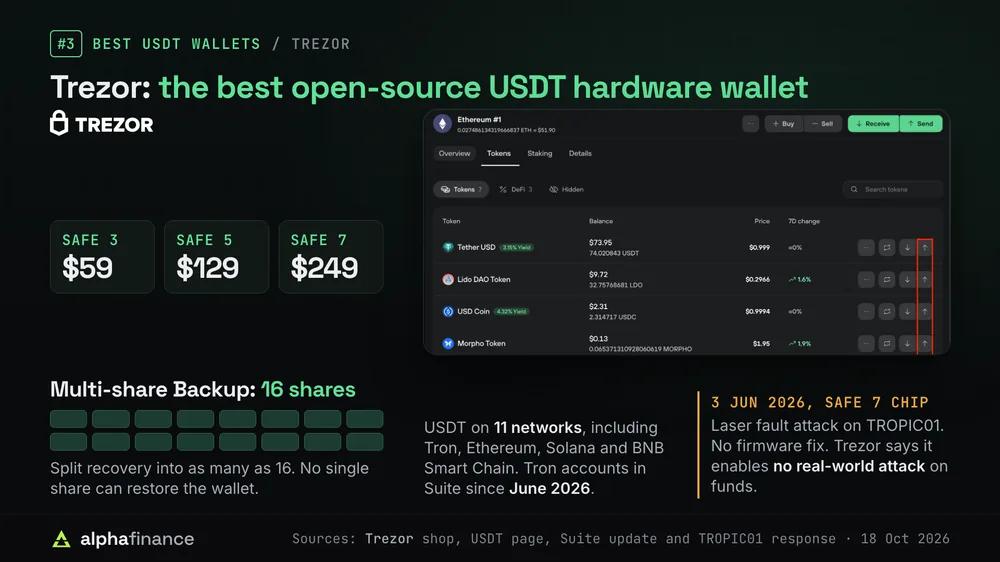
Trezor makes its device code public so holders can inspect its security. The current Safe 3, Safe 5 and Safe 7 models are all open source and have an EAL6+ secure element, according to Trezor's model comparison. Its shop listed prices of $59, $129 and $249 respectively on 18 Oct 2026.
Announced on 21 Oct 2025, the Safe 7 adds TROPIC01, a secure element with an auditable design. It also includes Bluetooth and firmware checks designed to resist future quantum computers.
All current models support Multi-share Backup. Recovery can be split into as many as 16 shares, with no single share sufficient to restore the wallet, as described in Trezor's backup guide.
Across its 11 listed networks, Trezor's USDT page includes Tron, Ethereum, Solana, BNB Smart Chain and Arbitrum One. It names MetaMask and Rabby as compatible apps. Full Tron account management arrived in desktop Trezor Suite with the June 2026 Suite update. That page says fees can be paid in USDT or the network's own coin, without explaining how to do so in Trezor Suite.
Attackers used Trezor's support contact form to distribute phishing emails in June 2025, The Block reported. Trezor said they had not accessed its systems or user data.
On 3 Jun 2026, Trezor disclosed a laser fault attack against the Safe 7's TROPIC01 chip by Ledger's Donjon lab. Firmware cannot fix the flaw. However, Trezor's response says it does not enable a real-world attack capable of stealing users' funds.
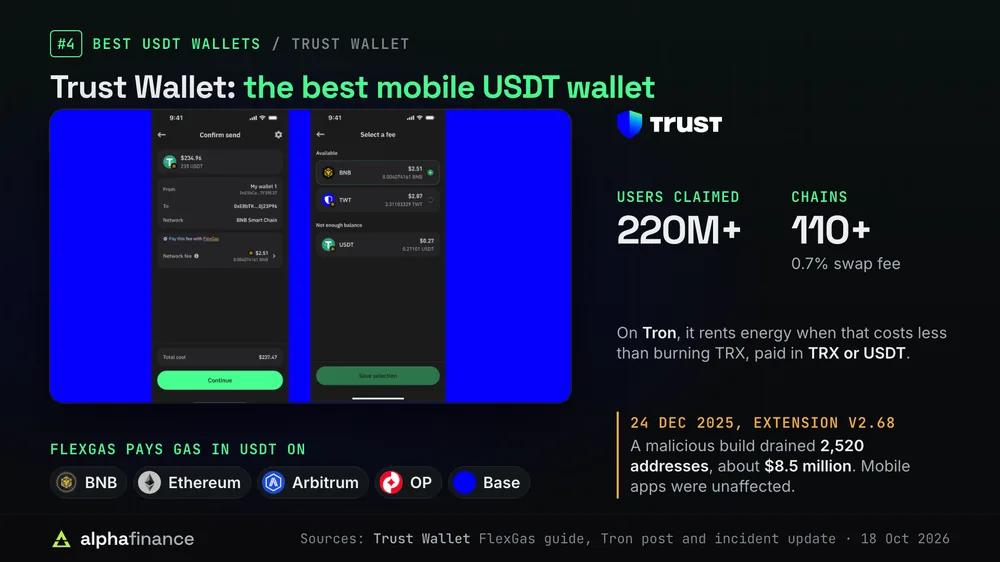
Among the apps on this list, Trust Wallet offers the widest network coverage and several ways to transfer without holding a gas coin. Its 2025 year-end update claims more than 220 million users and support for over 110 chains.
FlexGas accepts USDT, USDC or Trust Wallet's TWT token for gas on BNB Smart Chain, Ethereum, Arbitrum, OP Mainnet and Base, according to Trust Wallet's FlexGas guide. The feature uses EIP-7702, an Ethereum standard that allows an ordinary wallet address to act as a smart account.
For Tron transfers, the wallet automatically rents energy when doing so costs less than burning TRX. Payment can be made in TRX or USDT. The Tron transfer announcement, updated 19 Aug 2026, claims savings of up to 40%.
On 24 Dec 2025, a malicious version 2.68 of Trust Wallet's browser extension appeared on the Chrome Web Store. Its incident update identified 2,520 drained addresses and traced about $8.5 million in assets to 17 attacker-controlled addresses. Trust Wallet said the mobile apps were unaffected and committed to voluntarily reimbursing affected users.
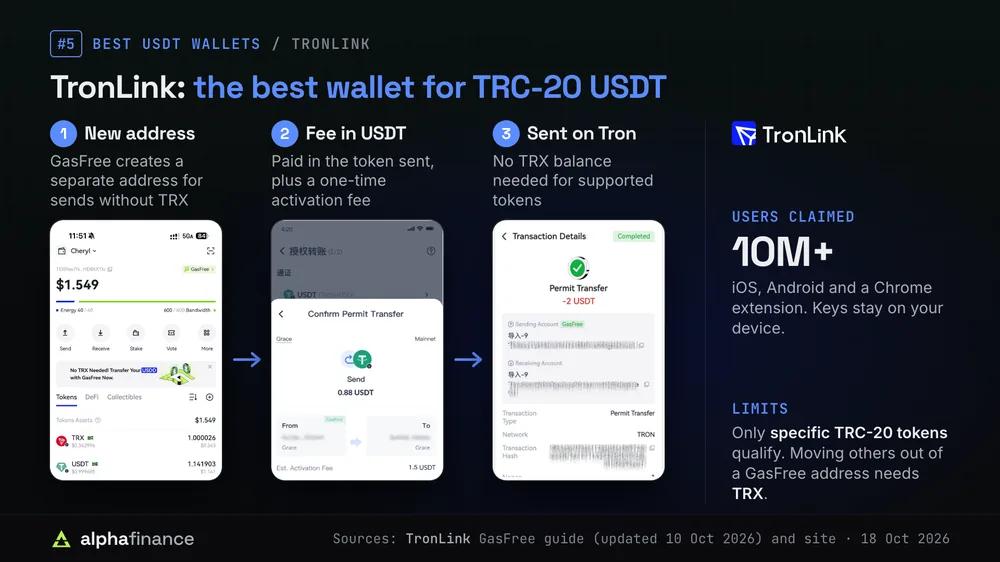
Built for Tron, which holds half of all USDT, TronLink supports selected TRC-20 transfers without a TRX balance. The wallet stores keys on your device and is available for iOS, Android and as a Chrome extension. Its site claims more than 10 million users.
TronLink's GasFree feature creates a separate wallet address and charges transfer fees in the token being sent. A one-time activation fee is added to the first transfer, according to the GasFree guide, updated 10 Oct 2026.
Only specific TRC-20 tokens qualify. Moving an unsupported token out of a GasFree address requires TRX. The TronLink extension also supports Ethereum, BNB Chain and BitTorrent Chain.
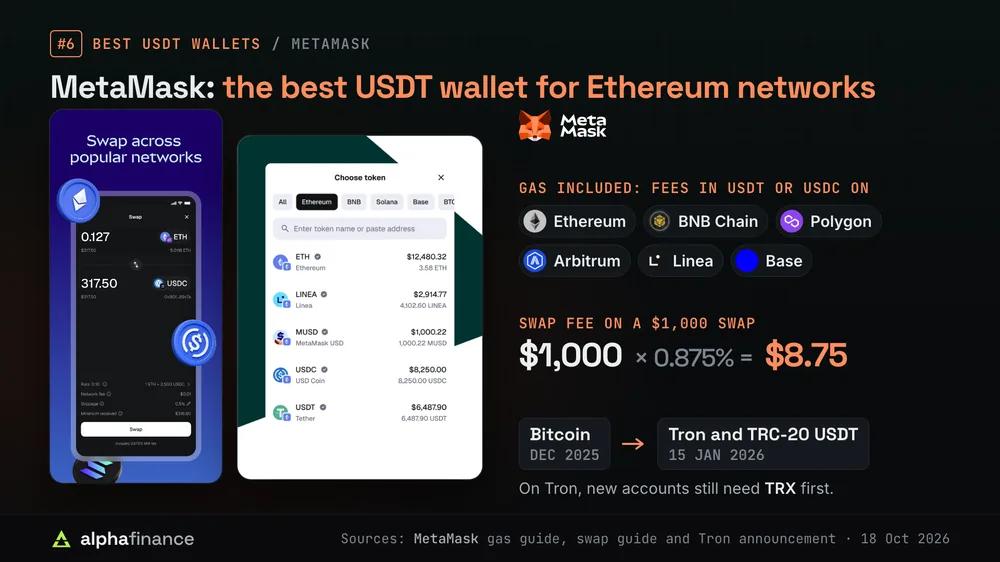
MetaMask is suited to USDT holders using Ethereum and its compatible networks. It added Bitcoin in December 2025, followed by Tron support on 15 Jan 2026. Tron, including TRC-20 USDT, is available on both mobile and the extension.
Gas-included transactions accept USDT or USDC for network fees on Ethereum, BNB Chain, Polygon, Arbitrum, Linea and Base. Users must enable Smart Transactions, and a small MetaMask fee applies, according to MetaMask's gas guide. There is no equivalent on Tron, where new accounts still need to receive TRX first.
You can also use MetaMask with a hardware wallet for signing. Trezor's USDT page lists it as a compatible app, allowing keys to remain on the device while you access MetaMask's networks.
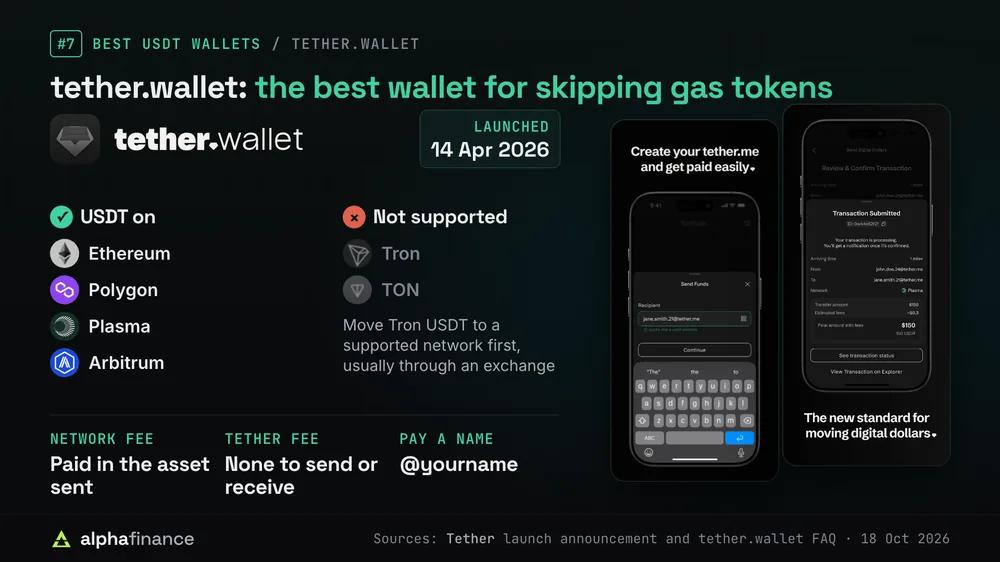
Tether launched tether.wallet on 14 Apr 2026. Built on its open-source Wallet Development Kit (WDK), the self-custodial app keeps keys on your device and charges fees in the asset being transferred. No second coin is needed.
According to the tether.wallet FAQ, supported assets include USDT and Tether Gold (XAUT) on Ethereum, Polygon, Plasma and Arbitrum, plus USAT on Ethereum. Bitcoin works on its main blockchain and over Lightning, its network for fast small payments. Available on iOS and Android, the app lets users pay a username such as @yourname instead of a long address. Tether charges no send or receive fee.
Neither Tron nor TON is supported. USDT on Tron must first move to a supported network, usually through an exchange.
Outside the top seven, TON users can consider Keeper, formerly Tonkeeper. It supports TON and Tron, with a Battery feature that pays for TRC-20 USDT transfers from a balance topped up using TON or USDT, according to Keeper's gasless guide.
USDT fee payment removes the need to hold a second coin, although it can cost slightly more than using TRX or ETH. A third party, often called a relayer or paymaster, pays the network in its native coin and deducts the equivalent from your USDT.
| Wallet | Tron fee options | EVM network fee options | Extra charges |
|---|---|---|---|
| Tangem | USDT for sends | USDT, USDT0 or USDC on five networks | May cost slightly more than native gas |
| Trust Wallet | Energy rental paid in TRX or USDT | USDT on five networks via FlexGas | 0.7% swap fee |
| TronLink | Fee in the token sent, via GasFree | Native coin only | One-time GasFree activation fee |
| MetaMask | TRX only | USDT or USDC on six networks | Small gas-included fee, 0.875% swap fee |
| tether.wallet | Not supported | Fee in the asset sent on four networks | No Tether send or receive fee |
| Ledger | TRX only | Native coin only | None beyond network fees |
| Trezor | No USDT option described | No USDT option described | None beyond network fees |
Details come from each wallet's fee page as of 18 Oct 2026, linked above.
The first transfer from a new Tron address carries an extra cost in any wallet. Tangem includes activation in the first Smart Gas send, whereas MetaMask requires TRX to be sent to the address beforehand.
Swap fees outweigh gas for frequent converters. Before network fees, a $1,000 swap costs $8.75 at MetaMask's 0.875% rate or $7.00 at Trust Wallet's 0.7%.
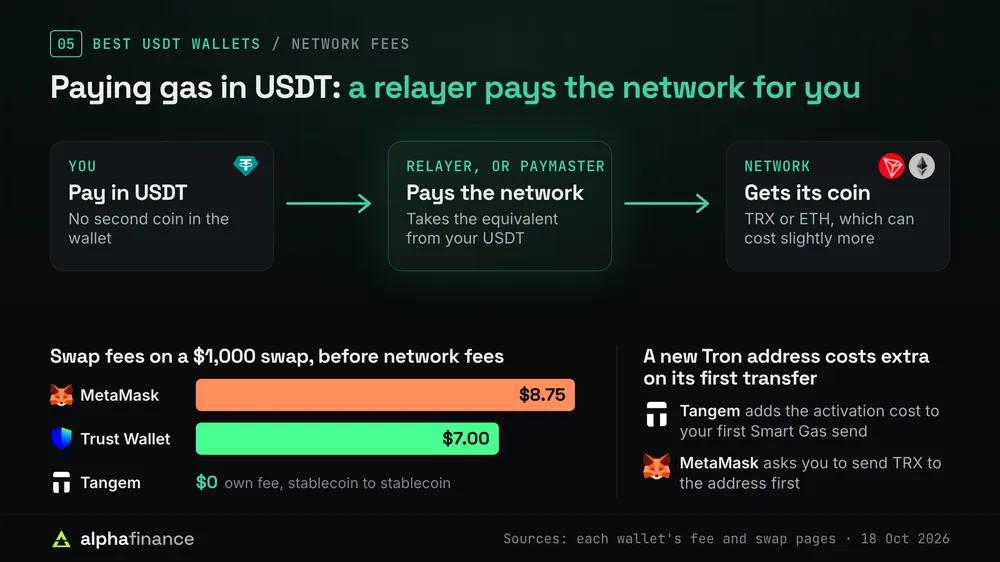
Recent developments give USDT holders fewer coins to manage and more low-fee networks to choose from. They can now also use a wallet built by Tether itself.
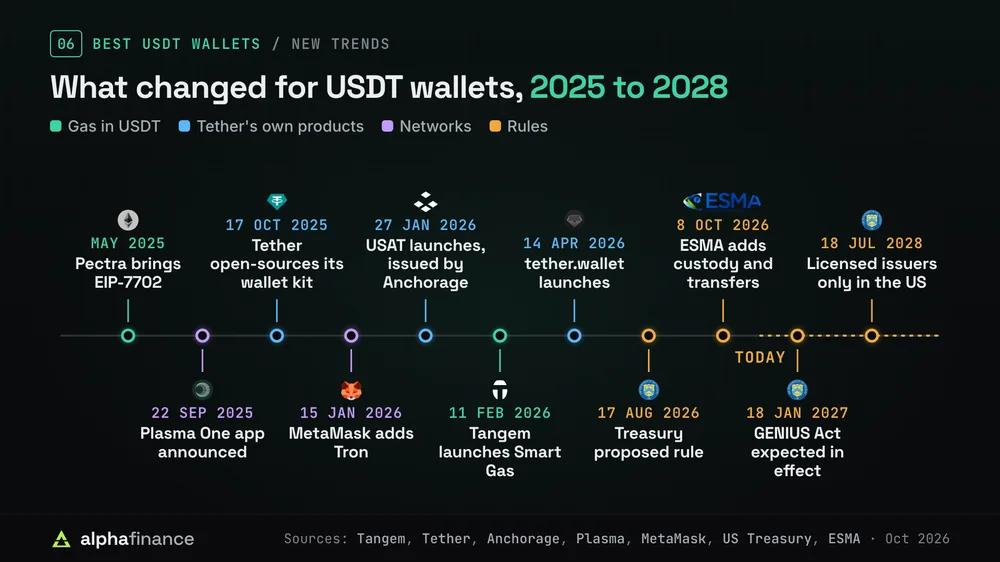
EIP-7702 underpins both Trust Wallet's FlexGas and Tangem's Smart Gas. The standard arrived with Ethereum's Pectra upgrade in May 2025, as noted in Tangem's Smart Gas announcement. It upgrades an existing address, so users retain that address when they start paying gas in USDT.
Tether now competes with other wallets holding its token. On 17 Oct 2025, it open-sourced its Wallet Development Kit for developers building self-custodial wallets. The code became the basis for tether.wallet, released in April 2026.
Separate from USDT, USAT is Tether's dollar stablecoin for the US market. It launched on 27 Jan 2026 with Anchorage Digital Bank as issuer, according to Anchorage's launch announcement. Anchorage is a nationally chartered bank supervised by the Office of the Comptroller of the Currency. Tether Operations does not issue USAT.
Plasma and Stable are designed for low-cost USDT transfers. On its own network, Plasma offers zero-fee USDT sends, although its site says third-party fees may apply. The network held 708.6 million USDT on 17 Oct 2026, according to DefiLlama.
Plasma One, Plasma's non-custodial money app with a Visa card, was announced on 22 Sep 2025. Stable takes a different approach to network fees, using USDT0 as its fee coin so holders need no separate gas token, per Stable's documentation.
US and EU rules restrict where USDT can be bought while leaving self-custody wallets largely untouched. Signed in July 2025, the US GENIUS Act established a licensing regime for payment stablecoin issuers. Our explainer on the Clarity Act examines the broader US market structure debate.
Treasury expects the Act to take effect on 18 Jan 2027, according to its proposed rule of 17 Aug 2026. From 18 Jul 2028, digital asset service providers generally may offer payment stablecoins to people in the US only if a licensed issuer issued them.
In the EU, the European Securities and Markets Authority (ESMA) instructed crypto service providers on 17 Jan 2025 to stop helping clients buy stablecoins that do not comply with the Markets in Crypto-Assets Regulation (MiCA). Sales could continue through the end of March 2025.
An ESMA opinion of 8 Oct 2026 extends that expectation to custody and transfers, allowing licensed firms no more than three months to wind down existing holdings. Self-custody wallet makers fall outside MiCA under recital 83 of the regulation. Our guide to MiCA-licensed exchanges in Europe compares licensed venues.
Nobody can reverse a mistaken or stolen transfer from a self-custody wallet. In 2025, victims filed 181,565 cryptocurrency complaints with the FBI's Internet Crime Complaint Center, reporting $11.37 billion in losses, according to the FBI's 2025 Internet Crime Report.
Even a sound wallet can be exposed through compromised software around it. Attackers stole about $1.5 billion from Bybit in February 2025, a theft the FBI attributed to North Korea. Sygnia's forensic investigation found that they had compromised a Safe{Wallet} developer's machine and changed the web app's code.
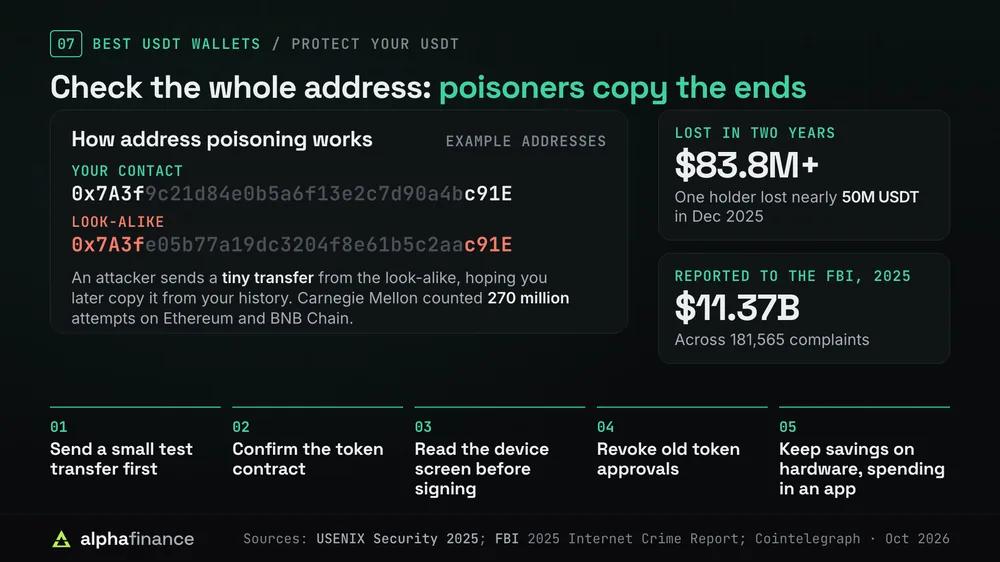
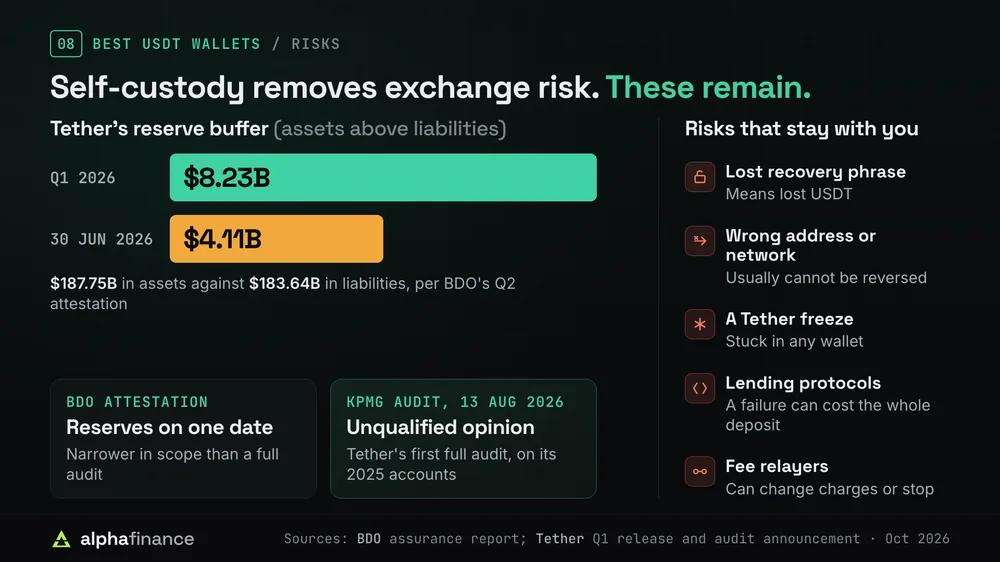
Self-custody removes exchange risk but puts responsibility for the keys on you. Losing the recovery phrase means losing USDT, while transfers to the wrong address or network usually cannot be reversed.
Tether's reserves underpin USDT's value. Its Q2 2026 attestation showed $187.75 billion in assets and $183.64 billion in liabilities on 30 Jun 2026, leaving a $4.11 billion buffer, according to the BDO assurance report. Three months earlier, the buffer was $8.23 billion, per Tether's Q1 2026 release.
An attestation checks reserves at one date and has a narrower scope than a full audit. Tether's first full audit, conducted by KPMG, gave an unqualified opinion on its 2025 financial statements, Tether announced on 13 Aug 2026.
A freeze by Tether leaves the balance stuck regardless of the wallet used. Regulation may also limit where USDT can be sold for dollars.
Lending introduces smart contract risk, with the entire deposit at stake if a protocol fails. USDT fee payment also relies on third-party relayers that may change their charges or cease operating.
Not investment advice
This article explains market data. Nothing on this page is a recommendation to buy, sell or leverage any asset. Digital assets are volatile and you can lose everything you put in. If you are unsure whether a trade is appropriate for you, a licensed adviser in your jurisdiction is the right next step.


Fact checked by
Verifies every figure against primary sources before publication. Meet the team
Tangem is our choice for most USDT holders. It keeps keys on a certified chip and accepts USDT for network fees on Tron and four Ethereum-compatible networks, according to Tangem's fee guide. Ledger and Trezor suit larger balances. For a free mobile app, Trust Wallet is a suitable option.
Tron is the most used low-cost network, accounting for 50.6% of all USDT on 17 Oct 2026, according to DefiLlama. Plasma offers zero-fee USDT transfers within its network, although its site notes that third-party fees may apply. Ethereum transfers cost more but provide access to more DeFi apps.
Several wallets allow it. Tangem's Smart Gas takes the Tron fee in USDT. Keeper's Battery pays for TRC-20 USDT transfers using a balance topped up with TON or USDT, while TronLink's GasFree charges fees in the token sent for supported TRC-20 tokens.
Under Tether's terms of service, it can freeze tokens and blacklist addresses in any wallet. By 28 Sep 2026, Tether reported more than $5 billion frozen in cooperation with law enforcement agencies.
Tether launched tether.wallet on 14 Apr 2026. The self-custodial iOS and Android app charges fees in the asset being sent. Its FAQ lists USDT support on Ethereum, Polygon, Plasma and Arbitrum. Tron is not yet supported.
Keeping keys off your phone and computer helps protect larger balances from malware and malicious browser extensions. Trust Wallet's December 2025 extension incident drained 2,520 addresses, according to its update. Tangem sets start at $54.90 on its pricing page.