Markets
 BTC
BTC ETH
ETH BNB
BNB XRP
XRP SOL
SOL ZEC
ZEC HYPE
HYPE DOGE
DOGE LINK
LINK TON
TON AVAX
AVAX SUI
SUI TAO
TAO AAVE
AAVE PUMP
PUMP MORPHO
 ARB
ARB LIT
LIT--:-- UTC
Research/Market structure
What the Clarity Act would decide about crypto securities, exchange licences and customer coins, and where the bill stands after the Senate blocked it on 15 Sep 2026.
 By Alpha Finance Editorial Team
 Fact-checked by Vince Dioquino
Every figure, platform detail and regulatory claim on this page was traced to a primary source by the named fact checker before publication, and is re-checked when those facts change. The review date moves only when a person has re-read the page.
The editorial policy → Editorial policy Report an errorThe Clarity Act is a US bill that would define in law which crypto tokens are securities and which are commodities. It would also put one federal regulator in charge of licensing crypto exchanges. After passing the House in July 2025, it was blocked in the Senate on 15 Sep 2026. Federal agencies are now writing substitute rules under their existing powers.
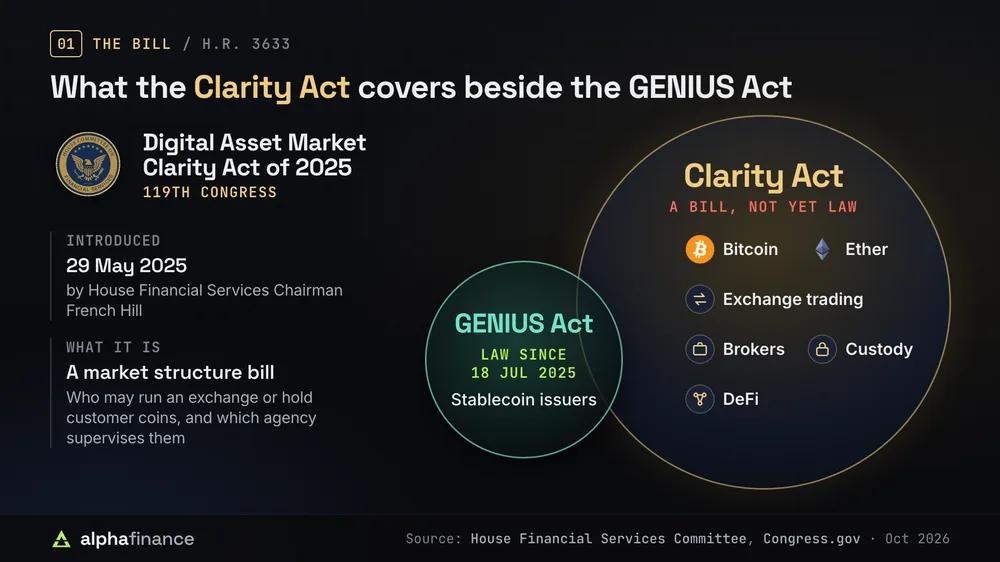
The Digital Asset Market Clarity Act of 2025 is a proposed federal rulebook for US crypto trading. House Financial Services Chairman French Hill introduced it on 29 May 2025 as H.R. 3633 in the 119th Congress.
Lawmakers call it a market structure bill because it determines who may operate an exchange or hold customers' coins, and which agency supervises those businesses.
Its companion, the GENIUS Act, became law on 18 Jul 2025. GENIUS regulates issuers of stablecoins, tokens designed to stay worth one US dollar. The Clarity Act covers most of the remaining market, including Bitcoin and Ether, exchange trading and brokers. It also addresses custody, the safekeeping of customer coins, and decentralised finance.
The one-sentence version
The Clarity Act would classify crypto tokens as securities or commodities in law and establish CFTC licensing for exchanges that trade the commodities.
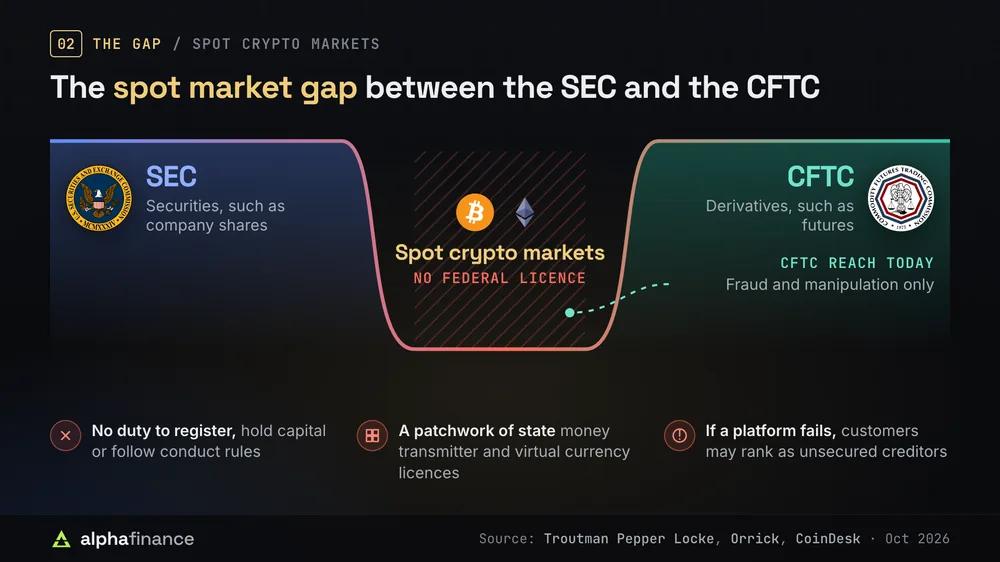
No federal agency fully supervises most US crypto trading. The two regulators that share responsibility have no boundary between their roles set in law.
The Securities and Exchange Commission (SEC) oversees securities, such as company shares. Derivatives fall under the Commodity Futures Trading Commission (CFTC). These include futures, contracts to buy or sell an asset at a set price on a later date.
Bitcoin and Ether are treated as commodities, as CoinDesk's summary of the bill explains. Most trading in both takes place on spot markets, where the coin changes hands for immediate payment.
The Commodity Exchange Act lets the CFTC pursue spot-market fraud and manipulation. It does not give the agency authority to require a spot exchange to register, hold capital or follow conduct rules, according to Troutman Pepper Locke's analysis of the bill.
Exchanges operate instead under a patchwork of state money transmitter and virtual currency licences, described in Orrick's client briefing. If a platform fails, its customers may rank as unsecured creditors, who are paid after secured lenders in bankruptcy.
A token's status as a security determines the rules its issuer and exchanges must follow. The final Senate text of 14 Sep 2026 sets out the following definitions.
The text treats subsequent trades between ordinary buyers and sellers as not involving a security. Fundraising remains under the SEC, while everyday trading moves to the CFTC.
| Asset type | Example | Main regulator under the bill |
|---|---|---|
| Digital commodity | Bitcoin or Ether | CFTC |
| Ancillary asset | A new token sold by its founding team | SEC for the sale; CFTC for later trading |
| Payment stablecoin | A dollar-backed token | Banking regulators, under the GENIUS Act |
| Digital security | A share or bond issued as a token | SEC |

The text would let founders raise limited sums without full SEC registration. For up to four years, it exempts token sales of up to $50 million a year, or 10% of outstanding tokens if greater. Total fundraising under the exemption is capped at $200 million.
While a project remains under one group's control, founders, executives and large holders would have to wait at least 12 months before selling. That wait falls to six months once the project is certified as free of such control. The lock-ups resemble vesting schedules, the timed releases of insider coins shown on a token unlock calendar.
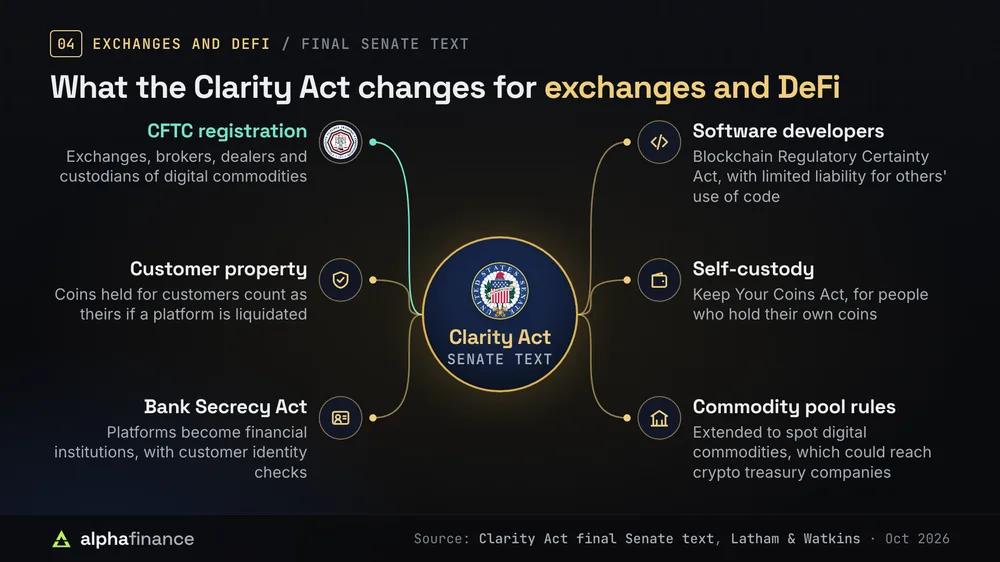
Licensing and custody have the most practical significance for people who keep coins on a platform. The Senate text's Digital Commodity Intermediaries Act division creates CFTC registration for digital commodity exchanges, brokers, dealers and custodians.
The bill also addresses matters beyond trading:
Decentralised finance (DeFi) lets people trade or lend tokens through software from their own wallets, without a company holding the assets. Examples include the lending pools on our DeFi yields board. Developers would receive limited protection from liability for others' use of their code. Regulators would also be directed to write rules for trading protocols that are not decentralised.
For listed companies holding crypto, another provision could matter. Latham & Watkins notes that the bill extends the CFTC's rules for commodity pools, or pooled investment funds, to spot digital commodities. Those rules could reach digital asset treasury companies such as those on our Bitcoin corporate treasuries page.
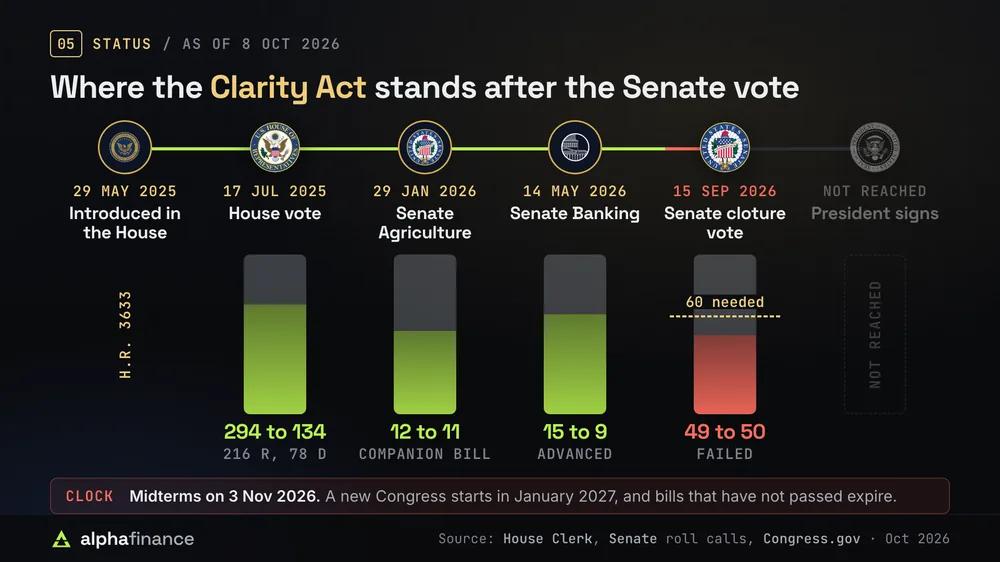
The Clarity Act has passed the House but remains stalled in the Senate. Before the president can sign it, both chambers must approve identical text.
| Date | Step | Result |
|---|---|---|
| 29 May 2025 | Introduced in the House | H.R. 3633 |
| 17 Jul 2025 | House vote | Passed 294 to 134 |
| 29 Jan 2026 | Senate Agriculture Committee vote on its companion bill | Advanced 12 to 11 |
| 14 May 2026 | Senate Banking Committee vote | Advanced 15 to 9 |
| 14 Sep 2026 | Final Senate text released | Divisions on securities, commodities and ethics |
| 15 Sep 2026 | Senate cloture vote | Failed 49 to 50; 60 needed |
Cloture ends debate and moves a bill forward, requiring support from 60 of the Senate's 100 members. Every Democrat who voted on 15 Sep 2026 opposed the motion, as did Republicans Susan Collins, Josh Hawley and Jerry Moran.
Republican Thom Tillis also voted no, for procedural reasons. A senator on the winning side can request another vote, so his switch preserved that option. As of 8 Oct 2026, no second vote had been scheduled.
The House vote drew broader bipartisan support. Of the 294 members voting in favour, 78 were Democrats and 216 were Republicans.
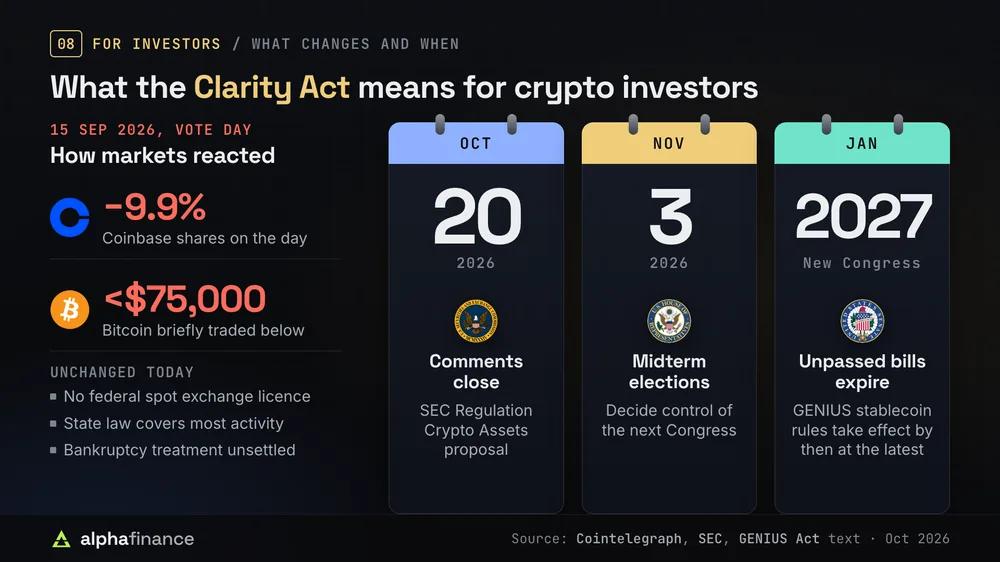
Midterm elections take place on 3 Nov 2026, followed by a new Congress in January 2027. Any bill that has not passed by then expires and must be reintroduced. Even if the Senate approves its version this year, that text would return to the House for approval.
Two disputes outside the bill's core design stopped it from advancing. Negotiators had agreed on more than 600 pages of text, according to CoinDesk's report on the vote.
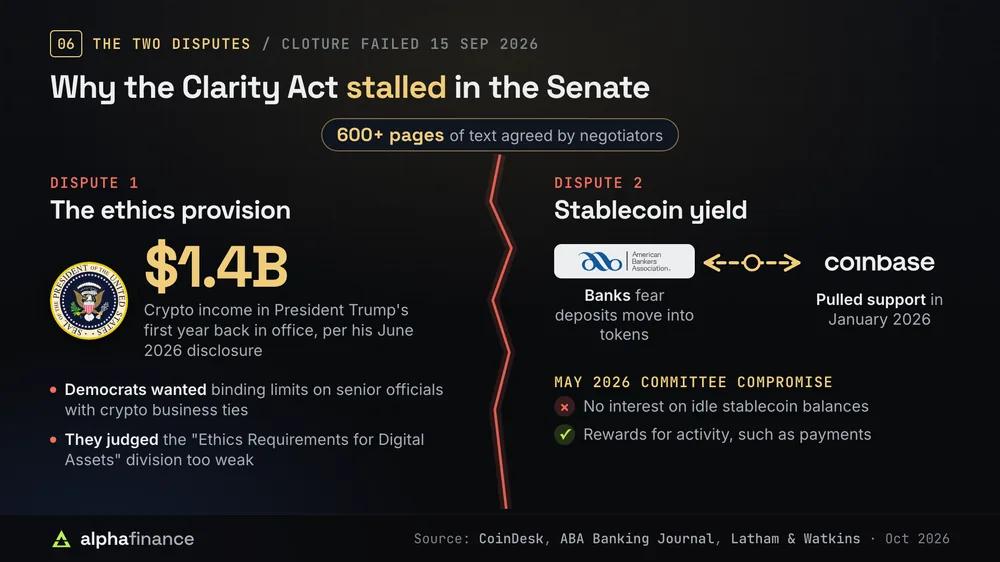
Democrats sought binding limits on senior government officials with business ties to crypto companies. They judged the final text's "Ethics Requirements for Digital Assets" division too weak.
President Trump's family ventures were central to the dispute. His June 2026 financial disclosure showed about $1.4 billion in income from crypto businesses during his first year back in office, according to CoinDesk's account of the negotiations. Proposals passed between Republicans, the White House and Democrats until the morning of the vote, without an agreement.
Whether exchanges may pay customers a return on stablecoin holdings was the second dispute. The GENIUS Act prohibits issuers from paying interest, but banks argue that exchanges can still pass rewards to customers. The American Bankers Association urged senators to close that gap through the Clarity Act.
Banks fear savers will move deposits into higher-paying tokens. The stablecoin supply on each blockchain shows the amounts involved. Crypto companies opposed the restrictions. In January 2026, Coinbase withdrew its support over an earlier draft's treatment of rewards, tokenised stocks and DeFi, CoinDesk reported at the time.
A compromise in the May 2026 committee text prohibited interest on idle stablecoin balances while allowing rewards for activity, such as making payments. Latham & Watkins' legislative tracker records those terms.
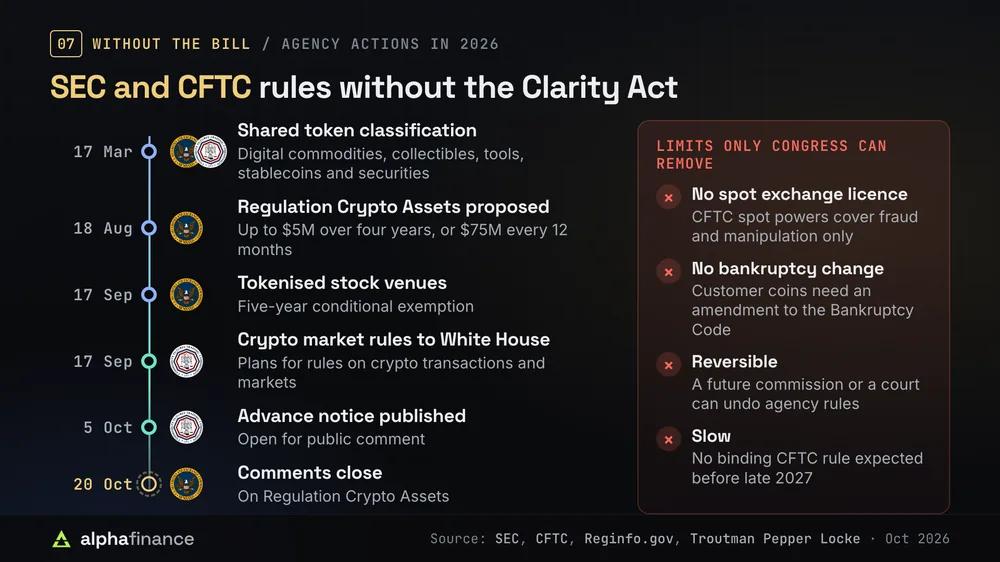
The SEC and CFTC are using their existing powers to write rules while the bill is stalled. Their 2026 actions cover some of the matters the Clarity Act would have settled in law.
Only Congress can remove some limits on these actions. Troutman Pepper Locke does not expect a binding CFTC rule before late 2027.
| Issue | Under the Clarity Act | Under agency rules alone |
|---|---|---|
| Licensing of spot exchanges | CFTC registration for exchanges, brokers and dealers | Unavailable; CFTC spot powers cover fraud and manipulation only |
| Customer coins in a bankruptcy | Treated as customer property | Unchanged; needs an amendment to the Bankruptcy Code |
| Token fundraising | Up to $50 million a year, set in statute | Up to $75 million a year, if the SEC adopts its proposal |
| Durability | Changed only by a new act of Congress | Can be reversed by a future commission or struck down in court |
When announcing the fundraising proposal, SEC Chairman Paul Atkins said legislation remains indispensable for rules that a later regulator cannot unwind.
Holding Bitcoin or trading on a US exchange remains subject to the same rules as before the Senate vote. Spot exchanges have no federal licence, most of their activity falls under state law, and the bankruptcy treatment of customer coins remains unsettled.
On 15 Sep 2026, Coinbase shares fell 9.9% and Bitcoin briefly traded below $75,000, according to Cointelegraph's market report. An exchange-traded fund (ETF) is a fund with shares traded on a stock exchange. Daily Bitcoin ETF flows show whether fund investors added or withdrew money around events such as that vote.
The next steps follow a fixed calendar.
House committee chairs French Hill and Glenn Thompson say they remain committed to passing framework legislation with the Senate.
In the European Union, the transition period under MiCA crypto regulation ended on 1 Jul 2026. Providers there now need authorisation to serve customers.
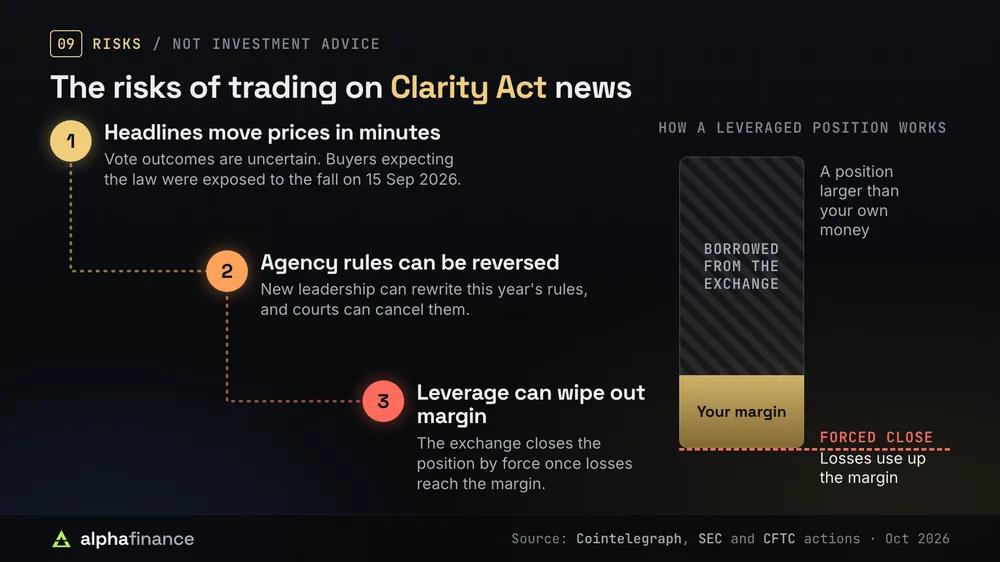
Crypto prices can react to political headlines within minutes, while vote outcomes remain uncertain in advance. Buyers expecting the law to pass were exposed to the fall on 15 Sep 2026 when it failed to advance.
New agency leadership can rewrite rules issued this year, and courts can cancel them. A platform or token permitted today may therefore face different treatment later.
Leverage lets traders borrow from an exchange to take a position larger than their own money, called margin, would allow. The entire margin can be lost if losses reach that amount and the exchange forcibly closes the position. Our crypto liquidations page counts these forced closures across futures markets.
Not investment advice
This article explains market data. Nothing on this page is a recommendation to buy, sell or leverage any asset. Digital assets are volatile and you can lose everything you put in. If you are unsure whether a trade is appropriate for you, a licensed adviser in your jurisdiction is the right next step.


Fact checked by
Verifies every figure against primary sources before publication. Meet the team
No. It passed the House of Representatives on 17 Jul 2025 but has not passed the Senate or been signed into law. Both chambers would need to approve identical text before the current Congress ends in January 2027.
The Clarity Act sets federal rules for US crypto markets, defining which tokens are securities and which are commodities. It creates CFTC registration for crypto exchanges, brokers and dealers, adds bankruptcy protection for customer assets, and requires disclosures from teams selling new tokens.
No. The Senate motion to begin debate failed by 49 votes to 50 on 15 Sep 2026, below the 60 required. The bill remains on the Senate calendar and could be called up again, although no new vote is scheduled.
The GENIUS Act regulates stablecoin issuers and became law on 18 Jul 2025. The Clarity Act covers the wider crypto market, including exchanges, brokers and custody, while dividing responsibilities between the SEC and CFTC. It has not become law.
It is stalled in the Senate, with little time remaining in this Congress. A senator preserved the right to request a second vote, but revival would require a new agreement on ethics rules and stablecoin rewards. Without congressional action before January 2027, a new bill would have to be introduced.