Markets
 BTC
BTC ETH
ETH BNB
BNB XRP
XRP SOL
SOL ZEC
ZEC HYPE
HYPE DOGE
DOGE LINK
LINK TON
TON AVAX
AVAX SUI
SUI TAO
TAO AAVE
AAVE PUMP
PUMP MORPHO
 ARB
ARB LIT
LIT--:-- UTC
Research/Derivatives
The best Hyperliquid wallets ranked on what you pay per trade, how your keys are protected and which markets you can reach, using each wallet's own published fees.

 By Alpha Finance Editorial Team
 Fact-checked by Vince Dioquino
Every figure, platform detail and regulatory claim on this page was traced to a primary source by the named fact checker before publication, and is re-checked when those facts change. The review date moves only when a person has re-read the page.
The editorial policy → Editorial policy Report an errorYour Hyperliquid wallet holds your keys and usually adds a fee to each trade. At the base fee tier, opening a $10,000 position costs $4.50 under Hyperliquid's own fee schedule. Through MetaMask's perps screen, the same trade costs $14.32 for users below Rewards level 4, according to MetaMask's help centre.
Phantom launched in-wallet perps in July 2025, as The Block reported at launch, prompting other wallets to build Hyperliquid trading into their apps. By 14 Oct 2026, Phantom alone had processed $51.6 billion in cumulative volume, according to DefiLlama's Phantom Perps dashboard.
Choosing a wallet in 2026 depends on how often you trade and whether you use a phone, desktop or hardware device. Wallet fees apply both when you open a position and when you close it, making the difference most significant for frequent traders.
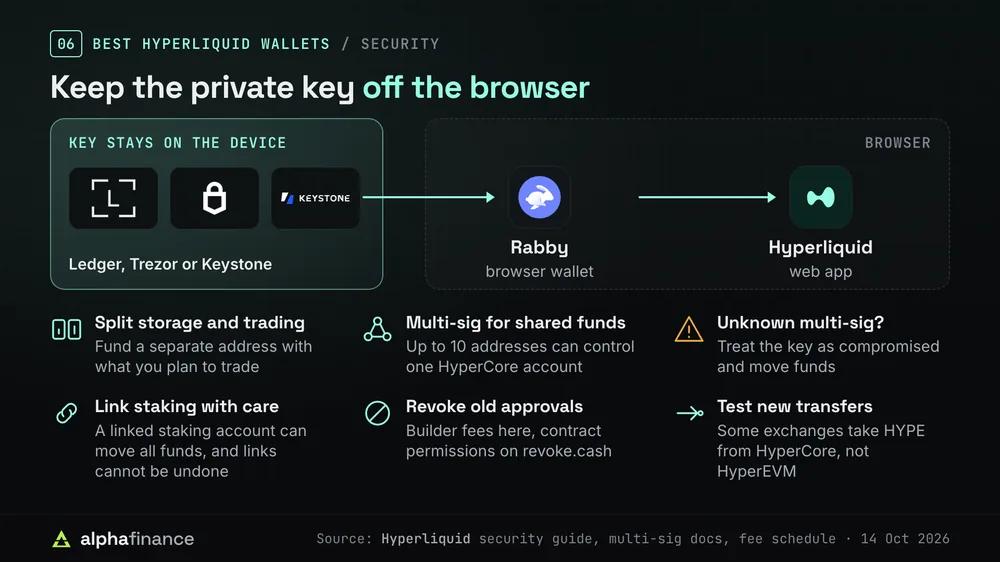
Your wallet address is your Hyperliquid account. Whoever controls its private key controls the balance. Hyperliquid is non-custodial, and its security guide states that only someone with your private key or seed phrase can sign transactions for your address.
Two parts of the Hyperliquid blockchain share one state. HyperCore runs the trading engine and its order books, which list buy and sell orders waiting to be filled. HyperEVM provides a smart contract layer compatible with the Ethereum Virtual Machine (EVM). Both are secured by the same consensus, according to Hyperliquid's HyperEVM documentation.
Perpetual futures, or perps, are Hyperliquid's core market. These contracts track an asset's price without expiring. Rather than buying the token, you post USDC, a stablecoin pegged to the US dollar, as collateral. You can then go long to profit if the price rises or short to profit if it falls, as Hyperliquid's onboarding guide explains.
This collateral is called margin. If losses exhaust it, the position is liquidated, which means it is forcibly closed and the margin is lost. Our crypto liquidations dashboard tracks these forced closures across markets.
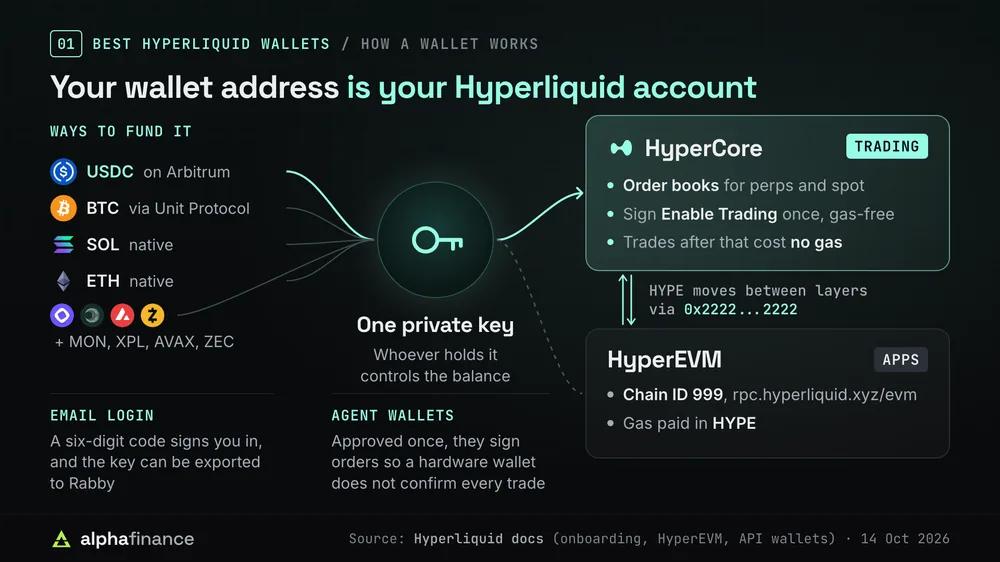
Clicking Enable Trading on Hyperliquid's web app prompts your wallet to sign one gas-free message. Subsequent trades also cost no gas, according to the onboarding guide.
A main account can approve API wallets, also called agent wallets, to sign actions on its behalf, as Hyperliquid's developer documentation describes. Once approved, an agent wallet signs orders for the account, so the main wallet does not have to approve each one.
Add HyperEVM to your wallet using chain ID 999, the RPC address https://rpc.hyperliquid.xyz/evm and HYPE as the gas token. These settings appear in Hyperliquid's HyperEVM guide.
You can move HYPE between HyperCore and HyperEVM with the app's transfer button or by sending it to 0x2222222222222222222222222222222222222222. Every spot asset has its own transfer address, so the same guide warns that sending any other token to this address loses it.
The standard deposit uses USDC on Arbitrum, with a little ETH on that network to cover gas. USDC is now minted natively on Hyperliquid, and the legacy Arbitrum bridge holds less than 10% of its supply, according to Hyperliquid's USDC page. According to the onboarding guide, the web app also accepts native BTC, SOL, ETH, MON, XPL, AVAX and ZEC sent to a deposit address.
Unit Protocol, a separate service, handles deposits over the Bitcoin network, as Hyperliquid's deposit support page notes. Email login uses a six-digit code, and its deposit address also accepts USDC on Ethereum, Base or Polygon. You can later export that email wallet's private key into an extension such as Rabby.
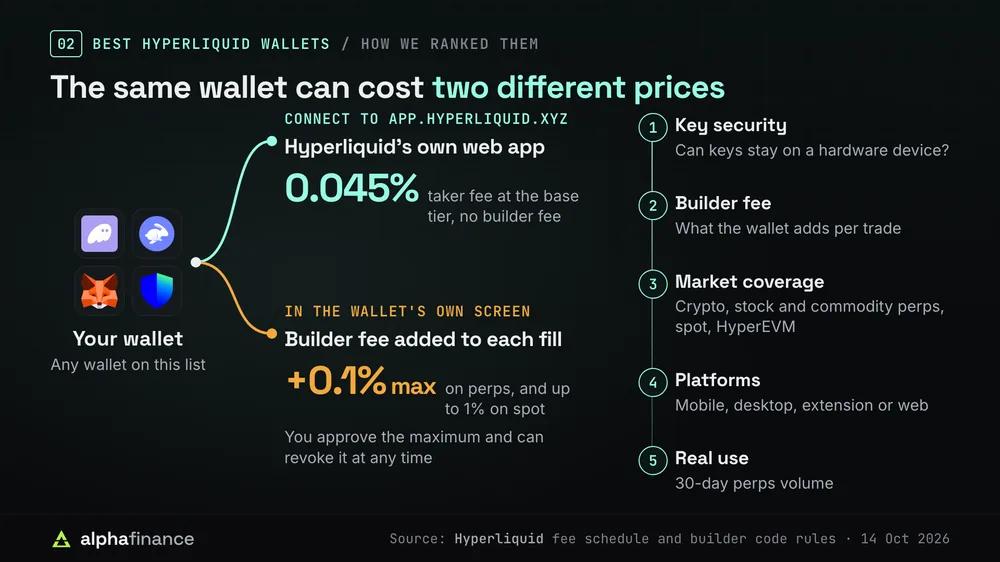
Our rankings focus on the features and costs that affect traders' results, using each company's help pages and public trading data.
You avoid the wallet's builder fee by connecting it directly to Hyperliquid's web app. Under the builder code documentation, that fee applies only to trades sent through the wallet's own trading screen.
Phantom is the best fit for most traders. Later picks cater to more specific needs, including cold storage and stock perps.
| Wallet | Best for | Platforms | 30-day perps volume |
|---|---|---|---|
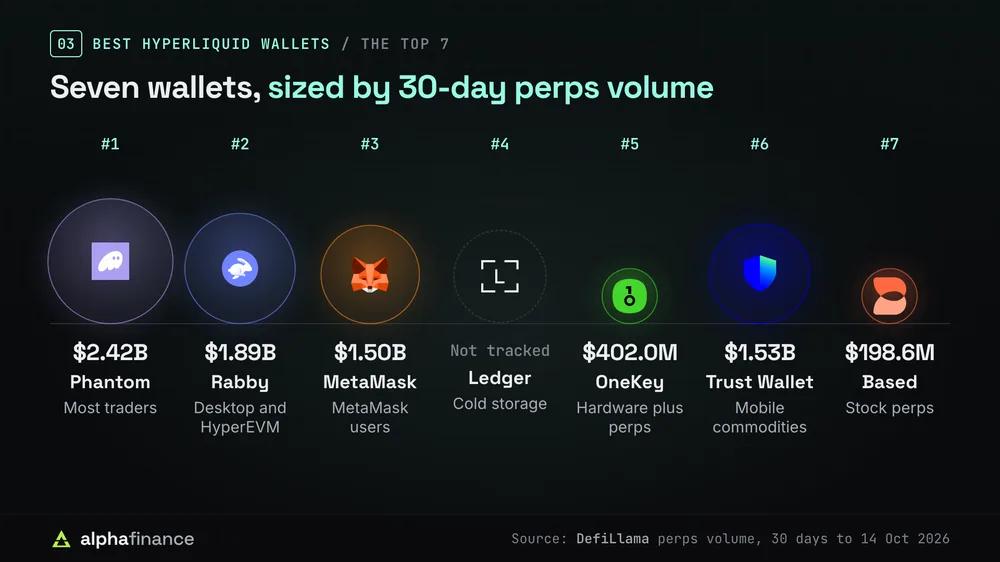
| Phantom | Most traders | Mobile, web terminal | $2.42 billion |
| Rabby | Desktop and HyperEVM | Mobile, extension | $1.89 billion |
| MetaMask | MetaMask users | Mobile, extension | $1.50 billion |
| Ledger | Cold storage | Ledger Wallet app, device | Not listed |
| OneKey | Hardware plus perps | Desktop, mobile | $402.0M |
| Trust Wallet | Mobile commodities | Mobile | $1.53 billion |
| Based | Stock perps | iOS, Android, web | $198.6M |
Volumes cover the 30 days to 14 Oct 2026 and come from DefiLlama's dashboards for Phantom Perps, Rabby Perps, MetaMask Perps, OneKey Perps, Trust Wallet Perps and Based.
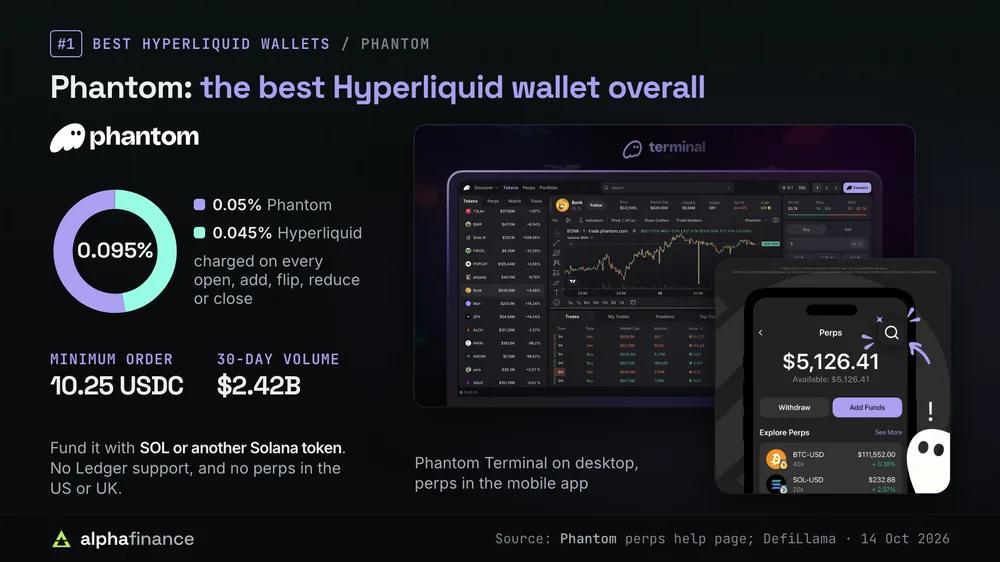
Phantom has the most polished in-wallet Hyperliquid trading experience on phone and desktop. Perps are available in its mobile app and Phantom Terminal at trade.phantom.com. Signing in to the same account shows your positions on both, according to Phantom's perps help page.
Funding can come from SOL, your Phantom Cash balance or another supported Solana token. Phantom converts the funds to USDC and bridges them to Hyperliquid, so Solana users do not need an Arbitrum balance.
DefiLlama recorded $2.42 billion of Phantom perps volume in the 30 days to 14 Oct 2026. If you connect Phantom directly to Hyperliquid's web app, USDC withdrawn over Arbitrum arrives on a network Phantom does not display. Hyperliquid's support page explains how to recover it by importing the key into Rabby.
Our guide to Hyperliquid's restricted countries explains the access rules that apply in different countries.
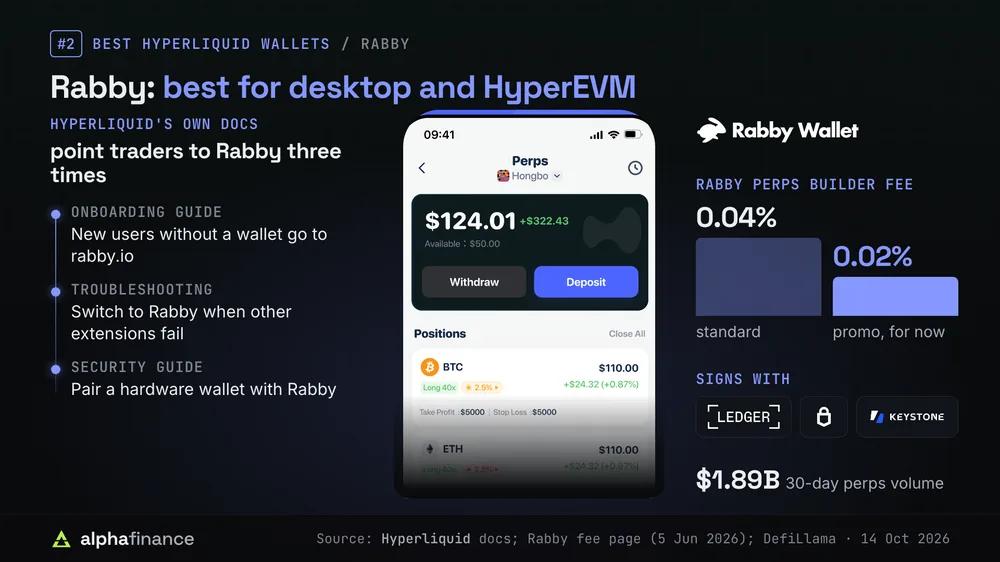
Hyperliquid's documentation repeatedly directs users to Rabby, making it the safest default for desktop trading and HyperEVM. Its onboarding guide sends new users without a wallet to rabby.io. The wallet troubleshooting page also suggests Rabby when other extensions fail to connect.
Rabby Perps, its in-wallet trading screen, launched on mobile and the browser extension in September 2025.
With $1.89 billion traded in the 30 days to 14 Oct 2026, Rabby Perps exceeded MetaMask's $1.50 billion over the same period, according to DefiLlama's Rabby Perps data.
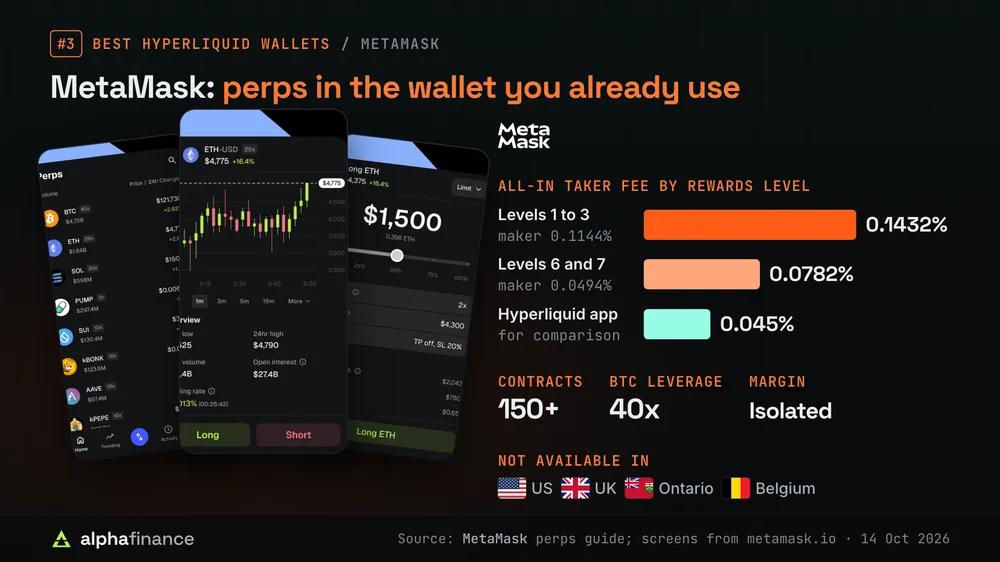
Existing MetaMask users can trade Hyperliquid perps without changing wallets, although its published fees are the highest on this list. Both MetaMask Mobile and the MetaMask Extension support perps. Deposited EVM tokens are converted to USDC on Hyperliquid, as MetaMask's perps guide explains.
More than 150 contracts cover crypto, commodities, stocks and currencies, and leverage goes up to 40x on BTC. The same guide states that all orders use isolated margin, limiting each position's losses to the margin assigned to it.
By 14 Oct 2026, MetaMask Perps had processed $13.47 billion in volume, according to DefiLlama.
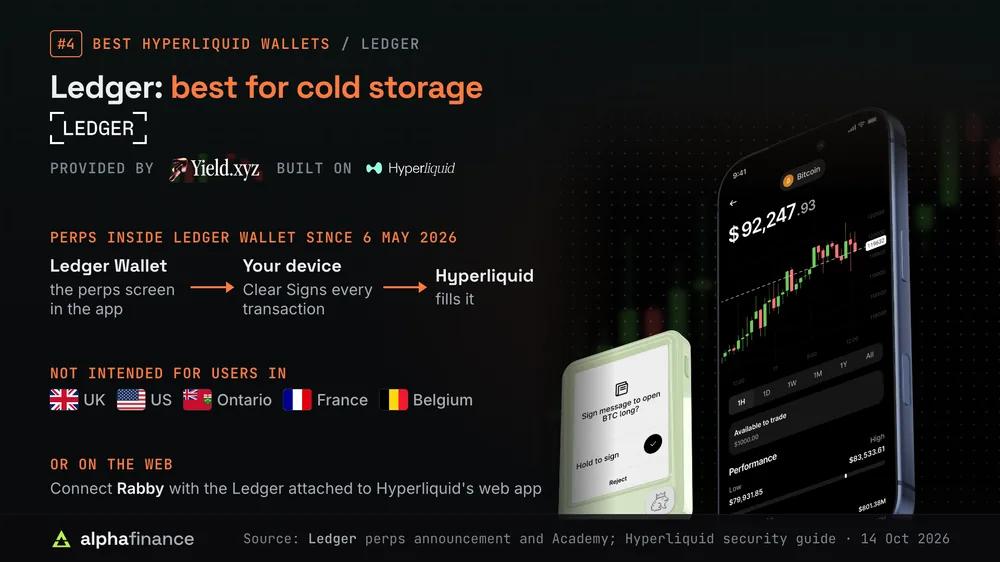
Ledger keeps your keys on a hardware device and suits long-term HYPE holders who also trade. Since 6 May 2026, Ledger Wallet has offered perps inside the app, provided by Yield.xyz and built on Hyperliquid. Every transaction is Clear Signed on the device, according to Ledger's perps announcement. The service is not intended for users in the UK, the US, Ontario, France or Belgium, and the announcement lists no fee.
Ledger Wallet also supports sending, receiving and swapping HYPE and other HyperEVM tokens, per Ledger Academy's Hyperliquid guide, updated 26 May 2026. Outside the app, you can connect Rabby to Hyperliquid's web app with the Ledger attached. Hyperliquid's security guide recommends that arrangement because the private key stays out of the browser.
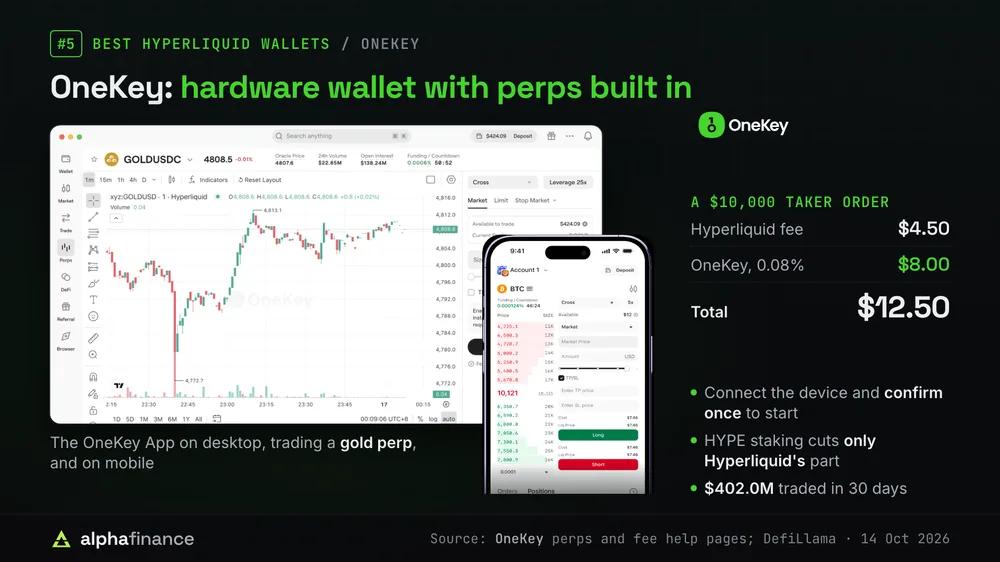
OneKey builds Hyperliquid trading into its own app, so its hardware wallet users need no browser extension. The OneKey App supports perps on desktop and mobile. When you first open the futures module, you connect the device and confirm authorisation once, according to OneKey's perps help page.
DefiLlama recorded $402.0 million of OneKey Perps volume in the 30 days to 14 Oct 2026. Fees exceed those of Phantom and Rabby, so its main appeal is device-confirmed security within one app.
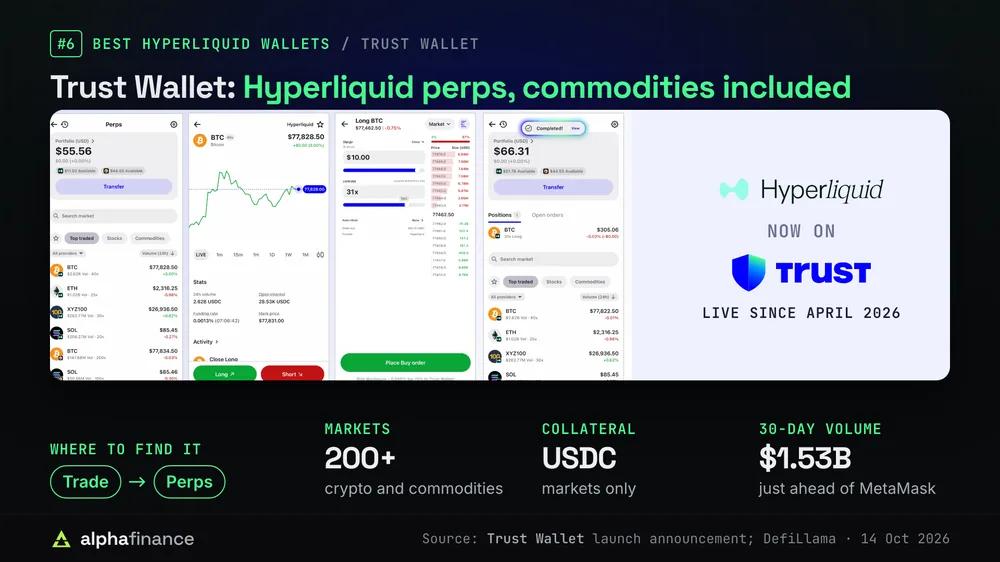
Mobile traders who already use Trust Wallet can access Hyperliquid perps within the app. Its April 2026 launch announcement describes more than 200 perps markets across crypto and commodities. Open Trade, then Perps, to access them.
The integration covers USDC markets only and is unavailable in some regions, according to the same announcement. Review the fee on the order confirmation screen, as builder charges differ between wallets.
DefiLlama recorded $1.53 billion of Trust Wallet Perps volume in the 30 days to 14 Oct 2026, slightly ahead of MetaMask.
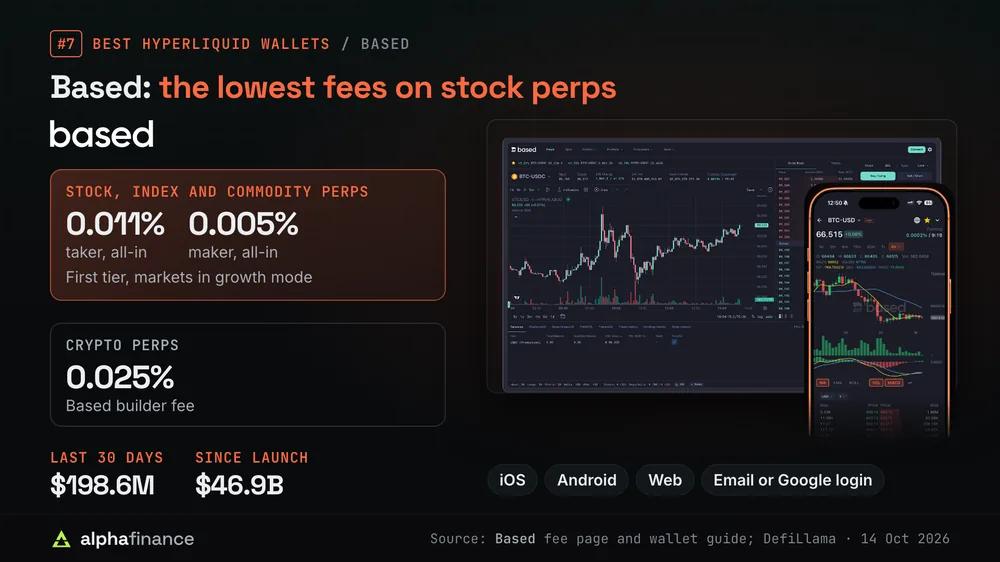
Based has the lowest published all-in fees on stock, index and commodity perps among these wallets. At the first tier, its fee page lists total rates of 0.011% taker and 0.005% maker for markets in growth mode. This covers most stock, index and commodity perps on trade.xyz.
For crypto perps, the builder fee is 0.025%, according to its own wallet guide. Based runs on iOS, Android and the web, and Privy provides its email or Google login.
Trading activity has fallen sharply. DefiLlama's Based dashboard shows $198.6 million of perps volume in the 30 days to 14 Oct 2026, compared with $46.9 billion since launch.
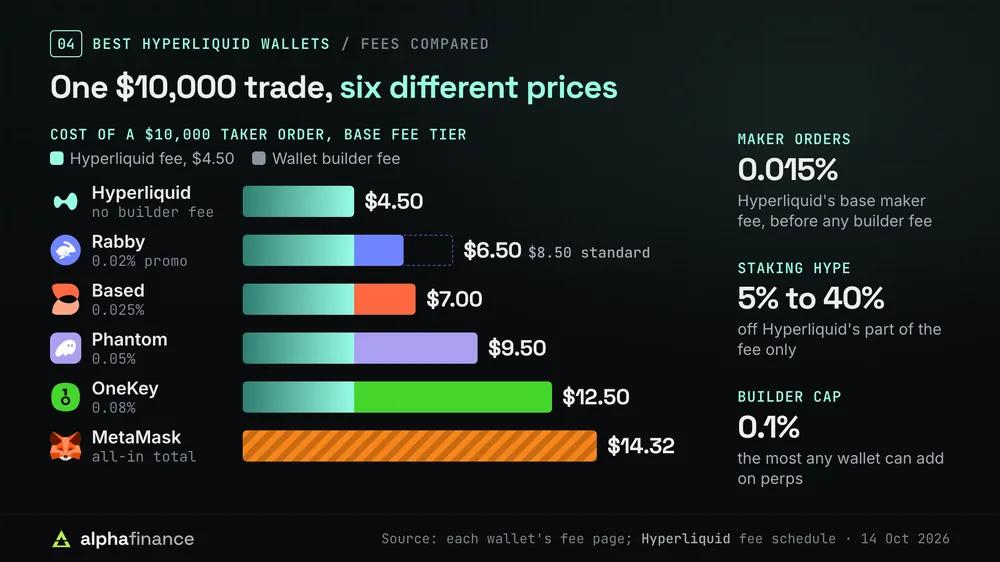
Every wallet passes on the same Hyperliquid trading fee, so builder fees account for the main cost difference. Under Hyperliquid's fee schedule, the base perps rate is 0.045% for takers, whose orders fill immediately. Makers, whose orders wait on the order book, pay 0.015%.
| Wallet | Builder fee (perps) | All-in taker fee | Cost of $10,000 taker order |
|---|---|---|---|
| Hyperliquid app, direct | None | 0.045% | $4.50 |
| Based | 0.025% | 0.070% | $7.00 |
| Rabby | 0.04% (0.02% promo) | 0.085% (0.065%) | $8.50 ($6.50) |
| Phantom | 0.05% | 0.095% | $9.50 |
| OneKey | 0.08% | 0.125% | $12.50 |
| MetaMask | Included in total | 0.1432% | $14.32 |
Figures use the base fee tier and each wallet's published fee page as of 14 Oct 2026. MetaMask publishes only its total rate, shown here for Rewards levels 1 to 3.
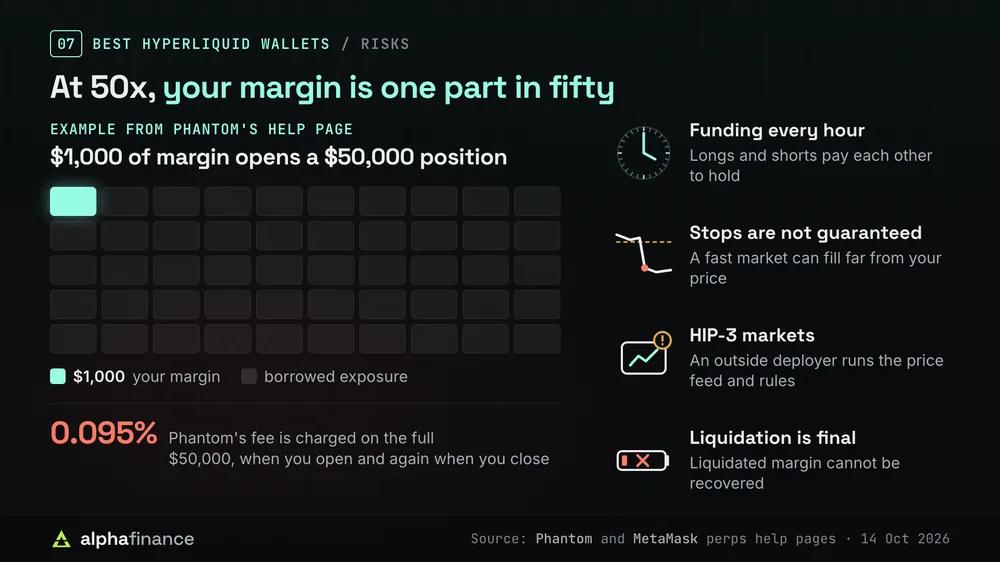
Trading fees apply to the full position, including the borrowed portion. In the example on Phantom's help page, $1,000 of margin at 50x leverage creates a $50,000 position. The 0.095% fee applies to that $50,000 on both opening and closing.
Depending on the amount staked, HYPE staking reduces the Hyperliquid portion of the fee by 5% to 40%, according to the fee schedule. The builder code rules allow up to 10 active builder fee approvals at once, any of which you can revoke.
Wallets now compete on market access as well as price. Their markets stretch from stock perps to outcome contracts.
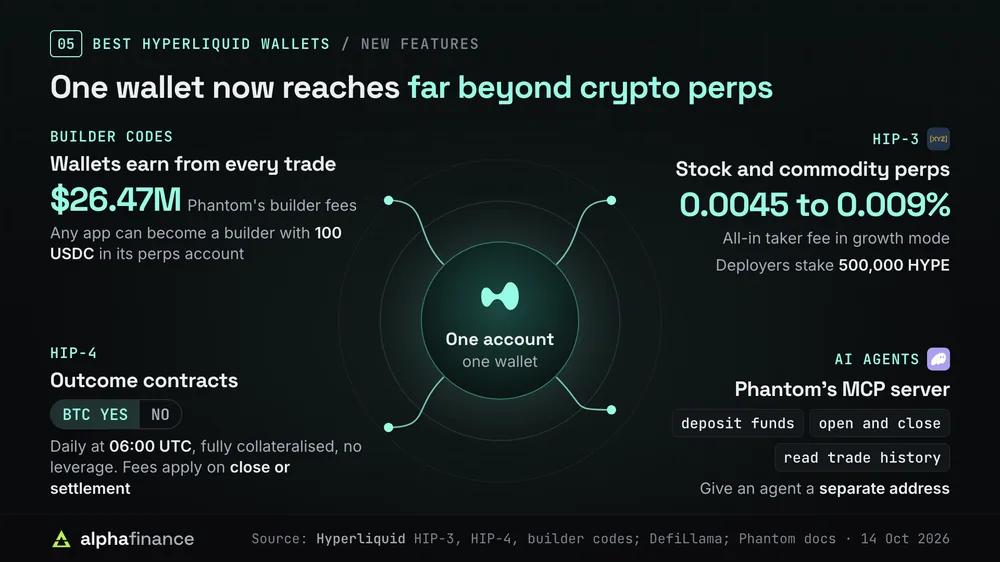
Builder codes allow wallets to earn revenue from every trade their users place. By 14 Oct 2026, Phantom had collected $26.47 million in builder fees, according to DefiLlama.
An app needs 100 USDC in its perps account to become a builder under the builder code rules. Builders choose their own rates. Among these wallets, published builder fees run from Rabby's promotional 0.02% to OneKey's 0.08%, while MetaMask publishes only a higher all-in total.
Outside teams can launch perps markets on Hyperliquid through HIP-3, bringing stock and commodity contracts into wallets. Under the HIP-3 specification, a deployer must stake 500,000 HYPE and set the market's price feed and rules. Validators can penalise deployers for faulty operation.
Growth-mode markets have an all-in taker rate of 0.0045% to 0.009%, five to ten times below the standard crypto perps rate, according to the fee schedule. Our RWA perps dashboard compares live stock, gold, oil and currency markets.
HIP-4 introduces fully collateralised outcome contracts that settle within a fixed range, with no leverage or liquidations. The first market is a recurring yes-or-no BTC contract that settles daily at 06:00 UTC. The HIP-4 documentation describes zero fees for initial testing, and builder codes still apply. Hyperliquid's fee schedule now charges outcome trades only when a position closes or settles.
These contracts put Hyperliquid wallets alongside prediction markets. Our prediction markets dashboard shows the odds traders pay on other venues.
Some wallets let AI assistants place Hyperliquid trades for users. Phantom's MCP server, a connector for AI tools, provides a set of perps tools for Hyperliquid. These tools can deposit funds, move USDC from spot to perps, open and close positions, and read trade history.
Giving an AI agent trading access creates the same risk as authorising any other signer. Keeping a small balance at a separate address limits what the agent can lose.
The private key determines the security of a Hyperliquid account. With a self-custody wallet, no exchange can reverse a transaction for you.
Trading through a wallet makes leverage easier to access without making it safer. A position can lose all the funds posted as margin. MetaMask's perps guide states that liquidated margin cannot be recovered.
Because leverage increases position size, even a small adverse price move can wipe out the margin. Our liquidation price calculator shows where a position would be forcibly closed for a given entry price, leverage and maintenance margin.
Keeping a position open also carries costs. Funding payments between longs and shorts help keep the perps price close to the spot price. On Hyperliquid, funding is charged hourly, according to MetaMask's perps guide. Current rates appear in our funding rates dashboard.
In a fast market, stop-loss and take-profit orders may fill far from the price you choose. MetaMask's guide warns that these orders are not guaranteed. HIP-3 markets carry additional risk because an outside deployer controls the price feed and market rules.
For active traders, a 0.05% builder fee more than doubles the base taker cost each time a position opens or closes.
Not investment advice
This article explains market data. Nothing on this page is a recommendation to buy, sell or leverage any asset. Digital assets are volatile and you can lose everything you put in. If you are unsure whether a trade is appropriate for you, a licensed adviser in your jurisdiction is the right next step.


Fact checked by
Verifies every figure against primary sources before publication. Meet the team
Phantom is the best Hyperliquid wallet for most traders. It supports in-wallet perps on mobile and desktop and leads wallet trading volume. Phantom's help page lists a 0.095% fee per trade, including Hyperliquid's charge. Rabby better serves desktop and hardware wallet users and is recommended in Hyperliquid's own documentation.
Pair a Ledger, Trezor or Keystone device with a browser wallet such as Rabby, as Hyperliquid's security guide recommends. Ledger Wallet and the OneKey App also have their own perps screens that work with each maker's devices. Phantom's in-wallet perps do not support Ledger.
Most wallets add a builder fee to trades sent through their trading screen. Under Hyperliquid's builder code rules, these fees are capped at 0.1% on perps and 1% on spot. You approve the maximum before any fee is charged. All-in taker rates on this list range from 0.065% at Rabby, during its promotion, to MetaMask's published 0.1432%.
Create a custom network using chain ID 999, the RPC address https://rpc.hyperliquid.xyz/evm and HYPE as the currency symbol. For a one-click alternative, Hyperliquid's HyperEVM guide lists Chainlist. You need HYPE on HyperEVM to pay gas.
Phantom and MetaMask both exclude the US and UK from their in-wallet perps services. Phantom's help page lists other excluded territories, while MetaMask's guide also excludes Ontario and Belgium. Ledger's in-app perps exclude the UK, the US, Ontario, France and Belgium. Check your country's access rules before connecting a wallet.