Markets
 BTC
BTC ETH
ETH BNB
BNB XRP
XRP SOL
SOL ZEC
ZEC HYPE
HYPE DOGE
DOGE LINK
LINK TON
TON AVAX
AVAX SUI
SUI TAO
TAO AAVE
AAVE PUMP
PUMP MORPHO
 ARB
ARB LIT
LIT--:-- UTC
Research/Platform guides
Bybit restricted countries in full, the markets where it is limiting accounts or products, the licence behind each regional platform, and what regulators have done about it.
 By Alpha Finance Editorial Team
 Fact-checked by Vince Dioquino
Every figure, platform detail and regulatory claim on this page was traced to a primary source by the named fact checker before publication, and is re-checked when those facts change. The review date moves only when a person has re-read the page.
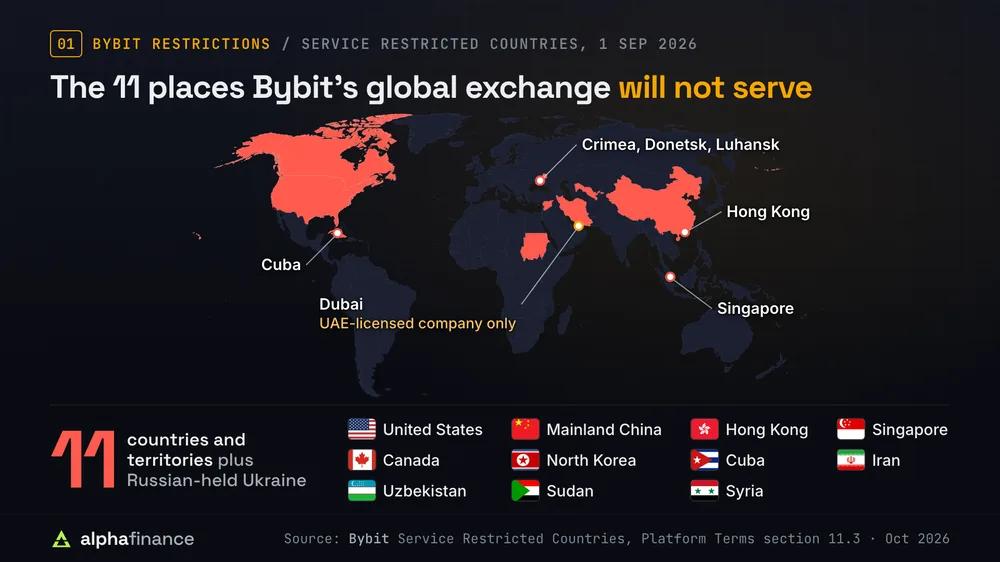
The editorial policy → Editorial policy Report an errorResidents of 11 countries and territories cannot use Bybit under its terms, including the United States, mainland China, Canada, Singapore and Hong Kong. Last updated on 1 Sep 2026, the exclusion list also covers Russian-controlled parts of Ukraine.
Other markets have changed since late 2025. Bybit finished leaving Japan in July 2026 and is moving residents of 29 European countries to a separately licensed platform. In the United Kingdom, it has reopened with fewer products.
The exchange reported more than 80 million users in its UK launch announcement in December 2025. Its best-known products are perpetual futures, contracts that track a coin's price without an expiry date. Traders on one side pay a regular fee to the other. Our funding rates dashboard shows Bybit's fee alongside those of five other exchanges.
The places below appear on Bybit's Service Restricted Countries page, last updated on 1 Sep 2026. Residents cannot open or keep an account on its global exchange.
The page repeats section 11.3 of the platform terms, which calls these places Excluded Jurisdictions.
| Region | Excluded jurisdictions named by Bybit |
|---|---|
| Americas | United States; Canada; Cuba |
| East and South-East Asia | Chinese Mainland; Hong Kong; Singapore; North Korea |
| Central Asia and Middle East | Uzbekistan; Iran; Syria |
| Africa | Sudan |
| Europe | Russian-controlled regions of Ukraine, listed as Crimea, Donetsk, Luhansk and Rostov; Sevastopol |
| United Arab Emirates | Dubai, for customers of Bybit Virtual Asset Platform Operator LLC only |
The one-sentence version
Bybit's global exchange is closed to the United States, mainland China, Hong Kong, Singapore, Canada, North Korea, Cuba, Iran, Uzbekistan, Sudan, Syria and Russian-controlled regions of Ukraine.
The wording includes Rostov among the Ukrainian regions, although it is a Russian region bordering Donetsk and Luhansk. That sentence also allows Bybit to add jurisdictions at its sole discretion, making the published names a minimum.
Bybit does not explain individual entries. According to Willkie Farr & Gallagher's US sanctions guide, comprehensive US sanctions cover Cuba, Iran, North Korea and the Crimea, Donetsk and Luhansk regions of Ukraine. Syria stays on Bybit's list even though the US ended its comprehensive Syria sanctions on 1 Jul 2025, according to the US Treasury's Office of Foreign Assets Control.
Separate restrictions apply worldwide to anyone on the US Treasury's blocked persons list, the EU's consolidated sanctions list or the UK sanctions list. Bybit also refuses entities at least 50% owned or controlled by a listed person. The same definition covers persons in Seychelles, except international business companies incorporated there. Its terms call all of them Prohibited Parties.
Licensing rules explain the largest developed markets on the list. Citing recent regulatory development, Bybit stopped accepting Canadian customers on 31 May 2023. Existing users had until 30 Sep 2023 to close positions, Blockworks reported.
Hong Kong's Securities and Futures Commission added Bybit to its alert list of suspicious trading platforms on 14 Mar 2024. No Bybit company was licensed there, the regulator said, according to The Block's report on the alert. A licence application from Spark Fintech Limited, the company behind Bybit's Hong Kong platform, has been pending on the SFC's list of trading platform applicants since 6 Jun 2025.
The mainland China exclusion is based on residence. Chinese citizens living in countries Bybit serves have been able to register since June 2024, while internet addresses inside China remain blocked, Decrypt reported.
Europe, Japan, Brazil and the United Kingdom do not appear on the excluded list. Residents nevertheless have access to less than the global exchange offers, or none of it in Japan's case.
| Market | What changed | Key date |
|---|---|---|
| European Economic Area, 29 countries | Services on the global exchange are being limited in stages; residents are served by Bybit EU | Notice of 29 Jun 2026 |
| Japan | Exit completed; only withdrawals and limited conversions remain | Positions force-closed on 22 Jul 2026 |
| Brazil | Eligible users moved to a local Bybit company; products not permitted locally are restricted | Migration on 24 Sep 2026 |
| United Kingdom | Spot trading and a peer-to-peer marketplace only | Relaunched on 19 Dec 2025 |
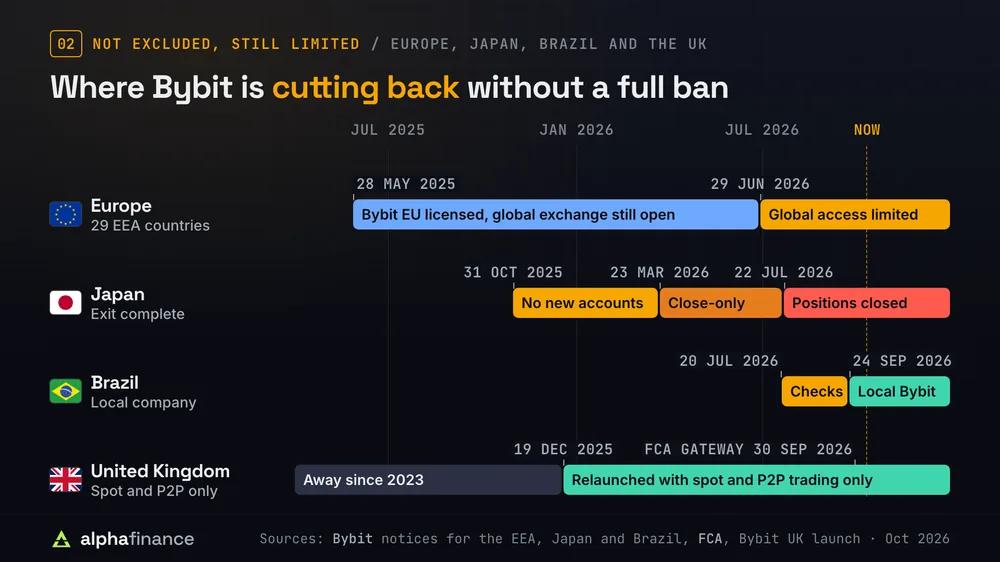
At 12:00 UTC on 31 Oct 2025, Bybit stopped new registrations from Japanese residents and nationals, according to Bybit's press release on Japan.
It announced plans to end services for Japanese residents two months later, Cointelegraph reported. Under Bybit's notice of 22 Dec 2025, anyone wrongly classified as a resident had until 22 Jan 2026 to prove an address elsewhere.
Accounts of Japanese residents moved to close-only mode at 12:00 Japan time on 23 Mar 2026, and remaining positions were force-closed on 22 Jul 2026, according to Bybit's notice of 22 Jan 2026. Bybit declared the exit complete as of 22 Jul 2026, leaving withdrawals and conversions into BTC, ETH or USDC open.
Japan's Financial Services Agency has not registered Bybit. It issued formal warnings in May 2021, March 2023 and November 2024, according to DL News.
Bybit is transferring residents of the European Economic Area (EEA) from its global exchange to a separate platform at bybit.eu. The EEA comprises the EU plus Iceland, Liechtenstein and Norway.
A notice dated 29 Jun 2026 said access to some global services would be progressively limited in 29 EEA countries, crypto.news reported. Bybit promised affected users advance notice and continued access to their assets. Malta was the only EEA country omitted because Bybit EU's licence is not in use there.
Eligible Brazilian residents and companies were moved to a new Bybit company based in Brazil on 24 Sep 2026, according to Bybit's notice of 20 Jul 2026. Users who had not completed the requested identity checks had open positions force-closed on 21 Sep 2026.
Products not permitted under Brazilian rules are restricted for migrated users. From 29 Oct 2026, Brazilian real deposits and withdrawals are limited to eligible users registered in Brazil. Brazilian nationals living abroad stay outside the migration if they prove an address outside Brazil.
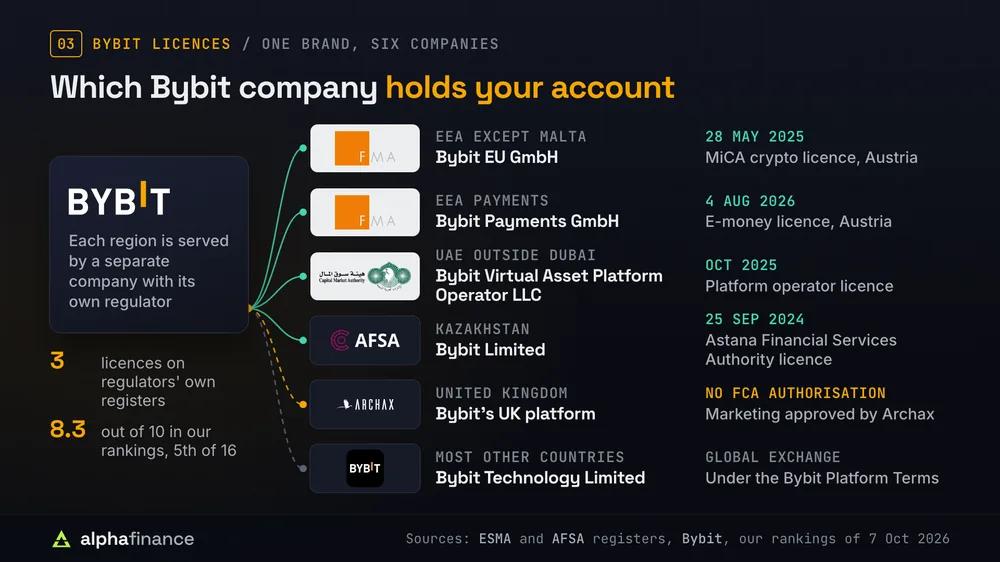
Where you live determines which Bybit company holds your account. Each company answers to a different regulator.
| Region | Bybit company | Licence or status |
|---|---|---|
| EEA except Malta | Bybit EU GmbH | Crypto licence from Austria's Financial Market Authority, granted 28 May 2025 |
| EEA payments | Bybit Payments GmbH | Electronic money institution licence from the same authority, granted 4 Aug 2026 |
| United Arab Emirates outside Dubai | Bybit Virtual Asset Platform Operator LLC | Platform operator licence from the federal Securities and Commodities Authority, now the Capital Market Authority, announced October 2025 |
| Kazakhstan | Bybit Limited | Licence from the Astana Financial Services Authority, active since 25 Sep 2024 |
| United Kingdom | Bybit's UK platform | No FCA authorisation; marketing approved by Archax on 18 Dec 2025 |
| Most other countries | Bybit Technology Limited | The global exchange, under the Bybit Platform Terms |
The EU register of crypto firms, maintained by the European Securities and Markets Authority (ESMA), records the Austrian licence date. In its announcement of the UAE licence, Bybit said the approval covers trading, brokerage, custody and currency conversion for retail and institutional clients. The federal authority became the Capital Market Authority on 1 Jan 2026, Latham & Watkins noted.
Kazakhstan's entry is available on the AFSA public register. Malaysia's securities regulator identifies the global operator as Bybit Technology Limited, formerly Bybit Fintech Limited.
Our crypto exchange rankings count licences only when they appear on a regulator's own register. As of 7 Oct 2026, Bybit received credit for three, covering the EU, the UAE and Kazakhstan. Its score of 8.3 out of 10 placed it fifth among 16 exchanges.
European customers use an Austrian company supervised under the Markets in Crypto-Assets Regulation (MiCA), the EU's crypto law. Its product range is narrower than the global exchange's.
Bybit EU GmbH received its licence from Austria's Financial Market Authority on 28 May 2025. A licence granted by one member state can be used across the EEA through an arrangement called passporting.
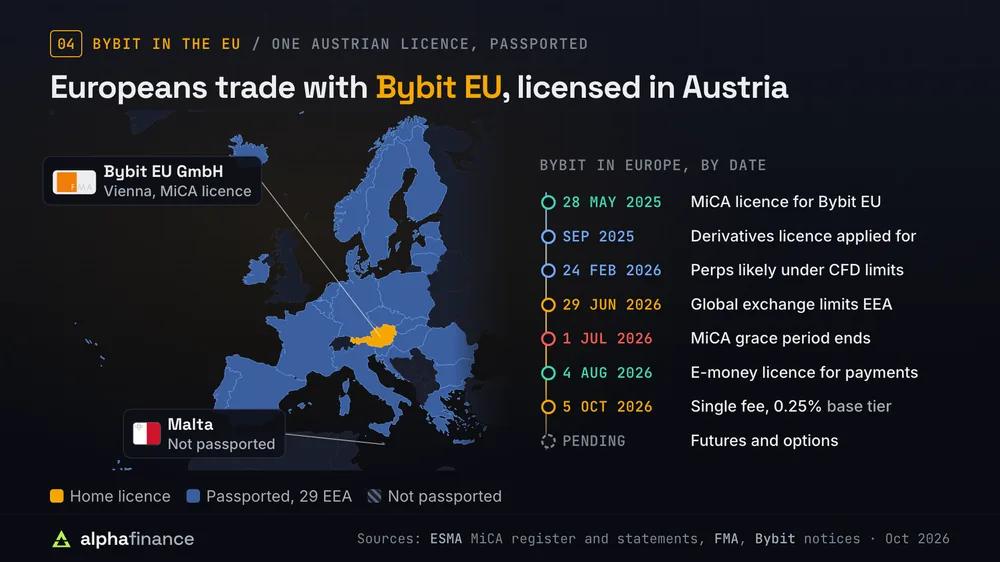
The grace period for firms operating under older national rules ended on 1 Jul 2026. Unlicensed providers must wind down their EU business after that date. Firms based outside the EU cannot serve or solicit EU clients, ESMA said in its statement of 23 Jun 2026.
Because Bybit's global exchange has no MiCA licence, its European customers are being transferred.
Bybit EU is authorised to provide custody, exchange crypto for money or other crypto, and handle placement and transfers. Bybit's announcement of its payments licence lists these services and says a sister company can now issue electronic money and run payment services.
A single fee structure has applied since 5 Oct 2026, with spot trades charged 0.25% at the base tier, according to Bybit EU's fee schedule. The platform ranks third of ten in our assessment of MiCA-licensed exchanges in Europe, which notes that its terms name no out-of-court complaints body.
Bybit EU does not yet offer leveraged contracts. Derivatives, whose value follows an asset's price, fall under MiFID II in the EU. That is the rulebook for investment firms.
In September 2025, group company Bybit X GmbH applied for an Austrian investment firm licence to offer futures and options on bybit.eu, according to Bybit EU's statement on the application. In September 2026 The Paypers reported that approval was expected within about two months, citing a CoinDesk interview with chief executive Ben Zhou.
Zhou said a year of European operations under the crypto licence alone had not been profitable. Perpetual futures are likely to fall under national restrictions on contracts for difference, ESMA said on 24 Feb 2026.
Bybit excludes Americans and offers Britons a reduced service. Australians can access the global exchange, although it has no local licence behind it.
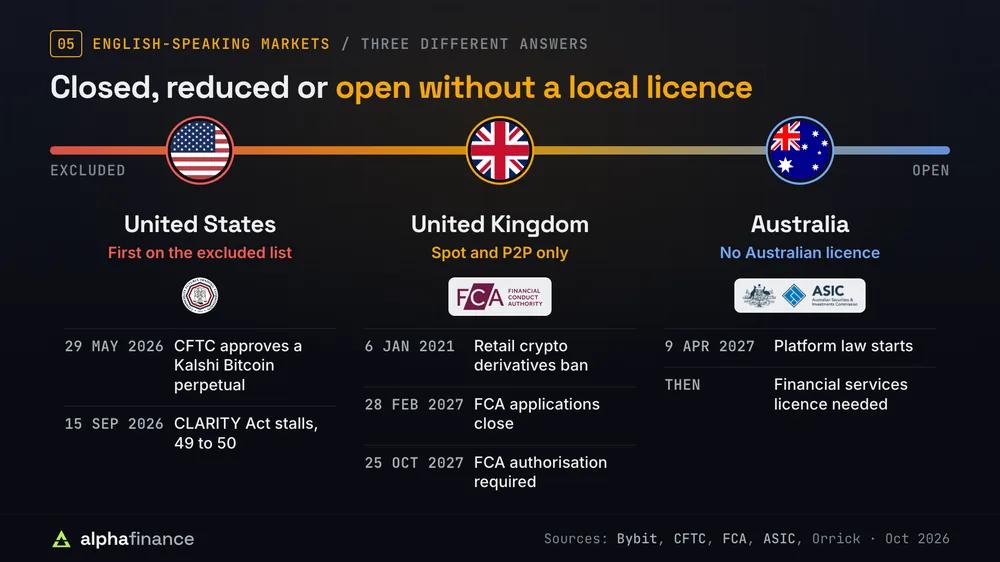
The United States appears first on Bybit's excluded list. Bybit has no American company, and our rankings found no US licence on the registers checked on 7 Oct 2026.
On 29 May 2026, the Commodity Futures Trading Commission, the US derivatives regulator, approved a Bitcoin perpetual contract submitted by Kalshi. A bill establishing federal rules for exchanges later stalled in the Senate on 15 Sep 2026 following a 49 to 50 vote. Our CLARITY Act explainer covers that bill.
Americans comparing licensed options can start with our list of crypto exchanges in the United States.
Bybit suspended UK services in October 2023 ahead of stricter marketing rules and relaunched on 19 Dec 2025. UK residents can use it again.
The platform offers spot trading, where coins are bought and delivered straight away, alongside a peer-to-peer marketplace for customers to trade with each other. It does not offer derivatives. The Financial Conduct Authority (FCA) has banned crypto derivatives for retail consumers since 6 Jan 2021.
Bybit states in its launch announcement that the FCA does not authorise, regulate or register it. Archax, an FCA-authorised firm, approved its marketing on 18 Dec 2025. Neither the Financial Ombudsman Service nor the Financial Services Compensation Scheme covers its customers.
The application window for the UK's full crypto regime opened on 30 Sep 2026 and closes on 28 Feb 2027. Firms will need FCA authorisation from 25 Oct 2027, according to the FCA's guidance for crypto firms.
Australian residents can open accounts on the global exchange because Australia is absent from the excluded list. None of the three licences our rankings credit to Bybit is Australian.
The country's digital asset platform law takes effect on 9 Apr 2027, according to ASIC's reform roadmap. Platforms will then need a financial services licence. Our guide to crypto exchanges in Australia covers those that already hold local approvals.
Several countries have taken action against Bybit despite not appearing on its excluded list. Serving local customers without registration has usually been the reason.
| Date | Regulator | Action against Bybit |
|---|---|---|
| 14 Mar 2024 | Securities and Futures Commission, Hong Kong | Added to the alert list of suspicious trading platforms |
| 22 Oct 2024 | De Nederlandsche Bank, Netherlands | Fined €2.25 million for serving Dutch customers without registration until September 2023 |
| 27 Dec 2024 | Securities Commission Malaysia | Reprimanded Bybit and its chief executive and ordered its website and apps disabled |
| 31 Jan 2025 | Financial Intelligence Unit, India | Imposed a penalty of ₹9.27 crore for operating without registration |
| 28 Jun 2025 | Securities and Exchange Commission, Thailand | Had access blocked from this date for operating without a licence |
| 1 Aug 2025 | Securities and Exchange Commission, Philippines | Named Bybit among ten unregistered platforms |
| 17 Jun 2026 | Monetary Authority of Singapore | Added Bybit Fintech Limited to the Investor Alert List |
Cointelegraph's report on the ten exchanges covered the Philippine advisory. In India, the regulator said Bybit had continued expanding without registration, resulting in its websites being blocked.
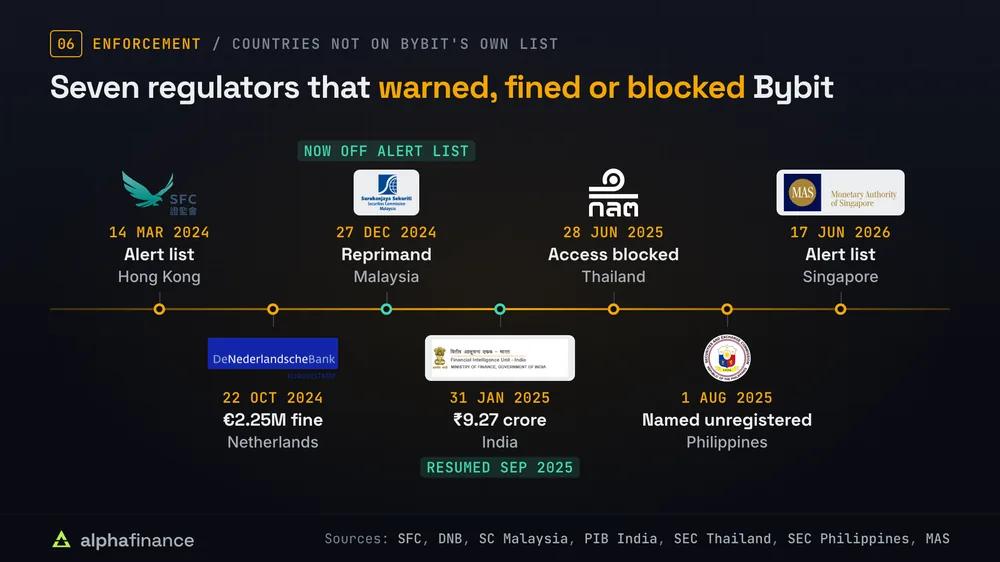
Full trading resumed in India in September 2025, according to CoinDesk's report on the UAE licence.
Bybit had appeared on Malaysia's Investor Alert List since July 2021. Zhou said in April 2026 that the Securities Commission had removed it following talks with the regulator, BanklessTimes reported. Bybit no longer appeared on the SC's Investor Alert List when we checked on 10 Oct 2026.
Singapore's Investor Alert List warns the public about firms that may be mistaken for licensed businesses. An entry carries no fine and makes no finding of wrongdoing.
In response, Bybit said it does not serve Singapore, excludes the country in its terms and blocks Singapore internet addresses, according to Fintech News Singapore. The exchange said it was asking the regulator to explain the basis for the listing.
Residence and identity documents determine eligibility on Bybit. The internet connection provides a secondary check.
Customers must tell Bybit immediately if they become resident in an excluded jurisdiction. Identity verification, known as know your customer (KYC), provides the evidence. For users classified as Japanese residents, Bybit required its second level of identity checks, including proof of address, to establish that they lived elsewhere.
The exchange says it blocks Singapore internet addresses. Decrypt reported that addresses in mainland China are also blocked.
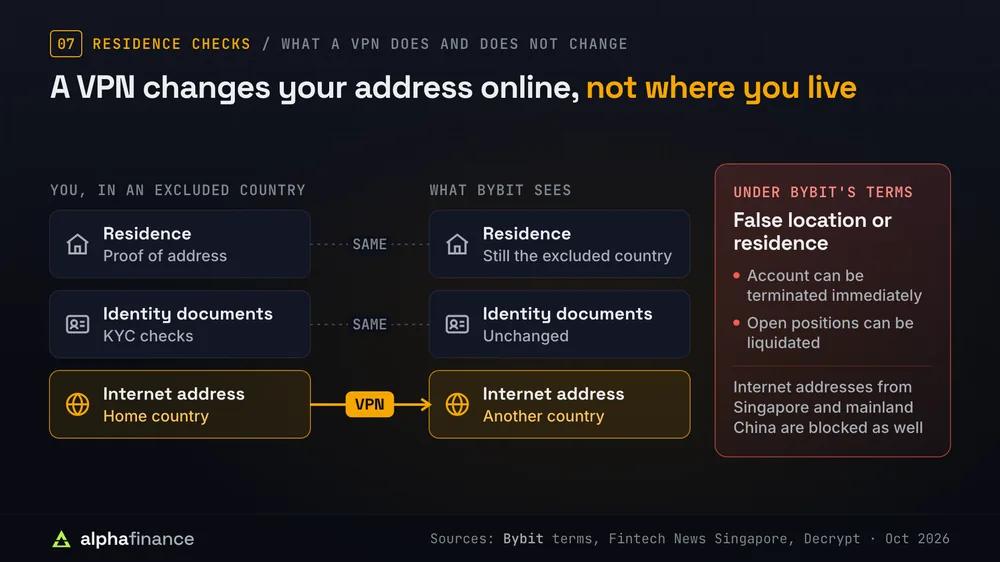
A virtual private network (VPN) changes the internet address visible to a website. It does not change residence or identity documents, which determine whether Bybit's exclusions apply.
Under its terms, Bybit can immediately terminate an account and liquidate open positions if it finds that a user supplied false information about their location or residence.
Bybit can immediately close an account opened from an excluded place and end open trades at the market price available that day.
The clause containing the country list grants this power. Forced closure matters most for leveraged positions, which let traders control more than the money they put up. That money is called margin, and a leveraged position can lose all of it.
A price move of about 10% against a trade at 10 times leverage is enough to lose the entire margin. The exchange then closes the position through a liquidation. Our crypto liquidations dashboard tracks these events across futures markets, while our liquidation price calculator shows the price at which a given position would close.
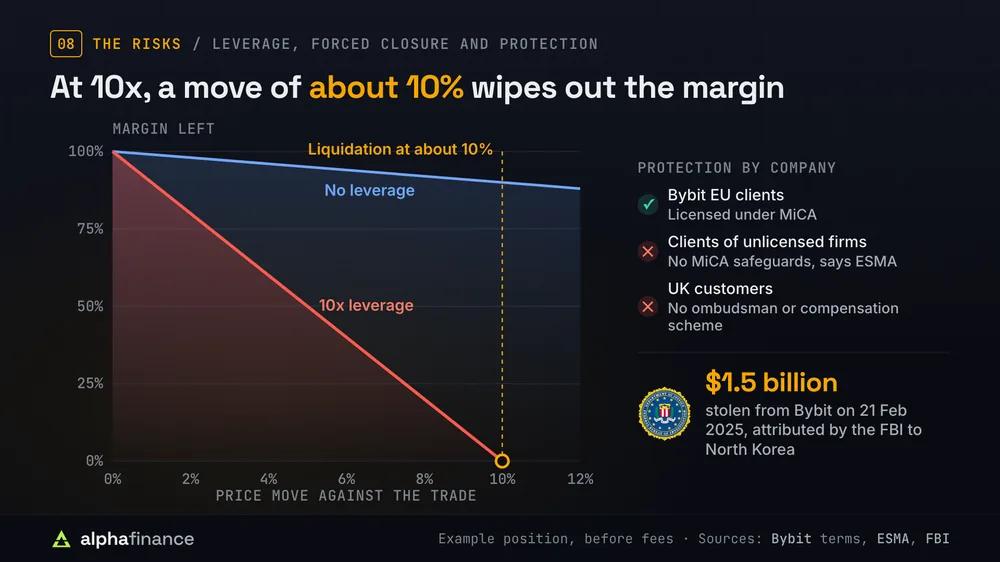
The company holding an account determines its legal protections. ESMA's June statement says clients of firms without an EU licence do not receive MiCA's safeguards. UK customers cannot use the ombudsman or the compensation scheme.
On 21 Feb 2025, about $1.5 billion in crypto was stolen from Bybit. The FBI attributed the theft to North Korea. A later national block creates a separate problem for customers, as Thailand's regulator illustrated when it told users to deal with their assets before its June 2025 block.
Not investment advice
This article explains market data. Nothing on this page is a recommendation to buy, sell or leverage any asset. Digital assets are volatile and you can lose everything you put in. If you are unsure whether a trade is appropriate for you, a licensed adviser in your jurisdiction is the right next step.


Fact checked by
Verifies every figure against primary sources before publication. Meet the team
Bybit restricted countries are the United States, mainland China, Hong Kong, Singapore, Canada, North Korea, Cuba, Iran, Uzbekistan, Sudan and Syria. It also excludes Russian-controlled regions of Ukraine and Sevastopol. Bybit's restricted countries page was last updated on 1 Sep 2026, and the exchange can add places at its discretion.
US residents cannot use Bybit. The United States appears first on the excluded list, and Bybit has no American company. Its terms allow account termination and liquidation of open positions when users make false statements about residence.
Bybit's UK platform is available to residents following its relaunch on 19 Dec 2025. It offers spot trading and a peer-to-peer marketplace. Although authorised firm Archax approves its marketing, Bybit is not authorised, regulated or registered by the FCA. Crypto derivatives remain banned for UK retail customers.
Austria's Financial Market Authority granted Bybit EU GmbH a MiCA licence on 28 May 2025, according to ESMA's register. Through bybit.eu, it serves every EEA country except Malta. The global exchange has no EU licence and began limiting services for EEA residents after its notice of 29 Jun 2026.
Australian residents can open accounts on the global exchange because their country is not excluded. Our rankings found licences in the EU, the UAE and Kazakhstan on 7 Oct 2026, but none in Australia. Australian law will require platforms to hold a financial services licence from 9 Apr 2027.
A VPN hides an internet address without changing where a customer lives. Bybit bases eligibility on residence and requires identity checks. False statements about location can result in account closure and liquidation of open positions.