Markets
 BTC
BTC ETH
ETH BNB
BNB XRP
XRP SOL
SOL ZEC
ZEC HYPE
HYPE DOGE
DOGE LINK
LINK TON
TON AVAX
AVAX SUI
SUI TAO
TAO AAVE
AAVE PUMP
PUMP MORPHO
 ARB
ARB LIT
LIT--:-- UTC
Research/Founders
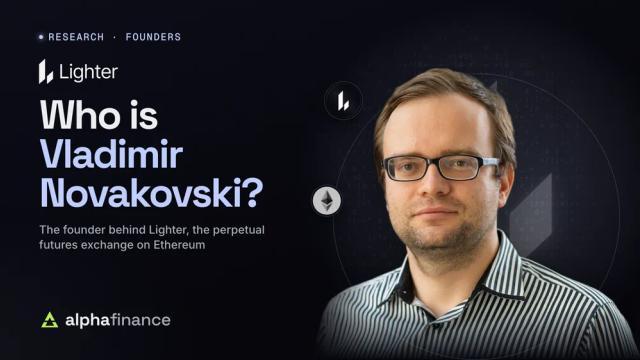
Vladimir Novakovski's path from Harvard at 16 and Citadel to founding Lighter, how his LIT token stake is valued, and why Robinhood and US regulators now shape his plans.
 By Alpha Finance Editorial Team
 Fact-checked by Vince Dioquino
Every figure, platform detail and regulatory claim on this page was traced to a primary source by the named fact checker before publication, and is re-checked when those facts change. The review date moves only when a person has re-read the page.
The editorial policy → Editorial policy Report an errorVladimir Novakovski founded Lighter in 2022 by rebuilding a stalled AI start-up. He runs the perpetual futures exchange as chief executive. Lighter settles on Ethereum and charges no trading fee on its default account.
The former Citadel trader entered Harvard at 16. Today, he manages Lighter's Robinhood partnership and advises the US derivatives regulator, while his team's tokens remain locked until December 2026.
Vladimir Novakovski, usually called Vlad, decides how Lighter and its token work. On the decentralised exchange (DEX), customers trade from their own crypto wallets while software on a public blockchain holds the funds. Lighter's documentation says users retain custody of their assets at all times.
Perpetual futures account for most activity. Traders use these contracts with leverage to hold positions larger than the money they put up, known as margin.
According to DefiLlama's Lighter dashboard, the exchange processed $58.7 billion of perpetual futures trades in the 30 days to 9 Oct 2026. Lifetime volume reached $1.85 trillion, while open interest, the total value of positions still open, stood at $875.3 million.
Lighter ranked third by 30-day volume on DefiLlama's ranking of perpetual futures exchanges. Hyperliquid led with $208.9 billion, followed by Variational at $72.0 billion.
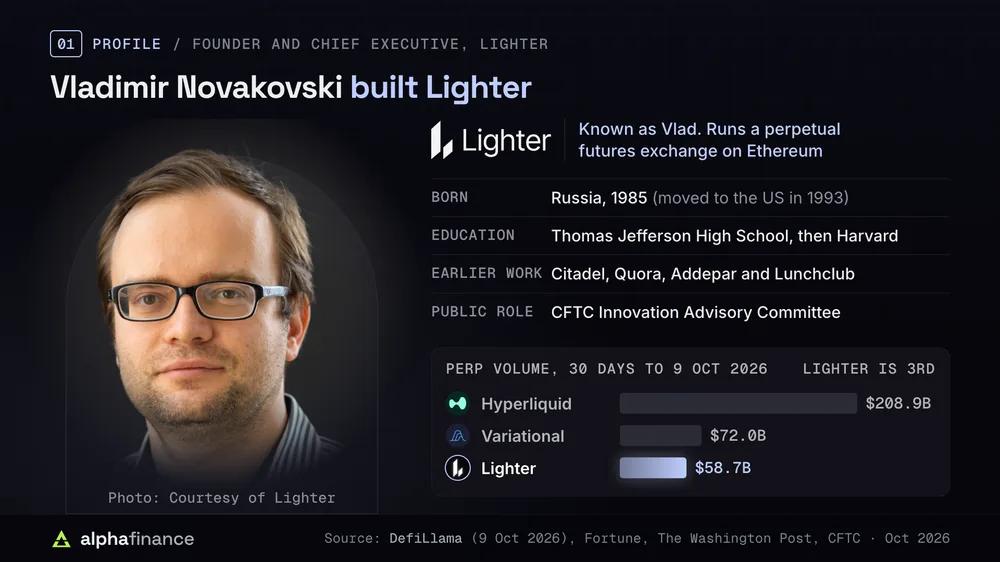
Born in Russia, Novakovski moved to the United States with his parents in 1993 without speaking English. Both parents had studied physics in Moscow, he told The Washington Post in February 2001. Competitive science and, later, high-speed trading shaped the exchange he would build.
At the time of the newspaper's interview, he was 15 and attended Thomas Jefferson High School for Science and Technology in Fairfax County, Virginia. His design for a computer that calculates using light had reached the final of the Intel Science Talent Search.
Silver medals followed that summer at the International Physics Olympiad in Turkey and the International Olympiad in Informatics in Finland. The magazine of the computing association USENIX recorded both results in August 2001, spelling his surname Novakovsky.
Fortune reported in November 2025 that Novakovski entered Harvard at 16, graduated early and joined Citadel at 18. He told the magazine that the hedge fund's founder, Ken Griffin, recruited him personally. Fortune gave his age as 40. Together with the Post's account, that places his birth in 1985.
From 2004, his work at Citadel involved building high-frequency trading systems for foreign exchange, according to his X profile. These systems use software to place and cancel orders in fractions of a second. His profile also lists subsequent machine learning roles at Quora and a position as vice-president of engineering at Addepar.
Novakovski co-founded the AI-powered networking service Lunchclub in 2017 with Scott Wu and Hayley Leibson. The company raised about $30 million and grew during the pandemic before stalling in 2022, Fortune reported. Wu left to start Cognition, the AI coding company in which Novakovski's profile lists him as an early investor.
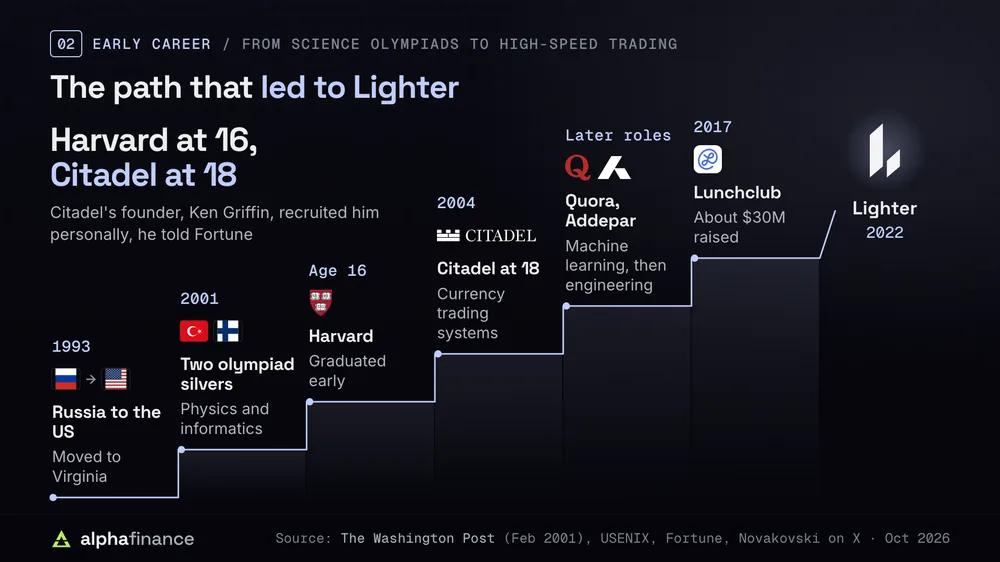
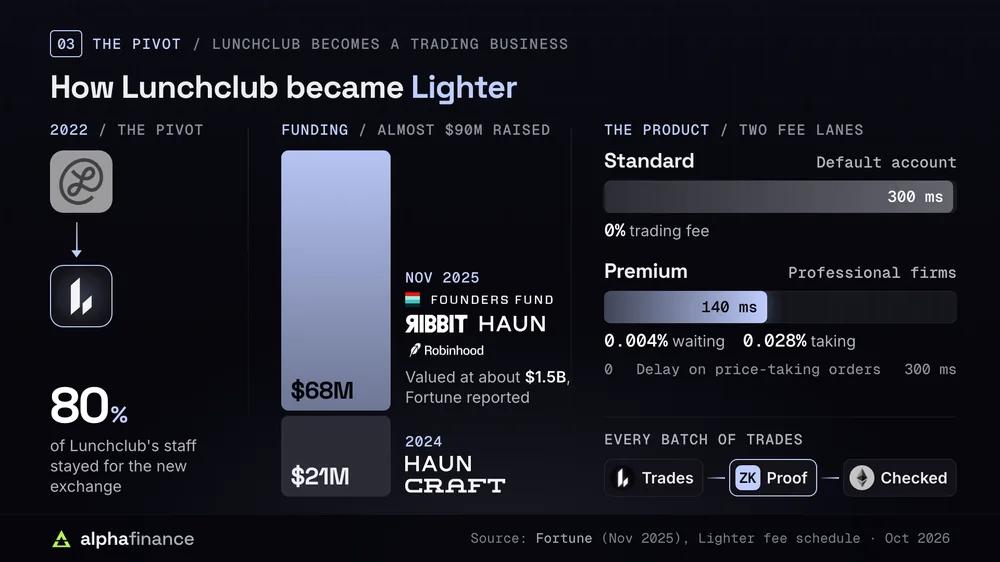
In 2022, Novakovski converted the stalled Lunchclub business into Lighter, returning to the trading systems he knew best. He retained 80% of the staff, according to Fortune. Haun Ventures and Craft Ventures then led a $21 million funding round in 2024.
Lighter runs on its own network attached to Ethereum, known as a layer 2. Every batch of trades generates a zero-knowledge proof, cryptographic evidence that trades and liquidations followed the published rules. A liquidation forcibly closes a position whose margin has run out. According to Lighter's technical documentation, Ethereum checks each proof before the exchange's records update.
Professional firms pay for faster execution, while standard accounts trade free. Orders from standard accounts that take an existing price face a 300 millisecond delay. Under Lighter's fee schedule, premium accounts pay 0.004% for orders that wait in the order book and 0.028% for those that take a price, with a 140 millisecond delay. The order book is the live list of buy and sell orders.
Trading began with invited testers in January 2025. The Defiant reported that Lighter opened to the public on 1 Oct 2025.
Lighter announced a further $68 million round on 11 Nov 2025, led by Founders Fund and Ribbit Capital, with Haun Ventures and Robinhood also participating. Two people familiar with the deal told Fortune that the company was valued at about $1.5 billion. Founders Fund partner Joey Krug said Novakovski and his team accounted for most of the firm's decision to invest.
Almost $90 million in venture funding distinguishes Lighter from Hyperliquid, which took no venture money. Our profile of Jeff Yan explains how Hyperliquid was funded.
| Date | Event | What it changed |
|---|---|---|
| 1993 | Family moves from Russia to the US | He starts school in Virginia |
| 2001 | Silver medals at the physics and informatics olympiads | He ranks among the top student competitors |
| 2004 | Joins Citadel at 18 | A career in high-speed trading begins |
| 2017 | Co-founds Lunchclub | First company as chief executive |
| 2022 | Converts Lunchclub into Lighter | He returns to trading systems |
| Oct 2025 | Lighter opens to the public | Trading extends beyond invited testers |
| Nov 2025 | Raises $68M | Founders Fund, Ribbit Capital and Robinhood invest |
| Dec 2025 | LIT token launches | 25% of supply goes to users |
| Jul 2026 | Robinhood Wallet adds Lighter | A mainstream brokerage app offers its markets |
| Dec 2026 | Team and investor tokens begin to unlock | Supply available to sell starts to grow |
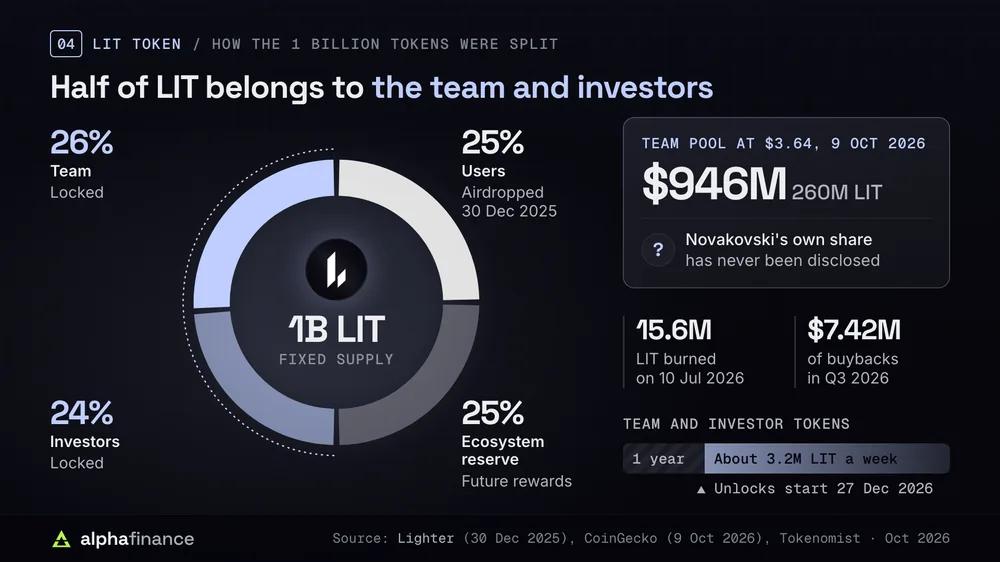
Novakovski holds his stake in Lighter through a token he cannot yet sell. The exchange announced the Lighter Infrastructure Token (LIT) on 30 Dec 2025, fixing supply at 1 billion. Lighter's launch post outlined the following allocation.
| Allocation | Share of supply | Status on 9 Oct 2026 |
|---|---|---|
| Users | 25% | Distributed on 30 Dec 2025 |
| Ecosystem reserve | 25% | Held for future user rewards and partnerships |
| Team | 26% | Locked until 27 Dec 2026 |
| Investors | 24% | Locked until 27 Dec 2026 |
Users received their 25% through an airdrop, a free distribution to people who had earned points by trading during 2025. CoinDesk reported that blockchain analytics firm Bubblemaps valued the distribution at $675 million. Our crypto airdrop tracker follows projects that may issue a token next.
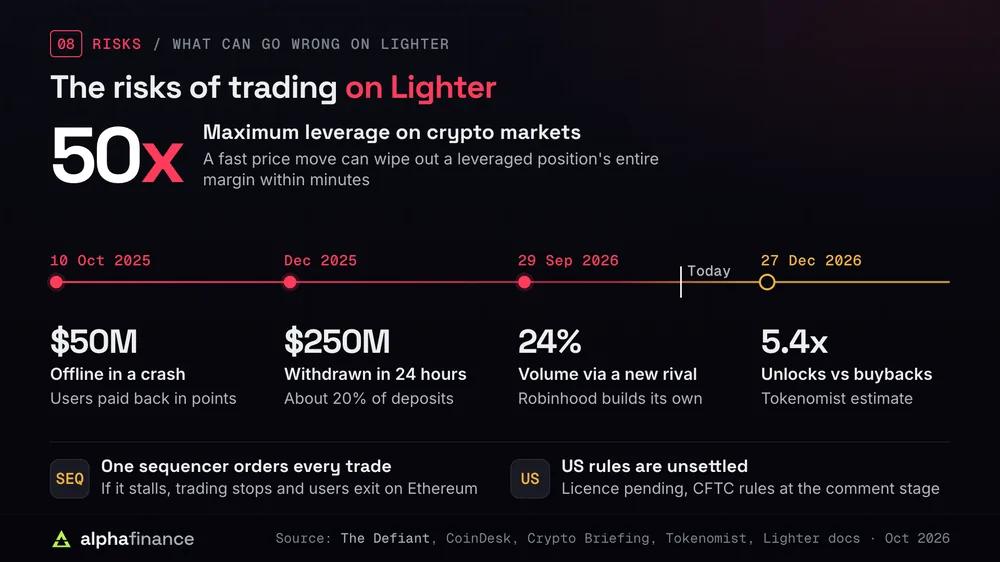
The team and investor allocations have a one-year lock, followed by equal releases over three years. This process is called vesting. Tokenomist's July 2026 analysis puts the first release on 27 Dec 2026 and estimates that about 3.2 million LIT will be released each week thereafter. Our token unlock calendar lists these scheduled releases, known as token unlocks, by date.
Some traders criticised the allocation of half the supply to insiders, Cointelegraph reported. At Hyperliquid, the equivalent share is 23.8%, according to Tokenomist.
Novakovski argues that LIT is the only claim on the business. Speaking on Unchained's The Chopping Block podcast in July 2026, he explained that a single US company, Lighter, issued both its shares and the token.
In an essay that month, he said shareholders had been told their stake would exist only as a token allocation. Fewer than 1% chose to sell, according to Odaily's summary of the essay.
Lighter uses trading fee revenue to buy LIT on the market and has destroyed the purchased tokens since 30 Jun 2026. Its first burn removed 15.6 million LIT on 10 Jul 2026. DefiLlama recorded $7.42 million of buybacks in the third quarter of 2026. The highest-earning crypto projects ranking compares Lighter's revenue with other projects.
According to CoinGecko's LIT page, LIT traded at $3.64 on 9 Oct 2026, valuing the 250 million circulating tokens at $909.5 million. That price put the team's 260 million tokens at about $946 million on paper. Novakovski has not disclosed his portion, so any quoted net worth figure is an estimate. Our live crypto prices include LIT.
Through Robinhood, Lighter can reach customers who have never used a crypto exchange. Since September 2026, the brokerage has also become a competitor. Novakovski told Unchained in July 2026 that he and a Robinhood founder attended high school together.
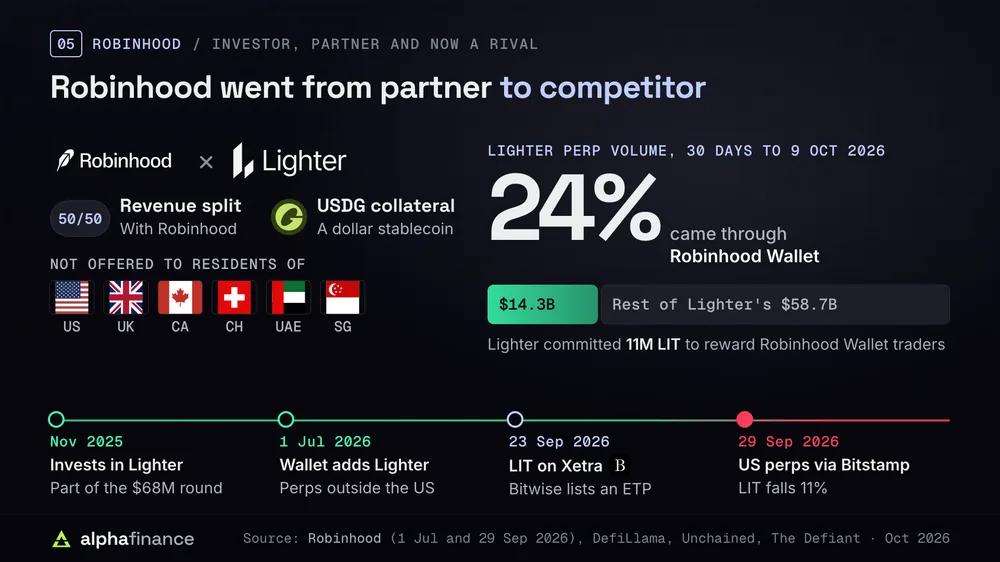
On 1 Jul 2026, Robinhood announced that eligible users in selected countries could trade Lighter perpetual futures within the Robinhood Wallet app. Lighter committed 11 million LIT to user rewards. The offering excludes residents of the US, UK, Canada, Switzerland, the United Arab Emirates and Singapore.
Revenue from this trading is split equally between the companies, Novakovski said on Unchained. Positions are backed by collateral held in USDG, a stablecoin designed to remain worth one US dollar. He acknowledged that using USDG adds friction for market makers, the trading firms that continuously post buy and sell orders.
DefiLlama's figures show that Robinhood trading generated $14.3 billion of Lighter's perpetual futures volume in the 30 days to 9 Oct 2026. That represented 24% of the total.
On 29 Sep 2026, Robinhood announced plans that exposed the partnership's limits. Eligible US customers would receive perpetual futures in its main app in the coming months. Robinhood's own registered futures business will supply those contracts through Bitstamp, an exchange it owns. The Defiant reported that LIT fell 11% after the announcement.
A week earlier, stock market investors had gained access to LIT. Bitwise listed an exchange-traded product (ETP) holding the token on Germany's Xetra market on 23 Sep 2026, according to crypto.news. An ETP trades on a stock exchange as a security that tracks an underlying asset.
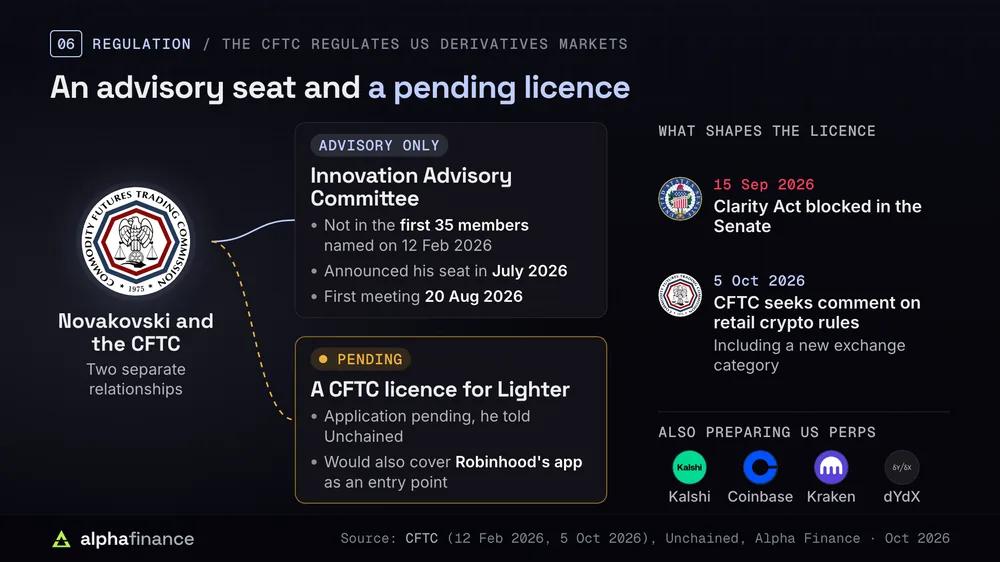
The Commodity Futures Trading Commission (CFTC) regulates US derivatives markets. Novakovski is seeking its approval for Lighter while serving on its Innovation Advisory Committee. The agency's committee roster lists him as Lighter's founder and chief executive.
His name did not appear among the first 35 members announced on 12 Feb 2026. He announced his appointment in July 2026, joining members including the chief executives of Robinhood, Coinbase and CME Group, as well as Polymarket's Shayne Coplan. The first committee meeting took place on 20 Aug 2026.
Under the committee's charter, its role is limited to advice. Membership therefore gives Lighter no approval of its own.
A CFTC licence application is pending, Novakovski told Unchained. He said approval would also cover Robinhood's app as an entry point to Lighter.
Congress has made the licensing process less predictable. As our Clarity Act explainer describes, the bill would have set licensing rules for crypto exchanges but was blocked in the Senate on 15 Sep 2026. The CFTC began seeking public comment on its own rules for retail crypto trading on 5 Oct 2026, including a new exchange registration category.
Established competitors are preparing to enter that market. Unchained's interview summary names Kalshi, Coinbase, Kraken and dYdX among the companies working on US perpetual futures.
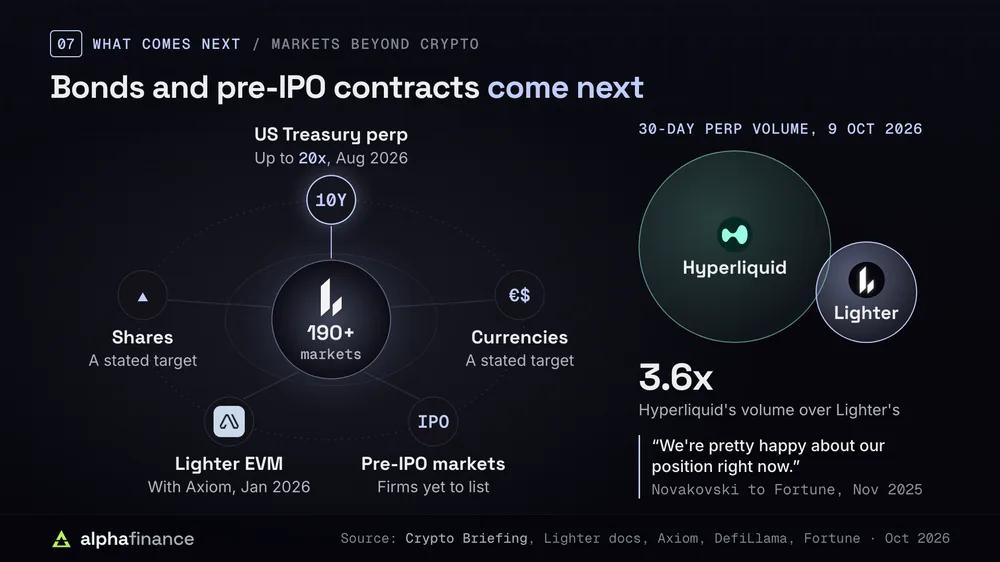
Novakovski wants Lighter to host markets in shares, currencies and government bonds alongside crypto. His aim, he told Fortune, is to build infrastructure that verifies financial activity is conducted fairly and transparently.
At Korea Blockchain Week, held from 29 Sep to 1 Oct 2026, he described fixed income as a large opportunity for decentralised finance, Crypto Briefing reported. Bonds are his newest target. Lighter had launched a perpetual contract on the 10-year US Treasury in August 2026, offering leverage of up to 20 times. By then, the exchange listed more than 190 markets.
Lighter's pre-IPO markets offer contracts on companies that have yet to list on a stock exchange. Hyperliquid hosts a comparable range of perpetuals on stocks, gold and oil, tracked by our dashboard.
Outside developers can also build on Lighter through a second project, Lighter EVM. Axiom's announcement of the collaboration, published on 30 Jan 2026, says it allows other teams to run lending and other applications that draw on the exchange's markets.
Lighter still trails the market leader by a wide margin. On 9 Oct 2026, Hyperliquid's 30-day volume was about 3.6 times Lighter's in DefiLlama's ranking. Our Hyperliquid statistics page details its figures. When Fortune asked Novakovski in November 2025 how the exchanges compared, he replied, "We're pretty happy about our position right now."
Fast price moves can wipe out a leveraged position's entire margin within minutes. Lighter's crypto markets offer leverage of up to 50 times, Crypto Briefing reported. Our liquidation price calculator shows the price at which a given position would be forcibly closed.
Not investment advice
This article explains market data. Nothing on this page is a recommendation to buy, sell or leverage any asset. Digital assets are volatile and you can lose everything you put in. If you are unsure whether a trade is appropriate for you, a licensed adviser in your jurisdiction is the right next step.


Fact checked by
Verifies every figure against primary sources before publication. Meet the team
Vladimir Novakovski founded Lighter and runs the Ethereum-based decentralised perpetual futures exchange as chief executive. Born in Russia and raised in Virginia, he entered Harvard at 16 before joining Citadel at 18. He subsequently worked at Quora and Addepar, then co-founded the AI networking start-up Lunchclub.
In 2022, Vladimir Novakovski founded Lighter by turning his earlier company, Lunchclub, into a trading business. Fortune reported that he retained 80% of the Lunchclub team. Trading began with invited users in January 2025, followed by the public launch on 1 Oct 2025.
Novakovski has not made his net worth public, so published figures are estimates. He holds an undisclosed portion of the 26% of LIT reserved for Lighter's team. The entire team pool was worth about $946 million on paper at the token's price on 9 Oct 2026 and remains locked until 27 Dec 2026.
Fortune reported that Novakovski was 40 in November 2025, while The Washington Post described him as 15 in February 2001. Together, those accounts place his birth in 1985. His family moved from Russia to the United States in 1993.
Robinhood does not own Lighter. It is an investor and distribution partner, having participated in the $68 million funding round in November 2025. Since 1 Jul 2026, the Robinhood Wallet has offered perpetual futures on Lighter outside the US. Its planned US perpetual futures offering will use Robinhood's own Bitstamp exchange.
The CFTC lists Novakovski as a member of its Innovation Advisory Committee, which advises the agency on technology and financial innovation. His advisory role gives Lighter no licence. He has said a CFTC licence application is pending.