Shayne Coplan built Polymarket alone in a New York apartment and now runs a company valued at $21 billion. His record includes a federal penalty, an FBI search and a lawsuit from his home state.
Every figure, platform detail and regulatory claim on this page was traced to a
primary source by the named fact checker before publication, and is re-checked each
quarter. The review date moves only when a person has re-read the page.
Shayne Coplan founded Polymarket and still runs it: After leaving New York University, he started the prediction market in 2020 and remains chief executive. A funding round reported on 31 Aug 2026 valued the company at $21 billion.
His wealth sits in a private company: The most cited net worth estimate is $1 billion, based on an 11% stake that Polymarket has never confirmed. Its shares do not trade publicly, so the figure changes only when new investors set a price.
He was investigated and never charged: Polymarket received a $1.4 million fine from the US derivatives regulator in January 2022. The FBI searched Coplan's home in November 2024, and both federal investigations closed in July 2025.
Polymarket returned to the US through an acquisition: In July 2025, Coplan's company paid $112 million for a licensed exchange. Its US app opened to all eligible users in May 2026.
New legal threats arrived in 2026: A US soldier was charged in April with trading on classified information on Polymarket. On 24 Sep 2026, New York State sued the company's US exchange, calling it unlicensed gambling.
Shayne Coplan founded Polymarket in his New York apartment in 2020 and remains its chief executive. The prediction market lets people trade on the outcome of real-world events. A funding round reported in August 2026 valued the company at $21 billion.
Coplan, 28, presents Polymarket as a source of real-time information. A growing number of US states call it gambling. The company has faced a federal penalty and an FBI search of his home, followed by a lawsuit from New York State.
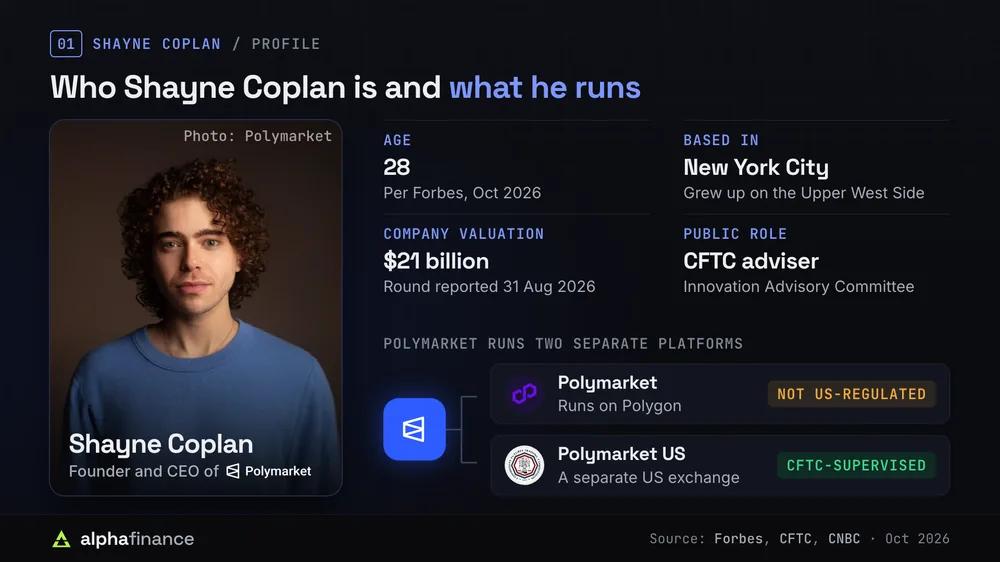
Who Shayne Coplan is and what he runs
As the head of one of the two largest prediction markets, Coplan decides how it operates and which events people can trade. Contracts pay $1 if a stated event happens and nothing if it does not. A price of 40 cents implies a 40% chance. Our prediction market odds dashboard displays those live probabilities.
Polymarket offers event contracts through two platforms. The international site runs on the Polygon blockchain and is not regulated in the United States, CNBC reported on 29 Sep 2026. Its separate Polymarket US exchange is supervised by the Commodity Futures Trading Commission (CFTC), the regulator of US derivatives markets such as futures.
Full name: Shayne Coplan
Role: Founder and chief executive of Polymarket
Age: 28, according to Forbes on 1 Oct 2026
Based in: New York City
Education: The Beacon School, then one semester of computer science at New York University
Company valuation: $21 billion, reported on 31 Aug 2026
Public role: Member of the CFTC's Innovation Advisory Committee, named on 12 Feb 2026
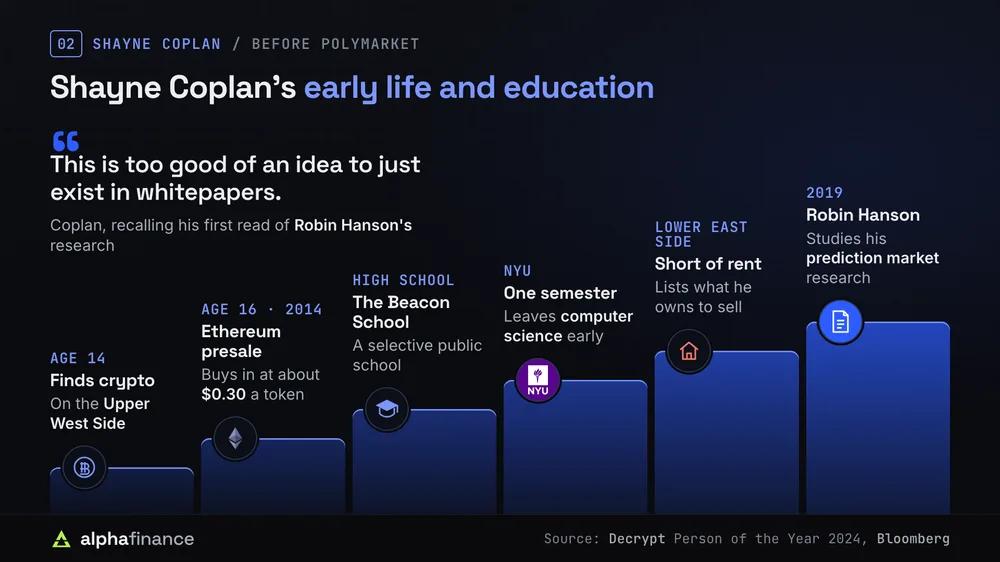
Shayne Coplan's early life and education
Coplan came to prediction markets through cryptocurrency. He grew up on Manhattan's Upper West Side and discovered crypto at 14, according to Decrypt's 2024 Person of the Year profile. Two years later, he bought Ethereum at about $0.30 a token in its 2014 presale, before the network went live.
After attending The Beacon School, a selective public high school, Coplan studied computer science at New York University. He left after one semester. Both his parents teach at universities in New York City, Decrypt reported.
Within a few years, money was tight enough that he listed the contents of his Lower East Side apartment to see what he could sell to cover rent, Bloomberg reported. He began reading economist Robin Hanson's research on prediction markets in 2019 and later recalled thinking, "This is too good of an idea to just exist in whitepapers."
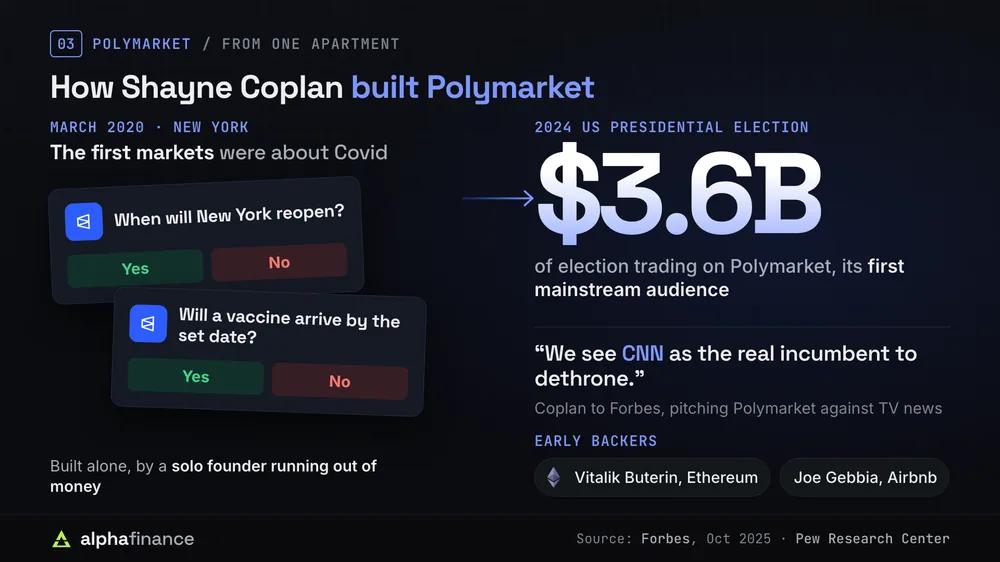
How Shayne Coplan built Polymarket
During the first Covid lockdown, Coplan built Polymarket alone and launched it from his apartment in March 2020. The first markets asked when New York would reopen and whether a vaccine would arrive by a set date, according to Forbes. He has described working from a makeshift bathroom office as a solo founder running out of money.
Augur and Gnosis, earlier blockchain prediction markets, had attracted few users. Coplan pitched Polymarket as a rival to television news. "We see CNN as the real incumbent to dethrone," he told Forbes. Ethereum co-founder Vitalik Buterin and Airbnb co-founder Joe Gebbia were among its early backers.
A mainstream audience arrived during the 2024 US presidential election, when Polymarket's election trading reached $3.6 billion, according to Forbes. Politics was the platform's largest category during the vote, Pew Research Center found.
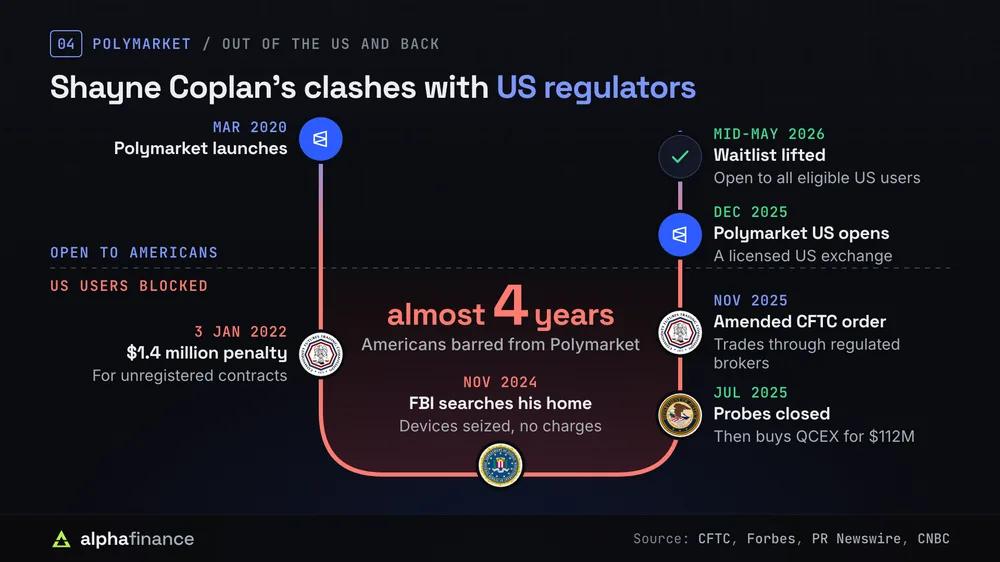
Shayne Coplan's clashes with US regulators
On 3 Jan 2022, the CFTC ordered Polymarket to pay a $1.4 million penalty for offering event contracts without registering as an exchange. Polymarket wound down the offending markets and blocked US users. Americans remained barred for almost four years as Coplan worked to regain access.
FBI agents searched his apartment and seized his devices a week after the 2024 election. Forbes linked the search to possible breaches of the 2022 settlement. Coplan was never charged. In July 2025, the Department of Justice and the CFTC closed their investigations.
Polymarket paid $112 million for QCEX a week later. QCEX owned a CFTC-licensed exchange and clearinghouse, which stands between buyers and sellers to guarantee that each trade settles.
The CFTC issued an amended order of designation for Polymarket US in November 2025. This allowed customers to trade through futures commission merchants, the regulated brokers of the derivatives industry. The US exchange launched in December 2025 and lifted its waitlist in mid-May 2026, according to CNBC.
Key dates in Shayne Coplan's career
Date
Event
What it changed
Mar 2020
Coplan launches Polymarket
A solo founder opens markets on Covid outcomes
Jan 2022
CFTC orders a $1.4M penalty
Polymarket blocks US users
Nov 2024
FBI searches Coplan's home
A federal investigation becomes public
Jul 2025
Investigations close and QCEX is acquired
Polymarket owns a licensed US exchange
Oct 2025
Intercontinental Exchange agrees to invest up to $2B
Coplan becomes a billionaire on paper
Dec 2025
Polymarket US launches
Americans can trade on a regulated exchange
Feb 2026
CFTC names Coplan to an advisory committee
A former enforcement target advises the regulator
Apr 2026
US soldier charged over Maduro trades
Prosecutors allege classified information was traded on the site
Sep 2026
New York State sues Polymarket US
A state court will test whether the contracts are gambling
Polymarket's funding and Shayne Coplan's net worth
Coplan's billionaire status rests on his stake in Polymarket. With no publicly traded shares, the private company is revalued whenever investors buy in.
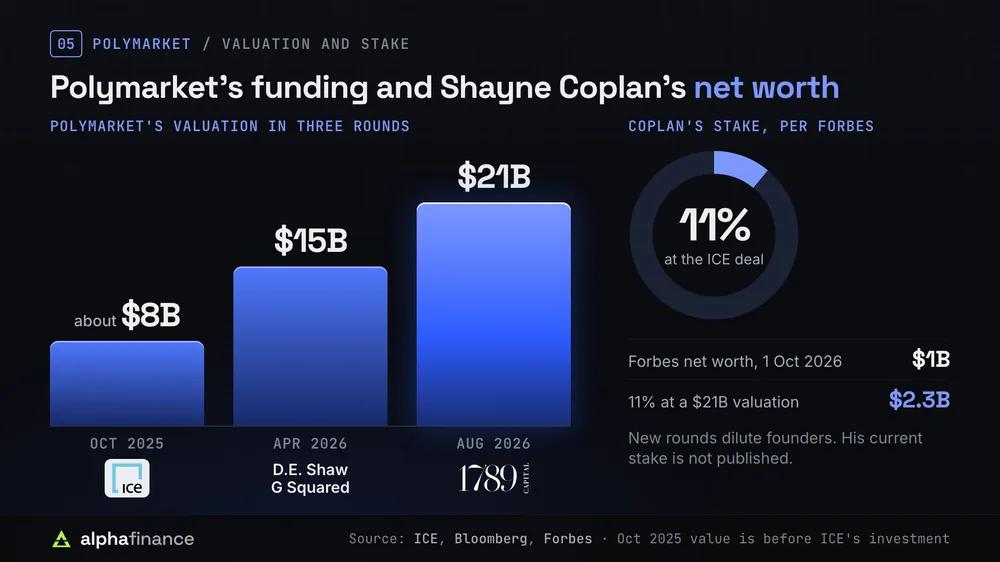
Intercontinental Exchange (ICE), which owns the New York Stock Exchange, is his best-known backer. On 7 Oct 2025, ICE agreed to invest up to $2 billion at a valuation of about $8 billion before the investment. A further $600 million investment was completed on 27 Mar 2026.
Date
Investors
Valuation
Oct 2025
Intercontinental Exchange
About $8B before the investment
Apr 2026
Round that added D.E. Shaw and G Squared
$15B
Aug 2026
Round led by 1789 Capital
$21B after the investment
Bloomberg reported the April and August valuations. Its 31 Aug 2026 report said 1789 Capital was leading a $1 billion round. Donald Trump Jr., a partner at 1789, advises both Polymarket and its main rival, Kalshi.
On 1 Oct 2026, Forbes's profile of Coplan listed his net worth at $1 billion. The estimate dates from the ICE deal, when Forbes put his stake at about 11%. At a $21 billion valuation, that percentage would be worth about $2.3 billion. Each funding round issues new shares and reduces a founder's percentage, however, and Polymarket has not disclosed his current holding.
Polymarket still charged no trading fees as late as October 2025, Forbes noted. By 26 Jun 2026, the company told CNBC its annualised revenue was well above $1 billion. Annualised revenue scales the latest period's income to a full year.
Insider trading claims and state lawsuits against Polymarket
Prosecutors and Congress are scrutinising the markets that made Coplan famous. State attorneys general are also challenging his company's operations.
Insider trading on war and politics markets
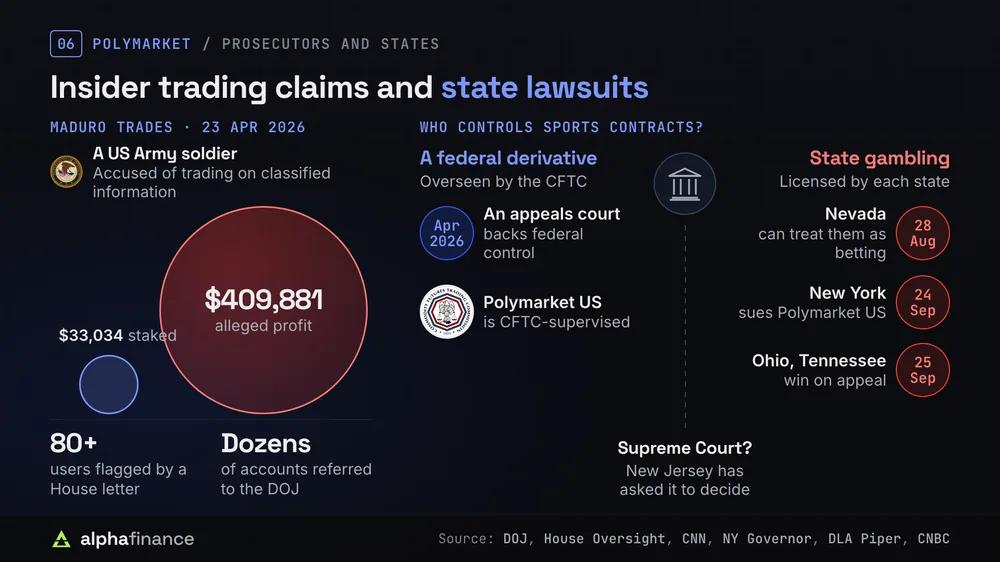
Betting on an event with confidential information about its outcome constitutes insider trading on a prediction market. On 23 Apr 2026, the Department of Justice charged US Army soldier Gannon Ken Van Dyke with using classified information about the operation to capture Venezuela's Nicolás Maduro. Prosecutors allege he staked about $33,034 on Polymarket contracts and made about $409,881. A parallel civil complaint was filed by the CFTC.
Polymarket says it identified Van Dyke and referred him to prosecutors. The company had published market integrity rules a month earlier, banning trades based on stolen or leaked information. Those rules also prohibit anyone who can influence an outcome from trading on it. On 21 Aug 2026, a senior official told CNN that Polymarket had referred dozens of accounts to the Justice Department.
In a 22 May 2026 letter to Coplan, the House Oversight Committee requested records on identity checks and insider trading. It cited reporting that more than 80 users had placed suspicious bets. The committee expanded its inquiry on 29 Sep 2026 to include other platforms, among them Hyperliquid. We cover its co-founder in our profile of Jeff Yan.
WIRED reported in September 2026 that the CFTC had authorised at least three more investigations into Polymarket trades between May and July. CCN summarised the findings. Coplan had addressed the scrutiny at an MIT conference in March 2026, saying growth brings "more money, more problems" and calling the Iran markets complicated, according to Bloomberg.
State gambling lawsuits and the Supreme Court
Sports contracts are the subject of a separate legal dispute. New York's governor and attorney general sued Polymarket US on 24 Sep 2026, alleging that it operates an unlicensed gambling business. The state seeks to stop the operation and impose fines, as well as require repayments to users. Polymarket sued the state that same day, CNBC reported.
Federal appeals courts have reached conflicting decisions on who has authority. In April 2026, one court held that event contracts are derivatives under the CFTC's control. Another ruled on 28 Aug 2026 that Nevada could treat sports contracts as betting, according to DLA Piper's litigation tracker.
On 25 Sep 2026, a third court sided with Ohio and Tennessee. New Jersey has asked the Supreme Court to resolve the question, CNBC reported.
Sports now dominate Polymarket's business, with trading nearing $22 billion across June and July 2026, Pew found. Polymarket US accounted for 39% of company volume in July, up from 4% in January. The same legal dispute explains the US states that restrict Kalshi's sports markets.
Shayne Coplan's rivalry with Kalshi's Tarek Mansour
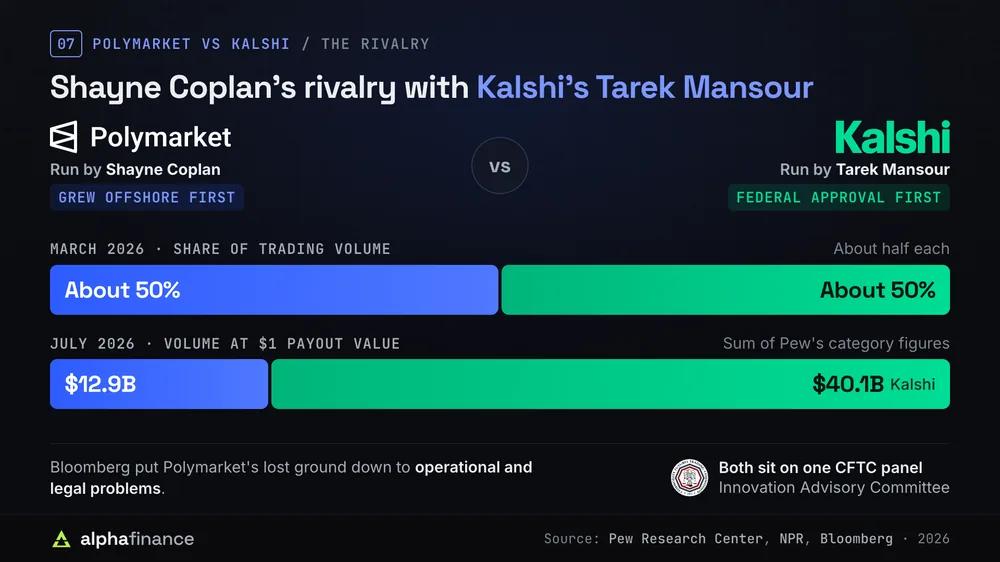
Kalshi obtained federal approval before opening in the US. Polymarket grew offshore first. The opposing strategies have been accompanied by open hostility between Coplan and Kalshi chief Tarek Mansour. According to NPR, Kalshi staff worked with influencers to spread memes mocking Coplan after the FBI search. Mansour later admitted this.
The platforms each held about half of all trading volume in March 2026, Pew found, but Kalshi subsequently pulled ahead. By July, Pew's category figures totalled about $40.1 billion for Kalshi and $12.9 billion for Polymarket.
These totals exceed the cash that changed hands because Pew counts each contract at its $1 payout value. Bloomberg attributed Polymarket's loss of ground to operational and legal problems.
Both founders remain members of the CFTC's Innovation Advisory Committee.
What Shayne Coplan plans next for Polymarket
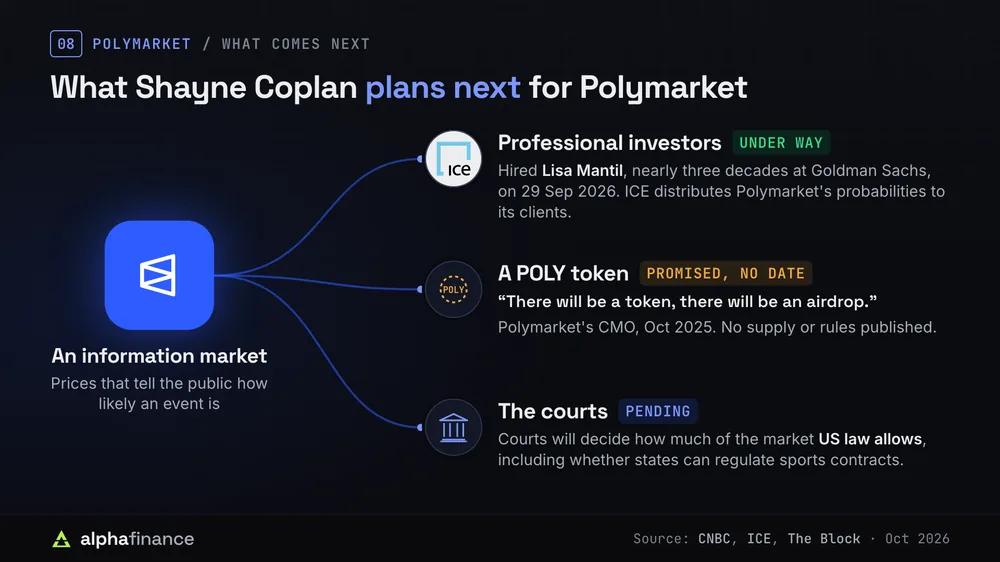
Polymarket hired Lisa Mantil as head of institutional growth on 29 Sep 2026 as Coplan targets professional investors. Mantil spent nearly three decades at Goldman Sachs, CNBC reported in its coverage of the hire that day. ICE also became a distributor of Polymarket's probabilities to institutional clients under the 2025 agreement.
A token is another possibility. In October 2025, Coplan posted the ticker POLY alongside Bitcoin and Ethereum. His chief marketing officer then said, "There will be a token, there will be an airdrop," The Block reported. An airdrop distributes a new token free to a project's early users.
No launch date has been published since then, nor has Polymarket disclosed the token supply or eligibility rules. Our crypto airdrop tracker lists projects without tokens and the odds traders assign to a launch.
For Coplan, Polymarket remains an information market whose prices tell the public how likely an event is. How much of that market US law permits will be decided in court.
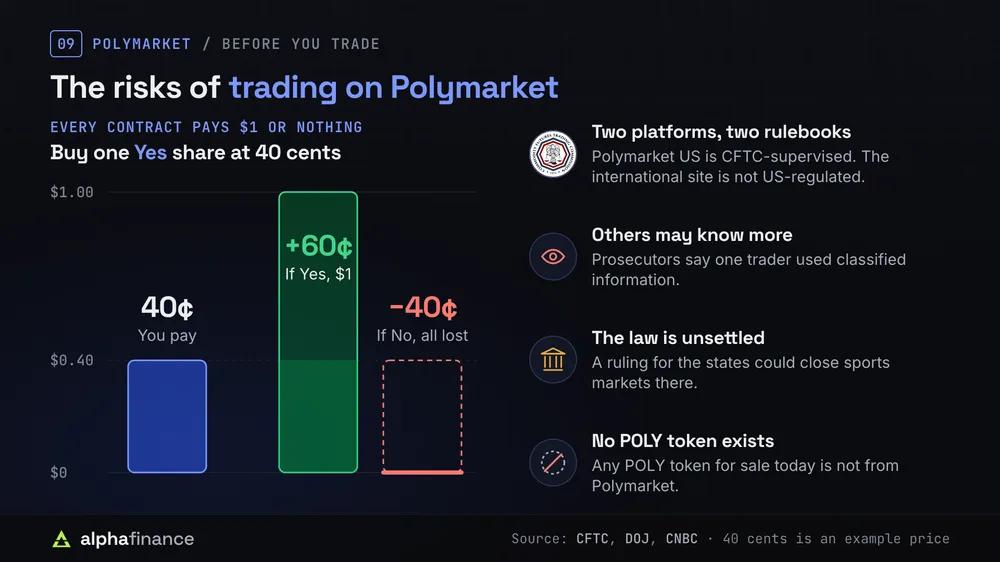
The risks of trading on Polymarket
Every Polymarket contract pays either $1 or nothing. If a position resolves against the trader, the entire amount paid for it is lost. The founder's reputation offers no protection for that money.
The two platforms carry different protections: The CFTC supervises Polymarket US. The international site is not regulated in the United States.
Other traders may know more: In the Van Dyke case, prosecutors allege that a trader held classified information unavailable to the people trading against him.
The law is unsettled: Courts are deciding whether states can regulate sports contracts. An adverse ruling could close those markets in a state.
No POLY token exists: Polymarket has not launched a token. Any POLY token offered for sale today does not come from the company.
Not investment advice
This article explains market data. Nothing on this page is a recommendation to buy, sell
or leverage any asset. Digital assets are volatile and you can lose everything you put
in. If you are unsure whether a trade is appropriate for you, a licensed adviser in your
jurisdiction is the right next step.
Written by
Alpha Finance Editorial Team
Part of the Alpha Finance research team. Meet the team
Fact checked by
Vince Dioquino
Verifies every figure against primary sources before publication. Meet the team
Questions
Who is Shayne Coplan?
Shayne Coplan founded Polymarket in New York in 2020 and remains chief executive. He built the prediction market alone after leaving New York University following one semester. A funding round reported in August 2026 valued the company at $21 billion.
What is Shayne Coplan's net worth?
Forbes listed Shayne Coplan's net worth at $1 billion on 1 Oct 2026, based on an estimated 11% stake in Polymarket. The private company has not disclosed his holding.
How old is Shayne Coplan?
According to Forbes's profile on 1 Oct 2026, Shayne Coplan is 28. He launched Polymarket in his early twenties and was 27 when Forbes named him the world's youngest self-made billionaire in October 2025.
Why did the FBI search Shayne Coplan's home?
In November 2024, the FBI searched Coplan's New York apartment and seized his devices as part of an investigation into whether Polymarket had breached its 2022 CFTC settlement. No charges were brought against him. The investigation closed in July 2025.
Is Polymarket legal in the US?
The federally regulated Polymarket US exchange has been open to all eligible US users since May 2026. Its status under state law remains disputed. On 24 Sep 2026, New York sued the exchange, and the Supreme Court has been asked to decide whether states can regulate sports contracts.
Does Polymarket have a token?
As of 3 Oct 2026, Polymarket has no token. Its chief marketing officer announced plans for a token and an airdrop in October 2025, but the company has not published a launch date. Token supply and eligibility rules also remain undisclosed.
 By Alpha Finance Editorial Team
 Fact-checked by Vince Dioquino