Kalshi restricted countries explained: the 55 jurisdictions its terms exclude, the US states limiting its sports markets and how regulators abroad treat it.
Every figure, platform detail and regulatory claim on this page was traced to a
primary source by the named fact checker before publication, and is re-checked each
quarter. The review date moves only when a person has re-read the page.
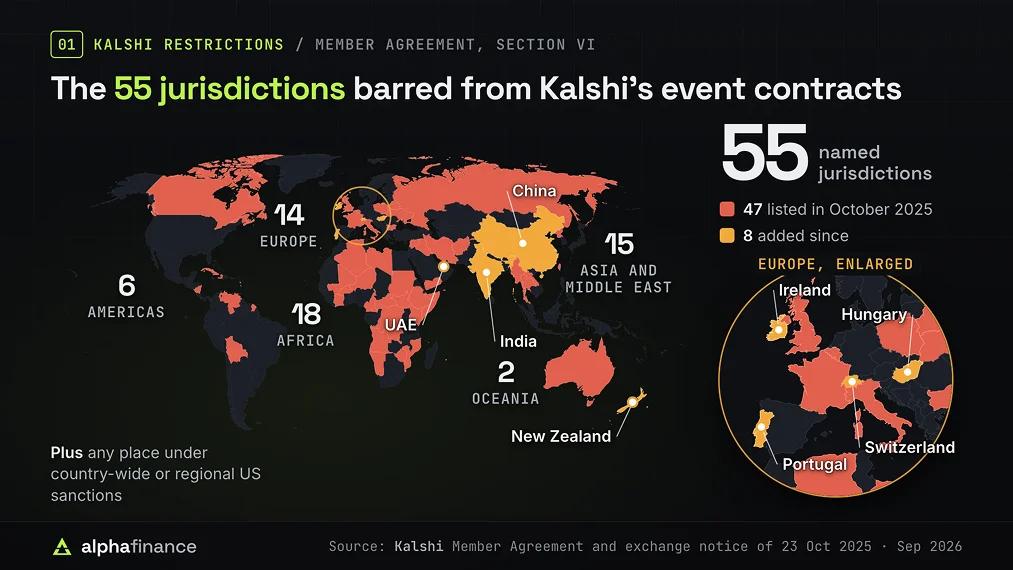
Kalshi's terms name 55 restricted jurisdictions: Anyone domiciled, organised or located in one of them cannot trade event contracts, which pay out on the outcome of a stated event. Canada, the United Kingdom, Australia, France, India and China are among those listed.
The list grew by eight in under a year: Hungary, India, Ireland, New Zealand, China, Portugal, Switzerland and the United Arab Emirates were added after October 2025.
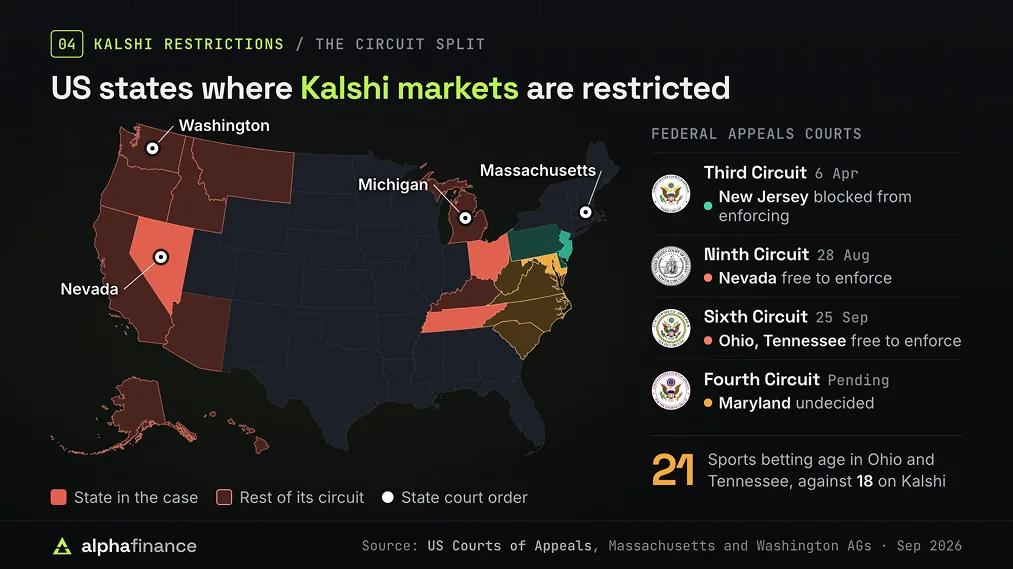
US appeals courts are split on state power over Kalshi: The Third Circuit shielded Kalshi from New Jersey's gambling law in April. Since then, the Ninth and Sixth Circuits have allowed Nevada, Ohio and Tennessee to enforce theirs against its sports contracts.
Kalshi perpetual futures are limited to US users: These contracts track an asset's price and never expire. Access requires users to be based in the US, pass identity checks and complete a separate application.
Kalshi bars event contract trading from 55 named jurisdictions, including Canada, the United Kingdom, Australia and France. Court orders have also removed its sports markets from several US states.
The US exchange offers event contracts that pay a fixed amount if a stated event happens and nothing otherwise. Each contract's price reflects the probability traders assign to that outcome, as shown in Alpha Finance's live prediction market odds. On 7 May 2026, Kalshi reported annualised trading volume of $178 billion.
The full list of Kalshi restricted countries
Section VI of Kalshi's Member Agreement prohibits anyone domiciled in, organised in or located in 55 named jurisdictions from trading event contracts. Every user accepts this agreement at sign-up. The list below reflects the version on kalshi.com on 30 Sep 2026.
Region
Number
Restricted jurisdictions
Africa
18
Algeria, Angola, Burkina Faso, Cameroon, Central African Republic, Côte d'Ivoire, Democratic Republic of the Congo, Ethiopia, Kenya, Libya, Mali, Mozambique, Namibia, Niger, Somalia, South Sudan, Sudan, Zimbabwe
Asia and the Middle East
15
Afghanistan, India, Iran, Iraq, Laos, Lebanon, Myanmar, North Korea, People's Republic of China, Singapore, Syria, Taiwan, Thailand, United Arab Emirates, Yemen
Europe
14
Belarus, Belgium, Bulgaria, France, Hungary, Ireland, Italy, Monaco, Poland, Portugal, Russia, Switzerland, Ukraine, United Kingdom
Any jurisdiction or territory under country-wide, territory-wide or regional US economic sanctions is also covered. Changes to US sanctions can therefore widen the restrictions before Kalshi updates its named list.
Eligibility depends on where a person is domiciled, where a company is organised and the user's physical location. The wording does not refer to citizenship. A French citizen living in a permitted country falls outside the clause, while a visitor physically in France falls within it.
The agreement states that this restriction applies only to event contract trading. It does not, by itself, prohibit membership or non-trading access. Kalshi retains sole discretion to grant, deny or revoke access for anyone.
How the Kalshi restricted list has changed
An exchange notice dated 23 Oct 2025 named 47 restricted jurisdictions. Eight have since been added: Hungary, India, Ireland, New Zealand, the People's Republic of China, Portugal, Switzerland and the United Arab Emirates. The Ukraine entry expanded from five named regions to the whole country.
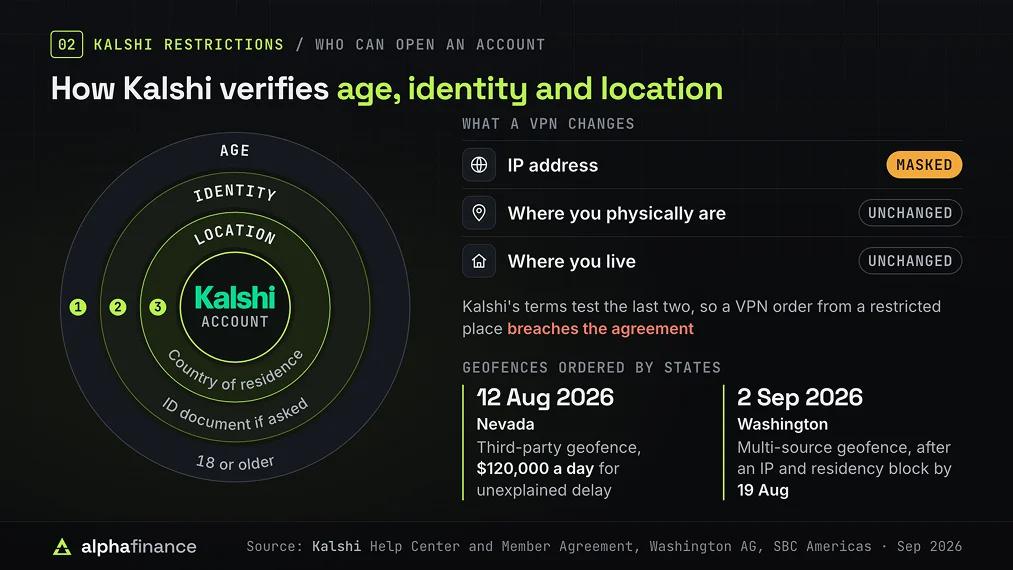
Users must be at least 18 and pass identity checks to open a Kalshi account. Applicants provide personal details and may need to submit an identity document, according to Kalshi's sign-up guide. Each user is responsible for ensuring that using the exchange is lawful where they are.
Kalshi says US law and Commodity Futures Trading Commission (CFTC) rules require it to verify every account holder and retain records. The CFTC is the US derivatives regulator. Under the Member Agreement, Kalshi can also periodically re-check a member's statements.
A Washington state court order required Kalshi to block trading by residency and IP address by 19 Aug 2026. An IP address is the number that identifies an internet connection. According to the Washington Attorney General's office, a multi-source geofence had to follow by 2 Sep 2026. A geofence checks a device's physical position to block activity within a set boundary.
What a VPN does to Kalshi eligibility
A virtual private network (VPN) makes an internet connection appear to originate elsewhere. It changes neither domicile nor physical location, the measures used in Kalshi's agreement. With every order, users repeat their promise to be outside a restricted jurisdiction. Placing an order through a VPN from a restricted place therefore breaches the agreement.
A breach can lead Kalshi to suspend services or end the agreement. In Nevada, gaming regulator investigators were still able to trade from inside the state despite Kalshi's IP-based block, the regulator told a state court. Kalshi subsequently agreed to install a third-party geofence by 12 Aug 2026, with a $120,000 daily penalty for unexplained delay, trade publication SBC Americas reported.
How the CFTC regulates Kalshi in the United States
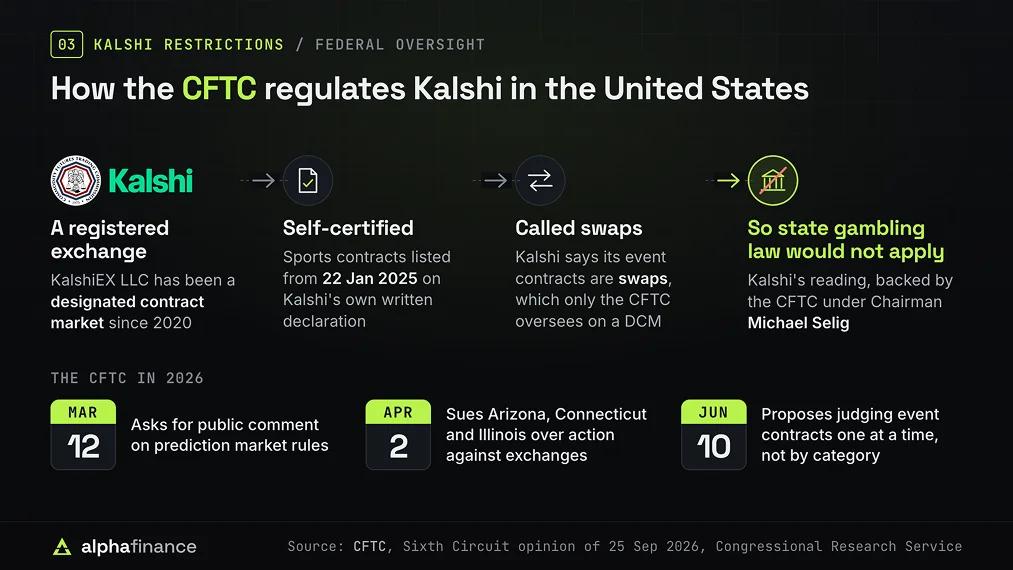
Kalshi argues that its single federal registration places its contracts beyond state gambling law. KalshiEX LLC is a designated contract market (DCM), the CFTC's category for a registered derivatives exchange.
Its DCM registration dates to 2020. As the Sixth Circuit's opinion of 25 Sep 2026 recounts, Kalshi began listing sports contracts on 22 Jan 2025 through self-certification. This process allows an exchange to list a product after declaring in writing that it complies with the law.
Federal law gives the CFTC sole authority over swaps traded on a DCM. In a swap, two parties exchange payments tied to a price, a rate or an event with financial consequences. Kalshi's position is that its event contracts qualify as swaps, leaving state gambling regulators without authority over them.
The markets available to a Kalshi user depend on their state. Courts in Nevada, Washington and Michigan have ordered Kalshi to stop offering sports contracts. Massachusetts won a similar order in January.
Federal appeals courts disagree on whether states have that authority.
Appeals court
Decision date
State law at issue
Result for Kalshi
Third Circuit
6 Apr 2026
New Jersey
State enforcement blocked while the case continues
Ninth Circuit
28 Aug 2026
Nevada
State free to enforce its gaming law
Sixth Circuit
25 Sep 2026
Ohio and Tennessee
Both states free to enforce sports betting law
Fourth Circuit
Pending
Maryland
Undecided
The Sixth Circuit found that Kalshi had not shown its sports contracts qualified as swaps. It read the definition as requiring an event with an inherent financial consequence, such as an interest rate change. A game's result did not meet that test. Even if the contracts were swaps, the court added, state gambling laws would still apply.
Sports bettors in Ohio and Tennessee must be 21, three years older than Kalshi's minimum. Both states also require a state licence, which Kalshi lacks. The opinion records Ohio's regulator describing the age gap as a disregard of its legal age limit.
Washington's order covers sports, elections, politics, entertainment, culture, technology and science, as well as mentions markets. In January, Massachusetts obtained a preliminary injunction covering sports contracts until Kalshi obtains a state sports wagering licence. Such an injunction applies while a case continues.
After a Michigan court directed Kalshi to cancel trades already made by residents, the exchange filed an emergency rule to close those positions. The CFTC suspended that rule on 14 Jul 2026 and ordered Kalshi to fulfil the trades as normal.
How regulators outside the US treat Kalshi
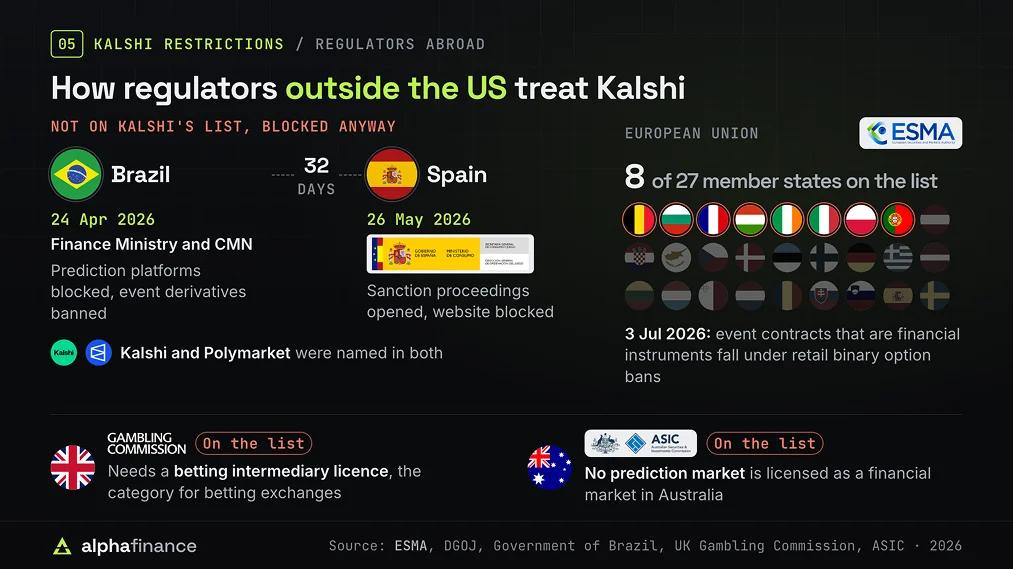
Countries absent from Kalshi's list may still classify its contracts as unlicensed gambling or a banned financial product. Spain and Brazil blocked the website within five weeks of each other, although neither is listed in the Member Agreement.
Jurisdiction
Regulator
Position
On Kalshi's list?
European Union
EU markets regulator (ESMA)
Event contracts that are financial instruments fall under retail bans on binary options
8 of 27 member states
Spain
Gambling regulator (DGOJ)
Sanction proceedings opened and website blocked, 26 May 2026
No
Brazil
Finance Ministry and monetary council (CMN)
Prediction platforms blocked, 24 Apr 2026
No
Great Britain
Gambling Commission
Betting intermediary licence required
Yes
Australia
Securities regulator (ASIC)
No prediction market licensed as a financial market
Yes
Kalshi in the European Union and Spain
On 3 Jul 2026, the European Securities and Markets Authority (ESMA) said that event contracts qualifying as financial instruments are derivatives subject to national bans on selling binary options to retail clients. Binary options pay a fixed amount or nothing based on a yes-or-no outcome. Distributing these contracts in the EU also requires authorisation as an investment firm, ESMA said.
Spain's Dirección General de Ordenación del Juego (DGOJ), its gambling regulator, opened sanction proceedings against Kalshi and Polymarket on 26 May 2026 for operating without a Spanish licence. Both websites were ordered blocked until the case is resolved.
How Brazil blocked Kalshi
Brazil's government announced the blocking of prediction platforms on 24 Apr 2026. That same day, the Conselho Monetário Nacional (CMN), the national monetary council, prohibited derivatives tied to sports, political and entertainment events. The blocked list included Kalshi and Polymarket, Folhapress reported.
In Australia, no prediction market is licensed as a financial market, according to the Australian Securities and Investments Commission (ASIC). Its guidance warns that offshore platform users lose access to local dispute resolution and client money safeguards.
Where Kalshi perpetual futures are available
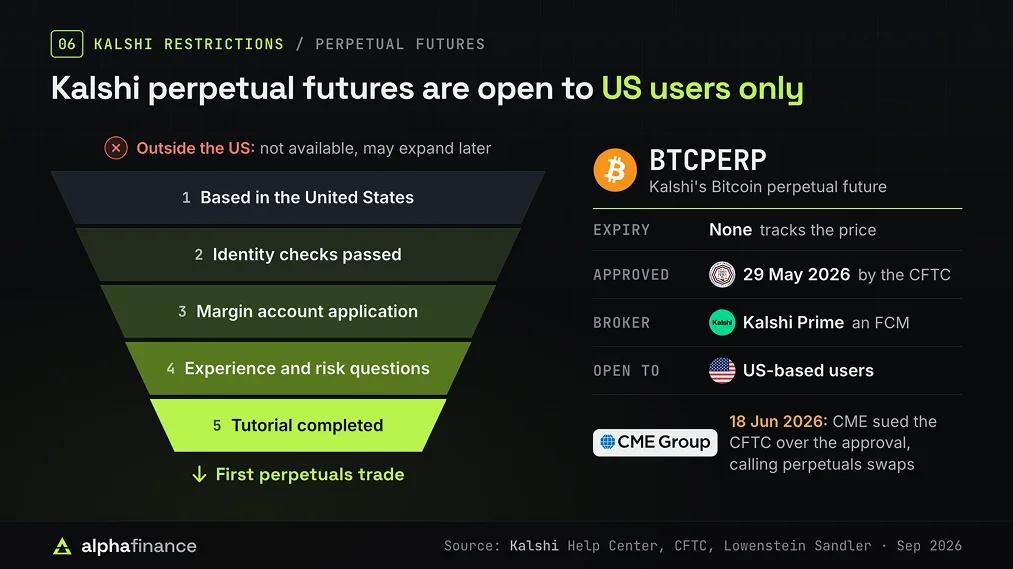
Only US-based users who pass identity checks and receive separate approval can access Kalshi's perpetual futures.
Perpetual futures track an asset's price without expiring. Traders post margin as collateral and use leverage to hold positions larger than that amount. On 29 May 2026, the CFTC approved Kalshi's Bitcoin contract, BTCPERP.
Every user must apply for a margin account and answer questions about their experience and risk tolerance, according to Kalshi's perpetuals access page. A tutorial is required before the first trade. Most retail users trade through Kalshi Prime, a registered futures commission merchant (FCM). An FCM is a broker that holds customer funds for futures trading. The page says international availability may expand later.
For products other than event contracts, the Member Agreement's country list defers to applicable law and Kalshi policy. That policy currently limits perpetuals to the United States. CME, the Chicago futures exchange operator, sued the CFTC on 18 Jun 2026 over the approval, arguing that perpetuals are swaps.
Funding payments pass from traders on one side of a perpetual to those on the other, keeping the contract's price near the underlying asset's price. Alpha Finance's funding rates across six exchanges provide a comparison with offshore venues.
The disagreement between appeals courts is heading to the Supreme Court, where a ruling would determine state access for every US user. On 2 Sep 2026, New Jersey asked the Supreme Court to review the Third Circuit decision.
States are also passing laws aimed directly at prediction markets. The Sixth Circuit noted that a federal court found on 27 Jul 2026 that federal law likely overrode part of Minnesota's prediction market statute.
The CFTC's proposed rule, if adopted, would establish how the agency reviews contracts involving gaming, war or terrorism. Kalshi's October 2025 notice separately reserves its right to change the restricted list at any time to comply with laws or regulators in any jurisdiction.
The risks of trading on Kalshi
Users can lose money on every Kalshi product. Access rules can also change while positions remain open.
If an event contract settles against its holder, it pays nothing and the full purchase price is lost. The Member Agreement describes trading as highly speculative, with fees adding to losses. ASIC compares event contracts to binary options and says about 75% of retail clients lost money trading those.
A leveraged perpetual futures position can consume the entire amount posted as margin. Higher leverage means a smaller price move can trigger liquidation. Our liquidation price calculator shows that level for any entry price, leverage and margin.
The Michigan dispute left open positions caught between a state court and the CFTC. Trading from a restricted jurisdiction breaches the Member Agreement and can cost users access to their accounts. Where Kalshi is unlicensed, users trade without their home regulator's protections.
Not investment advice
This article explains market data. Nothing on this page is a recommendation to buy, sell
or leverage any asset. Digital assets are volatile and you can lose everything you put
in. If you are unsure whether a trade is appropriate for you, a licensed adviser in your
jurisdiction is the right next step.
Written by
Alpha Finance Editorial Team
Part of the Alpha Finance research team. Meet the team
Fact checked by
Vince Dioquino
Verifies every figure against primary sources before publication. Meet the team
Questions
How many Kalshi restricted countries are there?
As of 30 Sep 2026, Kalshi names 55 restricted jurisdictions in its Member Agreement, up from 47 in October 2025. It also excludes places under country-wide or regional US economic sanctions.
Are the UK, Canada and Australia Kalshi restricted countries?
All three appear in the Member Agreement. Anyone domiciled or located there is prohibited from trading event contracts. Ireland and New Zealand joined the list after October 2025.
Is Kalshi legal in the United States?
Kalshi operates as a federally registered exchange overseen by the CFTC. Appeals courts disagree on whether states can apply gambling laws to its sports contracts. State courts in Nevada, Washington and Michigan have ordered those markets removed, so availability varies by state and contract type.
Does a VPN make Kalshi available in a restricted country?
A VPN changes neither a user's domicile nor their physical location, both of which determine eligibility under Kalshi's terms. Using one to trade from a restricted country breaches the Member Agreement and can lead to account suspension or closure.
How old do you have to be to use Kalshi?
Users must be at least 18 and pass identity verification, according to Kalshi's sign-up guide. Ohio and Tennessee require sports bettors to be 21. That difference is one reason their regulators object to Kalshi's sports contracts.
 By Alpha Finance Editorial Team
 Fact-checked by Vince Dioquino