Every figure, platform detail and regulatory claim on this page was traced to a
primary source by the named fact checker before publication, and is re-checked each
quarter. The review date moves only when a person has re-read the page.
Fomo is a self-custodial social trading app: Built by FOMO Labs Inc., it creates a wallet that you control. Trades are public, letting you follow other traders and receive alerts when they buy.
Spot token trading drives most of the revenue: Originally a Solana memecoin app, Fomo now supports trading across several blockchains. Robinhood Chain generated about half its fees over the last 30 days.
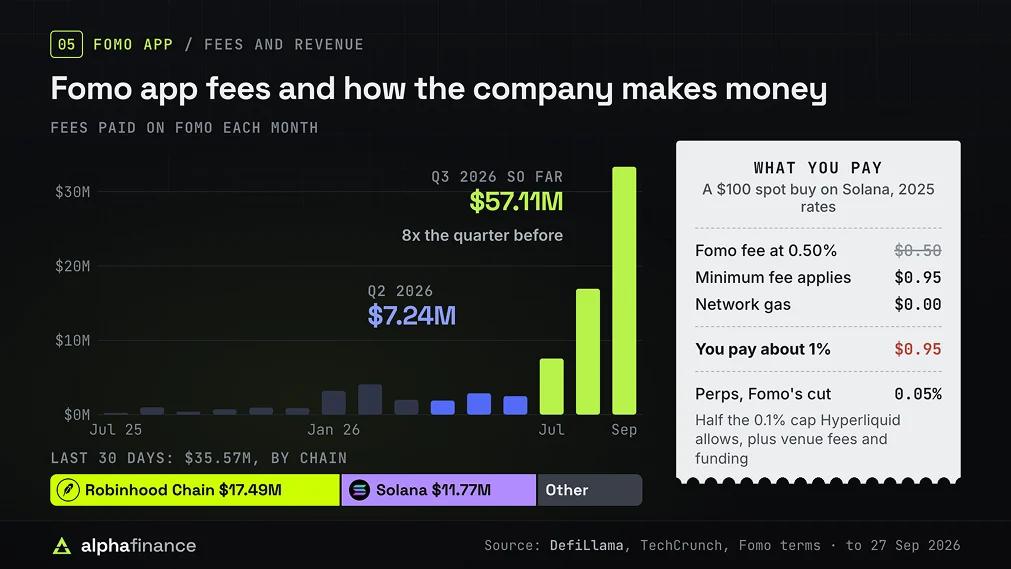
You pay a fee on every trade: Fomo charges a percentage of each spot trade, an outright token purchase or sale, while covering network fees. Perpetual futures, or perps, have a separate 0.05% Fomo fee on top of the venue's costs.
Perps are closed to US users: Hyperliquid and Trade[XYZ] execute Fomo's perps, which are usually traded with borrowed money. US persons cannot use them.
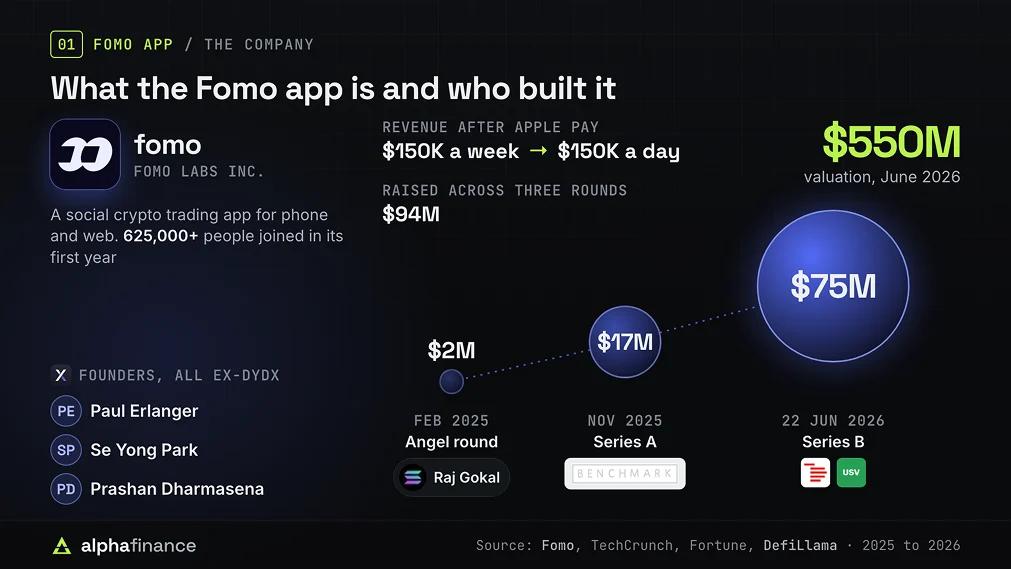
Fomo is a crypto trading app for phone and web that displays every buy and sell in a public feed. Other users can follow those trades. The app opened a public beta on 6 May 2025, and its maker's Series B announcement says more than 625,000 people joined in the first year.
DefiLlama's Fomo dashboard recorded $35.57 million in trading fees in the 30 days to 29 Sep 2026. Perps accounted for only about $0.9 million of that total.
What the Fomo app is and who built it
Fomo combines token trading with a live view of what other traders are buying. Its name, styled in lower case as "fomo", comes from "fear of missing out". FOMO Labs Inc. publishes the app on the App Store and Google Play.
Adding Apple Pay a month after launch marked a turning point. The founders told TechCrunch that weekly revenue reached about $150,000. By November 2025, the app was earning roughly that amount each day.
Round
Date
Amount
Lead investor
Angel round
Feb 2025
$2M
Individual angels, including Solana co-founder Raj Gokal
Several unrelated products have similar names. FLock.io operates a launchpad called FOMO for tokens tied to AI models. FomoPeek, a separate iPhone app, was involved in a malware scare in September.
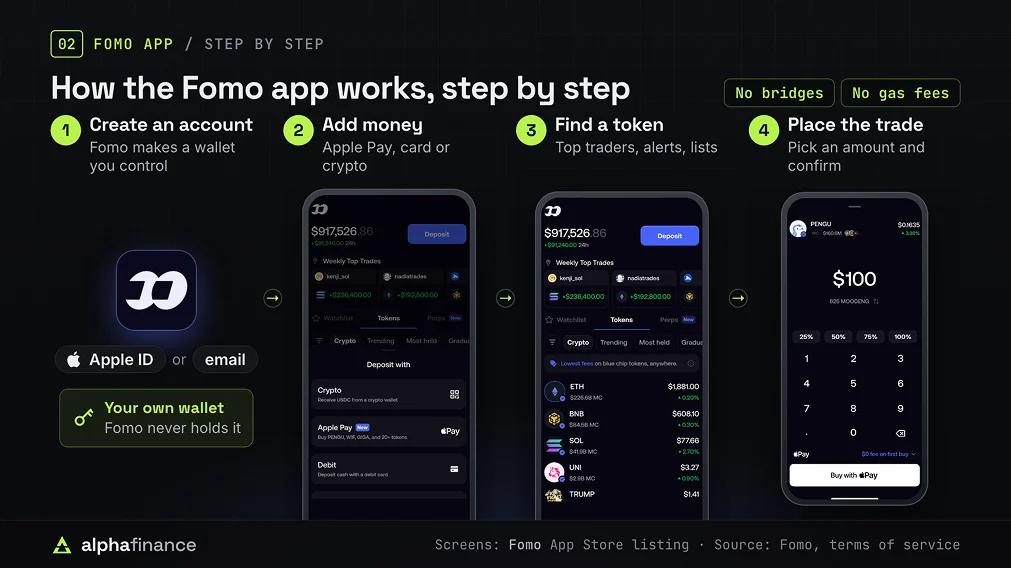
How the Fomo app works, step by step
Fomo removes the blockchain tasks that stop most newcomers from trading. Its Series B announcement promises access to any asset on any supported chain without bridges or gas fees.
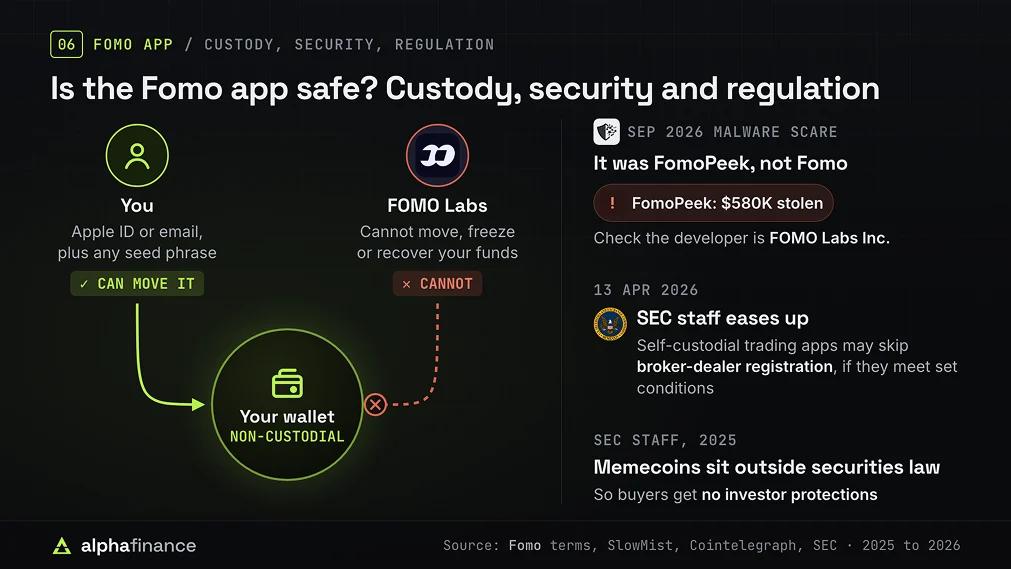
Create an account: Sign in with an Apple ID or email address, and Fomo creates a crypto wallet. Fomo's terms of service describe this trading wallet as non-custodial, meaning FOMO Labs never holds your funds. You are responsible for the login that secures or recovers it.
Add money: Fund your account with Apple Pay. Fomo says more than 68,000 people used this route for their first crypto purchase, spending a combined $25 million.
Find a token: The Fomo home page lists a top-trader feed and leaderboard, alongside real-time alerts showing what the best performers buy.
Place the trade: Choose an amount and confirm. One balance works across Fomo's supported blockchains. You never need to bridge funds (send them between blockchains through a separate service) or buy gas (the fee a blockchain charges to process a transaction).
The one-sentence version: Fomo combines a self-custodial wallet, trading screen and public social feed, with every trade placed by you and visible to everyone.
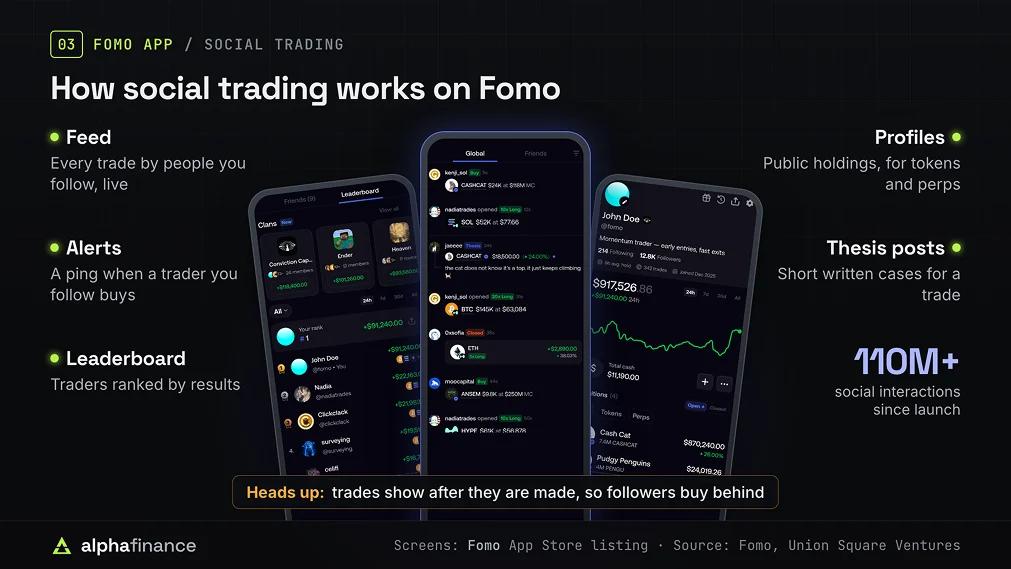
How social trading works on Fomo
Consider the visibility of your trades before signing up. As Union Square Ventures, one of Fomo's investors, explains, every position and trade on the app is public, as blockchain transactions are.
The perps launch post describes the feed, leaderboard, profiles and thesis posts as central to the app.
Feed: Every trade by someone you follow appears in a live stream as it happens.
The feed reveals which tokens attract attention, but a trade only appears after it has happened. When a token has few buyers and sellers, followers often buy from, or just behind, the trader they followed.
That same blockchain transparency allows our tracker of large Hyperliquid positions to display every open position over $1M, including its entry price, leverage and liquidation price.
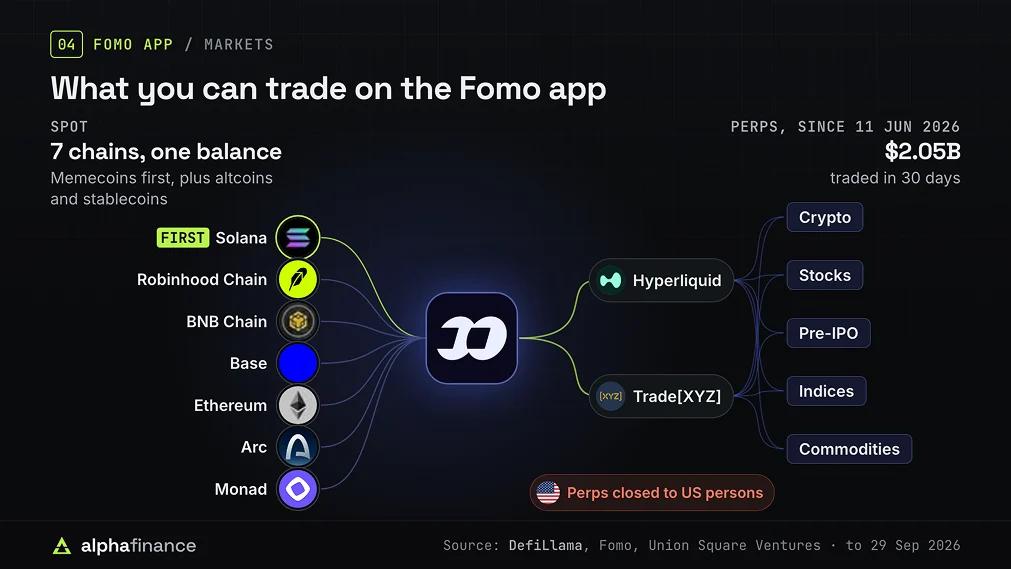
What you can trade on the Fomo app
Memecoins remain central to Fomo. Its home page also lists altcoins, meaning tokens other than Bitcoin, and stablecoins, which aim to maintain a steady value such as $1. The SEC's staff describes a memecoin as a token inspired by an internet joke, character or trend, typically bought for entertainment and speculation.
Robinhood Chain is the broker's own layer 2, a network built on Ethereum that settles transactions there. The chain went live on 1 Jul 2026 to host tokenised stocks, or tokens that track the price of a real share.
Perpetual futures, or perps, let you bet on a price rising (a long) or falling (a short). These contracts never expire. Traders usually use borrowed money, known as leverage, to open them.
Fomo launched perps on 11 Jun 2026, with execution on Hyperliquid and Trade[XYZ]. The markets cover crypto, stocks, pre-IPO companies, indices and commodities.
Positions are isolated, meaning the margin (the money you put up) for one trade cannot be drawn into another. You can set stop-loss and take-profit orders to close a position automatically at chosen prices.
Under Fomo's terms, US persons cannot access perps. Outside protocols operate, match and settle every trade, and Fomo never takes the other side. DefiLlama counted $2.05 billion in perps volume through the app over the same 30 days to 29 Sep.
Perps holders also pay or receive funding, a regular payment between long and short traders that keeps the contract close to the market price. Our tools let you compare funding rates across six exchanges, including Hyperliquid, and view stock, gold and oil contracts on the real-world asset perps dashboard.
Check the fee displayed before confirming a trade. The spot rates date from 2025, and Fomo's terms allow it to change the perps fee without notice. At the listed rates, a $100 Solana spot trade incurs the $0.95 minimum, close to 1% of the trade.
For perps, Fomo collects its fee through a Hyperliquid builder code. This lets an app attach a fee to orders it sends to the exchange. Hyperliquid's documentation sets a 0.1% cap on perps builder fees, twice Fomo's rate.
Revenue has grown sharply since the summer. DefiLlama showed $31.98 million in revenue over the same 30 days, after payouts to users who referred others. Of the $35.57 million in fees, Robinhood Chain contributed $17.49 million and Solana $11.77 million.
Gross revenue for the current quarter so far reached $57.11 million. That is nearly eight times the $7.24 million earned in the entire previous quarter. Our ranking of crypto project revenue lets you compare those figures with the 100 highest earners.
User figures are less certain. Fomo's home page invites visitors to join 2.5 million traders, but no independent source confirms that company figure. At the Series B, Fortune reported that the company employed 17 people and added about 3,500 users a day.
Is the Fomo app safe? Custody, security and regulation
Because Fomo cannot move your money, its failure would not give it control over your funds. Security remains your responsibility. Its terms describe the trading wallet as non-custodial and make you solely responsible for the email account or Apple ID that secures it. That responsibility also covers any private key or seed phrase you view or export.
Anyone who sees your seed phrase, the list of words used to restore a wallet on any device, can take your funds. Fomo cannot reverse a transfer to the wrong address or undo a stolen login.
How the FomoPeek malware relates to Fomo
Security firm SlowMist discovered malicious code in versions 1.1 and 1.2 of FomoPeek in September 2026. The iPhone app, used to watch large wallets, was linked to nearly $580,000 in stolen crypto.
The firm had never identified the Fomo app, SlowMist founder Yu Xian said. Reports attributing the malware to Fomo were wrong. Check that the developer is FOMO Labs Inc. before installing, or follow the download links on fomo.family.
How regulators treat apps like Fomo
US regulators have softened their stance on self-custodial trading apps. On 13 Apr 2026, SEC staff said apps that help users trade crypto asset securities from their own self-custodial wallets can operate without broker-dealer registration if they meet set conditions. Broker-dealers are licensed firms that handle securities trades for clients. The statement expresses a staff view, has no legal force and lapses after five years.
Typical memecoins fall outside securities law under the SEC staff's 2025 memecoin statement, leaving buyers without that law's investor protections. Fortune noted that Fomo arguably falls outside money-handling laws because it does not hold customer funds. Co-founder Se Yong Park said the company works to remain compliant.
The risks of trading on the Fomo app
Everything you put into Fomo is at risk, and the app's speed makes rapid losses easy.
Most new memecoins fail:Solidus Labs studied tokens launched on Pump.fun, a Solana launchpad, from January 2024 to March 2025. About 98.7% showed signs of price manipulation or a rug pull, where creators withdraw the money from a token's trading pool. Of more than 7 million tokens, only about 97,000 retained over $1,000 in their pool. Pump.fun rejected the findings.
Following other traders adds its own risk: If a token has few buyers and sellers, followers can push up its price, giving the trader they followed an opportunity to sell into those purchases.
Leverage can wipe out your margin: You can lose the entire amount committed as margin to a leveraged perps position. Once losses reach that margin, liquidation occurs and the exchange forcibly closes the position. Our liquidation price calculator shows that price for a given entry and leverage.
Security depends on you: Users of popular crypto apps face lookalike apps, fake support accounts and phishing links. Lose access to the email or Apple ID securing your wallet, and you can lose the wallet.
Many reviews are paid by referrals: Users who refer others receive a share of each fee. DefiLlama shows about $5.03 million paid to referrers this quarter, so guides carrying a Fomo referral code earn money when you trade.
Check a small token's age and how much money its trading pool holds before buying. Our DEX screener with token risk flags displays new pairs and warnings about common token risks across 21 chains.
Not investment advice
This article explains market data. Nothing on this page is a recommendation to buy, sell
or leverage any asset. Digital assets are volatile and you can lose everything you put
in. If you are unsure whether a trade is appropriate for you, a licensed adviser in your
jurisdiction is the right next step.
Written by
Alpha Finance Editorial Team
Part of the Alpha Finance research team. Meet the team
Fact checked by
Vince Dioquino
Verifies every figure against primary sources before publication. Meet the team
Questions
What is the Fomo app used for?
Fomo lets you buy and sell crypto tokens, including memecoins, using one balance across several blockchains. You can also follow other traders. Available on iPhone, Android and the web, it offers perps on crypto, stocks, indices and commodities outside the US.
Is the Fomo app safe and legit?
FOMO Labs Inc. makes Fomo, a real app backed by Benchmark, Index Ventures and Union Square Ventures. The company cannot move funds from its non-custodial wallet or recover them if your login is stolen. Tokens traded on the app and lookalike apps pose the main dangers.
How much does Fomo charge per trade?
At its November 2025 Series A, Fomo charged 0.50% per spot trade, covered users' network fees and applied a $0.95 minimum on Solana trades. Perps have a 0.05% Fomo fee, plus venue fees and funding payments. Rates can change, so check the fee before confirming.
Can US users trade on the Fomo app?
US users can trade tokens and download Fomo through the US App Store. They cannot access perps, which run on outside venues, because Fomo's terms exclude US persons.
Who owns the Fomo app?
Fomo belongs to FOMO Labs Inc., founded by Paul Erlanger, Se Yong Park and Prashan Dharmasena. A $75 million Series B in June 2026 valued the company at $550 million.
 By Alpha Finance Editorial Team
 Fact-checked by Vince Dioquino