Markets
 BTC
 ETH
 BNB
 XRP
 SOL
 ZEC
 HYPE
 DOGE
 LINK
 TON
 AVAX
 SUI
 TAO
 AAVE
 PUMP
 MORPHO
 ARB
 LIT
--:-- UTC
Research/Market structure
DeFi statistics and trends: total value locked, perp DEX volume, onchain lending, staking, stablecoins and tokenized stocks, dated and sourced.
 By Alpha Finance Editorial Team
 Fact-checked by Vince Dioquino
Every figure, platform detail and regulatory claim on this page was traced to a primary source by the named fact checker before publication, and is re-checked when those facts change. The review date moves only when a person has re-read the page.
The editorial policy → Editorial policy Report an errorDecentralized finance runs financial services as software on public blockchains, without a bank or exchange in the middle. These services cover trading, lending and borrowing, as well as earning interest and issuing dollar-pegged tokens. In 2026, the sector holds about $94 billion in deposits and settles more than $1 trillion of trades a month. Its roughly $300 billion of stablecoins puts it on the scale of a mid-sized bank.
Deposits fell every month in the first half as prices dropped. Two exploits took nearly $600 million in a fortnight, adding to the decline. By August, trading was setting records and deposits were recovering. The ten statistics below measure different parts of that uneven year, with every figure dated and linked to the report, regulator or company that published it.
DeFi total value locked declined every month from January to June 2026, falling 39% from roughly $115 billion to about $70 billion by 24 Jun, according to CryptoRank's analysis of aggregator data. On 21 Sep 2026, DefiLlama's TVL dashboard recorded a recovery to about $93.9 billion across more than 6,500 protocols. Ethereum still holds the largest share, around $52.7 billion.
Bitcoin's drop of more than 50% from its October 2025 high dragged down the value of every coin sitting in DeFi. April 2026 brought two further shocks, the $295 million Drift Protocol exploit and the $293 million KelpDAO exploit. Lending markets suffered particularly heavy withdrawals. CryptoRank records Aave's TVL falling from $26.4 billion before the KelpDAO incident to $14.3 billion a few days later, a 46% decline for the largest lending protocol.
Since June, both prices and new deposits on Tron and Hyperliquid have contributed to the recovery. Those were the only two of the ten largest chains whose TVL grew in the first half.

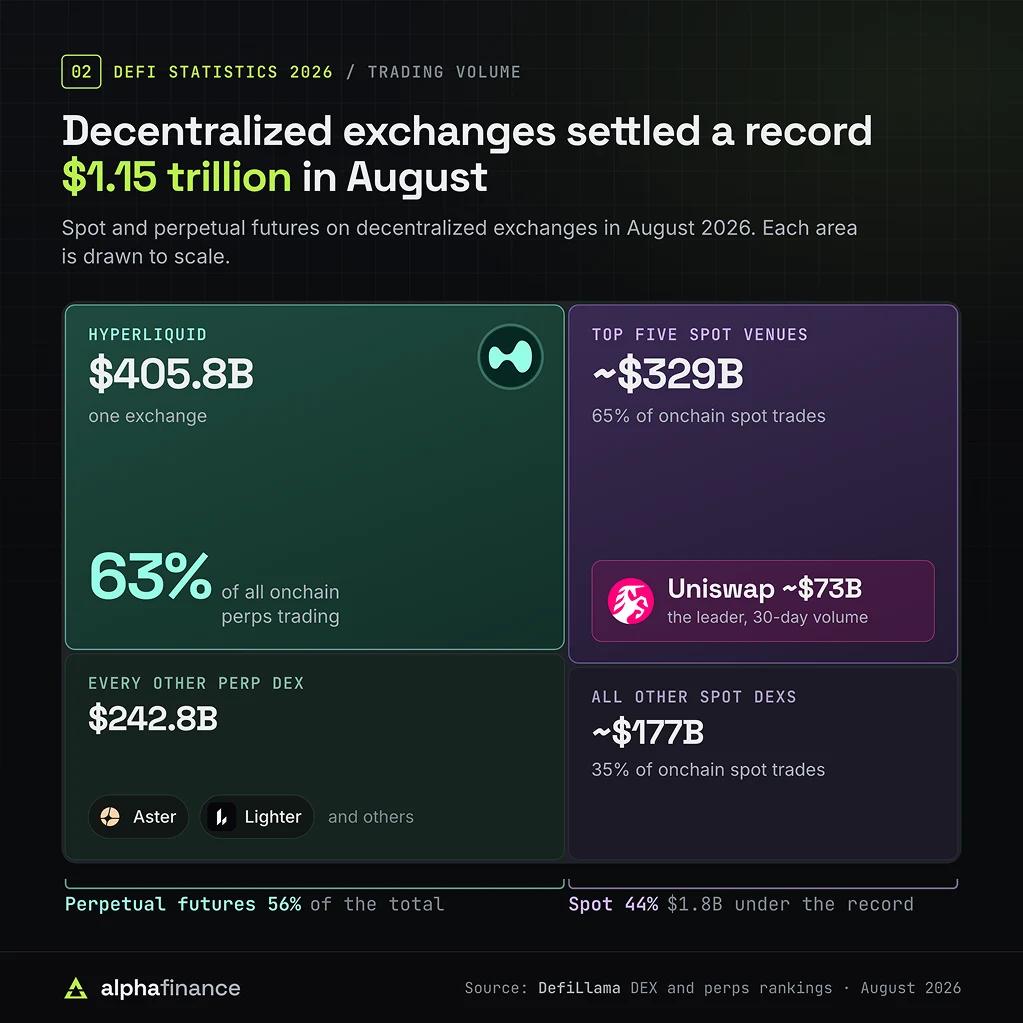
Decentralized exchanges (DEXs) settle trades directly between users' wallets rather than through a company holding their funds. Their August spot volume reached about $506 billion, just below January's record $507.8 billion, according to DefiLlama's DEX volume rankings. Another $648.6 billion in perpetual futures on DefiLlama's perpetuals dashboard pushed the combined total past $1.15 trillion for the first time.
More than half of onchain trading now comes from perpetual futures, a change from two years ago. Hyperliquid handled roughly $405.8 billion of August's perpetuals volume on the same dashboard, accounting for about 63% of the onchain total that month.
Spot trading is also concentrated. Uniswap leads with around $73 billion in 30-day volume across its supported chains, while the top five venues handle about 65% of onchain spot trades. Our DEX screener shows live onchain trading by chain.
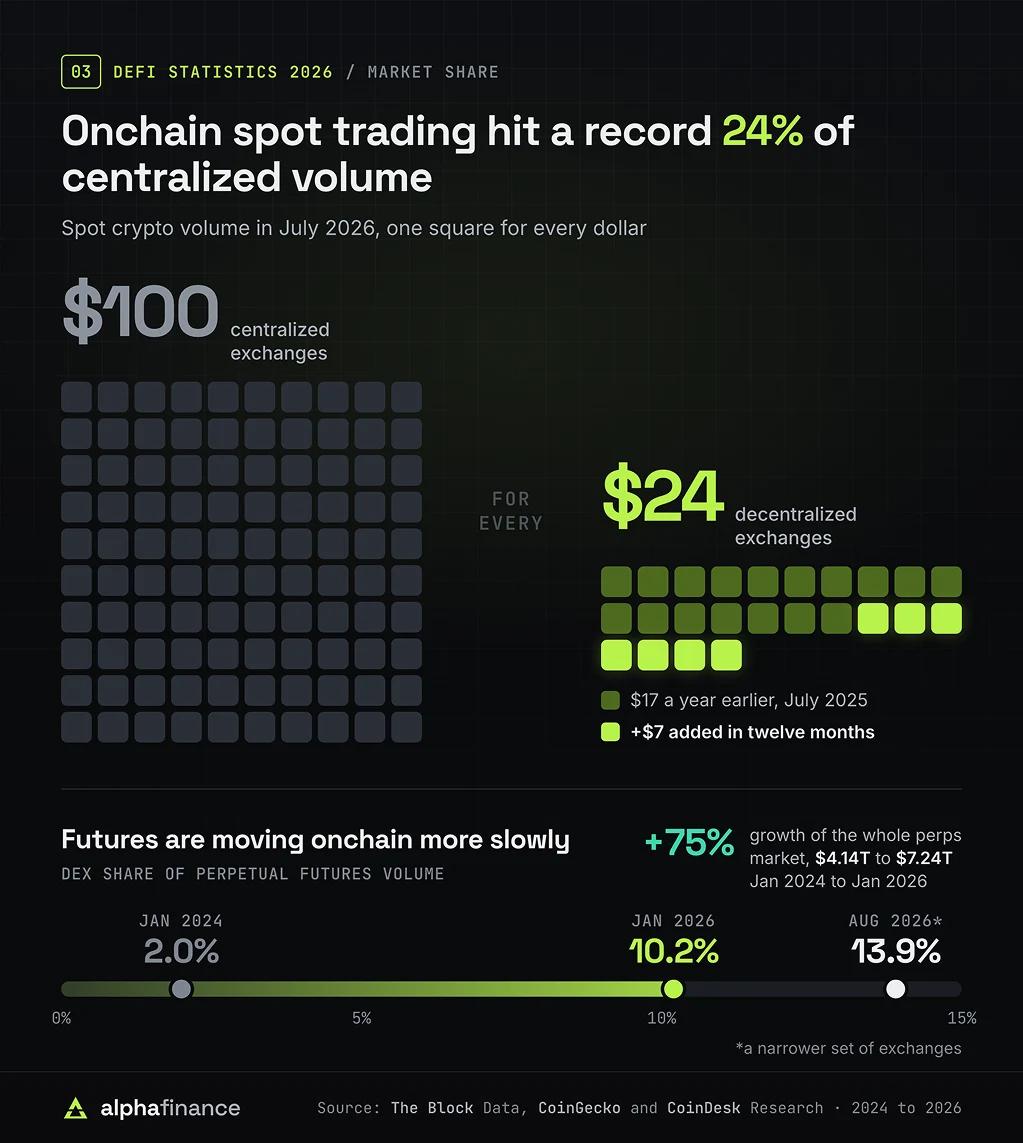
About $24 traded on decentralized exchanges for every $100 traded on centralized exchanges in July 2026. The Block's data dashboard recorded a DEX-to-CEX spot ratio of 24.14%, up from about 17% a year earlier and a new high, as The Block reported on 3 Aug 2026. Growth at decentralized venues coincided with a 12-month low in centralized exchange spot volume as retail trading cooled.
Futures are moving in the same direction more slowly. According to CoinGecko's 2026 CEX and DEX Trading Activity Report, the perpetual futures market grew 75% in two years, from $4.14 trillion in January 2024 to $7.24 trillion in January 2026. Decentralized venues increased their share from 2.0% to 10.2% over that period. Using a narrower set of exchanges, CoinDesk Research's August 2026 exchange review put the share at 13.9%. Between a tenth and a seventh of leveraged crypto trading now settles onchain.
That shift in where prices are set matters even to readers who never trade. With a tenth of futures trading and a quarter of spot trading happening onchain, activity at decentralized venues now moves the wider market. This includes liquidations, the forced closure of leveraged positions when collateral runs out, and funding rates, the periodic payments between traders betting on a rise and those betting on a fall.
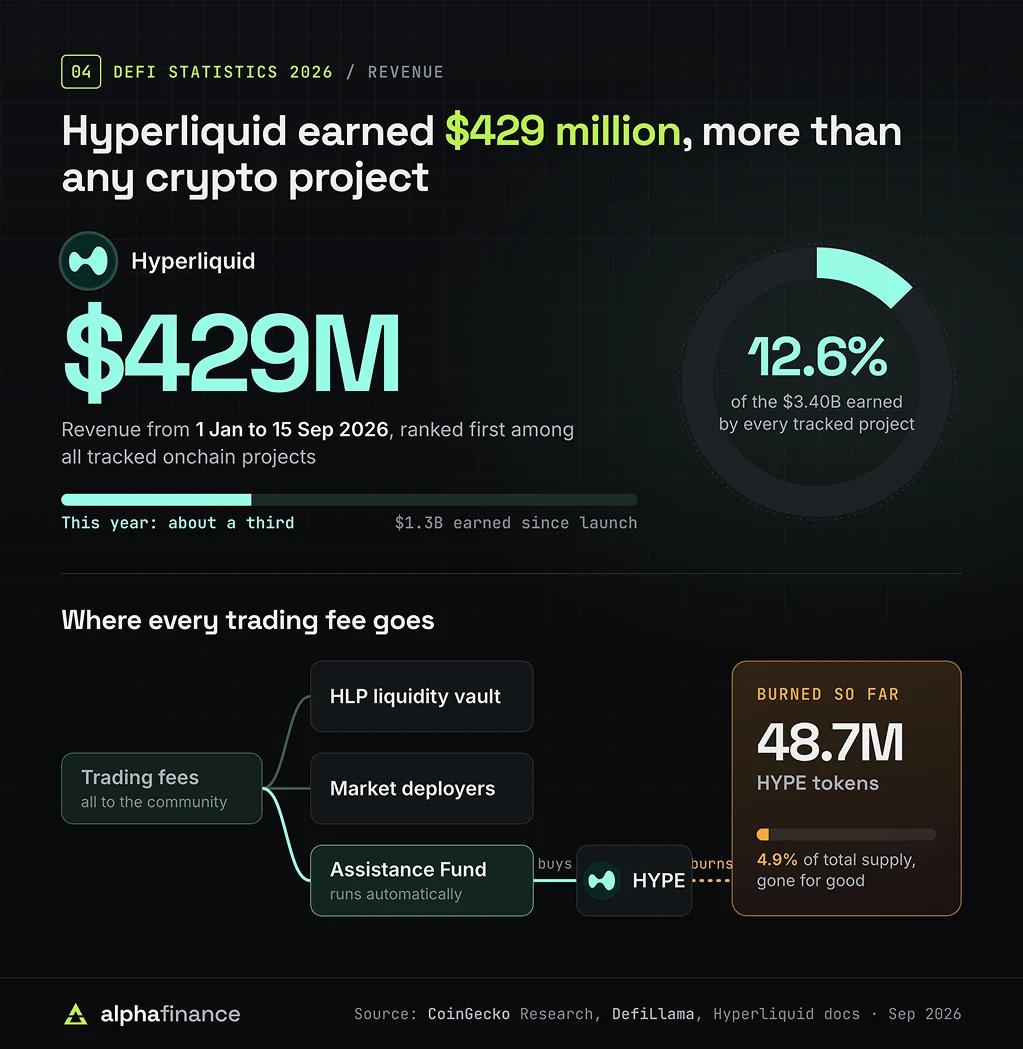
Hyperliquid generated $429.04 million between 1 Jan and 15 Sep 2026, leading CoinGecko's 2026 onchain revenue ranking. The ranking sets aside stablecoin issuers Tether and Circle and asset manager Grayscale because of their scale. The perpetual futures exchange, which runs on its own blockchain, accounted for 12.6% of the $3.40 billion earned by all tracked projects. DefiLlama's Hyperliquid page puts cumulative revenue since launch at about $1.3 billion, making this year's earnings roughly a third of the total.
All trading fees go to the community under Hyperliquid's own fee documentation. They are split between the HLP liquidity vault, market deployers and an Assistance Fund. The fund automatically converts fees into HYPE and burns it, removing tokens from both circulating and total supply. About 48.7 million HYPE, roughly 4.9% of total supply, had been removed by September 2026. Open interest reached $14.3 billion that month, its highest since before the October 2025 crash.
Competition has taken some of its share. Aster briefly overtook Hyperliquid on daily volume during a late-2025 incentive campaign, with Lighter, Grvt and others gaining ground since. Open interest is harder to inflate through rewards than volume. CoinGecko's State of Crypto Perpetuals Report 2026 found that perpetual DEXs' share of open interest rose from 3.6% at the start of 2025 to 13.5% by early 2026, most of it held on Hyperliquid.
Our Hyperliquid whale tracker lists every open position over $1 million, including its entry, leverage and liquidation price. The Hyperliquid liquidation heatmap shows where leveraged positions would be forced to close, while our project revenue page ranks projects by revenue.
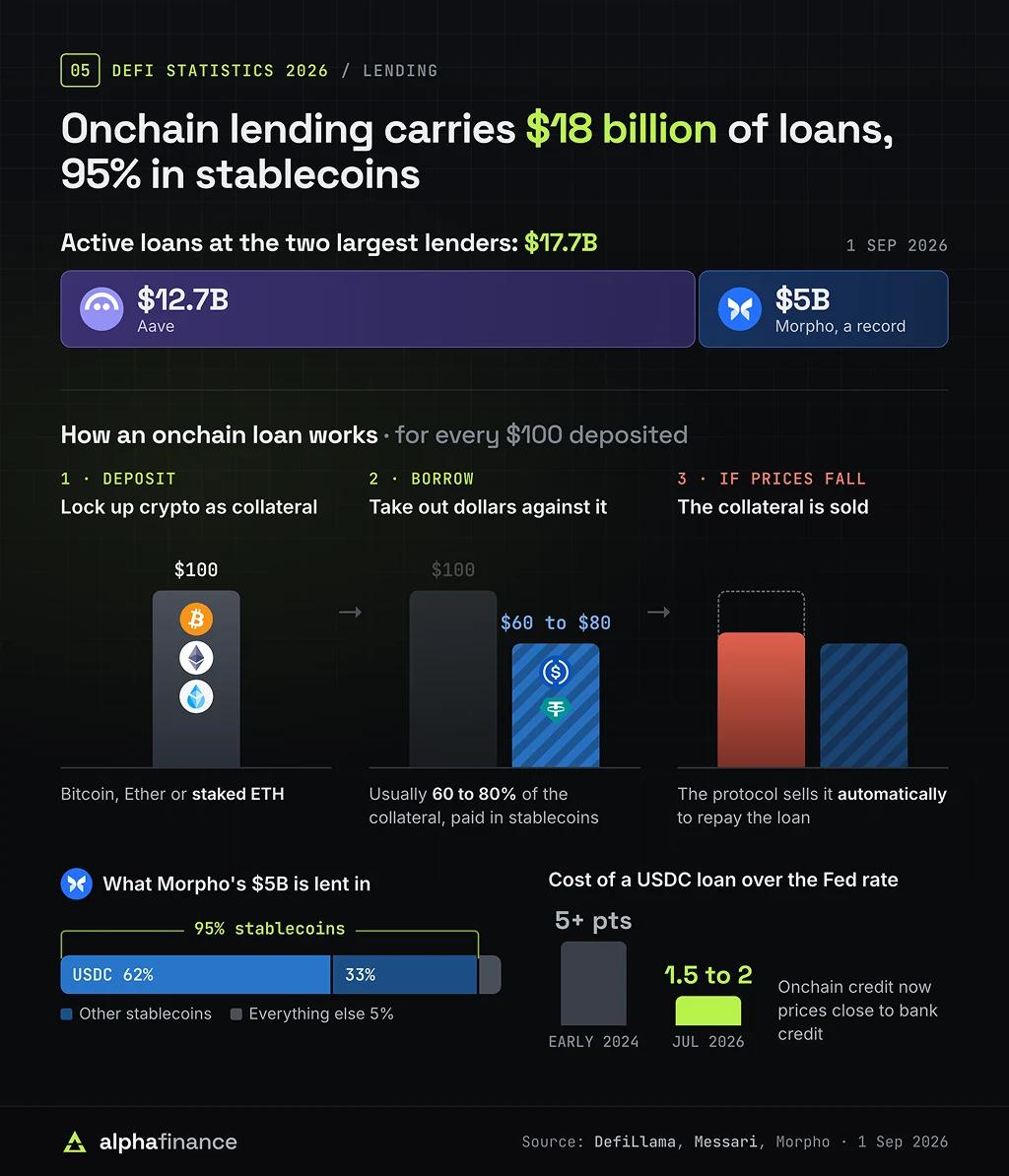
Crypto collateral backs what is now largely a stablecoin credit market. On 1 Sep 2026, the largest lending protocol, Aave, held about $12.7 billion of active loans and $17.7 billion of TVL, according to DefiLlama's Aave page. Second-ranked Morpho reached a record $5 billion of outstanding loans that day. Messari reported that stablecoins accounted for 95% of Morpho's debt, with USDC alone making up 62%. Across the lending category, deposits stood at about $54 billion in April 2026. The top ten protocols held 78%, according to DefiLlama's lending category.
Borrowers deposit crypto, such as Bitcoin, Ethereum or a liquid staking token, then borrow dollars against it, usually at 60 to 80% of the collateral's value. A large enough fall in that value triggers the protocol to sell the collateral and repay the loan. This mechanism explains why lending TVL fell hardest in April. The KelpDAO exploit affected a token widely used as collateral, and Aave lost 46% of its deposits within days.
Partners have driven Morpho's growth more than direct users. In Morpho's own 2026 outlook, it records deposits rising from $5 billion to $13 billion during 2025, while users increased from 67,000 to 1.4 million. Much of that growth came through integrations such as Coinbase's crypto-backed loans, which use Morpho's software.
Onchain credit also prices closer to traditional credit now. In Morpho's best-collateral markets, the gap between USDC borrowing rates and the US Federal Reserve's overnight rate narrowed from more than 5 percentage points in early 2024 to about 1.5 to 2 points in July 2026. Our DeFi yields page lists live lending and deposit rates, with each pool scored for trust.
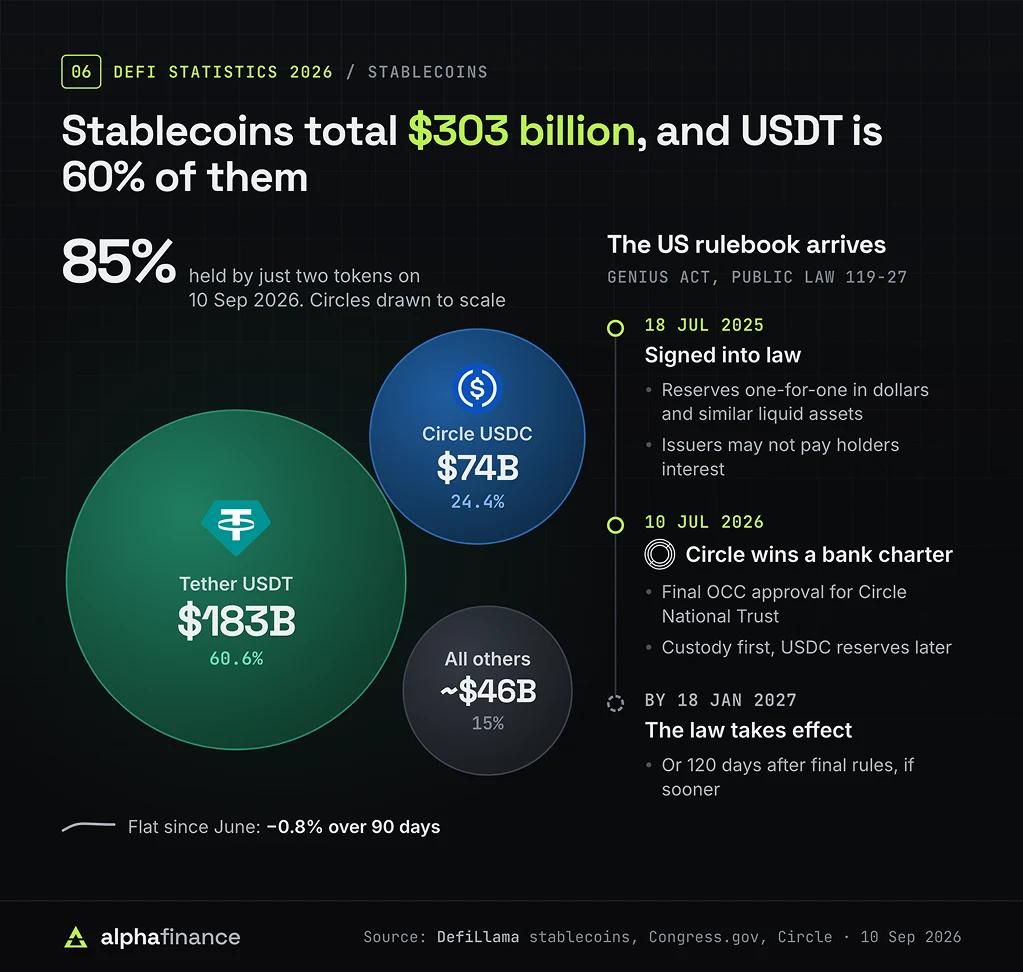
Roughly $303 billion of dollar-pegged tokens are in circulation, exceeding the deposits of most US regional banks. As of 10 Sep 2026, Tether's USDT accounted for about $183 billion, or 60.6%, and Circle's USDC about $74 billion, per DefiLlama's stablecoin dashboard. Together they hold more than 80% of the market. After steady growth through 2025, total supply has been flat since June, contracting 0.8% over 90 days. Stablecoin supply by chain appears on our blockchain data dashboard.
Most DeFi trades are priced in stablecoins and most loans are denominated in them, tying their supply to every other figure here. Traders also hold them on exchanges while waiting to buy. Backed by cash and short-term US government debt, USDT and USDC function in effect as tokenized money market funds whose holders receive none of the interest.
Signed into US law on 18 Jul 2025, the GENIUS Act (S.1582, Public Law 119-27) creates federal and state licensing for payment stablecoin issuers. Reserves must match issuance one-to-one in US currency and similarly liquid assets. Issuers cannot pay interest to holders, and state-only supervision is limited to those with $10 billion or less outstanding. The law takes effect on the earlier of 18 Jan 2027, 18 months after enactment, or 120 days after the primary federal regulators issue final rules.
Circle announced on 10 Jul 2026 that it had received final approval from the Office of the Comptroller of the Currency to establish Circle National Trust, a national trust bank. It will initially provide custody, with USDC reserve management planned as a future capability.
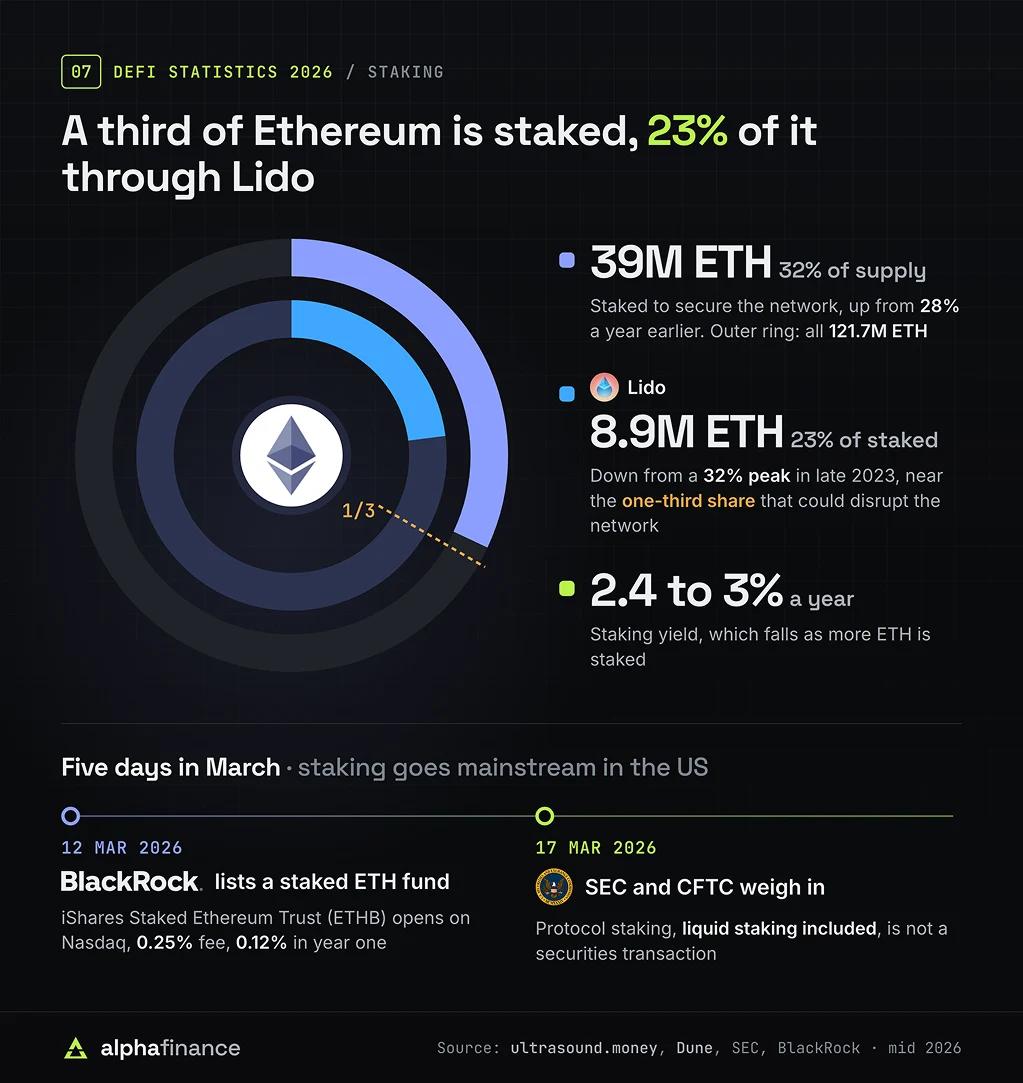
Around 39 million ETH was staked as of mid-2026, according to the ultrasound.money supply dashboard. That is about 32% of the 121.7 million total supply, up from roughly 28% a year earlier. Staking locks ETH to run or back a validator, the software that confirms transactions and secures the network. The annual yield is around 2.4 to 3% and falls as more ETH is staked.
Lido is the largest liquid staking provider, holding about 8.9 million ETH, or roughly 23% of all staked ETH, per the Dune staking dashboard. A liquid staking depositor receives a token representing the staked ETH, called stETH in Lido's case. It can be traded or used as loan collateral while the ETH remains locked. Lido takes a 10% fee on rewards, shared between its node operators and treasury. Its market share peaked at 32% in late 2023, close to the one-third threshold at which a single party could disrupt the network's ability to finalise transactions.
Regulation brought a structural change this year. In Release No. 33-11412, issued jointly with the CFTC on 17 Mar 2026, the SEC set out its view that protocol staking on public proof-of-stake networks does not involve securities transactions. That interpretation includes custodial and liquid staking and treats rewards as payment for validation services.
Five days earlier, on 12 Mar 2026, BlackRock's iShares Staked Ethereum Trust (ETHB) began trading on Nasdaq. Its product brief sets a 0.25% sponsor fee, waived to 0.12% for the first year, and plans to stake most of the trust's ether.
Staking-enabled exchange-traded funds give traditional investors access to staking yield through a brokerage account. Our Ethereum ETF flows dashboard tracks money moving into and out of these funds. The Ethereum corporate treasuries page lists companies holding ETH on their balance sheets, several of which stake it.
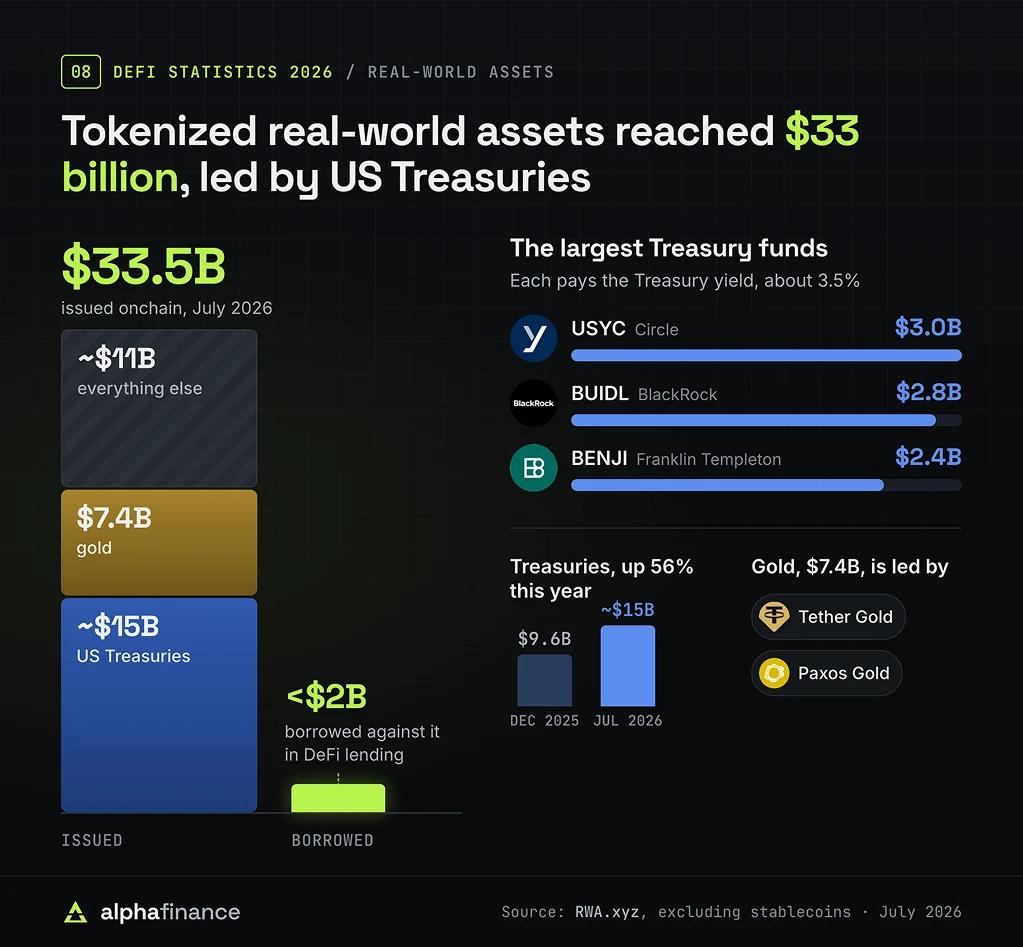
Traditional financial assets issued as blockchain tokens have grown roughly fourfold since early 2025. In July 2026, RWA.xyz, the most widely cited tracker, showed about $33.5 billion of tokenized real-world assets onchain, excluding stablecoins. A September 2026 reading from the same tracker reaches $46.2 billion when assets held on private platforms are included. The section on what these figures cannot tell you explains the gap. At roughly $15 billion, tokenized US Treasury products are the largest category, up from $9.6 billion at the end of 2025.
A tokenized Treasury represents a share in a fund holding short-term US government debt. It pays the Treasury yield, currently around 3.5% a year, and can move between wallets around the clock. RWA.xyz's fund pages put Circle's USYC at about $3 billion in July 2026, followed by BlackRock's BUIDL at about $2.8 billion and Franklin Templeton's BENJI at about $2.4 billion. Tokenized gold ranks next by category at about $7.4 billion, led by Tether Gold and Paxos Gold.
Transfer restrictions prevent most tokenized Treasury and credit products from being used freely in DeFi. In July 2026, total borrowing against tokenized real-world collateral across major lending protocols was under $2 billion, a fraction of the $33 billion issued. Growth so far largely reflects money parked in yield products rather than a new base of lending collateral. Our real world assets board tracks tokenized stocks, commodities and funds by issuer and sector.
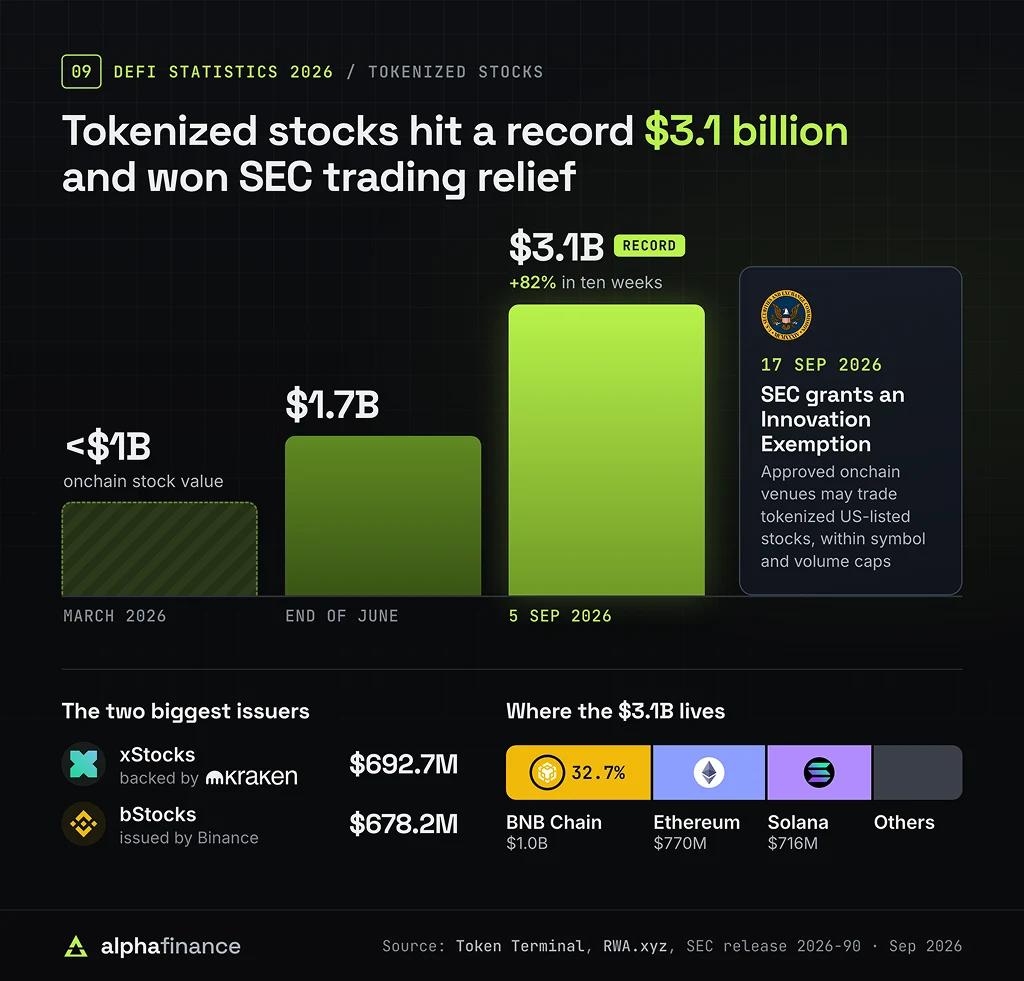
Onchain tokenized stock market capitalisation reached a record $3.1 billion on 5 Sep 2026, according to Token Terminal, which tracks assets by issuer and chain. The total was about $1.7 billion at the end of June and under $1 billion in March. By separating synthetic exposure from tokens backed by real shares, RWA.xyz's tokenized stocks page produced a lower reading of $2.9 billion on 18 Sep 2026.
A tokenized stock is backed one-for-one by a real share held by a custodian, allowing its price to track that share. Most issuers are crypto exchanges. Kraken-backed xStocks held about $692.7 million and Binance's bStocks about $678.2 million, together accounting for more than a third of the market. BNB Chain hosts the largest share at $1.0 billion, or 32.7%. Ethereum follows at $770 million, then Solana at $716 million. Binance launched commission-free trading in over 7,000 tokenized US stocks and ETFs on 1 Jun 2026. Robinhood offers EU users more than 200 stock and ETF tokens.
On 17 Sep 2026, the SEC issued a temporary "Innovation Exemption". Approved onchain venues can now trade tokenized US-listed stocks through permissioned automated market makers without registering as exchanges, subject to symbol limits and volume caps. This is the first defined framework under which a US regulator has allowed listed shares to trade on blockchain-based venues.
The market remains small relative to the assets it tracks. At $3.1 billion, tokenized stocks represent about 5.5% of tokenized real-world assets and a tiny share of US equity market capitalisation. Their underlying shares trade only during US market hours, so spreads widen at night and on weekends while the tokens keep trading.
Perpetual futures on stocks, gold and oil have grown alongside tokenized shares. They let traders take leveraged positions on those prices without owning the assets. Our stocks, gold, oil and FX perps page shows live markets, open interest and funding for these contracts.
CertiK's Hack3d H1 2026 report recorded $1,315,676,432 lost across 344 security incidents between January and June 2026. Losses were 46.8% below the first half of 2025 only because that period included the $1.45 billion Bybit theft. Excluding it, this year's losses were about 28% higher.
TRM Labs' H1 2026 analysis counts hacks and exploits but excludes phishing scams. It recorded 207 incidents, the highest six-month count in its records, with $972 million lost and a median loss of about $219,000 per hack.
Stolen keys and compromised signing infrastructure caused the most expensive attacks. CertiK attributed over $444 million of losses to just 33 wallet compromises. TRM found infrastructure compromises accounted for about 15% of incidents but roughly 76% of losses. Smart contract bugs occurred more often but cost far less.
Both firms attributed the two largest incidents, April 2026's Drift Protocol theft of $295 million and KelpDAO theft of $293 million, to North Korea's Lazarus Group. TRM estimates North Korea-linked theft at about $643 million, or 66% of everything stolen during the half-year.
Losses continued in the second half. CertiK counted about $215 million in August 2026, including $144.6 million from DeFi protocols. The largest was a $75 million price manipulation attack on Tectonic, a lending protocol on Cronos.
A protocol's yield does not establish its safety. Our DeFi yields page scores each pool out of 100 using its size, track record and audits, alongside the plausibility of its advertised yield. A high yield often signals risk in those other measures.

These figures measure different things. Understanding what each counts helps avoid conclusions the data cannot support.
Total value locked (TVL) is the dollar value of crypto deposited into DeFi applications, including lending and trading pools, staking contracts and vaults. Deposits and withdrawals change TVL, but so do the prices of the deposited coins. A fall therefore does not always mean money left. Our blockchain data dashboard shows TVL by chain.
Trading volume measures the dollar value of trades completed over a period. Spot volume counts coins changing hands. Perpetual futures volume counts the notional value of leveraged contracts that track a coin's price and never expire, which makes it far larger than spot volume.
Open interest is the total value of futures positions still open at a given moment. Where volume shows how much traded, open interest shows how much remains at risk.
Active loans measures the amount currently borrowed from a lending protocol. It gives a cleaner view of lending demand than TVL, which also includes deposits nobody has borrowed.
Stablecoin supply counts dollar-pegged tokens in circulation. These tokens serve as DeFi's cash, with most trades priced and most loans denominated in them.
Trading has moved onchain faster than saving has. Decentralized exchange volume set a record in August while deposits remained 20% below January, the central gap in DeFi this year.
Led by Hyperliquid, perpetual futures venues earn more than any other kind of crypto business and handle a tenth of all leveraged crypto trading. Money held in DeFi is becoming more conservative. Increasingly, it sits in stablecoins, staked ETH and tokenized Treasuries, earning yields close to bank deposits or government bonds without requiring a view on prices.
Almost every category is concentrated. Two stablecoins hold 80% of their market, and five tokenized assets account for about 70% of the real-world asset category. One provider stakes 23% of all ETH. The top ten lending protocols hold 78% of lending deposits, while five spot exchanges handle 65% of onchain spot volume. Anyone can build or use DeFi, but most money passes through a few applications. That concentration explains how a single exploit at KelpDAO could nearly halve Aave's deposits.
Traditional finance is entering as a customer rather than a competitor. BlackRock, Franklin Templeton and Circle issue tokenized funds. Coinbase runs loans on Morpho, while Kraken and Binance issue tokenized stocks. Staking ETFs earn validator rewards for brokerage clients. These businesses use DeFi software but retain the customer relationship and compliance obligations within a regulated company. The SEC's September exemption for tokenized stock venues points in the same direction.
Every figure above is an estimate shaped by a tracker's decisions about what to count.
The direction and approximate size of each figure are meaningful. Treat the last digit as a guide.
Everything counted here can be lost, through risks that differ from those of a bank account.
Lending pools, trading pools and staking contracts hold deposits in software rather than at an institution with a licence and deposit guarantee. A software flaw, stolen administrative keys or a manipulated price feed can allow those deposits to be taken. Usually, nobody is obliged to compensate the depositor. The $1.32 billion lost in the first half of 2026 came overwhelmingly from people who did nothing wrong.
Borrowing against crypto adds the risk of a forced sale. Once collateral falls to a protocol's threshold, it is sold automatically, often at a bad price during a crash. A leveraged perpetual futures position can also lose the entire amount posted as margin, sometimes within minutes.
Stablecoins may trade below one dollar if confidence in their issuer's reserves weakens. Tokenized Treasuries and stocks rely on an offchain custodian holding the assets the tokens claim to represent.
Yields on any dashboard, including ours, show what a pool paid recently. They neither predict future payments nor establish that the principal is safe.
Not investment advice
This article explains market data. Nothing on this page is a recommendation to buy, sell or leverage any asset. Digital assets are volatile and you can lose everything you put in. If you are unsure whether a trade is appropriate for you, a licensed adviser in your jurisdiction is the right next step.


Fact checked by
Verifies every figure against primary sources before publication. Meet the team
DeFi protocols held about $94 billion in deposits as of 21 Sep 2026, alongside roughly $303 billion of circulating stablecoins. August 2026 brought a record $1.15 trillion in decentralized exchange trades, but deposits remain below January's $115 billion.
Total value locked measures the dollar value of crypto deposited in DeFi applications. It fell 39% between January and June 2026 as sharp declines in Bitcoin and other coins reduced the value of existing deposits. Two April exploits took almost $600 million and prompted further withdrawals from lending protocols.
Hyperliquid leads by open interest and revenue. It held most onchain perpetual futures open interest in early 2026 and earned $429 million between January and mid-September, more than any other crypto project. Its largest challengers are Aster and Lighter. Aster has exceeded Hyperliquid's daily volume during incentive campaigns.
On 1 Sep 2026, Aave carried about $12.7 billion of active loans and Morpho about $5 billion, together representing the large majority of the market. Almost all borrowing is in stablecoins, backed by crypto collateral such as Bitcoin, Ethereum and staked ETH. Deposits across all lending protocols stood at about $54 billion in April 2026.
Onchain tokenized stock market capitalisation reached a record $3.1 billion on 5 Sep 2026, compared with under $1 billion in March. Kraken-backed xStocks and Binance's bStocks are the largest issuers, and about a third of the total is on BNB Chain. A temporary SEC exemption granted on 17 Sep 2026 allows approved onchain venues to trade tokenized US-listed stocks.
CertiK recorded about $1.32 billion across 344 incidents in the first half of 2026, plus around $215 million in August. Stolen private keys and compromised infrastructure caused most losses rather than smart contract bugs. The two largest incidents, at Drift Protocol and KelpDAO, were attributed to North Korea's Lazarus Group.