Markets
 BTC
 ETH
 BNB
 XRP
 SOL
 ZEC
 HYPE
 DOGE
 LINK
 TON
 AVAX
 SUI
 TAO
 AAVE
 PUMP
 MORPHO
 ARB
 LIT
--:-- UTC
Research/Market structure
Tron statistics covering USDT balances, account activity, transfer costs and TRX supply, plus the role of funds and regulators.
 By Alpha Finance Editorial Team
 Fact-checked by Vince Dioquino
Every figure, platform detail and regulatory claim on this page was traced to a primary source by the named fact checker before publication, and is re-checked when those facts change. The review date moves only when a person has re-read the page.
The editorial policy → Editorial policy Report an errorTron holds more USDT than any other blockchain. On 28 Oct 2026, Tronscan, which displays every Tron transaction, showed 94.25 billion USDT on the network. Ethereum held 88.3 billion, according to Etherscan's USDT token page. USDT is a stablecoin, a token designed to maintain a value of $1.
The 2026 Tron statistics show competing trends. Usage is near its highs, and a US fund now holds TRX, the network's own token. Transfers became cheaper after a 2025 fee cut, but TRX supply began growing instead of shrinking. Removing automated transfers also leaves Tron with a much smaller share of payments.
Tron's headline figures show a network used mainly to move USDT. Its app sector is modest, while token supply is growing slightly.
Total value locked (TVL) measures the tokens deposited in decentralised finance (DeFi) apps. These services let users lend, borrow and trade on a blockchain without a company holding their funds. Network fees are the amounts users pay to have transactions processed.
Our blockchain data dashboard tracks both measures for Tron and the other large networks.
| Metric | Figure | Date | Source |
|---|---|---|---|
| USDT supply on Tron | 94.25 billion | 28 Oct 2026 | Tronscan |
| USDT holder addresses | 77.87 million | 28 Oct 2026 | Tronscan |
| Daily transactions | 11.98 million | 28 Oct 2026 | Tronscan |
| Daily active accounts | 4.74 million | 28 Oct 2026 | Tronscan |
| Total accounts | 411.36 million | 28 Oct 2026 | Tronscan |
| Total transactions since launch | 15.99 billion | 28 Oct 2026 | Tronscan |
| Stablecoins settled in the quarter | $2.21 trillion | Q3 2026 | TRON DAO |
| Network fees, past 30 days | $24.12M | 29 Oct 2026 | DefiLlama |
| DeFi TVL | $5.57 billion | 29 Oct 2026 | DefiLlama |
| TRX price | $0.3312 | 30 Oct 2026 | CoinMarketCap |
| TRX market cap and rank | $31.47 billion, 8th | 30 Oct 2026 | CoinMarketCap |
| TRX staked | 45.71 billion (48.16% of supply) | Q3 2026 | TRON DAO |
| Net change in TRX supply | +125.8 million | Q3 2026 | TRON DAO |
| Time between blocks | 3 seconds | Oct 2026 | TRON developer docs |
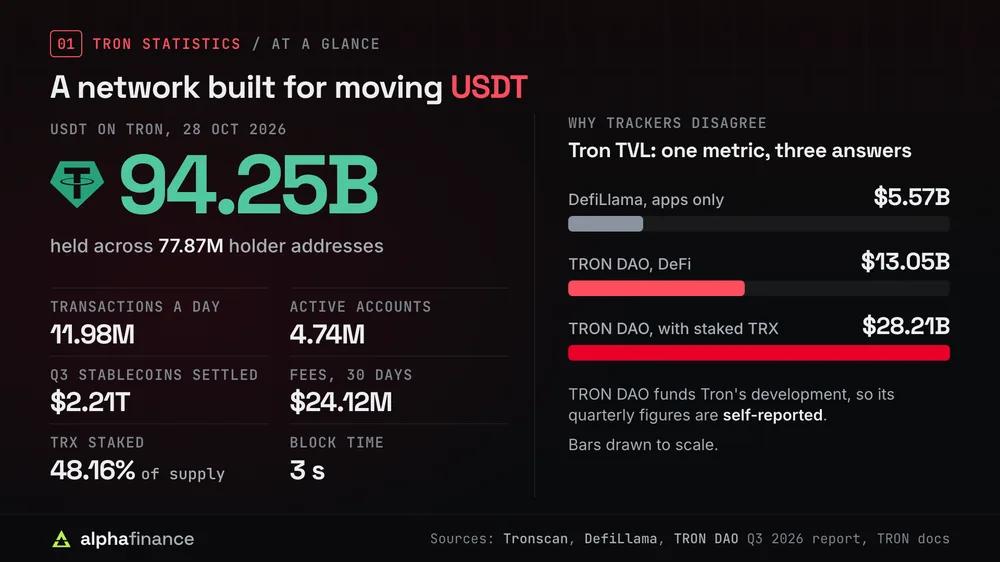
Different trackers can report figures three or more times apart for the same Tron metric. TRON DAO funds the network's development and publishes quarterly reports, making its figures self-reported.
Moving USDT is Tron's main use, and no other network holds more of the token. Tronscan recorded 94.25 billion USDT across 77.87 million holder addresses on 28 Oct 2026.
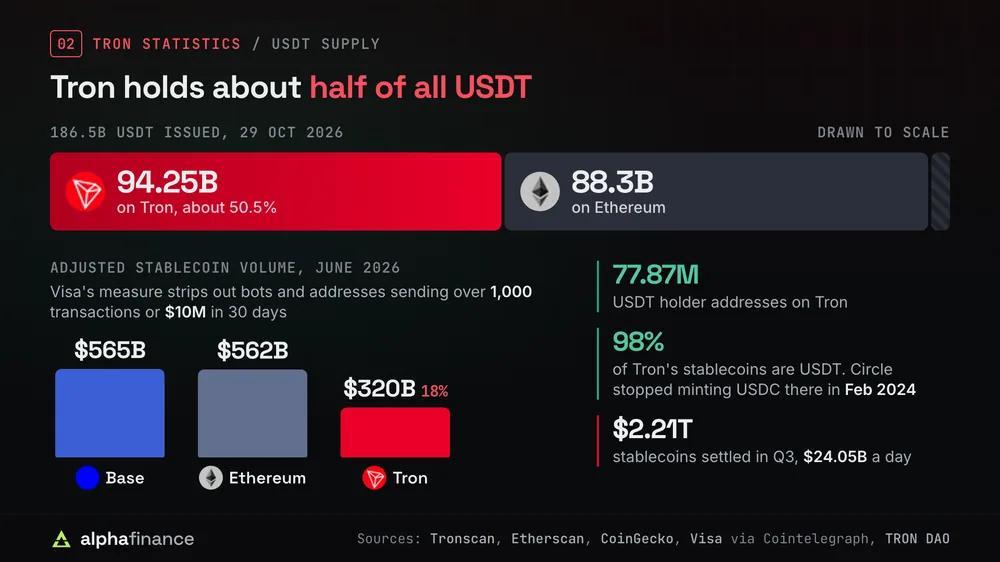
Total USDT supply reached 186.5 billion tokens on 29 Oct 2026, according to CoinGecko's Tether page. That gives Tron about 50.5% of all USDT issued, ahead of Ethereum's 88.3 billion. Our stablecoin statistics compare USDT with other dollar tokens.
About 98% of the stablecoins on Tron are USDT, based on DefiLlama's Tron stablecoin breakdown. Circle stopped minting USDC on Tron in Feb 2024. A stablecoin balance on the network is therefore almost always USDT. Our USDT wallet comparison covers where to keep it.
Tron settled $2.21 trillion in stablecoins during Q3 2026, according to TRON DAO's Q3 report. Settlement volume measures the value moved between addresses. The quarterly total was 5.1% above Q2 and averaged $24.05 billion a day. The report also says cumulative transaction volume passed $30 trillion in Sep 2026. On 28 Oct 2026 alone, Tronscan recorded 2.26 million USDT transfers.
Filtering out automated transfers reduces Tron's payments share considerably. Visa's onchain analytics dashboard excludes addresses sending more than 1,000 transactions or $10 million within 30 days. It also removes bot, bridge and exchange-internal activity.
Using that measure, Tron carried $320 billion in stablecoin volume in June 2026, about 18% of the total, as Cointelegraph reported from Visa's data. Base handled $565 billion and Ethereum $562 billion that month. The difference suggests that accounts transferring at very high frequency contribute much of Tron's raw volume.
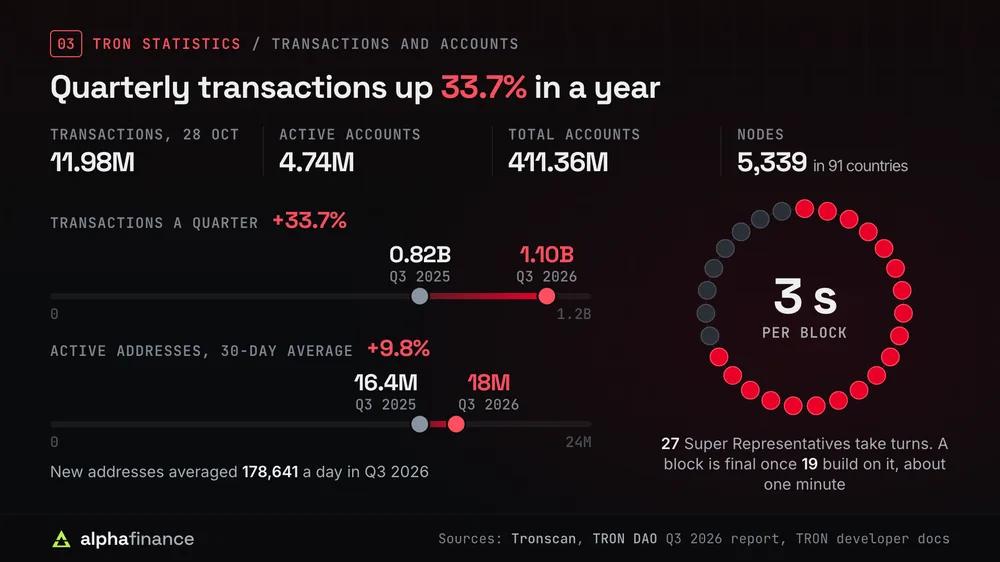
Tron processes around 12 million transactions daily. Its quarterly transaction count is about a third higher than a year earlier.
On 28 Oct 2026, Tronscan recorded 11.98 million transactions involving 4.74 million active accounts. Total accounts stood at 411.36 million, with 15.99 billion transactions processed since launch.
An account is an address. One person or exchange can control thousands of them, so account counts measure activity rather than people.
The TRON DAO Q3 2026 report tracks changes in that activity over the year.
A new Tron block is produced every three seconds. The network uses delegated proof of stake (DPoS), under which TRX holders vote for the validators that run it, according to the TRON developer documentation. The 27 validators receiving the most votes are called Super Representatives and take turns producing blocks. Finality occurs once 19 of them have built on a block, usually after about one minute.
Tronscan showed 131 transactions a second on 28 Oct 2026, compared with a recorded peak of 1,035. Voting power remains concentrated. TRON DAO reported that the five largest Super Representatives controlled 37.1% of votes in Q3 2026, including 11.42% held by Poloniex alone.
During that quarter, Proposal 107 activated features from the GreatVoyage v4.8.2 upgrade. They made Tron's smart contracts, the programs stored on the blockchain, more compatible with Ethereum's.
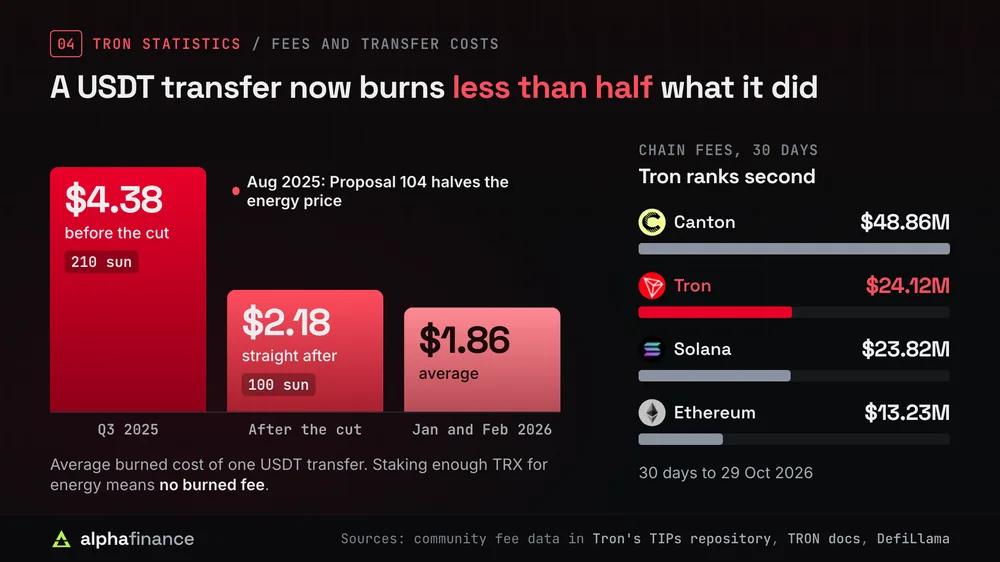
Tron remains one of the highest fee-earning blockchains after halving its prices in 2025. It ranked second in DefiLlama's chain fee ranking over the 30 days to 29 Oct 2026, collecting $24.12 million. Canton led with $48.86 million. Solana was a close third at $23.82 million, and Ethereum earned $13.23 million. Our crypto project revenue ranking compares these earnings with those of individual apps.
Transactions consume two resources on Tron. Bandwidth covers transaction size. Energy pays for the computing work performed by a smart contract, such as transferring USDT.
Users obtain these resources by staking TRX, which locks the tokens in their account. Alternatively, they pay by burning TRX, permanently destroying it. Tron's network parameter list sets the current energy price at 100 sun per unit. One sun is a millionth of a TRX.
Energy cost 210 sun until late Aug 2025. Super Representatives then voted on Proposal 104 to reduce it to 100 sun, as Cointelegraph reported at the time. This halved the TRX burned by users paying for transfers instead of staking.
Before the cut, the average burned cost of a USDT transfer was $4.38 in Q3 2025. It fell to $2.18 immediately afterwards and reached $1.86 in Jan and Feb 2026, according to community fee data in Tron's improvement proposal repository. Users who stake enough TRX to meet their energy needs pay no burned fee.
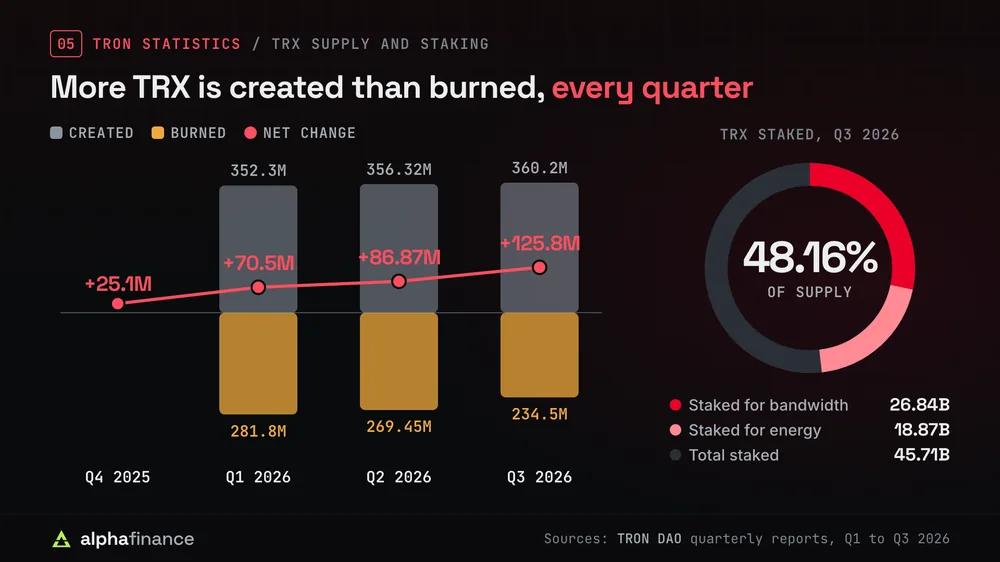
TRX supply has increased slightly in every quarter of the past year, while its price sits about a quarter below its record. On 30 Oct 2026, CoinMarketCap priced TRX at $0.3312. Its $31.47 billion market value ranked eighth among all crypto assets.
The token reached its all-time high of $0.4407 on 3 Dec 2024. The current price is about 24.8% below that level. Our crypto prices page tracks TRX live alongside the other large coins.
Every block creates new TRX. Block producers receive 8 TRX, while voters share 128 TRX per block, according to the TRON developer documentation on Super Representatives. Proposal 102 reduced those rewards from 16 TRX and 160 TRX in Jun 2025. Its sponsors expected the reduction to increase the annual rate of supply shrinkage from 0.85% to 1.29%, as set out in the proposal on the TRON DAO forum.
The energy price cut two months later reversed that effect. Lower prices reduced TRX burns, and more users chose to stake for energy. Net issuance, calculated as TRX created minus TRX burned, reached 25.1 million in Q4 2025, according to TRON DAO's Q1 2026 report. It has increased every quarter since.
| Quarter | TRX created | TRX burned | Net change in supply |
|---|---|---|---|
| Q1 2026 | 352.3M | 281.8M | +70.5M |
| Q2 2026 | 356.32M | 269.45M | +86.87M |
| Q3 2026 | 360.2M | 234.5M | +125.8M |
These figures come from TRON DAO's Q1 2026 report, Q2 2026 report and Q3 2026 report.
Burns offset 65.1% of newly created TRX in Q3 2026, compared with 75.6% in Q2. Supply increased by about 308 million TRX over the four quarters to Sep 2026. That represents roughly 0.3% of the 95.02 billion in circulation.
Staking provides energy or bandwidth for transactions. It also gives holders votes, which earn a share of block rewards when cast for a Super Representative.
In Q3 2026, holders had staked 45.71 billion TRX, equivalent to 48.16% of supply, according to TRON DAO. Of that total, 18.87 billion was staked for energy and 26.84 billion for bandwidth.
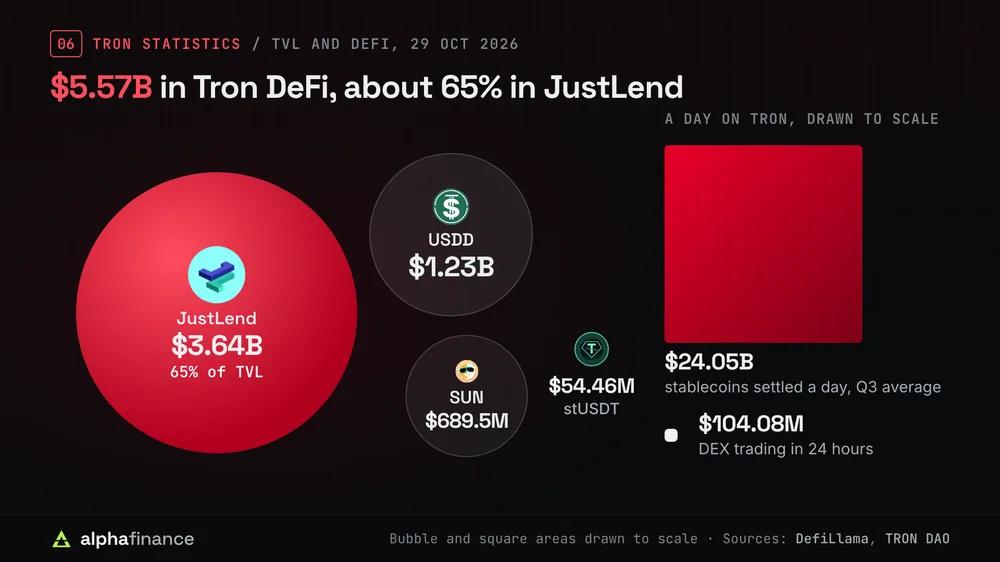
One lending protocol holds most of the money deposited in Tron apps. DefiLlama recorded $5.57 billion in Tron DeFi TVL on 29 Oct 2026.
DefiLlama lists four apps with the largest deposits.
Decentralised exchanges on Tron handled $104.08 million in trading over 24 hours, per DefiLlama. This is small compared with the network's average daily stablecoin settlement volume of $24.05 billion in Q3 2026. Our DeFi statistics compare those deposits with every other chain.
A listed fund now gives US investors access to TRX, while a Nasdaq company holds it as its main asset. An exchange-traded fund (ETF) has shares that trade on a stock exchange.
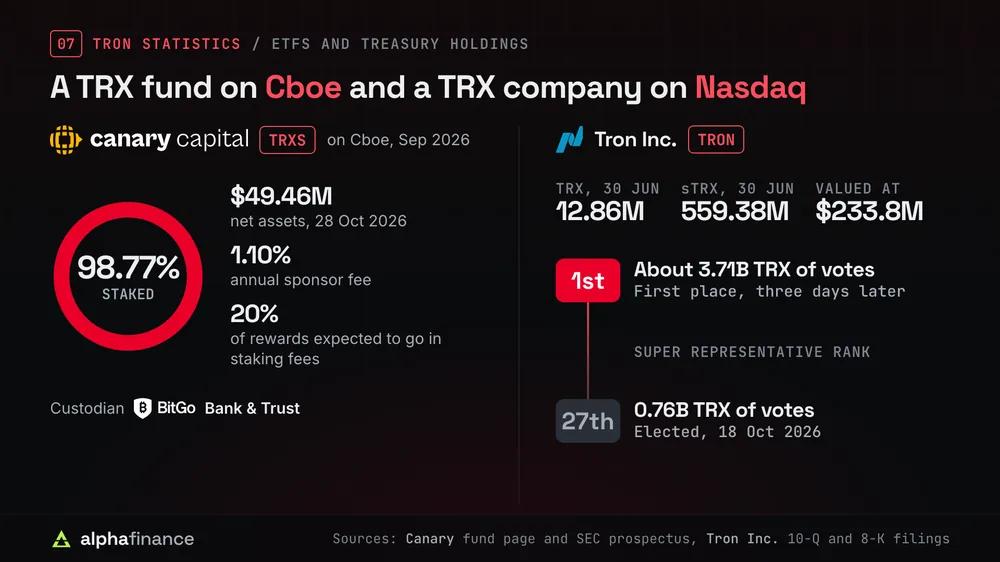
The Canary Staked TRX ETF launched on Cboe in Sep 2026 under the ticker TRXS. Canary's launch announcement describes it as the first US spot staked TRX ETF.
The fund's prospectus filed with the SEC names BitGo Bank & Trust as custodian and sets an annual sponsor fee of 1.10%. At least 90% of its TRX is expected to be staked. Staking fees shared among the provider, sponsor and custodian are expected to consume 20% of rewards.
On 28 Oct 2026, TRXS held $49.46 million in net assets, according to Canary's fund page. The page reported that 98.77% of its TRX was staked.
Tron Inc. (Nasdaq: TRON) held 12.86 million TRX outright and 559.38 million sTRX at 30 Jun 2026, according to its quarterly report filed with the SEC. sTRX is the token JustLend issues for TRX staked through it. The company valued these digital assets at $233.8 million.
The company also participates in running Tron. On 18 Oct 2026, it was elected a Super Representative in 27th place with 0.76 billion TRX of votes, according to an 8-K filing with the SEC. A second 8-K reported three days later that it had reached first place with about 3.71 billion TRX of votes.
Low-cost USDT transfers attract criminals as well as ordinary users. Freezing stolen and sanctioned funds has been Tron's main response.
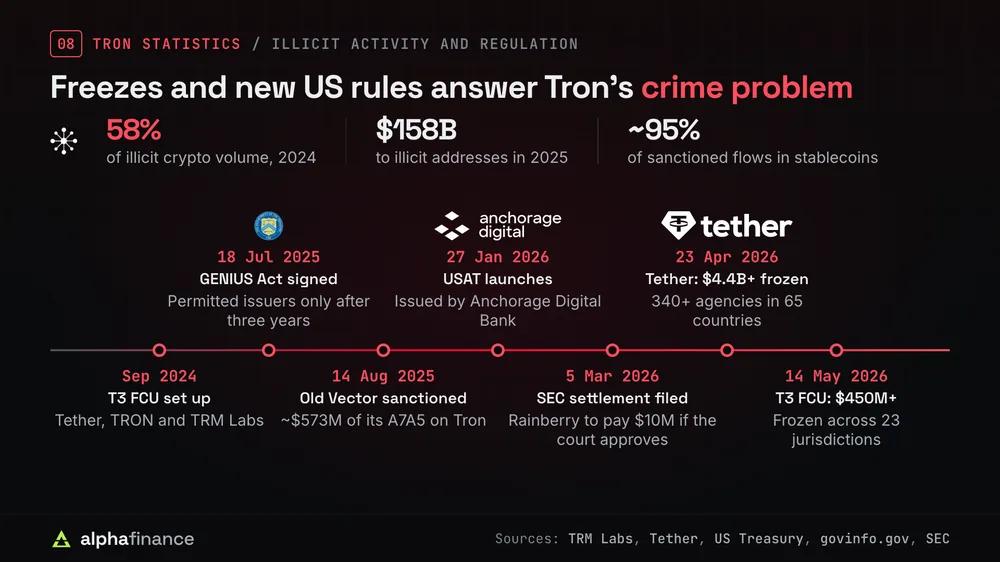
Blockchain analytics firm TRM Labs found that Tron accounted for 58% of illicit crypto volume in 2024, the largest share of any network. Tron also recorded the largest fall in illicit volume of any blockchain that year, a drop of $6 billion, according to its 2024 analysis.
Most crime-linked crypto activity now moves through stablecoins. TRM's 2026 Crypto Crime Report identified about $158 billion sent to illicit addresses in 2025, equivalent to 1.2% of the volume it could attribute. Stablecoins carried nearly 95% of funds reaching sanctioned entities. The firm also traced close to $1 billion linked to Iran's Revolutionary Guard through the Zedcex exchange, mainly as USDT on Tron.
The network also carries sanctioned tokens. DefiLlama's Tron stablecoin list records about $573 million of A7A5, a rouble-backed token. Its issuer, Old Vector, was sanctioned by the US Treasury on 14 Aug 2025.
Tether, TRON and TRM Labs established the T3 Financial Crime Unit in Sep 2024. By 14 May 2026, it had frozen more than $450 million in illicit assets across 23 jurisdictions, according to Tether's announcement. Tether reported that the unit intercepted 43.9% more criminal proceeds in 2025 than in 2024.
As of 23 Apr 2026, Tether had frozen more than $4.4 billion across all networks. It worked with more than 340 law enforcement agencies in 65 countries.
US stablecoin law now determines the conditions for USDT's future in America. Signed on 18 Jul 2025, the GENIUS Act makes it unlawful for US crypto service providers to offer a payment stablecoin from anyone other than a permitted issuer once three years have passed since enactment.
For a foreign issuer's stablecoin to be offered, the issuer must be able to comply with lawful orders. The act defines those orders to include token freezes. Tether's record shows that it already executes such orders on Tron. It also launched USAT, a separate US-regulated token, on 27 Jan 2026. Anchorage Digital Bank issues the token.
The US Securities and Exchange Commission's case against Tron founder Justin Sun is nearing its end. On 5 Mar 2026, the SEC filed a proposed judgment to dismiss all claims against Sun, the Tron Foundation and the BitTorrent Foundation, according to SEC litigation release 26496.
Under the proposal, Rainberry would pay a $10 million penalty over wash trading of TRX, meaning trading with itself to inflate volume. The settlement requires court approval before it takes effect.
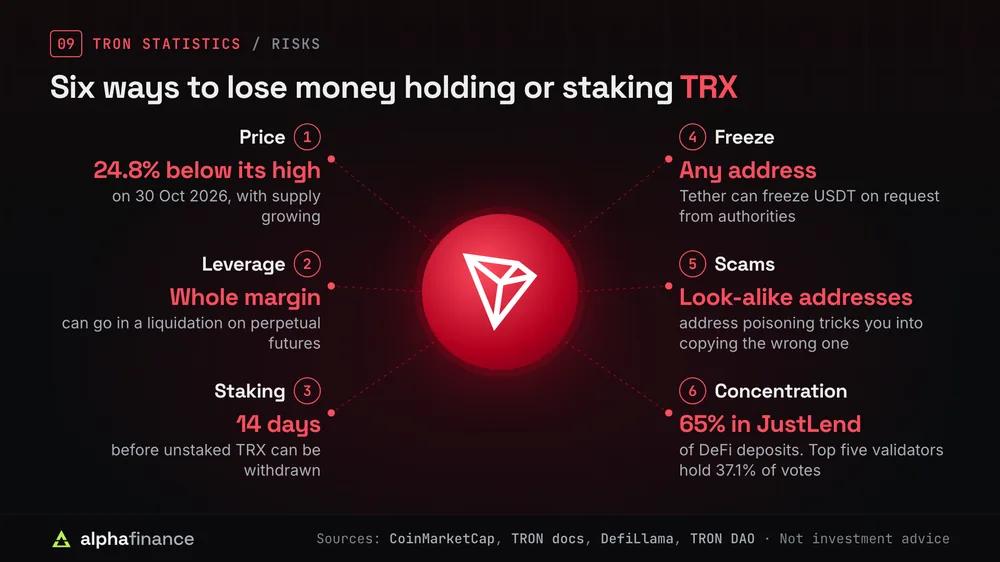
Holding TRX exposes investors to rapid price falls, and staked tokens cannot be withdrawn on demand. USDT held on Tron can also be frozen by its issuer. On 30 Oct 2026, TRX traded 24.8% below its all-time high. Crypto assets can fall much further within a short period.
Not investment advice
This article explains market data. Nothing on this page is a recommendation to buy, sell or leverage any asset. Digital assets are volatile and you can lose everything you put in. If you are unsure whether a trade is appropriate for you, a licensed adviser in your jurisdiction is the right next step.


Fact checked by
Verifies every figure against primary sources before publication. Meet the team
Tronscan recorded 94.25 billion USDT on Tron on 28 Oct 2026. That is about half of all USDT and the largest balance on any blockchain, ahead of Ethereum's 88.3 billion. USDT accounts for about 98% of Tron's stablecoins.
Tron handled 11.98 million transactions on 28 Oct 2026, when 4.74 million accounts were active. According to TRON DAO's Q3 report, quarterly transactions reached about 1.10 billion in Q3 2026, roughly a third above the previous year. These figures measure activity rather than people because accounts are addresses.
The average burned cost of a USDT transfer was about $1.86 in Jan and Feb 2026, compared with $4.38 before the Aug 2025 fee cut. Those figures come from community data in Tron's improvement proposal repository. Fees are paid in TRX, so their dollar cost changes with the token's price. Staking enough TRX to cover the energy consumed removes the burned fee.
Supply has grown slowly since the 2025 fee cut reduced TRX burns. Net issuance reached 125.8 million TRX in Q3 2026, when burns offset only 65.1% of new supply, according to TRON DAO. Supply increased by about 0.3% over the four quarters to Sep 2026.
Yes. The Canary Staked TRX ETF launched on Cboe in Sep 2026 under the ticker TRXS. It held $49.46 million in net assets on 28 Oct 2026, according to Canary's fund page. Almost all its TRX is staked, and the annual sponsor fee is 1.10%.
Staking locks TRX in your account to obtain energy or bandwidth for transactions. It also provides votes for Super Representatives, which earn a share of block rewards when cast. Holders had staked 48.16% of all TRX in Q3 2026. The TRON documentation specifies a 14-day wait before unstaked TRX becomes withdrawable.