Markets
 BTC
 ETH
 BNB
 XRP
 SOL
 ZEC
 HYPE
 DOGE
 LINK
 TON
 AVAX
 SUI
 TAO
 AAVE
 PUMP
 MORPHO
 ARB
 LIT
--:-- UTC
Research/Stablecoins
Stablecoin statistics on total supply, the two issuers behind most of it, the blockchains that hold it, payment volumes, reserves and the licensing rules arriving in 2027.
 By Alpha Finance Editorial Team
 Fact-checked by Vince Dioquino
Every figure, platform detail and regulatory claim on this page was traced to a primary source by the named fact checker before publication, and is re-checked when those facts change. The review date moves only when a person has re-read the page.
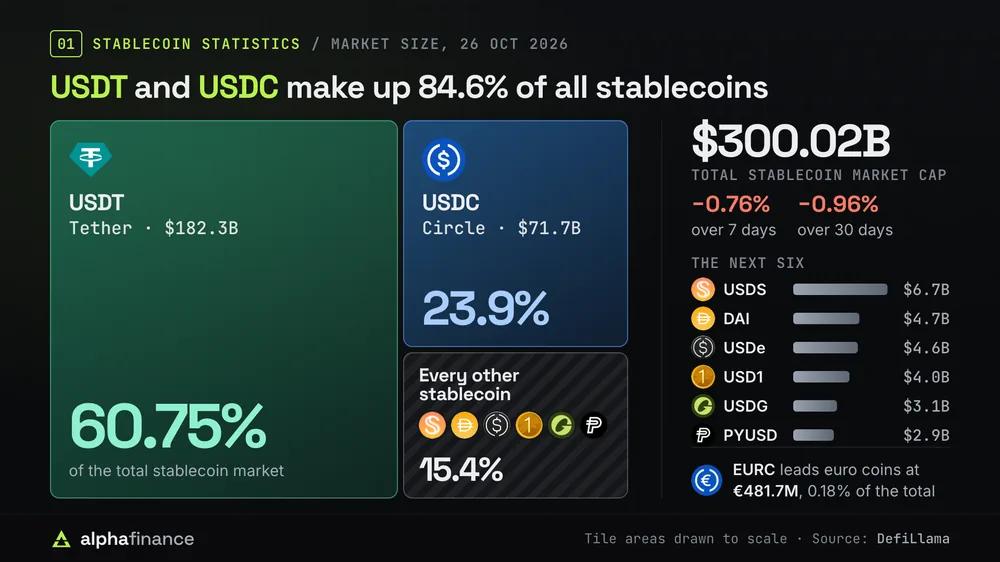
The editorial policy → Editorial policy Report an errorStablecoin statistics for October 2026 put circulating supply at $300.02 billion on 26 Oct, according to DefiLlama's stablecoin tracker. These crypto tokens are designed to hold a value of one US dollar, with reserves that the issuer promises to redeem at par. USDT and USDC together represent 84.6% of the total.
Over the previous 30 days, supply fell 0.96% as stablecoin rules became firmer. The US GENIUS Act and its first final regulation take effect on 18 Jan 2027, according to the Office of the Comptroller of the Currency (OCC), the national bank regulator. The Hong Kong Monetary Authority (HKMA) licensed its first two issuers in April.
Almost all of the roughly $300 billion stablecoin market tracks the US dollar.
On 26 Oct 2026, market capitalisation stood at $300.02 billion, down 0.76% over seven days, according to DefiLlama's stablecoin rankings. This measure multiplies the number of circulating tokens by their price. USDT accounted for 60.75% of the market, while the eight largest dollar stablecoins held a combined 93.3%.
| Stablecoin | Issuer | How it holds its value | Market cap (26 Oct 2026) |
|---|---|---|---|
| USDT | Tether | Treasury bills, repurchase agreements, gold, bitcoin and loans | $182.3B |
| USDC | Circle | Cash and short-term government debt | $71.7B |
| USDS | Sky | Crypto and other collateral | $6.7B |
| DAI | Sky (formerly MakerDAO) | Crypto collateral | $4.7B |
| USDe | Ethena | Crypto hedged with perpetual futures | $4.6B |
| USD1 | World Liberty Financial | Cash and short-term government debt | $4.0B |
| USDG | Paxos | Cash and short-term government debt | $3.1B |
| PYUSD | PayPal, issued by Paxos | Cash and short-term government debt | $2.9B |
Issuers of fiat-backed tokens such as USDT and USDC hold cash and government debt they can sell to repay holders. DAI and USDS are created against crypto deposited as collateral. USDe instead pairs crypto holdings with perpetual futures so that price movements in one offset the other. These futures contracts track an asset's price and never expire.
The largest euro stablecoin, Circle's EURC, had €481.7 million in circulation on 26 Oct 2026, worth about $538.6M. That is about 0.18% of all stablecoins, based on the same DefiLlama data.
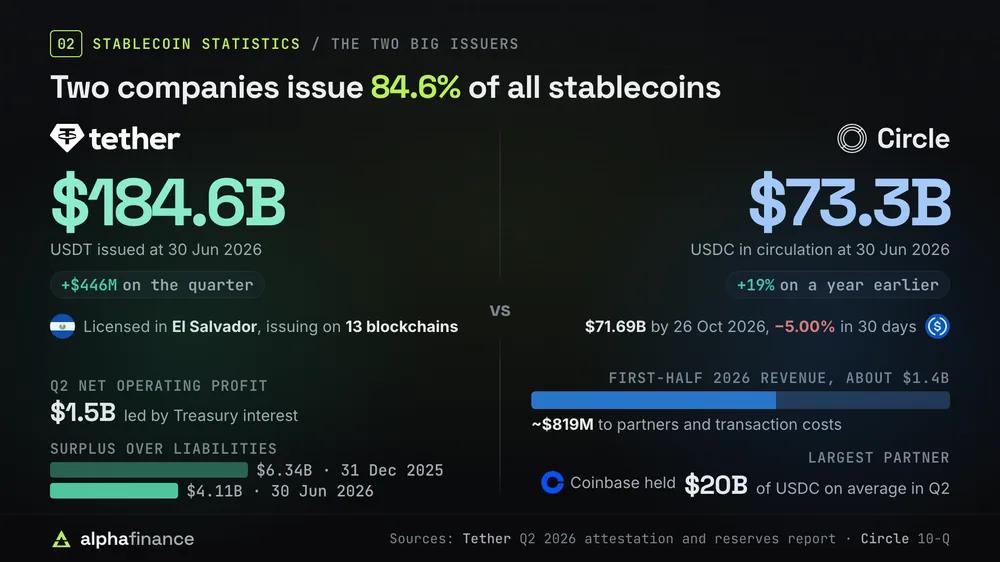
With two companies issuing 84.6% of all stablecoins, most of the market's risk rests on their reserves, profits and licences.
At 30 Jun 2026, Tether had about $184.6 billion of USDT issued, according to its second-quarter attestation release. That was $446 million more than three months earlier, despite a contraction in the wider market. An attestation is an accountant's check of reserves on a single date.
Interest on Treasury holdings drove much of Tether's $1.5 billion net operating profit for the quarter. The company also said its reserves had weathered volatility in gold and bitcoin.
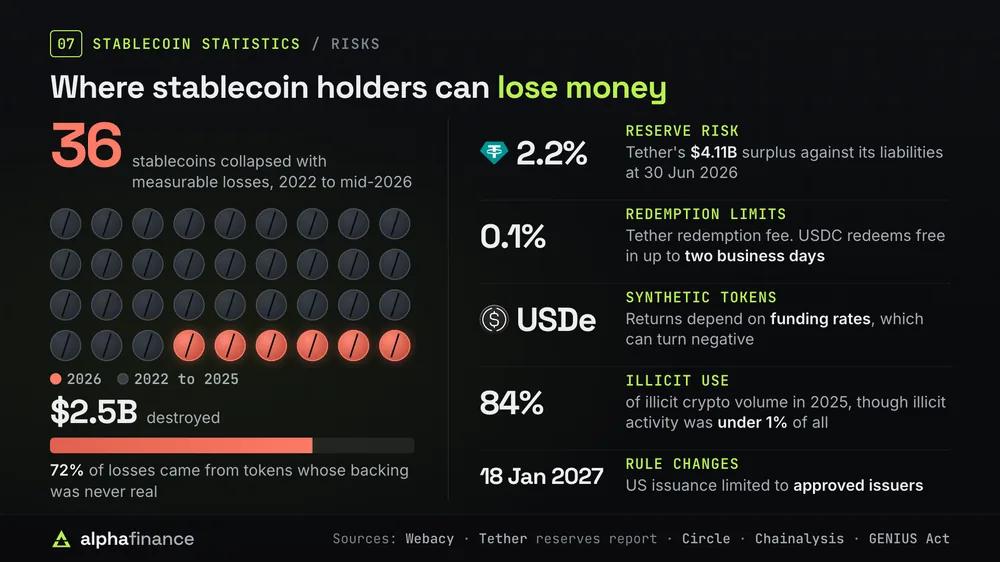
Its financial figures and reserves report records a $4.11 billion surplus of assets over liabilities at 30 Jun 2026, compared with $6.34 billion at 31 Dec 2025. The six-month financial result was negative $3.17 billion.
The report describes Tether International as an authorised stablecoin issuer under El Salvador's Digital Asset Issuance Law, with tokens issued on 13 blockchains.
In August, KPMG issued a clean opinion on Tether International's full 2025 financial statements. This was the company's first complete audit, The Block reported. Tether also launched USAT for American customers on 27 Jan 2026. Anchorage Digital Bank issues the separate token, according to CoinDesk.
USDC circulation reached $73.3 billion at 30 Jun 2026, up 19% from a year earlier, according to Circle's second-quarter 10-Q, its quarterly filing with the US Securities and Exchange Commission. By 26 Oct 2026, supply had eased to $71.69 billion, a 5.00% decline over 30 days, on DefiLlama's USDC page.
Partners that hold USDC for their users are central to Circle's business. Of about $1.4 billion in revenue earned during the first half of 2026, roughly $819 million went to distribution partners and transaction costs, according to Circle's breakdown of USDC economics. Coinbase, its largest partner, held an average of $20 billion in USDC across its products during the second quarter.
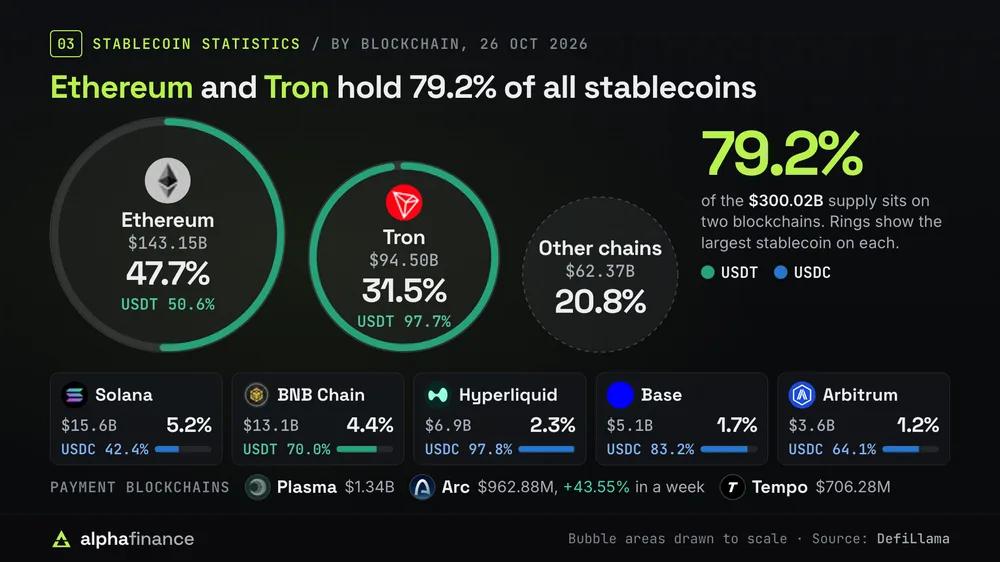
Ethereum and Tron hold 79.2% of stablecoin supply, despite stablecoins running on dozens of blockchains. The fees and users of those two networks therefore determine where most stablecoin activity takes place.
DefiLlama's breakdown by chain put Ethereum's stablecoin supply at $143.15 billion on 26 Oct 2026, compared with $94.50 billion on Tron.
| Blockchain | Stablecoin supply | Share of total | Largest stablecoin (share on chain) |
|---|---|---|---|
| Ethereum | $143.1B | 47.7% | USDT (50.6%) |
| Tron | $94.5B | 31.5% | USDT (97.7%) |
| Solana | $15.6B | 5.2% | USDC (42.4%) |
| BNB Chain | $13.1B | 4.4% | USDT (70.0%) |
| Hyperliquid L1 | $6.9B | 2.3% | USDC (97.8%) |
| Base | $5.1B | 1.7% | USDC (83.2%) |
| Arbitrum | $3.6B | 1.2% | USDC (64.1%) |
Our blockchain data dashboard provides five years of history for the stablecoin float on each major blockchain, meaning the value of stablecoins circulating there.
Each network has its own USDT token. A holder can therefore receive only the versions supported by their wallet. Our guide to the best USDT wallets compares network coverage and how wallets charge fees.
Hyperliquid held $6.91 billion of stablecoins, of which 97.8% was USDC. The perpetual futures exchange runs on its own blockchain and earns a share of the interest on users' USDC holdings, as our Hyperliquid statistics show.
Blockchains built for payments are also growing, though from a small base. Circle's Arc held $962.88M of stablecoins on 26 Oct 2026, a weekly increase of 43.55%. Plasma held $1.34 billion and Tempo $706.28M, according to DefiLlama's chain data.
Trading and automated transfers account for most stablecoin activity. Tokens change hands far more often than their supply might suggest, but raw transaction volume overstates everyday use.
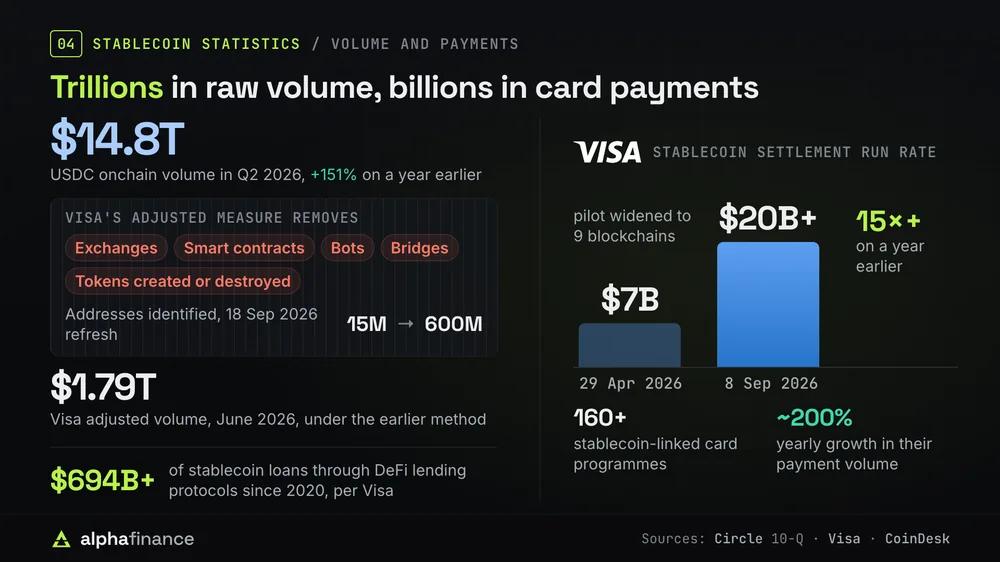
In the second quarter of 2026, USDC alone recorded $14.8 trillion of onchain transaction volume, up 151% from a year earlier, according to Circle's 10-Q. Onchain means recorded on a public blockchain. Circle's October note on USDC economics puts USDC's share of global stablecoin transaction volume at roughly 77% in June 2026.
Visa's onchain analytics changelog explains how its adjusted measure filters activity. It excludes transfers by exchanges and by smart contracts, which are programs that run on a blockchain. Bots and bridges, which move tokens between blockchains, are excluded too, as are tokens being created or destroyed.
A data refresh on 18 Sep 2026 expanded the set of identified addresses from about 15 million to roughly 600 million. Adjusted volume fell as a result, while the adjusted transaction count declined by less than 2%.
Figures produced before that refresh cannot be compared with newer adjusted figures. Using the earlier method, Visa's dashboard recorded a record $1.79 trillion in adjusted volume for June 2026, CoinDesk reported.
Visa said on 8 Sep 2026 that its stablecoin settlement volume had exceeded a $20 billion annualised run rate. This projects recent activity over a full year and represented growth of more than 15 times from a year earlier. Its network supports more than 160 stablecoin-linked card programmes, whose payment volume rose nearly 200% year on year.
That settlement run rate was $7 billion on 29 Apr 2026, when Visa expanded its pilot to nine blockchains. Arc, Base, Canton, Polygon and Tempo joined the pilot, which allows card issuers and acquirers, the banks serving merchants, to settle with Visa in stablecoins.
Borrowing and lending provide another use for stablecoins through DeFi, or decentralised finance. These apps run on blockchains without a company in the middle. Since 2020, more than $694 billion in stablecoin loans have passed through DeFi lending protocols, according to Visa's 8 Sep 2026 release. Our tracker of DeFi yields across major protocols shows the rates those loans pay.
Growth in fiat-backed stablecoins adds demand for Treasury bills because their reserves hold large portfolios of short-term US government debt.
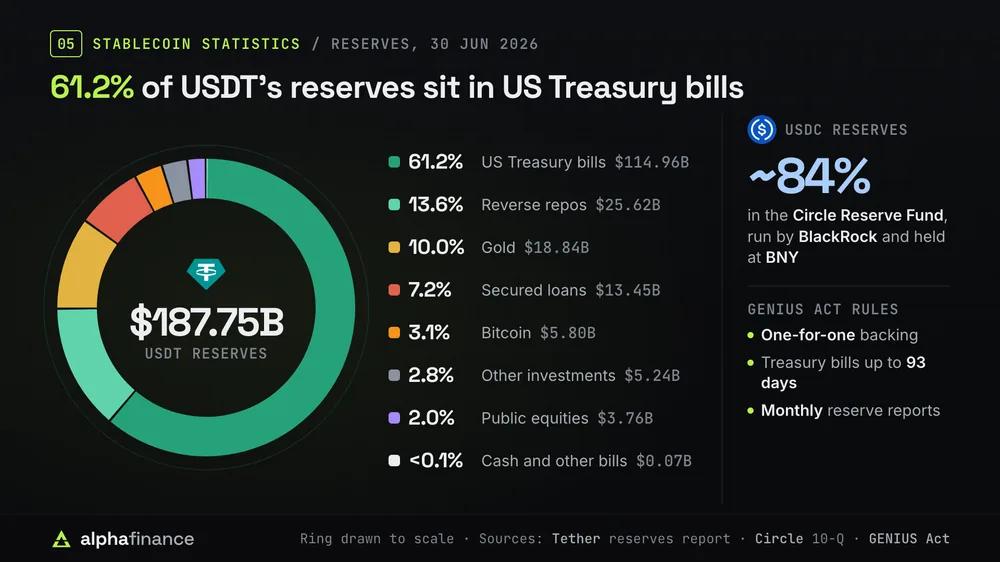
Treasury bills mature within a year and are the main reserve asset for both large issuers. According to Tether's reserves report, they made up 61.2% of its reserves at 30 Jun 2026, with a weighted average maturity below 90 days.
| USDT reserve asset (30 Jun 2026) | Amount | Share of reserves |
|---|---|---|
| US Treasury bills | $114.96B | 61.2% |
| Reverse repurchase agreements, overnight and term | $25.62B | 13.6% |
| Gold | $18.84B | 10.0% |
| Secured loans | $13.45B | 7.2% |
| Bitcoin | $5.80B | 3.1% |
| Other investments | $5.24B | 2.8% |
| Public equities | $3.76B | 2.0% |
| Cash, bank deposits, other bills and bonds | $0.07B | Under 0.1% |
| Total | $187.75B | 100% |
Reverse repurchase agreements are short loans secured by Treasuries. Gold, bitcoin and listed shares accounted for 15.1% of Tether's reserves. Another 7.2% consisted of secured loans, meaning cash lent against collateral. More than a fifth of USDT's backing can therefore move sharply in price or depends on borrowers repaying.
About 84% of USDC's simpler reserve portfolio sat in the Circle Reserve Fund at 30 Jun 2026, according to Circle's 10-Q. Circle's note on USDC economics describes it as a government money market fund managed by BlackRock and held in custody at BNY.
The GENIUS Act requires permitted issuers to back every token one for one and publish their reserve composition monthly. Eligible assets include cash, bank deposits and Treasury bills maturing in 93 days or less, alongside repurchase agreements backed by Treasuries.
An April 2025 Treasury Borrowing Advisory Committee presentation cited Standard Chartered's projection that stablecoin supply could reach about $2 trillion by 2028. That would be roughly 6.7 times today's supply.
The Bank for International Settlements, a forum for central banks, examined the potential strains that widespread stablecoin adoption could place on banks and financial markets in its June 2026 Annual Economic Report. It argued that stablecoins fall short of the properties it expects of money.
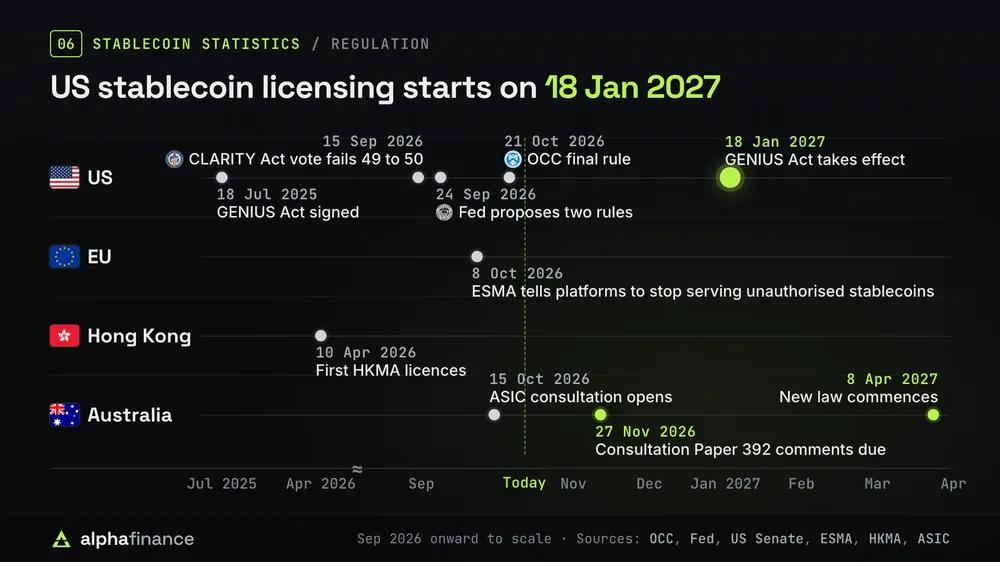
During 2026, stablecoin rules progressed from proposals to licences. These requirements will determine which tokens exchanges and banks can offer in each market.
| Jurisdiction | Main law | Status (27 Oct 2026) | Effect on stablecoins |
|---|---|---|---|
| United States | GENIUS Act | Takes effect 18 Jan 2027 | Approved issuers only; full reserves; no interest paid by issuers |
| European Union | MiCA | In force; ESMA told platforms on 8 Oct 2026 to stop serving unauthorised stablecoins | Single-currency tokens must be issued by a bank or e-money institution |
| Hong Kong | Stablecoins Ordinance | Two licences granted 10 Apr 2026 | Issuing a stablecoin tied to a government currency needs an HKMA licence |
| Australia | Digital Assets Framework Act 2026 | Commences 8 Apr 2027 | Platforms holding tokens for customers need a financial services licence |
The GENIUS Act, signed into US law on 18 Jul 2025, establishes a federal licence for stablecoin issuers and prohibits licensed issuers from paying holders interest or yield. Announced on 21 Oct 2026, the OCC's final rule sets requirements for issuers under its supervision. It takes effect on 18 Jan 2027.
For issuers under its own supervision, the Federal Reserve proposed two companion rules on 24 Sep 2026. They cover reserves and capital, as well as applications from banks seeking to issue stablecoins.
Whether exchanges and wallets can reward users for stablecoin balances was meant to be resolved by the CLARITY Act. Our guide to the CLARITY Act explains the market structure bill. On 15 Sep 2026, a procedural vote to begin Senate debate failed 49 to 50, below the required 60 votes, according to the Senate roll call.
Under the EU's Markets in Crypto-Assets Regulation, or MiCA, a stablecoin pegged to a single currency is an e-money token. Only a bank or licensed e-money institution may issue one. Our ranking of MiCA-licensed exchanges in Europe compares platforms on the register maintained by ESMA, the EU's securities markets regulator.
On 8 Oct 2026, ESMA told licensed crypto firms to stop providing services related to stablecoins that do not comply with MiCA to clients in the EU. Under ESMA's guidance, national regulators should have any remaining exposure removed within three months of that opinion.
Anchorpoint Financial and HSBC received the HKMA's first two stablecoin issuer licences on 10 Apr 2026. The HKMA said the first round had attracted 36 applications and that further licences would remain very limited.
Australia's initial focus is on platforms. From 8 Apr 2027, when the Digital Assets Framework Act commences, exchanges and custody platforms holding crypto for customers will need an Australian financial services licence. The Australian Securities and Investments Commission (ASIC) set out the requirement on 15 Oct 2026. The deadline for comments on its Consultation Paper 392 is 27 Nov 2026.
A separate payments reform covers stablecoin issuers. Treasury's March 2026 draft legislation would classify payment stablecoins as tokenised stored value facilities, placing providers above A$200 million under APRA, the prudential regulator, according to a summary by law firm Gilbert + Tobin. Our ranking of crypto exchanges in Australia compares local platforms by regulation, fees and security.
Maintaining a stablecoin's value depends on functioning reserves, redemptions and code. A failure in any of them can cost a holder part or all of their money.
Not investment advice
This article explains market data. Nothing on this page is a recommendation to buy, sell or leverage any asset. Digital assets are volatile and you can lose everything you put in. If you are unsure whether a trade is appropriate for you, a licensed adviser in your jurisdiction is the right next step.


Fact checked by
Verifies every figure against primary sources before publication. Meet the team
Tether's USDT has the largest market share. At 30 Jun 2026, Tether reported about $184.6 billion of USDT issued and said its share had exceeded 60%. USDC ranked second with $73.3 billion in circulation on that date, according to Circle's quarterly filing.
Short-term US government debt makes up most stablecoin reserves. Tether's reserves report shows that Treasury bills accounted for 61.2% of USDT reserves at 30 Jun 2026, with Treasury-backed repurchase agreements adding 13.6%. Most of the remainder consisted of gold, bitcoin, shares and secured loans. Circle held about 84% of USDC reserves in a government money market fund, according to its 10-Q filing.
Trackers either count every onchain transfer or adjust the total to remove exchange and automated activity. Under Visa's methodology, the adjusted measure excludes exchanges, smart contracts, bots, bridges and token creation. A September 2026 data refresh reduced that measure. Raw totals are much higher. USDC alone recorded $14.8 trillion in onchain volume during the second quarter of 2026, Circle reported.
The GENIUS Act and the OCC's final implementing rule take effect on 18 Jan 2027, the OCC confirmed. It will announce separately when applications open for prospective issuers. In October 2026, the Federal Reserve's own rules remained at the proposal stage.
The GENIUS Act prohibits licensed US issuers from paying interest or yield to holders. Rewards from exchanges and wallets remain unresolved following the CLARITY Act's failed procedural vote. The Senate voted 49 to 50 on 15 Sep 2026.