Markets
 BTC
BTC ETH
ETH BNB
BNB XRP
XRP SOL
SOL ZEC
ZEC HYPE
HYPE DOGE
DOGE LINK
LINK TON
TON AVAX
AVAX SUI
SUI TAO
TAO AAVE
AAVE PUMP
PUMP MORPHO
 ARB
ARB LIT
LIT--:-- UTC
Research/Founders
Guy Young's path from Cerberus to founding Ethena, how USDe works and what backs it now, his undisclosed ENA stake, and why USDe can't be offered in the EU.
 By Alpha Finance Editorial Team
 Fact-checked by Vince Dioquino
Every figure, platform detail and regulatory claim on this page was traced to a primary source by the named fact checker before publication, and is re-checked when those facts change. The review date moves only when a person has re-read the page.
The editorial policy → Editorial policy Report an errorGuy Young founded and leads Ethena Labs, the company behind USDe, a dollar-pegged token backed by crypto assets, loans and offsetting trades. He began building it in 2023 after leaving a six-year career at Cerberus Capital Management.
Within 20 months of launch, USDe passed $14 billion. Roughly two thirds of its supply disappeared after the October 2025 market crash. Young has spent 2026 replacing most of the token's backing and revising how ENA rewards holders.
A 2023 blog post inspired Guy Young to build one of crypto's largest dollar tokens. He remains chief executive of the company that issues it.
Ethena calls USDe a synthetic dollar. Like a stablecoin, it is designed to hold a value of one US dollar. Most stablecoins use cash and government debt as backing. USDe maintains its $1 value through crypto assets, loans and offsetting trades.
On 5 Oct 2026, DefiLlama's stablecoin rankings showed $4.909 billion of USDe in circulation, behind only Tether's USDT, Circle's USDC and Sky's USDS. Young's CoinDesk Most Influential 2025 profile credited him with creating a new category of yield-paying dollar tokens.
Neither Ethena's documentation nor Young's published biographies disclose his age, nationality or education.
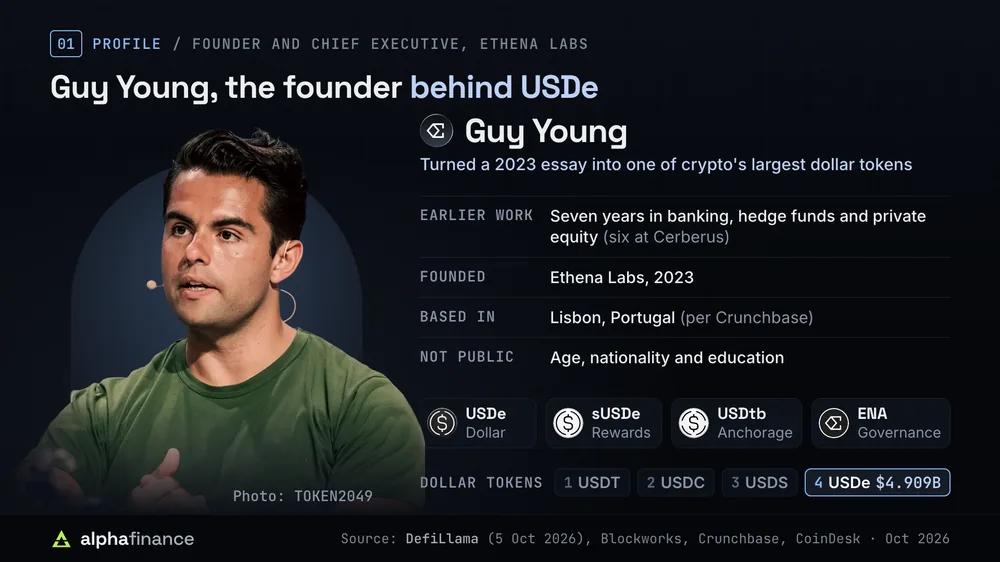
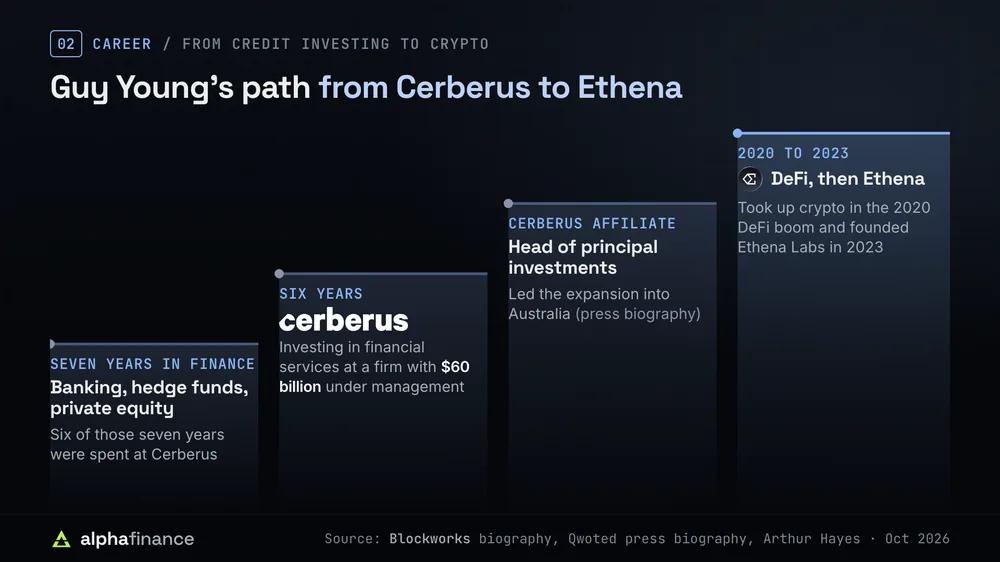
Young's background in credit investing shaped Ethena's design. According to his Blockworks biography, he spent six years investing in financial services businesses at Cerberus Capital Management, a firm with $60 billion under management.
He became head of principal investments at a Cerberus affiliate, says a press biography on Qwoted, a secondary source supplied on his behalf. In that role, he led the firm's expansion into Australia and oversaw investments in banking, specialty finance, insurance and fintech.
Arthur Hayes wrote in March 2024 that Young took up crypto during the DeFi boom of 2020. DeFi, short for decentralised finance, covers lending and trading run by software on a blockchain. Young discussed his move into crypto in an October 2023 interview on Castle Island Ventures' On the Brink podcast.
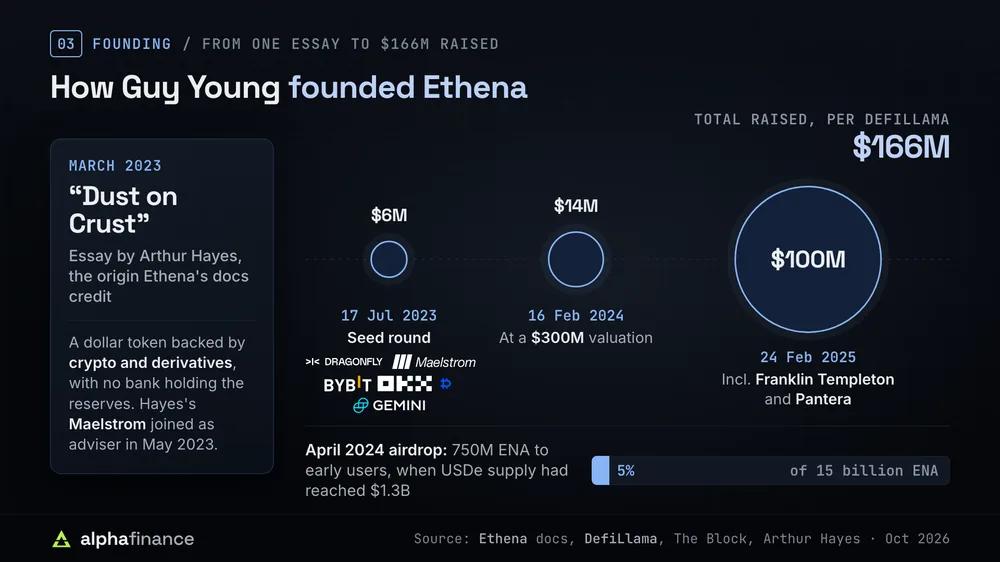
In March 2023, Hayes published "Dust on Crust", the essay Ethena's documentation credits as the project's origin. It proposed a dollar token backed by crypto assets and derivatives, contracts whose value follows another asset's price. No bank would hold the reserves.
Young put together a team and adapted the design. Hayes wrote in his 2024 essay that Maelstrom, his family office, joined as a founding adviser in May 2023 and received governance tokens in return.
A $6 million seed round on 17 Jul 2023 brought backing from Dragonfly Capital, Maelstrom and exchange investors including Bybit, OKX Ventures, Deribit and Gemini, according to DefiLlama's record of Ethena's raises. The next round raised $14 million on 16 Feb 2024 at a $300 million company valuation.
DefiLlama recorded a further $100 million on 24 Feb 2025 from investors including Franklin Templeton and Pantera Capital. It puts total funding at $166 million.
USDe's public launch came with a rewards campaign that began on 19 Feb 2024, The Defiant reported. Six weeks later, by which time supply had reached $1.3 billion, Ethena distributed 750 million ENA tokens to early users through an airdrop, a free token distribution. That represented 5% of ENA's 15 billion supply.
ENA gives holders a vote on how the protocol is run.
| Date | Event | What it changed |
|---|---|---|
| Mar 2023 | Arthur Hayes publishes "Dust on Crust" | Young starts work on a synthetic dollar |
| Jul 2023 | $6M seed round | Dragonfly, Maelstrom and exchanges back Ethena |
| Feb 2024 | USDe opens to the public | Supply reaches $1.3B in six weeks |
| Apr 2024 | ENA token launches | 750M ENA go to early users |
| Mar to Apr 2025 | BaFin acts against Ethena GmbH | USDe can no longer be offered in the EU |
| Jul 2025 | Anchorage Digital agrees to issue USDtb | Ethena gains a US-regulated dollar token |
| Oct 2025 | USDe peaks, then the market crashes | Supply falls 72% by late Aug 2026 |
| Jun 2026 | Coinbase and Janus Henderson deals | Custody and backing move towards traditional finance |
| Aug to Sep 2026 | Investor buyout, buyback vote, Ethena Pay | ENA's economics and USDe's reach change |
| Oct 2026 | Investor token lock-ups end | Monthly investor unlocks stop |
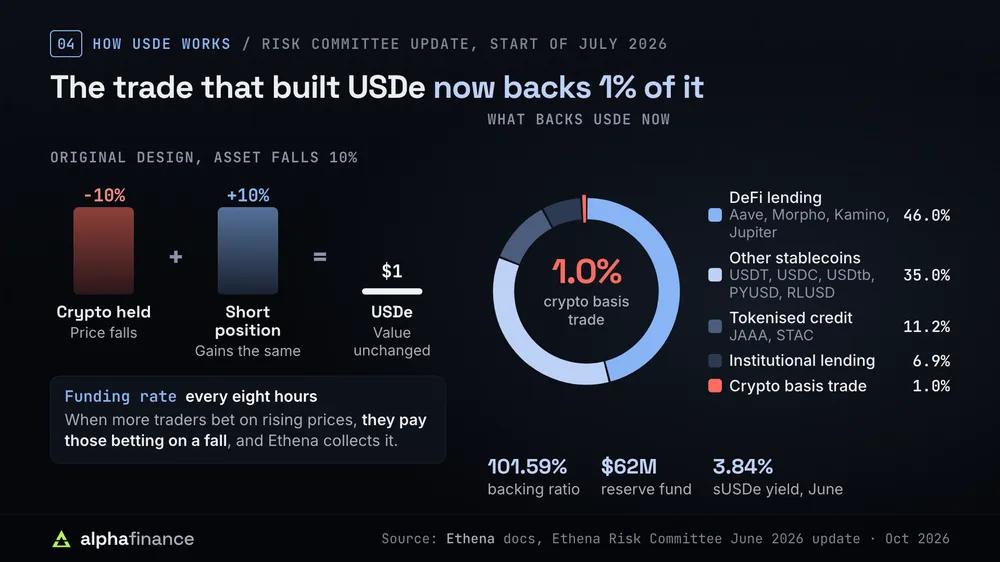
USDe maintains its dollar value by pairing assets with trades that offset their price movements. Under the original design in Ethena's explanation of how USDe works, the protocol holds a crypto asset and opens an equally sized short position, a bet that profits when the price falls.
A 10% drop in the asset produces an equivalent gain on the short, keeping their combined dollar value unchanged. Ethena takes the short position through perpetual futures, contracts that track an asset's price without expiring.
Perpetual futures traders on one side of a contract pay those on the other side a fee called the funding rate, usually every eight hours. When more traders bet on rising prices, they pay those betting on a fall. Ethena collects those payments. Our dashboard compares live funding rates across six exchanges.
Professional traders call the pairing a basis trade. It earns the gap between the futures price and the spot price, which is the price for immediate delivery. Users who stake USDe by locking it in Ethena's contract receive sUSDe, a token that collects the protocol's earnings.
Funding payments shrank as crypto markets cooled, leaving the trade behind only a small fraction of USDe. The Risk Committee's June governance update reported the following backing mix at the start of July 2026.
| What backs USDe | Share of backing | Yield |
|---|---|---|
| DeFi lending (Aave, Morpho, Kamino, Jupiter) | 46.0% | 3.1% |
| Other stablecoins (USDT, USDC, USDtb, PYUSD, RLUSD) | 35.0% | 3.8% |
| Tokenised credit funds (JAAA, STAC) | 11.2% | 5% |
| Institutional lending | 6.9% | 4 to 7% |
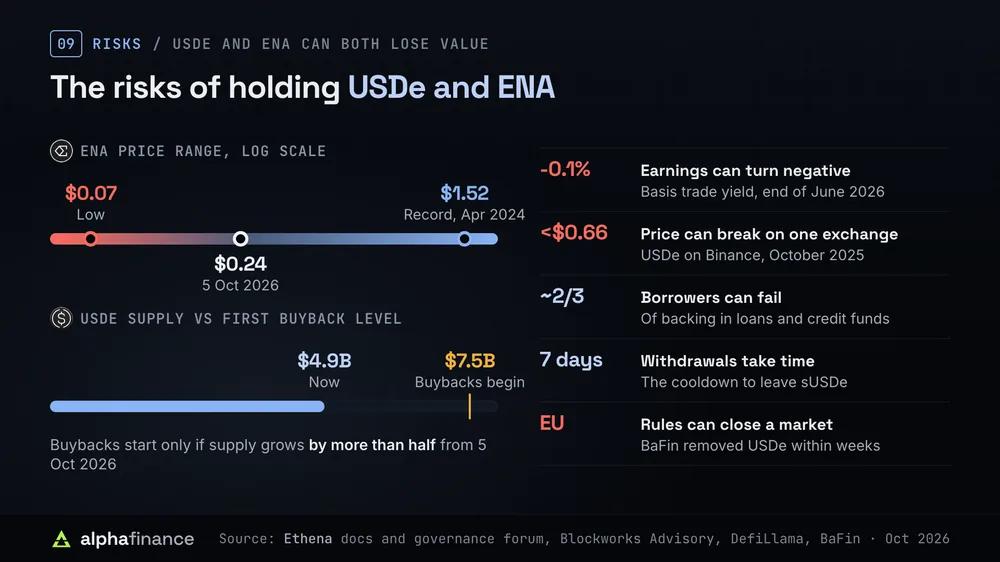
| Crypto basis trade | 1.0% | -0.1% |
Ethena held $1.0159 of assets for each USDe, a backing ratio of 101.59%, according to the same update. The reserve fund contained about $62 million. At the end of June, sUSDe paid 3.84% a year. Our DeFi yields dashboard compares returns from other dollar pools.
The one-sentence version
USDe is a dollar token whose backing has shifted from one offsetting crypto trade to a portfolio of loans, stablecoins and tokenised credit.
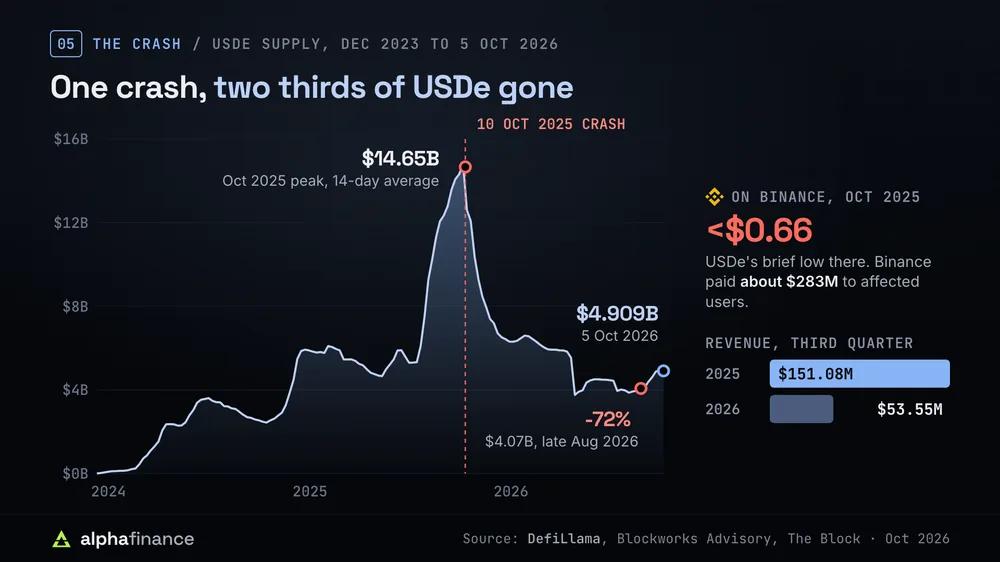
USDe's first growth phase ended with the market crash of 10 Oct 2025. That month, supply reached a 14-day average of $14.65 billion, according to Blockworks Advisory's analysis on Ethena's governance forum.
The sell-off triggered liquidations. These are forced closures of leveraged positions when the collateral pledged to back them runs out. Leverage means trading with borrowed money, and our crypto liquidations dashboard tracks those closures live.
USDe briefly traded below $0.66 on Binance, The Block reported. The exchange paid about $283 million to users affected between 21:36 and 22:16 UTC who held USDe or two other tokens as collateral. Binance said the wider sell-off had bottomed about 15 minutes before those prices broke.
Redemptions continued for months. By late August 2026, USDe supply was $4.07 billion, down 72% from the peak. Blockworks Advisory also found that sUSDe paid less than sUSDS, Sky's rival savings token, on 243 of the 705 days it studied.
Lower supply brought lower earnings. DefiLlama's Ethena income statement, available on the same page as its funding record, puts gross protocol revenue at $151.08 million in the third quarter of 2025 and $53.55 million in the third quarter of 2026. Our ranking of the highest-earning crypto projects shows Ethena's current position.
ENA closed at $0.07204 on 30 Jun 2026, according to StablecoinX's quarterly results. Its record high was $1.52 on 11 Apr 2024.
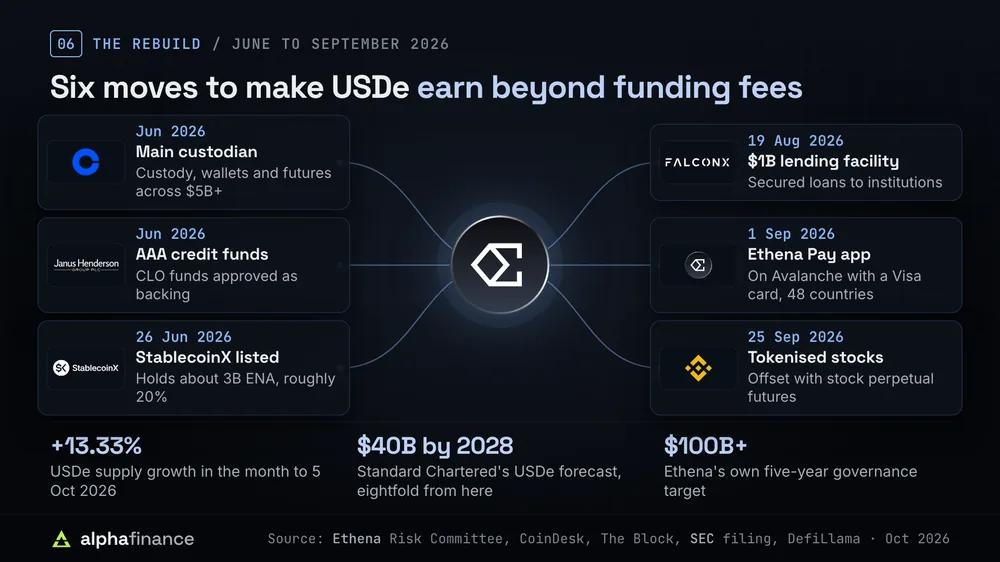
Young responded to the collapse by seeking earnings for USDe that can hold up when crypto traders stop paying to bet on rising prices.
DefiLlama's rankings show USDe grew 13.33% in the month to 5 Oct 2026 as supply began recovering. Standard Chartered initiated research coverage of ENA on 30 Sep 2026, forecasting a $2 token price by the end of 2028 and USDe supply of about $40 billion.
Meeting the bank's forecast would require USDe to grow more than eightfold. Ethena's own governance proposal targets more than $100 billion within five years.
Guy Young's net worth has not been made public. Any quoted figure is an estimate.
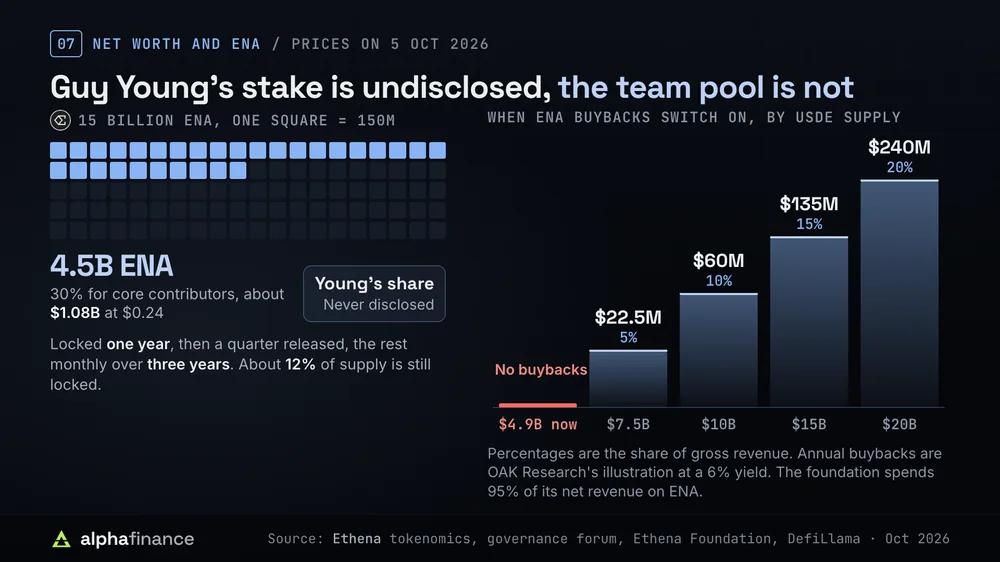
Core contributors, including the Ethena Labs team and advisers, have 30% of ENA's 15 billion supply reserved for them under Ethena's tokenomics. That amounts to 4.5 billion tokens, but Young's personal allocation is undisclosed.
The tokens were locked for one year before a quarter was released. The rest vest, or become available, monthly over three years. At the $0.24 ENA price shown on DefiLlama's Ethena page on 5 Oct 2026, the entire contributor pool was worth about $1.08 billion on paper.
That day, ENA ranked 59th among crypto assets with a market value of $2.47 billion. The current figure appears on our live crypto prices page.
Until this year, investor tokens followed the same vesting schedule. On 27 Aug 2026, the Ethena Foundation announced it had bought the locked tokens of major seed investors who had sold ENA since the October 2025 peak.
Investors who had not sold received an offer to exit at their purchase price. None accepted, The Block reported. Among the sellers, one wallet declined the buyout.
The remaining investor tokens are released from 5 Oct 2026, ending monthly investor unlocks. An unlock makes previously locked tokens available to sell. Team tokens, including Young's, retain their original schedule, with about 12% of supply still locked. Our token unlock calendar lists scheduled releases across the market.
Ethena Labs and the foundation also agreed in principle that the protocol's intellectual property and economic value belong to the foundation, according to the announcement. ENA holders govern the foundation. Ethena Labs shareholders have no claim on those assets or economic value.
Token holders subsequently approved a buyback plan known as a fee switch. The governance forum confirmed the result on 8 Sep 2026.
As USDe supply passes set thresholds, the foundation receives a share of gross protocol revenue. It then spends 95% of its net revenue buying ENA on the open market.
| USDe supply | Share of gross revenue | Illustrative annual buyback |
|---|---|---|
| $7.5B | 5% | $22.5M |
| $10B | 10% | $60M |
| $15B | 15% | $135M |
| $20B | 20% | $240M |
OAK Research published these illustrative dollar figures in the same forum thread using a 6% protocol yield. Blockworks Advisory put the realised yield at 4.60%. No buybacks are running with USDe supply at $4.9 billion.
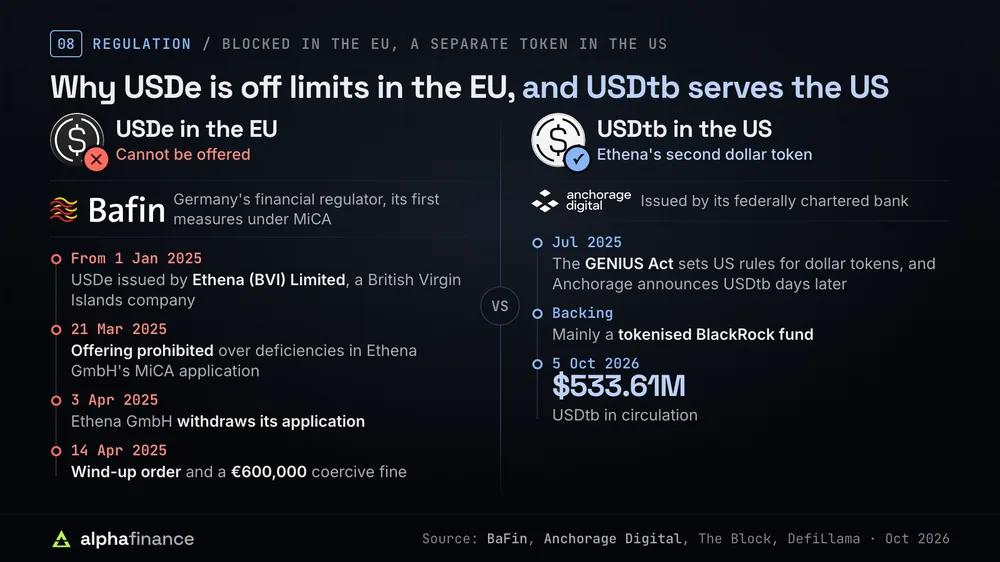
USDe cannot be offered in the European Union. Ethena serves the United States through a separate token.
On 21 Mar 2025, Germany's financial regulator, BaFin, prohibited Ethena GmbH from offering USDe, citing serious deficiencies in its application under MiCA, the EU's crypto rulebook.
The regulator also said it had grounds to suspect sUSDe tokens were securities being offered to the public in Germany. Issuance of USDe continued through Ethena (BVI) Limited. BaFin noted that the British Virgin Islands company had issued the token since 1 Jan 2025.
Ethena GmbH withdrew its application on 3 Apr 2025. On 14 Apr, BaFin ordered the German company to wind up its USDe business and disclosed a €600,000 coercive fine. The company later lodged an objection. BaFin said these were its first measures under MiCA.
In July 2025, the US GENIUS Act established rules for dollar tokens. Days later, Anchorage Digital announced that its federally chartered bank would issue USDtb, Ethena's second dollar token.
A tokenised BlackRock fund provides most of USDtb's backing, The Block reported. On 5 Oct 2026, DefiLlama's USDtb page showed $533.61 million in circulation.
Both USDe and ENA can lose value. USDe also carries risks that a cash-backed dollar token avoids.
Not investment advice
This article explains market data. Nothing on this page is a recommendation to buy, sell or leverage any asset. Digital assets are volatile and you can lose everything you put in. If you are unsure whether a trade is appropriate for you, a licensed adviser in your jurisdiction is the right next step.


Fact checked by
Verifies every figure against primary sources before publication. Meet the team
Guy Young founded and leads Ethena Labs, the company that created the USDe synthetic dollar and ENA token. Before starting Ethena in 2023, he spent six years at Cerberus Capital Management, according to his Blockworks speaker biography. CoinDesk included him in its Most Influential list in December 2025.
Guy Young founded Ethena Labs in 2023, drawing on "Dust on Crust", an essay Arthur Hayes published that March. Ethena's documentation identifies it as the project's origin. Two months later, Hayes's family office, Maelstrom, joined as a founding adviser and investor.
No public figure exists for Guy Young's net worth. Ethena's tokenomics page reserves 4.5 billion ENA for core contributors, but his portion is undisclosed. At ENA's $0.24 price on 5 Oct 2026, that entire pool was worth about $1.08 billion on paper.
Guy Young is Ethena's founder. Arthur Hayes backed and advised the project early, having written the essay that inspired it. In March 2024, Hayes disclosed that Maelstrom received governance tokens for its advisory work.
USDe pairs assets with trades that offset price movements to maintain its $1 value. Originally, Ethena held a crypto asset and took an equally sized bet against it through perpetual futures. By July 2026, about 99% of the backing consisted of lending, other stablecoins and tokenised credit funds.
USDe cannot be offered in the European Union following the German regulator's April 2025 order for Ethena GmbH to wind up its USDe business. Anchorage Digital Bank issues Ethena's separate USDtb token in the United States. Ethena Pay launched in September 2026 without access for residents of the US, EU or UK.