Markets
 BTC
BTC ETH
ETH BNB
BNB XRP
XRP SOL
SOL ZEC
ZEC HYPE
HYPE DOGE
DOGE LINK
LINK TON
TON AVAX
AVAX SUI
SUI TAO
TAO AAVE
AAVE PUMP
PUMP MORPHO
 ARB
ARB LIT
LIT--:-- UTC
The best crypto exchanges in Australia, ranked on what Bitcoin really costs, AUSTRAC registration, AUD banking and security.
Find the best exchange for
Europe
Americas
Asia Pacific
Nothing matches yet. Try a country or a region.
 By Alpha Finance Editorial Team
 Data maintained by Vince Dioquino
Every fee, registration and incident behind a score links to its source. The facts are re-checked each quarter, and sooner when an exchange changes its fees or registration or has an incident.
How we score → Editorial policy Report an errorThe same Bitcoin can cost several times more on one Australian exchange than another, because most headline fees leave out the spread, the gap between the price you pay and the market price. How exchanges hold your money, and where you can complain, differs too.
We ranked the ten Australians use most, five local and five from our worldwide ranking, all registered with AUSTRAC. Each is scored out of 10 on cost, regulation, security, liquidity, AUD banking and product, which puts them in a different order from our worldwide list.
Every fact is linked to its source. Click any row for the full review.
Each category's leader among the ten, and the number that put it there.
 Independent ReserveThe deepest AUD order book of the ten, with A$246k of Bitcoin near the market price. Also our pick for SMSFs.9.0 out of 10
 CoinJarA$1,000 of Bitcoin cost A$1.84 over the market price, the least of the seven we could price.8.6 out of 10
 CoinSpot476 coins for Australian accounts.8.5 out of 10
 OKXA Merkle tree with zero-knowledge checks of client balances, so you can look yours up. Level with Kraken on this, and ranked higher.8.5 out of 10
10 of 10 on AUSTRAC's register8 of 10 take free PayID depositsPrices measured 8 Oct 2026
| # | Exchange | Score | Feestaker / maker | AUD deposits | Proof of reserveslatest published | |
|---|---|---|---|---|---|---|
| 1 | Independent ReserveNot on worldwide list | 9.0 | 0.50% / 0.50%Order book or app | PayID freeCard free | Audited | Visit |
| 2 | CoinJarNot on worldwide list | 8.6 | 0.10% / 0.10%CoinJar Exchange (BTC/AUD) | PayID freeNo card deposits | None | Visit |
| 3 | CoinSpotNot on worldwide list | 8.5 | 0.10% / 0.10%Markets page (BTC/AUD) | PayID freeCard free | Out of dateLast May 2024 | Visit |
| 4 | OKX#1 worldwide | 8.5 | 0.70% / 0.70%Spot (BTC/AUD) | Bank transfer freeNo PayID · card free | Merkle + zk | Visit |
| 5 |  BTC MarketsNot on worldwide list BTC MarketsNot on worldwide list | 8.1 | 0.85% / 0.85%Advanced Trade (BTC/AUD) | PayID freeCard free | None | Visit |
| 6 |  Coinbase#4 worldwide Coinbase#4 worldwide | 7.5 | Not publishedShown after sign-in | PayID freeNo card deposits | Audited accountsNo per-user proof | Visit |
| 7 |  Kraken#6 worldwide Kraken#6 worldwide | 7.5 | 0.80% / 0.40%Kraken Pro (BTC/AUD) | PayID freeCard 3.75% | Audited Merkle | Visit |
| 8 |  SwyftxNot on worldwide list SwyftxNot on worldwide list | 7.1 | 0.60% + spreadNo order book | PayID freeCard free | None | Visit |
| 9 |  Crypto.com#14 worldwide Crypto.com#14 worldwide | 6.5 | Not publishedShown on the trade preview | PayID freeCard free | Out of dateLast Dec 2022 | Visit |
| 10 |  Binance#2 worldwide Binance#2 worldwide | 5.0 | 0.10% / 0.10%BTC/USDT; no AUD pair | PayID fee not publishedCard fee not published | Merkle + zk | Visit |
Score is for Australians: out of 10 from six checks with fixed rules, scaled so the leading exchange is 9. Hover a score for its breakdown, and click a row to jump to its full review. Under each name is its place on our worldwide ranking, which weighs trading volume and futures that matter less when you buy with Australian dollars. Australian exchanges are not on it. Fees are at the entry tier: taker for an order that fills at once, maker for one that waits on the order book. An app with no order book adds a spread on top, and the cost chart adds the two together. Exchanges can't pay for a place or a score, and nothing here is financial advice. See how we're funded.
Buying A$1,000 of Bitcoin on CoinJar Exchange cost A$1.84 more than the market price, the least we measured, while Swyftx charged A$11.83 extra. The solid part of each bar is the trading fee and the outlined part is the spread, the amount an exchange's price ran over the midpoint of Australia's public BTC/AUD prices, which we use as the market price.
Extra you pay to buy A$1,000 of BitcoinOver the market price, by the cheapest way to buy on each exchange
CoinJar Exchange0.18%A$1.84Order bookCoinSpot Markets0.54%A$5.43Order bookIndependent Reserve0.57%A$5.71Order bookKraken Pro0.80%A$7.97Order bookBTC Markets Advanced Trade0.87%A$8.71Order bookOKX Spot0.98%A$9.79Order bookSwyftx1.18%A$11.83Instant orderNo public AUD price, so not drawn: Coinbase, Crypto.com and Binance. In the table each is marked at the dearest cost measured that day.
The order book is usually the cheaper way to buy, with a small fee, while the instant-buy button in the same app often charges 1% or more. Order size matters too, because a large order uses up the cheapest offers and fills the rest at higher prices. The amount buttons show the difference.
We went through each exchange ourselves, reading its Australian terms and fees line by line, finding it on AUSTRAC's register and pricing A$1,000 of Bitcoin on its live order book. Each review covers what the table leaves out, and every fact links to its source.
Top score · Not on worldwide list
Built for caution: owned by IG Group, every client balance audited each year, and one 0.5% fee in the app or on the order book. Its terms still let it stake your coins and keep the rewards.

Good for
Incidents in the last five years
NoneNo hacks, fines or market failures in the last five years.
Cheapest to buy · Not on worldwide list
Best for buyers who use its separate Exchange screen: the cheapest Bitcoin we measured and near-free stablecoin swaps to AUD. It publishes no proof of reserves.
Good for
Most coins · Not on worldwide list
The most coins of any Australian exchange here (476), with live chat around the clock, made for altcoin buyers. Only 16 coins get the 0.1% order book, and its BTC/AUD book is the thinnest we measured.
Good for
Watch out for
For traders who want perpetual futures under an Australian licence next to spot, with Bitcoin withdrawals for about A$1.80. Australian retail pays 0.70% a trade, and spot complaints can't go to AFCA.
Good for
Incidents in the last five years
Since 2013 · Not on worldwide list
An AUD order book since 2013, with accounts for SMSFs, companies, partnerships and trusts. Its 0.85% entry fee is the highest published here, and it caps payouts for lost coins at A$10,000.

Good for
Incidents in the last five years
NoneNo hacks, fines or market failures in the last five years.
The global brand with its own AFSL and SMSF accounts for up to six trustees, plus tax exports. AUD can't buy Bitcoin directly, and the fee Australians pay shows only after sign-in.
Good for
Incidents in the last five years
A faulty update took down transfers and trading for about 50 minutes.
Fined EUR 21.5M by the Central Bank of Ireland for transaction-monitoring failures.
Bribed overseas support contractors stole personal data of 69,461 customers.
and 1 earlier
For order-book traders: the deepest BTC/AUD book we measured, 0.40% limit orders and AFCA for complaints. Market orders cost 0.80%, and it was ordered to pay A$8 million in 2024.
Good for
Incidents in the last five years
Disclosed an extortion attempt after support staff viewed limited data on about 2,000 client accounts. Kraken says there was no breach of its systems and no client funds were at risk.
Ordered by Australia's Federal Court to pay A$8M after ASIC action over its margin product.
A deposit bug let security researchers withdraw about US$3M from Kraken's own treasury, not from client accounts; the funds were returned.
and 1 earlier
Since 2019 · Not on worldwide list
Made for SMSFs, companies and trusts under one login, with trades feeding into BGL and Xero. Every order fills at Swyftx's own quote: 0.6% plus a spread, and coin swaps are charged twice.
Good for
An all-in-one app: 400+ coins, free PayID, Apple Pay and Google Pay deposits, and free tax reports. Its fee shows only at checkout, and its last proof of reserves dates from December 2022.
Good for
Incidents in the last five years
A US judge let Nevada's cease-and-desist stand, so sports event contracts were pulled for Nevada residents.
The Dutch central bank fined Foris DAX MT EUR 2.85M for serving Dutch users while unregistered.
Attackers bypassed 2FA and drained 483 accounts of about US$34M; Crypto.com reimbursed the affected users.
and 1 more
The widest coin list here (600+) and a 15,000 BTC emergency fund for users. AUD buys go through a quote with no order book, it has no AFSL yet, and its derivatives arm was ordered to pay A$10 million in 2026.
Good for
Watch out for
Incidents in the last five years
The Federal Court ordered Oztures Trading, Binance Australia's derivatives arm, to pay A$10 million for treating 524 retail clients as wholesale.
USDe, wBETH and BNSOL lost their pegs on Binance's own order books in the 10 Oct crash; Binance paid about US$283M to users liquidated as a result.
AUSTRAC ordered an external audit of Binance Australia's anti-money-laundering controls.
and 2 earlier
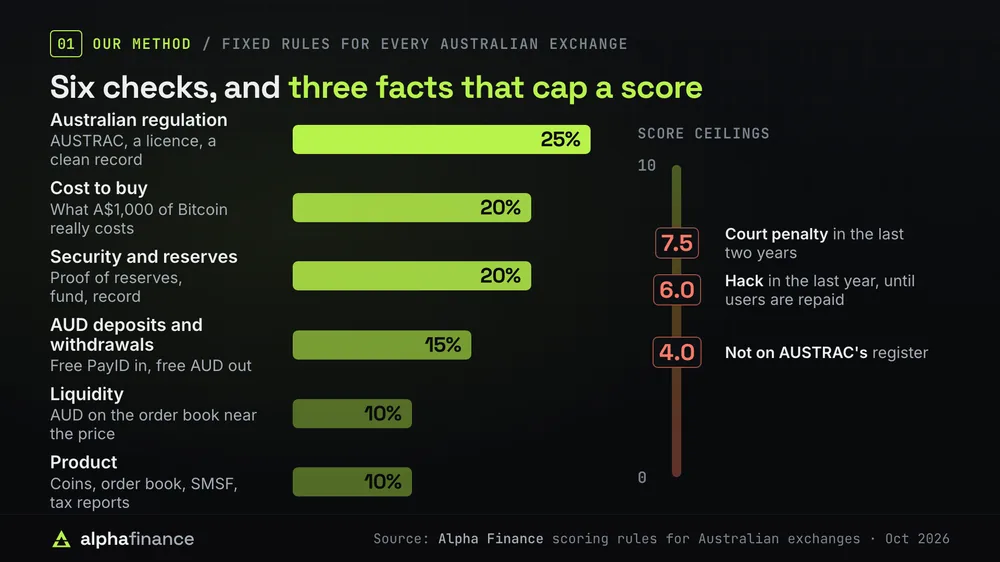
Every exchange is marked out of 10 on six checks. Each check has a fixed rule, and the weighted total is scaled so the leading exchange reads 9. Scores come from that legwork, not from anything an exchange sent us.
| Check | Weight | How it is marked |
|---|---|---|
| Cost to buy | 20% | What A$1,000 of Bitcoin cost by the exchange's cheapest published way to buy on 8 Oct 2026, against the middle of the Australian market (the median mid price of the public AUD order books): the price paid plus the fee. 0.2% or less earns 10, and each 0.1% more costs 0.8. An exchange that publishes no AUD price can't be checked before you buy, so it is marked at the dearest cost measured that day, or at its published fees if they are higher. |
| Australian regulation | 25% | Registration with AUSTRAC earns 5. An Australian financial services licence held by the exchange or a company in its group earns 2. A clean record with Australian regulators for five years earns 3; a warning or notice leaves 1.5; a court finding or penalty leaves 0. |
| Security and reserves | 20% | Proof of reserves earns up to 4: 4 for one you can check your own balance against, or for audited accounts in public SEC filings, its own or its parent company's; 3 for an audit of the reserves alone; 2 for an attestation. Insurance or a protection fund that covers users earns 2 when its size is stated and 1 when it is not. The record starts at 4: a hack or an insolvency in the last five years costs 3 until users are confirmed repaid and 1 after; a data breach and a regulator's action anywhere cost 1 each; market failures cost 1 each, up to 2. |
| Liquidity | 10% | How much Bitcoin is for sale near the market price on the exchange's own BTC/AUD order book, counted as the Australian dollars offered within 0.5% of the market on 8 Oct 2026. A$10,000 or less earns 0 and A$10 million or more earns 10, on a log scale, so each tenfold step adds about 3.3. An exchange with no public AUD book earns 0. |
| AUD deposits and withdrawals | 15% | Free PayID deposits earn 4 (a free bank transfer without PayID earns 3). BPAY and card deposits earn 1 each. Free AUD withdrawals earn 2. No banking partner cutting the exchange off in the last two years earns 2. |
| Product | 10% | 300 coins or more earn 3 (100 earn 2, 30 earn 1). An AUD order book earns 2, SMSF accounts 2, tax reports 1, staking 1 and an OTC desk 1. |
Three facts hold a score down whatever the checks add up to. An exchange not on AUSTRAC's register stops at 4.0. An exchange hacked in the last year stops at 6.0 until users are confirmed repaid. An exchange penalised by an Australian court in the last two years stops at 7.5.
The facts were last checked on 8 Oct 2026. Scores are re-marked every quarter, and sooner when an exchange changes its fees or registration or has an incident.
Buying crypto in Australia takes five steps, and the choices made before your first trade decide most of the cost and the risk.
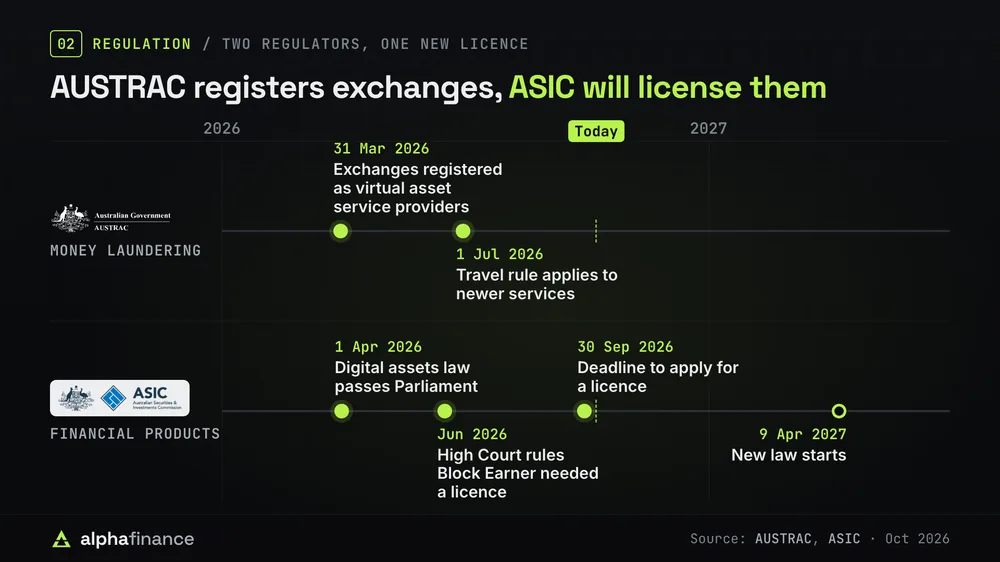
Crypto exchanges in Australia answer to AUSTRAC, which polices money laundering, and ASIC, which regulates financial products. Both sets of rules changed in the past year, and a new licence for exchanges starts in April 2027.
Since 31 March 2026 AUSTRAC has registered exchanges as virtual asset service providers, and its rules now also reach swaps between coins, crypto transfers and holding crypto for customers.
Firms offering those newer services had until 1 July 2026 to start following the travel rule, which makes them pass on who is sending and receiving each transfer, according to AUSTRAC's transitional rules.
Registration shows an exchange runs anti-money laundering checks. It says nothing about whether the exchange holds enough crypto to pay every customer back.
ASIC now treats many digital asset services as financial products. Firms offering them had until 30 September 2026 to apply for an Australian financial services licence (AFSL), and from 1 October those without one risk civil and criminal penalties, according to ASIC.
In June 2026 the High Court ruled unanimously that Block Earner's fixed-yield crypto product was a financial product that needed a licence.
The Corporations Amendment (Digital Assets Framework) Act 2026 goes further. It passed Parliament on 1 April 2026 and starts on 9 April 2027, when platforms that hold crypto for customers will need an AFSL, according to ASIC's roadmap for the new law. Exchanges that apply in time can keep operating while ASIC assesses them.
Licensed firms must belong to AFCA, the free financial ombudsman, and AFCA can't consider complaints against a crypto business that isn't a member.
Most licences held by the exchanges here cover cards, payments or derivatives rather than crypto trading, which is why our guide to OKX's restrictions and regulation separates its licensed derivatives arm from its spot exchange. Each review above says what the licence covers and where a complaint can go.
Crypto on an Australian exchange has no government guarantee, so your protection depends on how that exchange holds and uses customer assets.
The Financial Claims Scheme protects deposits at Australian banks, building societies and credit unions, up to A$250,000 per account holder at each institution. Crypto exchanges are none of those, and Moneysmart warns that you may not be protected if a platform fails or is hacked.
The ACX exchange collapsed around December 2019 when customers could no longer withdraw, and its liquidators received about A$22.75 million in claims from former customers, according to ASIC's case against a former director.
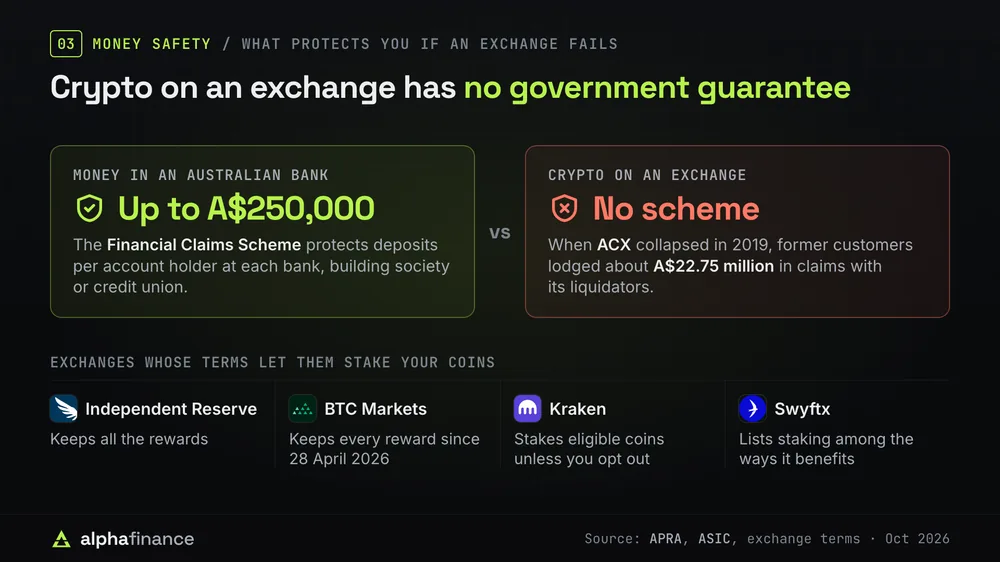
Four of the ten exchanges ranked here allow themselves to stake customer coins, locking them up with a blockchain network to earn rewards.
| Exchange | What its terms allow |
|---|---|
| Independent Reserve | Stake your coins without telling you and keep all the rewards. The only way out is to withdraw. |
| BTC Markets | Since 28 April 2026, stake your coins and keep every reward. A network penalty can shrink your balance. |
| Kraken | Stake eligible coins automatically unless you opt out, keeping a share of the rewards. |
| Swyftx | Stake your crypto among the ways Swyftx itself benefits, with your assets held alongside its own. |
Coinbase keeps Australian dollars in segregated accounts apart from its own money, while Independent Reserve's terms say the AUD in your account is not held on trust for you. Each review above links to the terms it quotes.
A proof of reserves shows that an exchange held at least as much crypto as its customers' balances at one moment. It doesn't show the exchange's debts, or whether those coins were borrowed, and the US SEC's chief accountant has said such reports are neither as rigorous nor as comprehensive as an audit.
The table's Proof of reserves column shows which of the ten publish one, and when.
Under the new law, ASIC will set asset-holding standards covering trust holding, separation from the platform's own assets and the right to withdraw your coins. Until those apply, splitting larger holdings across exchanges or keeping them in your own wallet limits what one failure can cost.
Not investment advice
This page is general information. Nothing on it is a recommendation to buy, sell or trade any asset or to use any exchange, and it does not take your situation into account. Digital assets are volatile and you can lose everything you put in. See the affiliate disclosure for how the site is funded.
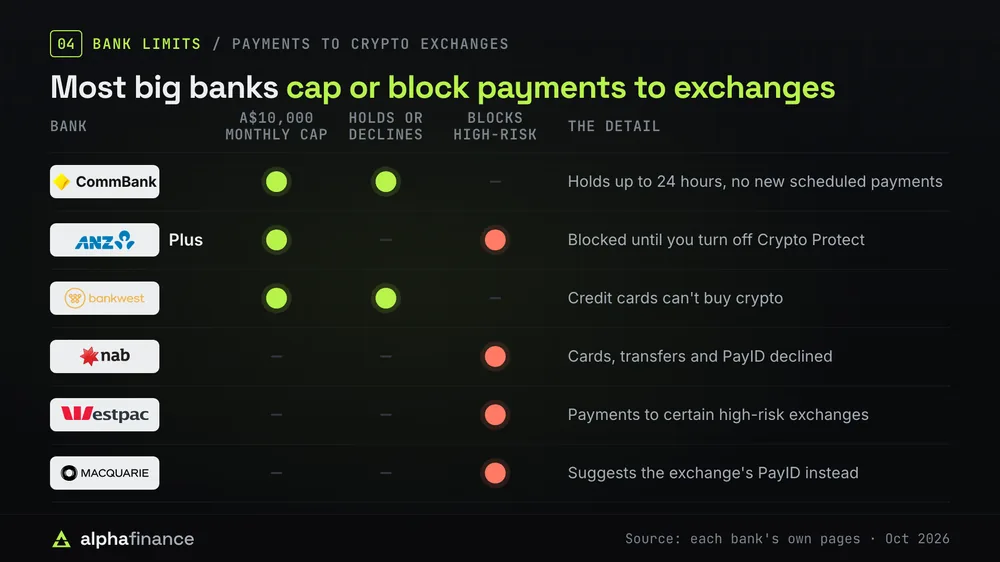
Most big Australian banks cap or block payments to crypto exchanges to cut scam losses, so a large deposit can be declined or held even when the exchange is registered.
| Bank | Payments to crypto exchanges |
|---|---|
| CommBank | Up to A$10,000 a calendar month across all your accounts, with no way to apply for more. Some payments are held for up to 24 hours. No new scheduled payments to exchanges since 30 September 2026. |
| ANZ Plus | Blocked while Crypto Protect is on. Turn it off and payments are limited to A$10,000 a calendar month. |
| Bankwest | Up to A$10,000 a month across your Bankwest accounts. Credit cards can't buy crypto, and some payments are declined or held for 24 hours. |
| NAB | Card payments, transfers and PayID payments to exchanges it rates high risk are declined. |
| Macquarie | May block payments to BSBs it links to high-risk exchanges, and suggests the exchange's PayID instead. |
| Westpac | Blocks payments to certain high-risk exchanges. |
CommBank says it won't restrict money coming back from an exchange. The Scams Prevention Framework will require banks, telcos and key digital platforms to take stronger action against scams from 31 March 2027, according to the Assistant Treasurer. Limits change often, so check your bank's own page and send a small payment first.
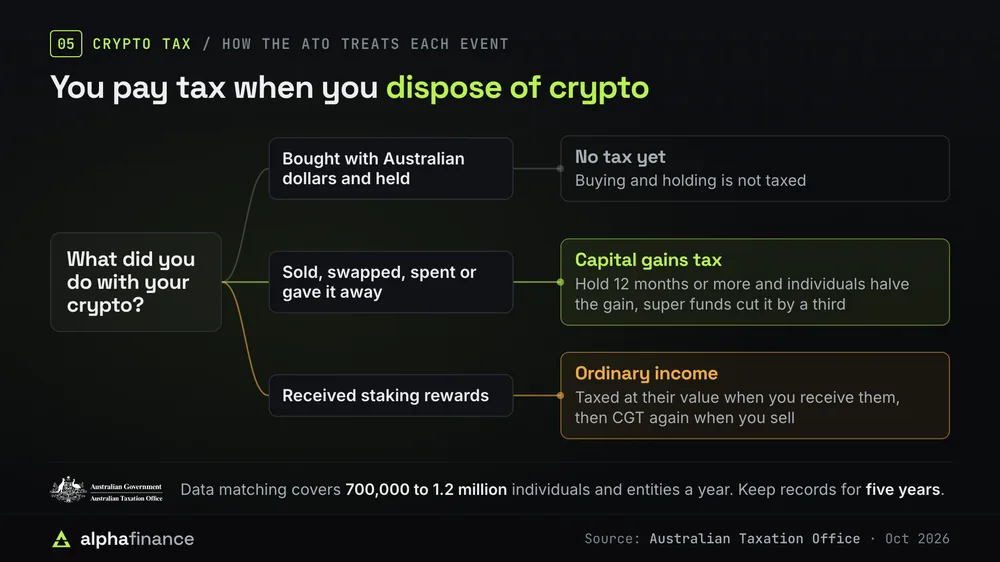
In Australia you pay tax when you dispose of crypto. Buying it with Australian dollars and holding it is not taxed.
The ATO treats crypto held as an investment as a capital gains tax (CGT) asset. A CGT event happens each time you:
Hold a coin for at least 12 months and the CGT discount halves the gain for an individual, or cuts it by a third for a complying super fund.
The ATO counts staking rewards as ordinary income at their value when you receive them, and CGT applies again when you later sell. Our staking rewards calculator estimates what a holding would earn at current rates.
The ATO's data-matching program collects records from crypto exchanges on about 700,000 to 1.2 million individuals and entities a year, according to the ATO's program protocol. The government has also committed to the OECD's Crypto-Asset Reporting Framework, which shares this data between countries, though the ATO says it is not yet law and the first exchange is expected in 2028.
Keep a record of every buy, sell, swap, transfer, staking reward and fee in Australian dollars. The ATO's record-keeping rules ask for five years from the year you dispose of the coin.
A self-managed super fund can buy crypto when its trust deed and investment strategy allow it, and the ATO looks as closely at how the fund holds the coins as at what it buys.
SMSF accounts are open at 8 of the 10 exchanges here (Independent Reserve, CoinJar, CoinSpot, OKX, BTC Markets, Coinbase, Kraken and Swyftx). Coinbase takes up to six trustees and exports capital gains reports, while Swyftx and CoinJar connect their SMSF accounts to BGL accounting software.
A fund that would rather not run a wallet can buy a Bitcoin ETF listed on the ASX, such as Betashares' QBTC, through a normal broking account. QBTC holds its Bitcoin through a US spot fund like those on our Bitcoin ETF flows dashboard, so there is no wallet to manage.
Coins on an exchange are a claim on that company, while coins in a wallet you control belong to you alone, along with the job of keeping them safe.
A software wallet keeps your private key, the secret code that moves your coins, on a phone or computer. A hardware wallet keeps it on a device that stays offline, which makes it much harder to steal. Lose the key or its recovery phrase and the coins are usually gone for good, and anyone who sees the phrase can take them.
Under the travel rule, an exchange sending crypto to a self-hosted wallet must collect and verify your details and the recipient's name first, and its policies must set out how it checks who controls the wallet, according to AUSTRAC's travel rule guidance. Coins coming in from your own wallet can be held until the exchange has that information.
Before a large withdrawal, send a small test amount on the right network and confirm it arrives, because a transfer to a wrong address can't be reversed. Our Bitcoin exchange flows page shows how much BTC is held on exchanges and how much moves off them each day.
Investment scams cost Australians more than any other kind of scam, and a request to buy or send crypto is one of their clearest signs.
Australians lost A$2.18 billion to scams in 2025, A$837.7 million of it to investment scams, according to the ACCC's figures for 2025. ASIC took down more than 3,000 crypto investment scams online in the 2025-26 financial year. Its Moneysmart guide to crypto scams lists the signs that recur:
Australia had more than 1,800 crypto ATMs by mid-2025, and users over 50 made up about 72% of transactions by value, so AUSTRAC limited cash deposits and withdrawals to A$5,000 and made operators show scam warnings. In August 2026 it suspended Cryptolink's registration and took its 96 machines offline. If someone tells you to put cash into a crypto ATM, treat it as a scam and call your bank.
Independent Reserve scores highest on our method, at 9.0 out of 10. For a particular need, CoinJar is the cheapest to buy, CoinSpot lists the most coins and OKX has the best proof of reserves. The best crypto exchange for you depends on what you need, such as the lowest cost on the order book, an SMSF account, a wide choice of coins or a proof of reserves you can check. Hover any score in the table to see how it breaks down.
Buy on an exchange's order book rather than its instant-buy button, and deposit by PayID where it is free. On 8 Oct 2026, CoinJar Exchange was the cheapest place to buy A$1,000 of Bitcoin, at A$1.84 (0.18%) over the market price.
Yes. Every exchange that swaps crypto for Australian dollars must register with AUSTRAC, and all 10 ranked here are on its register. From 9 April 2027, platforms that hold crypto for customers will also need an Australian financial services licence from ASIC.
No government scheme protects crypto held on an exchange. The Financial Claims Scheme covers deposits at banks, building societies and credit unions only. Your protection depends on how the exchange holds customer assets, so the table shows each one's proof of reserves and the reviews quote its terms.
You pay capital gains tax when you sell, swap, spend or give away crypto, but not when you buy it with Australian dollars. Hold a coin for at least 12 months and an individual pays tax on half the gain. Staking rewards are taxed as income when you receive them.
Yes, when the fund's trust deed and investment strategy allow it. The coins must be held in the fund's own name, apart from the members' personal crypto, and can't be bought from a member or other related party. 8 of the 10 exchanges here offer SMSF accounts.