Markets
 BTC
BTC ETH
ETH BNB
BNB XRP
XRP SOL
SOL ZEC
ZEC HYPE
HYPE DOGE
DOGE LINK
LINK TON
TON AVAX
AVAX SUI
SUI TAO
TAO AAVE
AAVE PUMP
PUMP MORPHO
 ARB
ARB LIT
LIT--:-- UTC
Research/Market structure
Tokenization statistics showing how much real-world value has moved onto blockchains, which assets and networks lead, what regulators changed, and how far today's figures sit from the forecasts.
 By Alpha Finance Editorial Team
 Fact-checked by Vince Dioquino
Every figure, platform detail and regulatory claim on this page was traced to a primary source by the named fact checker before publication, and is re-checked when those facts change. The review date moves only when a person has re-read the page.
The editorial policy → Editorial policy Report an errorThe latest tokenization statistics put tokenized real-world assets that can move freely between blockchain wallets at $39.11 billion on 13 Oct 2026, according to RWA.xyz's market overview. Tokenization means issuing a blockchain token that carries ownership of, or a claim on, an asset held offchain. That asset might be a Treasury bill, a loan or a bar of gold.
Short-term government debt funds that pay interest account for the largest share. Tokenized stocks remain smaller but are growing faster. During 2026, US regulators also approved new ways to trade shares on blockchains under securities law.
Today's total would need to grow roughly 51 times to reach McKinsey's base case of about $2 trillion by 2030.
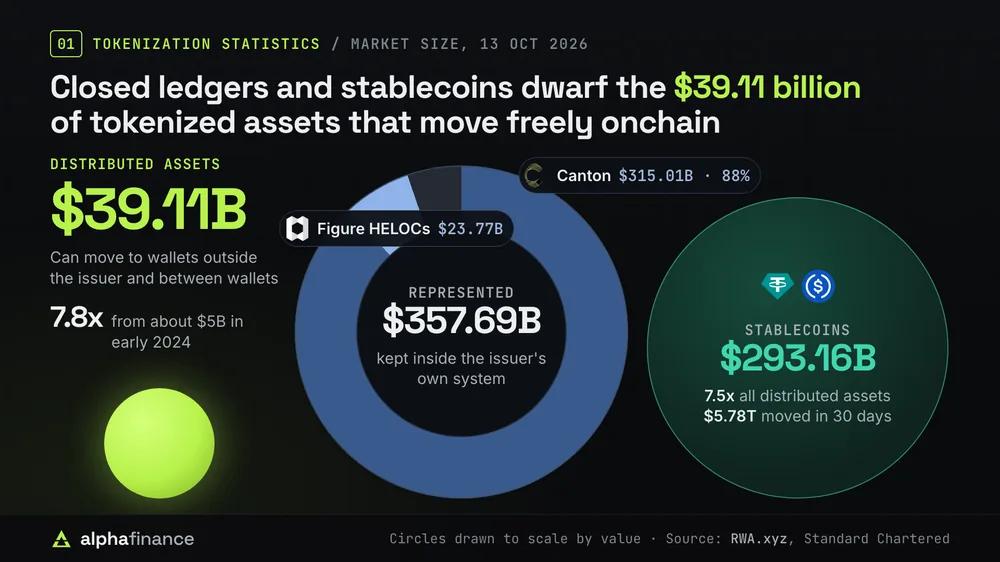
Transferable tokenized assets are worth tens of billions of dollars. Institutional ledgers that keep tokens inside one platform record about nine times as much.
Under a framework introduced on 21 Nov 2025, RWA.xyz divides the market into distributed and represented assets. Distributed assets can move to wallets outside the issuing platform and pass from one wallet to another. Represented assets remain within the issuer's system, where the blockchain serves as a record-keeping layer.
The stablecoin rows below use the stablecoin dashboard.
| Measure | Value on 13 Oct 2026 | Change over 30 days |
|---|---|---|
| Distributed asset value | $39.11B | +0.28% |
| Represented asset value | $357.69B | -1.29% |
| Tokenized asset holder addresses | 5,232,876 | +20.64% |
| Stablecoin market cap | $293.16B | +0.07% |
| Stablecoin holder addresses | 296.59M | +2.79% |
Most represented value sits on two ledgers. Canton, a network used by banks and market infrastructure firms, carried $315.01 billion in the RWA.xyz network table, or 88% of the total. On Figure's Provenance blockchain, tokenized home equity lines of credit added $23.77 billion, according to the tokenized credit dashboard. These are loans secured against a borrower's house.
Stablecoins are usually reported separately. Designed to hold a steady value against a currency such as the US dollar, they are worth 7.5 times all distributed real-world assets combined. Over the 30 days to 13 Oct 2026, holders moved $5.78 trillion of stablecoins onchain.
The distributed market has grown quickly from a small base. Standard Chartered and Synpulse estimated tokenized assets excluding stablecoins at around $5 billion in early 2024. Today's total is about 7.8 times larger, though the counts use different methods. Treat that multiple as a guide to direction.
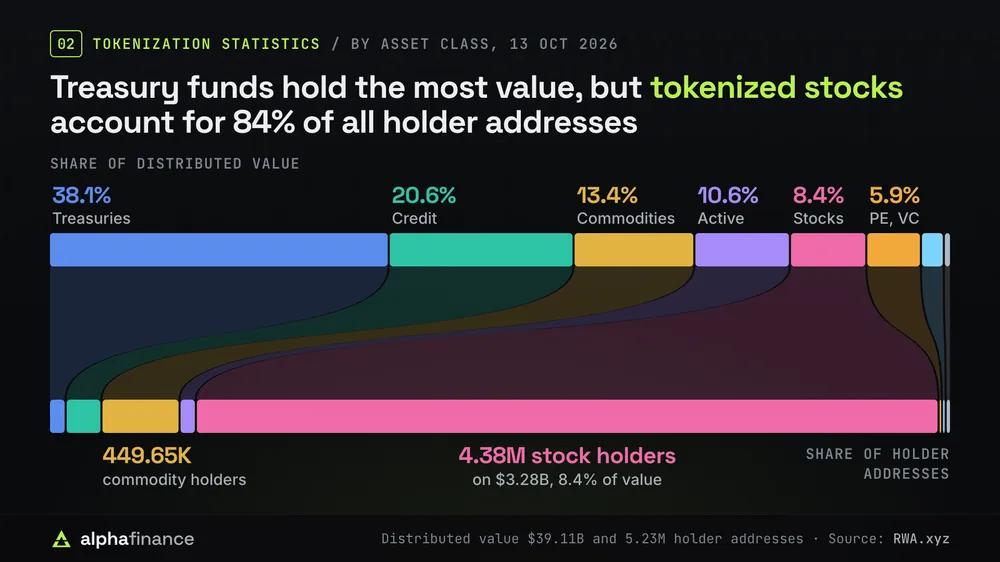
Almost three fifths of transferable tokenized value sits in US government debt and credit. Real estate, often used to explain tokenization, accounts for less than 1%.
The figures below come from RWA.xyz's asset class dashboards on 13 Oct 2026. Active strategies, funds that run hedge fund or interest rate trades, are dated 12 Oct 2026.
| Asset class | Distributed value | Share | 30-day change | Holders |
|---|---|---|---|---|
| US Treasury funds | $14.91B | 38.1% | -5.50% | 86,418 |
| Credit | $8.07B | 20.6% | +1.10% | 199,436 |
| Commodities | $5.24B | 13.4% | +7.34% | 449.65K |
| Active strategies | $4.13B | 10.6% | +8.56% | 83,919 |
| Stocks | $3.28B | 8.4% | +15.04% | 4.38M |
| Private equity and venture capital | $2.32B | 5.9% | +0.07% | 7,416 |
| Non-US government debt | $918.93M | 2.3% | -20.52% | 10,029 |
| Real estate | $226.56M | 0.6% | -0.08% | 19.29K |
Gold dominates tokenized commodities. Tether Gold held $3.02 billion and Paxos's PAX Gold $1.82 billion on the commodities dashboard, together accounting for 92% of the category. Commodity token holders increased 30.58% in 30 days.
Our tokenized real world assets board follows the traded part of the market. It covers stocks and commodities alongside exchange-traded funds (ETFs), whose shares trade on a stock exchange. Gold accounts for most of the board's market value, while tokenized stocks generate most of its trading volume.
Across 104 assets in 11 countries, real estate had $226.56 million distributed and $1.34 billion represented, according to the tokenized real estate dashboard.
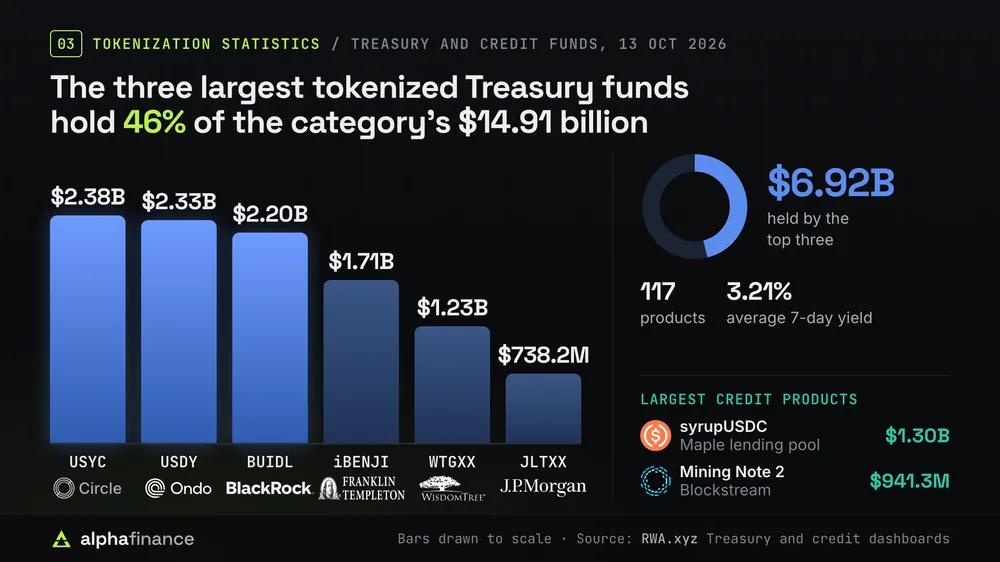
The three largest tokenized Treasury funds hold almost half of the category's value.
On 13 Oct 2026, RWA.xyz's Treasury fund dashboard listed 117 products worth $14.91 billion across 86,418 holder addresses. Most are money market funds, which hold short-dated government debt and aim to maintain a stable value. The average seven-day annual percentage yield (APY) was 3.21%. APY expresses the yearly return including compounded interest.
| Fund | Manager or platform | Value on 13 Oct 2026 |
|---|---|---|
| Circle USYC | Circle | $2.38B |
| Ondo US Dollar Yield (USDY) | Ondo | $2.33B |
| BlackRock USD Institutional Digital Liquidity Fund (BUIDL) | BlackRock, issued through Securitize | $2.20B |
| Franklin Templeton iBENJI | Franklin Templeton Benji Investments | $1.71B |
| WisdomTree Treasury Money Market Digital Fund (WTGXX) | WisdomTree | $1.23B |
| JPMorgan OnChain Liquidity-Token Money Market Fund (JLTXX) | Kinexys Digital Assets | $738.2M |
Together, the top three held $6.92 billion, or 46% of the category. For comparison, our DeFi yields board scores decentralised finance lending pools out of 100 based on size, track record, audits and yield plausibility.
Loans and bonds issued by companies and other borrowers make up tokenized credit. On 13 Oct 2026, the credit dashboard recorded $8.07 billion distributed across 2,703 assets, plus $37.71 billion represented.
Maple's syrupUSDC lending pool was the largest distributed credit product at $1.30 billion. Blockstream Mining Note 2 followed at $941.3 million. Issued through the STOKR platform, the note finances Bitcoin mining.
Tokenized stocks account for a small share of tokenized value, yet have more holders than every other category combined.
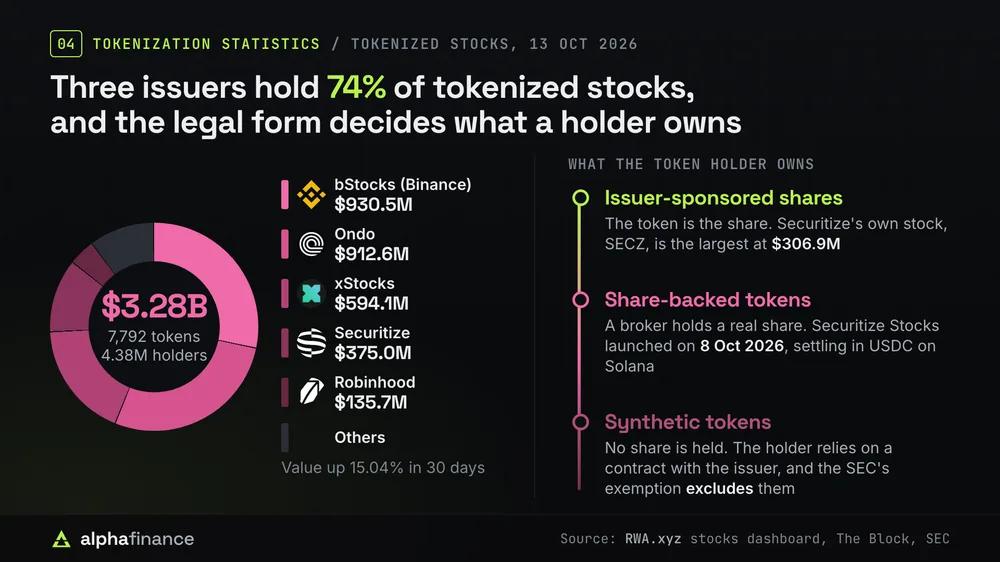
The tokenized stock dashboard recorded $3.28 billion across 7,792 tokens and 4.38 million holder addresses on 13 Oct 2026. Value rose 15.04% in 30 days. Over the same period, monthly transfers fell 71.62% to $9.96 billion, showing how quickly trading activity can swing.
With $930.5 million, bStocks led the issuers by value. Ondo followed at $912.6 million and xStocks at $594.1 million. Those three accounted for 74% of the total. Securitize held $375.0 million, while Robinhood had $135.7 million.
What a tokenized stock holder owns depends on the token's legal form.
Securitize launched its share-backed product, Securitize Stocks, on 8 Oct 2026, according to The Block's report on the launch. The release included tokens for US companies such as Apple, Nvidia and Tesla. Each token is backed one for one by a share at Securitize's regulated brokerage, with settlement in USDC, Circle's dollar stablecoin, on Solana.
In March 2026, the SEC approved a Nasdaq rule allowing eligible firms to trade certain stocks and exchange-traded products in tokenized form on the same order book as ordinary shares. An order book lists waiting buy and sell orders. The Depository Trust Company (DTC), the central depository that holds most US shares in custody, settles those trades as tokens.
The New York Stock Exchange's planned tokenized securities platform is designed for 24/7 trading, instant settlement and stablecoin funding. Announced on 19 Jan 2026, it remains subject to regulatory approval.
Price exposure is also available without holding a token. Perpetual futures have no expiry date, and regular payments between buyers and sellers keep their price close to the underlying asset. Our page on perpetual futures for stocks, gold and oil tracks these markets on Hyperliquid, a crypto derivatives exchange.
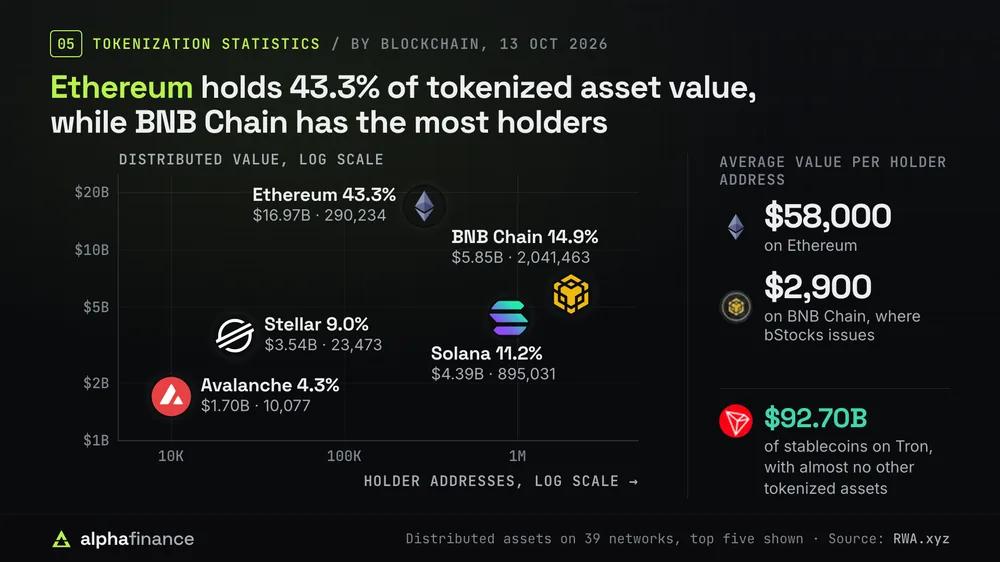
Ethereum leads in tokenized asset value, while BNB Chain has the most holders. That difference suggests a split between large institutional funds and smaller retail positions.
Distributed assets spanned 39 networks in RWA.xyz's network table on 13 Oct 2026.
| Network | Distributed value | Share | Holders | Stablecoins |
|---|---|---|---|---|
| Ethereum | $16.97B | 43.3% | 290,234 | $147.60B |
| BNB Chain | $5.85B | 14.9% | 2,041,463 | $12.80B |
| Solana | $4.39B | 11.2% | 895,031 | $14.83B |
| Stellar | $3.54B | 9.0% | 23,473 | $442.7M |
| Avalanche | $1.70B | 4.3% | 10,077 | $831.5M |
The average Ethereum holder address carries about $58,000 of tokenized assets. BNB Chain, where bStocks issues its tokens, averages about $2,900 per address.
Stablecoins and other tokenized assets often sit on different chains. Tron held $92.70 billion of stablecoins on that date but almost no other tokenized assets.
Our blockchain data dashboard places each chain's stablecoin supply alongside its total value locked (TVL), the money deposited in its applications, with five years of history.
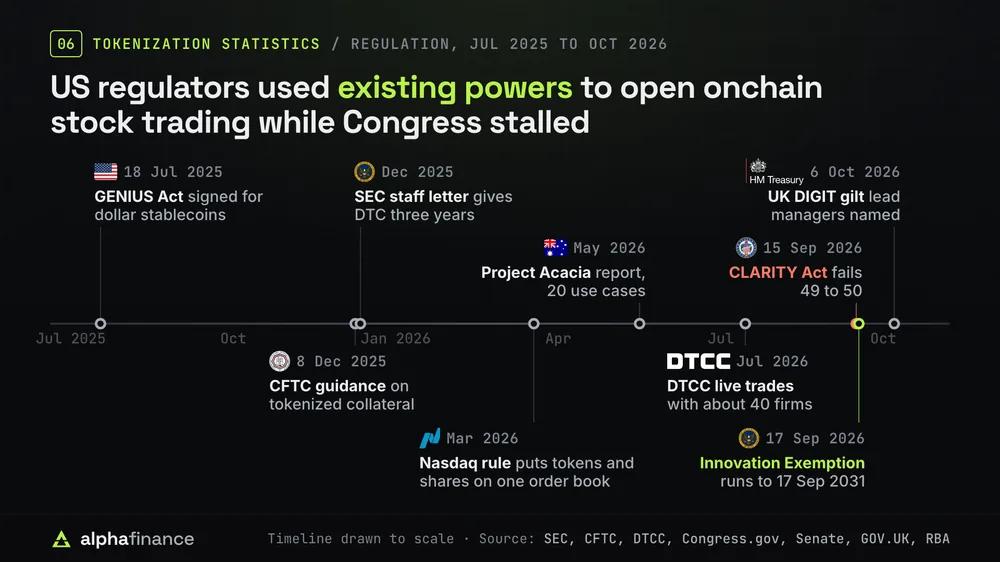
Regulators used existing powers for most of the 2026 rule changes that brought tokenized assets closer to mainstream markets. Congress passed only one of its two crypto bills.
| Date | Where | Action | What it allows |
|---|---|---|---|
| 18 Jul 2025 | United States | GENIUS Act signed into law | Federal rules for issuers of dollar payment stablecoins |
| 8 Dec 2025 | United States | Commodity Futures Trading Commission (CFTC) collateral guidance and pilot | Tokenized Treasuries and money market funds assessed as derivatives collateral; bitcoin, ether and USDC accepted as margin in a pilot |
| Dec 2025 | United States | SEC staff no-action letter to DTC | Three years to offer tokenization of eligible DTC-held securities |
| Mar 2026 | United States | SEC approves Nasdaq tokenized trading rule | Tokenized and ordinary shares on one order book |
| May 2026 | Australia | Project Acacia final report | Findings from 20 wholesale tokenized market use cases |
| Jul 2026 | United States | DTCC (DTC's parent) live production trades | About 40 firms traded tokenized DTC-held assets |
| 15 Sep 2026 | United States | CLARITY Act fails a Senate vote 49 to 50 | Market structure bill stalls |
| 17 Sep 2026 | United States | SEC Innovation Exemption | Five-year relief for venues trading tokenized US-listed shares |
| 6 Oct 2026 | United Kingdom | DIGIT lead managers appointed | First digitally native gilt, with issuance expected early in 2027 |
The broadest step is the Innovation Exemption. The SEC's exemptive order allows tokenized securities venues to trade tokenized US-listed shares through automated market makers. These software pools price trades by formula instead of matching individual buyers and sellers. Relief applies to shares tokenized by the issuer or an unaffiliated third party, provided they carry the same rights as ordinary shares. It excludes synthetic tokens and runs to 17 Sep 2031.
More than 50 firms had joined DTCC's industry working group by its May 2026 announcement. DTCC also confirmed that a December 2025 SEC staff no-action letter allows DTC to offer the service for three years, with launch planned for October 2026. In that letter, staff said they would not recommend enforcement.
For derivatives, the CFTC's December 2025 guidance explains how tokenized Treasuries and money market fund shares can serve as collateral under existing rules. Also called margin, collateral is the money a trader posts to cover possible losses on a futures position.
The Digital Asset Market Clarity Act would determine which tokens count as securities and which as commodities. On 15 Sep 2026, it failed a Senate procedural vote by 49 to 50, falling short of the 60 votes needed. Our explainer on why the Clarity Act stalled covers the bill's proposed changes.
In the UK, HM Treasury expects to issue DIGIT, a government bond created on a blockchain, by the first quarter of 2027 using an HSBC platform. Australia's Reserve Bank and other agencies are carrying out the program of work proposed in the Project Acacia final report for wholesale tokenized markets.
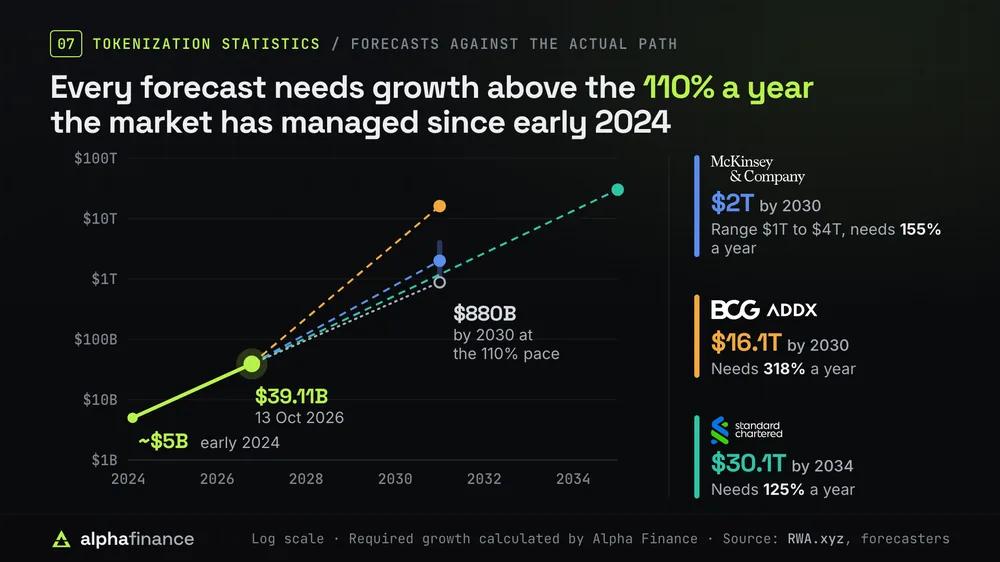
Tokenization forecasts range from about $2 trillion to more than $30 trillion. All require faster growth than the market has recorded since 2024.
| Forecaster | Published | Forecast | Target year | Annual growth needed |
|---|---|---|---|---|
| McKinsey | Jun 2024 | About $2 trillion (range $1 trillion to $4 trillion) | 2030 | 155% |
| BCG and ADDX | 2022 | $16.1 trillion (best case $68 trillion) | 2030 | 318% |
| Standard Chartered and Synpulse | Jun 2024 | Demand of up to $30.1 trillion | 2034 | 125% |
We calculated the last column as the annual compounded growth needed to take $39.11 billion on 13 Oct 2026 to each forecast by the end of its target year.
These forecasts have different scopes. McKinsey excludes cryptocurrencies and stablecoins, expecting mutual funds, bonds, loans and alternative funds to lead the first wave of adoption. BCG and ADDX expected adoption across equities, real estate, bonds and funds, and in less traditional assets such as car fleets and patents. In Standard Chartered's forecast, trade finance accounts for 16% of the total. Trade finance covers the loans and guarantees behind international trade.
By our arithmetic, growth from about $5 billion in early 2024 to $39.11 billion is roughly 110% a year. McKinsey's base case needs 155%.
Forecast check
Continuing at the growth rate recorded since early 2024 would put the market at roughly $880 billion by the end of 2030, under half of McKinsey's base case.
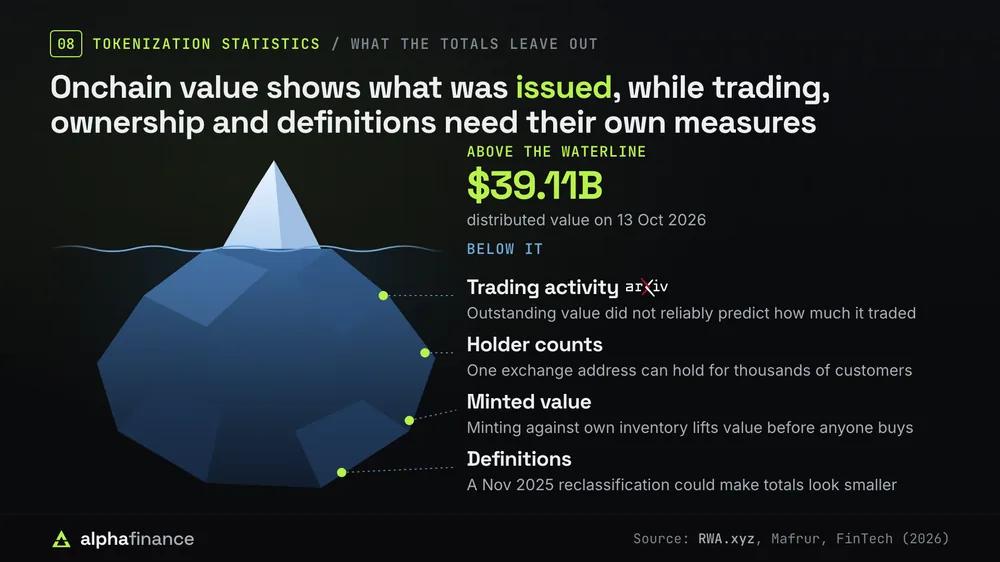
Onchain value measures how much has been issued. It does not replace separate measures of trading activity, ownership distribution or redemption terms.
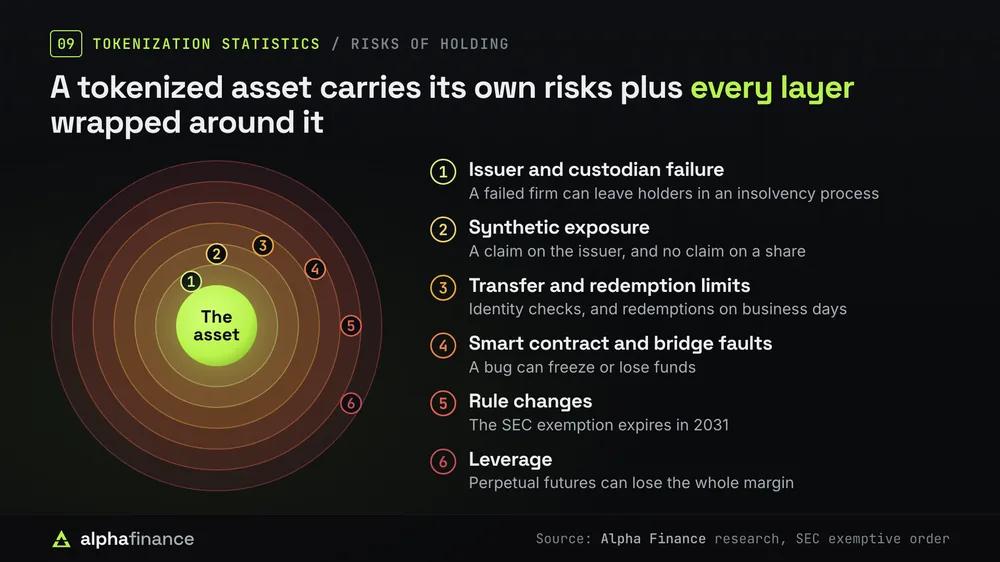
Holding a tokenized asset exposes you to the underlying asset's risks. The issuer, custodian and blockchain introduce additional risks.
Not investment advice
This article explains market data. Nothing on this page is a recommendation to buy, sell or leverage any asset. Digital assets are volatile and you can lose everything you put in. If you are unsure whether a trade is appropriate for you, a licensed adviser in your jurisdiction is the right next step.


Fact checked by
Verifies every figure against primary sources before publication. Meet the team
On 13 Oct 2026, transferable tokenized real-world assets were worth $39.11 billion, according to onchain market data for tokenized assets. Closed institutional ledgers recorded another $357.69 billion. Stablecoins were worth $293.16 billion and are usually counted separately.
Across 117 tokenized Treasury products, funds held $14.91 billion on 13 Oct 2026, representing 38.1% of transferable tokenized assets. Circle's USYC, Ondo's USDY and BlackRock's BUIDL were each worth more than $2.2 billion. Their average seven-day yield was 3.21%.
Most trackers report stablecoins separately because they track a currency. McKinsey's tokenization forecast also excludes them. On 13 Oct 2026, stablecoins were worth $293.16 billion, about 7.5 times all other transferable tokenized assets combined.
Ethereum led with $16.97 billion of transferable tokenized assets on 13 Oct 2026, or 43.3% of the total, according to tokenized asset data by network. Second-ranked BNB Chain held $5.85 billion and had the most holders, at 2.04 million addresses. Solana followed with $4.39 billion.
McKinsey's base case puts the market at about $2 trillion by 2030, excluding stablecoins. BCG and ADDX projected $16.1 trillion. Even the lower McKinsey figure would require growth of about 155% a year from today's $39.11 billion.