Markets
--:-- UTC

Research/Platform guides

7 Best Tron Wallets Compared

The best Tron wallets ranked on TRX staking and Super Representative voting, how each pays Tron's energy fees for USDT transfers and how it guards against poisoning and permission scams.
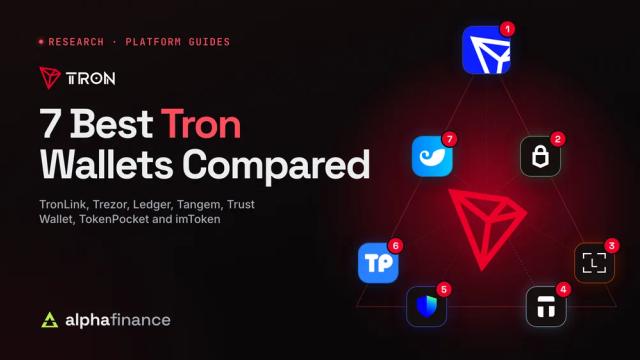
7 Best Tron Wallets Compared: the red TRON mark inside a large triangle with the seven ranked wallets on its edges, TronLink, Trezor, Ledger, Tangem, Trust Wallet, TokenPocket and imToken, numbered 1 to 7

Key takeaways

  • Every Tron transfer spends bandwidth or energy: Wallets cover the cost by burning TRX, using energy from staked TRX, renting energy, or charging the fee in USDT through GasFree.
  • TronLink is our top pick for most TRX holders: Built for Tron, it combines in-app staking and Super Representative voting with GasFree transfers and permission-change checks.
  • Hardware wallets now stake TRX directly: Trezor opened Tron to all Suite users in June 2026 and added TRX staking in July 2026, joining Ledger and Tangem.
  • Tron's lookalike-address and permission scams need the owner to act: Address poisoning tricks owners into copying a fake address. Multisig scams change account permissions after a seed phrase has been stolen.

The best Tron wallets hold the private keys to your TRX and TRC-20 tokens and let you stake TRX to cover transfer costs. They also warn you before you sign a dangerous transaction.

On 20 Oct 2026, Tron carried $92.82 billion of the $183.15 billion USDT in circulation, according to DefiLlama's Tether chain breakdown. Your choice of wallet determines what you pay to move USDT on the blockchain holding its largest supply.

TRX, Tron's native coin, ranked eighth among cryptocurrencies by market value at $31.45 billion on 21 Oct 2026, according to CoinMarketCap's TRX page. Our terminal tracks the live TRX price alongside the 100 largest coins.

How a Tron wallet works

A Tron wallet stores the private key used to sign transactions and determines how network fees are paid. The coins remain on the Tron blockchain. A self-custody wallet backs up the key with a seed phrase, a list of 12 to 24 words that can restore the wallet on any device.

USDT on Tron uses TRC-20, a smart-contract token standard comparable to Ethereum's ERC-20. The older TRC-10 standard is simpler, but some wallets no longer support it.
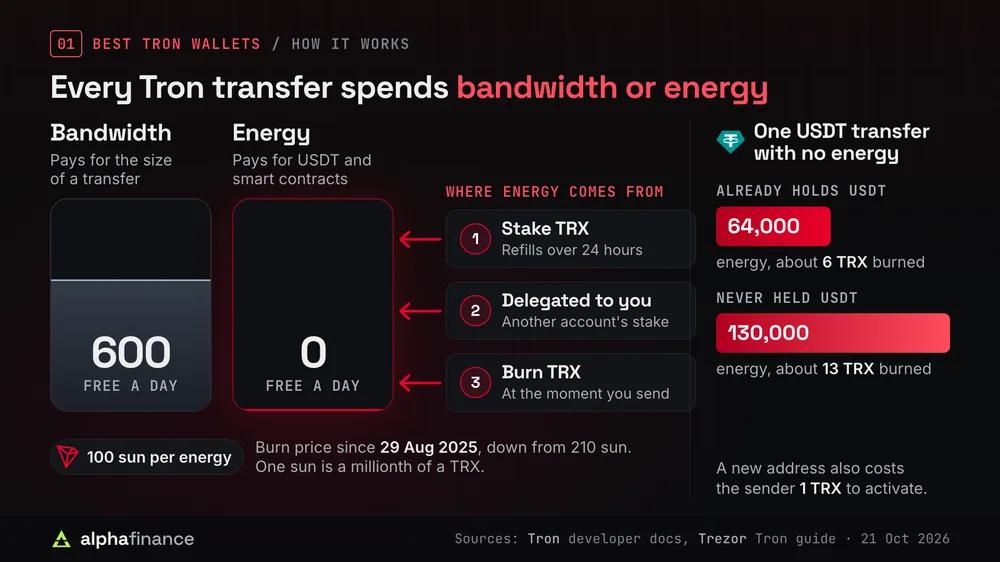
How a Tron wallet pays for transfers: every account gets 600 free bandwidth a day and no free energy; energy comes from staking TRX, which refills over 24 hours, from another account's delegated stake, or from burning TRX at 100 sun per energy since 29 Aug 2025, down from 210 sun; one USDT transfer needs about 64,000 energy, about 6 TRX burned, when the recipient already holds USDT and about 130,000 energy, about 13 TRX, when they have never held it, and a new address costs the sender 1 TRX to activate

Tron addresses and account activation

Tron addresses begin with T and remain invisible to the network until activated. Tron's account documentation says activation occurs when an existing account sends any amount of TRX or a TRC-10 token to the address. On mainnet, the sender pays a 1 TRX account creation fee.

A USDT transfer also costs more when the receiving address has never held USDT, as the energy figures below show.

Bandwidth and energy, Tron's two fee resources

Tron uses two resources to charge for transactions. Bandwidth covers a transaction's size in bytes, while energy pays for smart-contract computation, including every USDT transfer.

Each activated account receives 600 free bandwidth a day, enough for a few simple TRX transfers, but no free energy, according to Tron's resource model documentation. To obtain energy, you can stake TRX, receive resources delegated from another account's TRX, or burn TRX when sending a transaction.

Tron's fee documentation sets the burn price at 100 sun per unit of energy. One sun equals a millionth of a TRX. Super Representatives approved Proposal #104 to cut the energy price from 210 sun to 100 sun, effective 29 Aug 2025. The proposal estimated that the TRX burned for one USDT transfer would fall from about 13.5 TRX to about 6.4 TRX.

A USDT transfer uses about 64,000 energy if the recipient already holds USDT and about 130,000 if they do not, according to Trezor's Tron transfer guide. Without energy in the sending account, that costs roughly 6 to 13 TRX. Our guide to the best USDT wallets compares transfer costs on Tron, Ethereum and other networks.

Staking TRX and voting for Super Representatives

To stake TRX, you lock it in your own account in exchange for energy or bandwidth and voting power. The coins never leave your address. Tron's staking system, Stake 2.0, went live on 7 Apr 2023 under network proposal 84. Each staked TRX provides one TRON Power, according to TronLink's Stake 2.0 explainer.

Holders use TRON Power to vote for the 27 Super Representatives that produce Tron's blocks. Votes are counted every six hours, and the network pays 128 TRX per block to voters and 8 TRX per block to block producers, according to Tron's staking and rewards documentation. Returns vary because each Super Representative retains a share of voter rewards.

Unstaking starts a 14-day wait before TRX can be withdrawn on mainnet, regardless of the wallet used, under Tron's unstaking documentation. On 19 Oct 2026, holders had staked 45.37 billion TRX, or 47.75% of supply, according to TronScan's network statistics.

Those figures also put total value locked (TVL) at $28.13 billion. About half was staked TRX and the rest was deposited in Tron's apps. Our blockchain data dashboard lets you compare that figure with other networks.

How we ranked the best Tron wallets

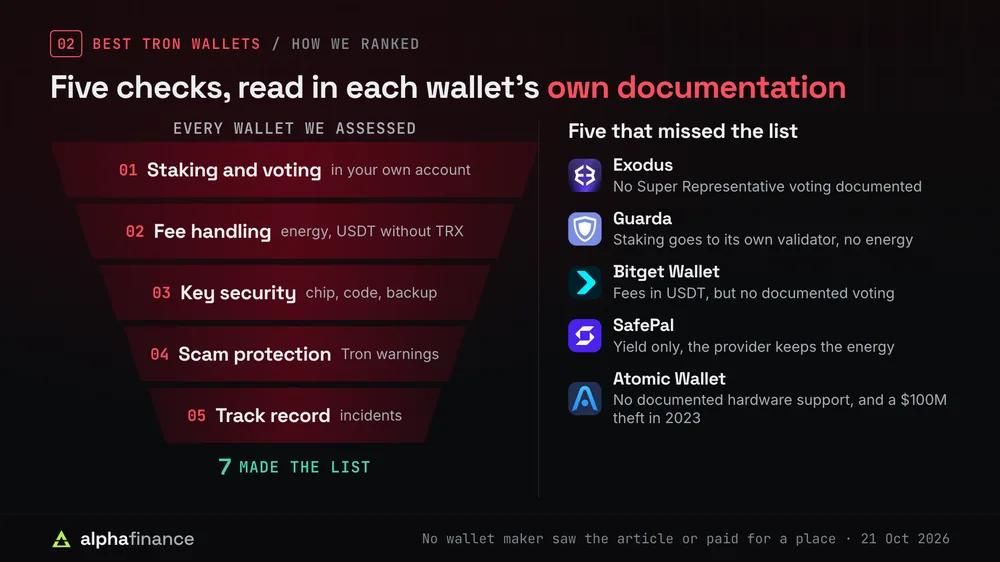
We reviewed each wallet's documentation, help centre and release notes in October 2026, alongside Tron's developer documentation. The ranking reflects the features described in those sources. No wallet maker saw this article or paid for inclusion, as required by our editorial policy.

We ranked the wallets against these checks:

  • Staking and voting: Can you stake TRX for energy and vote for Super Representatives inside the wallet while the resources and votes stay in your own account?
  • Fee handling: How does the wallet pay for bandwidth and energy? Can it send USDT without the sender holding TRX?
  • Key security: Where the private key is stored, whether the device or code has been certified or published, and how backups work.
  • Tron scam protection: Warnings about lookalike addresses, risky token approvals and account permission changes.
  • Track record: Recent security incidents and the company's response.

These wallets missed the list:

  • Exodus: The Exodus Tron FAQ confirms that desktop and mobile users can freeze TRX for energy or bandwidth. It documents neither Super Representative voting nor Tron support for Trezor devices.
  • Guarda: Its TRX staking delegates coins to Guarda's own validator. This earns rewards but provides no energy to cover fees.
  • Bitget Wallet: GetGas lets Tron fees be paid in USDT, USDC, ETH or SOL, but we found no documented Super Representative voting.
  • SafePal: Its TRX staking through XYSwap provides yield only. Energy, bandwidth and voting rights remain with the staking provider.
  • Atomic Wallet: We found no documented hardware wallet support. The FBI also attributed the $100 million Atomic Wallet theft of June 2023 to North Korean hackers.
How we ranked the best Tron wallets: five checks read in each wallet's own documentation, staking and voting in your own account, fee handling, key security, Tron scam protection and track record, narrowing every wallet assessed to the seven that made the list; Exodus, Guarda, Bitget Wallet, SafePal and Atomic Wallet missed it for reasons such as no documented Super Representative voting, staking that gives no energy, or a $100 million theft in 2023

The 7 best Tron wallets compared

The best Tron wallet for you depends on whether you mainly hold TRX, stake it, or send USDT.

WalletTypeTRX staking and votingHardware connectionBest for
TronLinkMobile app, browser extensionYes, bothLedger over BluetoothMost TRX holders
TrezorHardware walletYes, desktop SuiteIs the deviceStaking from cold storage
LedgerHardware walletYes, up to 5 SRs per voteIs the device; also works in TronLinkLedger owners using Tron apps
TangemHardware cardYes, in Tangem appIs the deviceSeedless cold storage
Trust WalletMobile app, browser extensionYes, bothLedger on extension, EVM chains onlyMultichain mobile users
TokenPocketMobile app, browser extensionYes, bothKeyPal and LedgerRenting energy
imTokenMobile appStaking for resourcesKeystone, EVM chains onlyAddress poisoning protection
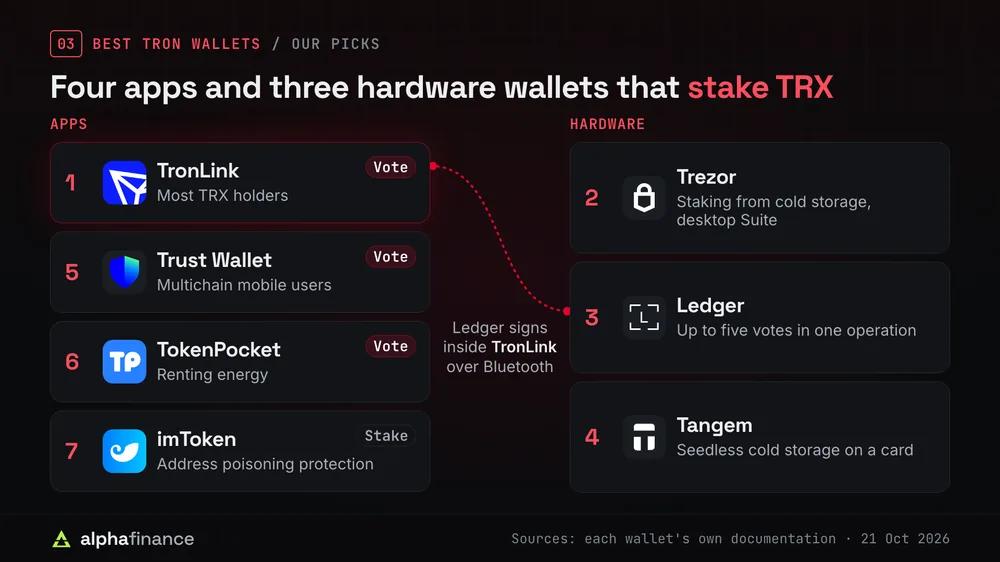
The seven best Tron wallets: four apps, 1 TronLink for most TRX holders, 5 Trust Wallet for multichain mobile users, 6 TokenPocket for renting energy and 7 imToken for address poisoning protection, and three hardware wallets, 2 Trezor for staking from cold storage, 3 Ledger with up to five votes in one operation and 4 Tangem for seedless cold storage on a card; Ledger signs inside TronLink over Bluetooth

1. TronLink: best Tron wallet overall

TronLink app screens from its help centre: the home screen with GasFree, Stake and Vote buttons, the Vote page for Super Representatives and the account security check report; TronLink says it has 10 million+ users, runs on mobile and as a Chrome extension, supports TRX, TRC-10, TRC-20 and TRC-721 and signs with a Ledger over Bluetooth, and a fake TronLink Chrome extension stole seed phrases in May 2026

Built specifically for Tron, TronLink offers more network-specific features than any other wallet in this ranking. It runs as a mobile app and Chrome extension and supports TRX, TRC-10, TRC-20 and TRC-721 tokens. TronLink's website says more than 10 million users trust it.
  • Staking and voting: Stake TRX for energy or bandwidth and vote for Super Representatives within the app. These features also work with multisig accounts, which require more than one signature.
  • GasFree transfers: Supported TRC-20 tokens can be sent without TRX, according to the TronLink GasFree guide, updated 10 Oct 2026. Fees are charged in the token sent, plus a one-time activation fee on the first transfer.
  • Security checks: TronLink's security services flag scam accounts and websites. They also warn about dangerous token approvals and suspicious changes to multisig permissions.
  • Hardware support: On mobile, TronLink can sign transfers with a Ledger over Bluetooth.
  • Watch for: Fake copies. In May 2026, SlowMist documented a fake TronLink Chrome extension that stole seed phrases. Install only through the links on tronlink.org.

2. Trezor: best hardware wallet for staking TRX

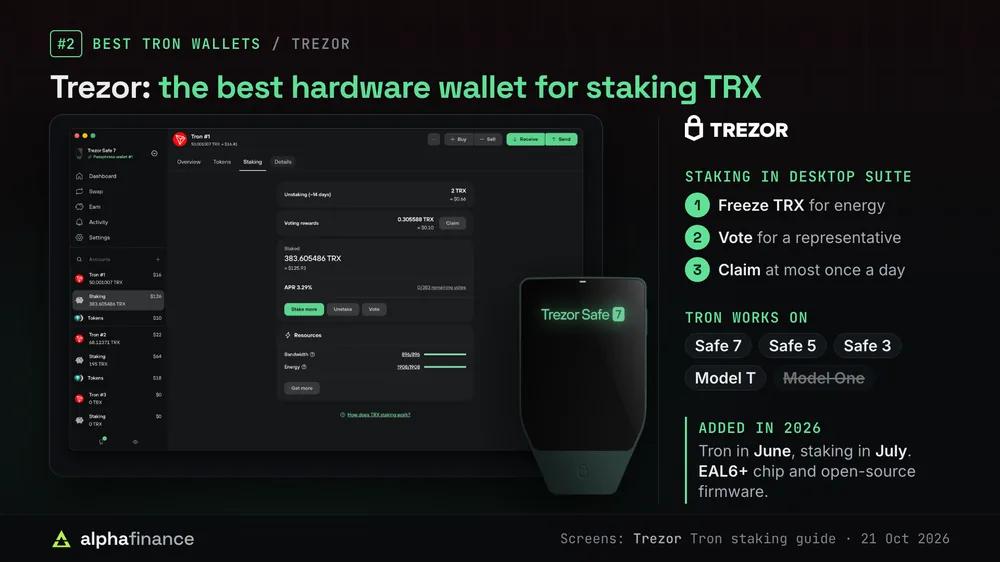
Trezor Suite desktop showing a Tron account's staking tab beside a Trezor Safe 7: staking takes three steps, freeze TRX for energy, vote for a representative and claim rewards at most once a day; Tron works on Safe 7, Safe 5, Safe 3 and Model T but not Model One, arrived for all users in June 2026 with staking in July, on an EAL6+ chip with open-source firmware

Trezor supports TRX staking while keeping the private key on an offline device running open-source code. Full Tron account management reached all users in the Trezor Suite June 2026 update. The July 2026 update then added TRX staking to desktop Suite.
  • Staking and voting: Staking requires two signed transactions: first freezing TRX, then voting for a Super Representative, as described in Trezor's TRX staking guide. Rewards must be claimed manually, at most once every 24 hours.
  • Devices: Tron works on the Safe 7, Safe 5, Safe 3 and Model T. The Model One and TRC-10 tokens are not supported.
  • Security: All three Safe models run open-source firmware and use a secure element, a tamper-resistant chip that stores the key. These chips are certified to EAL6+ under the Common Criteria standard, according to Trezor's model comparison.
  • Watch for: Staking, unstaking and reward claims are restricted to the desktop app. The mobile app can only display staked positions.

3. Ledger: best hardware wallet for TronLink users

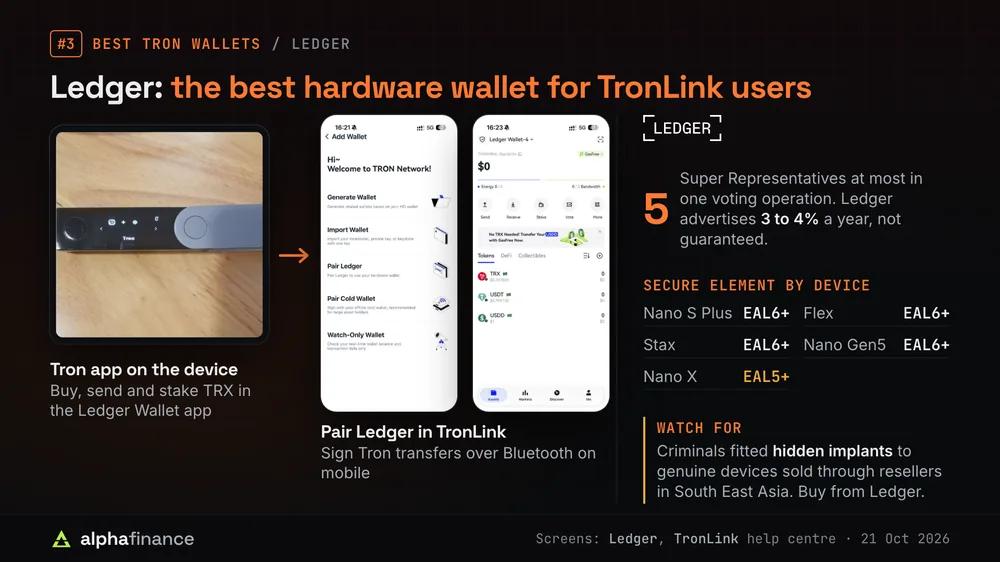
A Ledger Nano X showing the Tron app, then TronLink's Pair Ledger screen and a Ledger account inside TronLink; Ledger lets you vote for up to five Super Representatives at once and advertises 3 to 4% a year, not guaranteed; Nano S Plus, Flex, Stax and Nano Gen5 carry EAL6+ secure elements and Nano X EAL5+; criminals fitted hidden implants to genuine devices sold through resellers in South East Asia

Ledger is our hardware choice for TronLink users because it signs transactions in Tron's own apps as well as Ledger's software. TRX can be bought, sent and staked in the Ledger Wallet app, according to Ledger's Tron wallet page. TronLink also supports Ledger signing over Bluetooth on mobile.
  • Staking and voting: You can vote for up to five Super Representatives in one operation. Ledger's Tron staking page advertises annual rewards of 3 to 4%, while stating that returns are not guaranteed.
  • Security: Ledger's device comparison lists EAL6+ secure elements in the Nano S Plus, Flex, Stax and Nano Gen5. The Nano X uses an EAL5+ secure element.
  • Watch for: Where you buy. In October 2026, Ledger confirmed that criminals had fitted genuine devices with hidden implants that capture the recovery phrase during setup and sold them through resellers in South East Asia. It asked authorised resellers in the region to suspend sales.

4. Tangem: best seedless hardware wallet for TRX

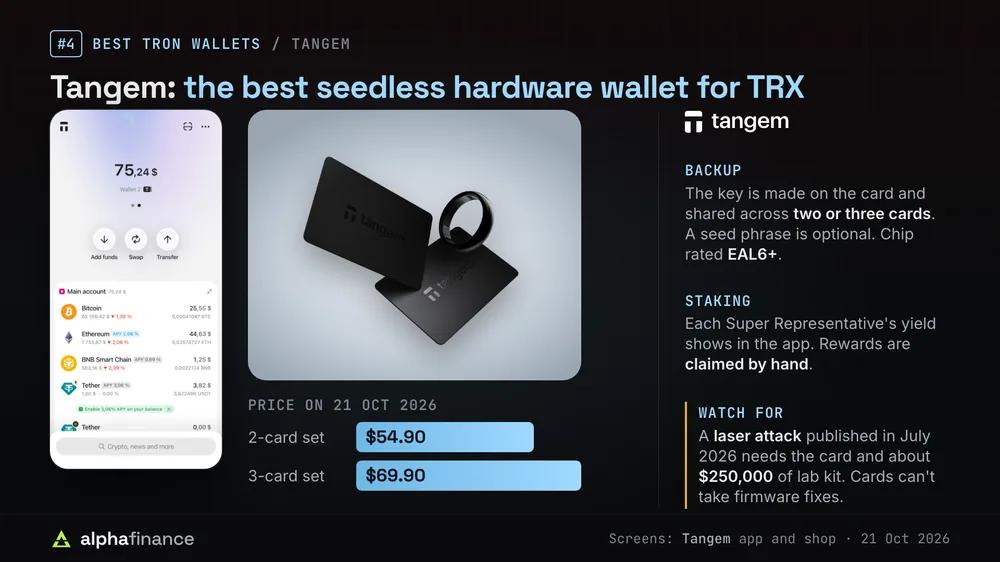
Tangem's app wallet screen beside its black cards and ring: a 2-card set costs $54.90 and a 3-card set $69.90 on 21 Oct 2026; the key is made on the card and shared across two or three cards with an optional seed phrase on an EAL6+ chip, Super Representative yields show in the app with rewards claimed by hand, and a July 2026 laser attack needs the card and about $250,000 of lab kit

Tangem's payment-sized card holds the private key offline, and you never have to write down a seed phrase. A 2-card set costs $54.90 and a 3-card set costs $69.90, according to Tangem's pricing page, checked 21 Oct 2026.
  • Backup: The card generates the key, which is shared across two or three cards. A seed phrase is optional, according to Tangem's security overview. Its chip carries an EAL6+ rating.
  • Staking and voting: The app displays each Super Representative's yield and highlights recommended representatives. Rewards require manual claims, as shown in Tangem's TRX staking guide, dated 4 Sep 2026.
  • Tokens: The same guide confirms that TRX can be bought and swapped in the Tangem app.
  • Watch for: In July 2026, Ledger's research team published a laser attack that resets a Tangem card's access code. Carrying it out requires the physical card and about $250,000 of lab equipment. Tangem cards cannot receive firmware fixes.

5. Trust Wallet: best multichain mobile wallet for TRX

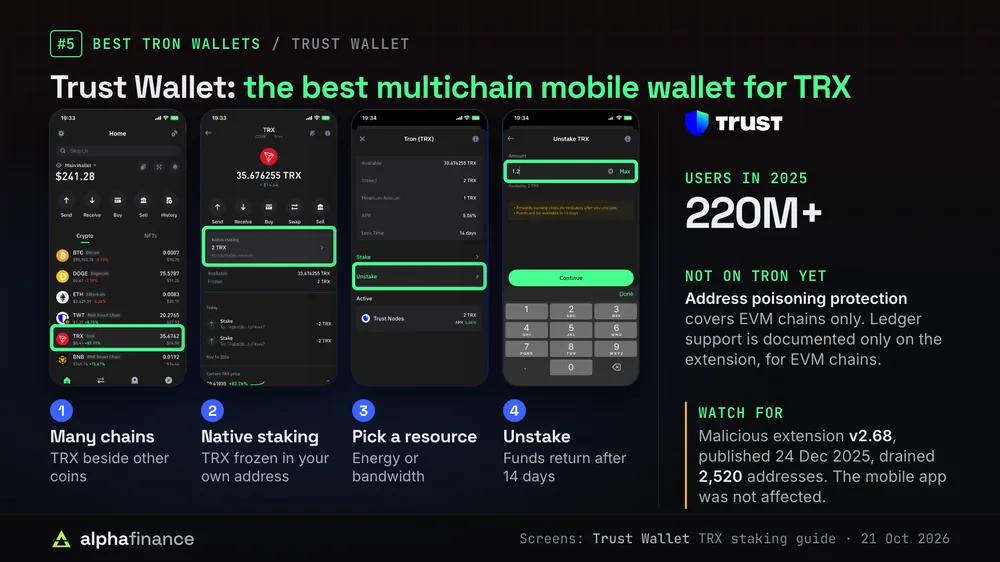
Four Trust Wallet screens from its TRX staking guide: TRX beside other coins, native staking of TRX in your own address, choosing energy or bandwidth, and unstaking with funds back after 14 days; Trust Wallet passed 220 million users in 2025, its address poisoning protection and documented Ledger support cover EVM chains only, and malicious extension v2.68, published 24 Dec 2025, drained 2,520 addresses

Trust Wallet lets you hold TRX alongside coins from many other chains in one mobile app. It passed 220 million users in 2025, according to Trust Wallet's 2025 year-end update.
  • Staking and voting: TRX is frozen in an address you control to obtain energy or bandwidth. Each frozen coin also provides voting power for Super Representatives, according to Trust Wallet's TRX staking guide, published 13 Aug 2026.
  • Hardware: Documented Ledger support is limited to the browser extension and EVM chains, meaning Ethereum and networks built to run its smart contracts. We found no Trust Wallet page showing Tron support on a Ledger.
  • Scam protection: Address poisoning protection launched in March 2026 for EVM chains. Tron is not yet covered.
  • Watch for: Extension risk. A malicious version 2.68, published on 24 Dec 2025, drained 2,520 wallet addresses, according to Trust Wallet's incident update. The company released a clean version 2.69 and offered reimbursement to affected users. The mobile app was unaffected.

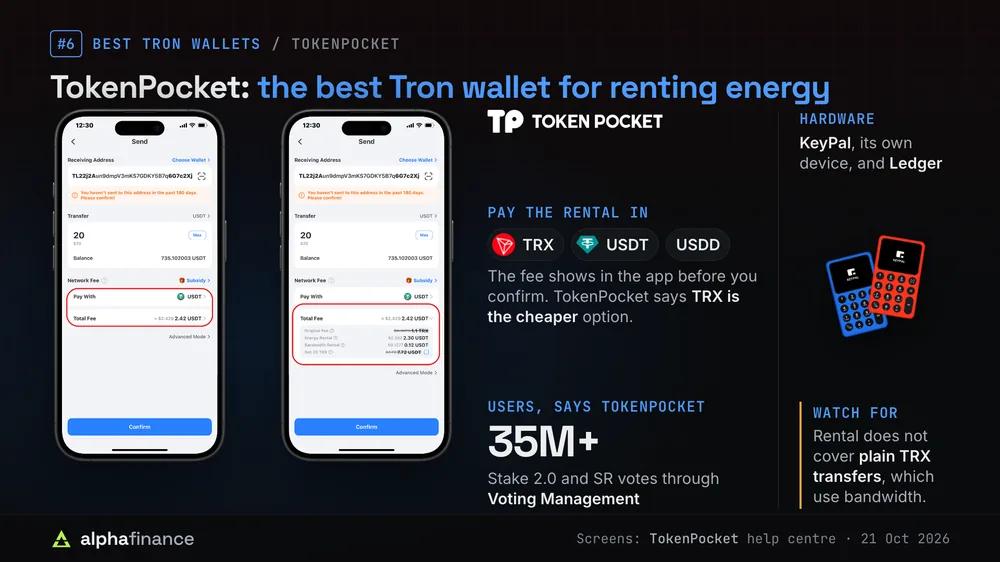
6. TokenPocket: best Tron wallet for renting energy

TokenPocket send screens paying a USDT transfer fee in USDT with energy rental, beside its KeyPal hardware wallets; rental can be paid in TRX, USDT or USDD with TRX the cheaper option, TokenPocket claims 35 million+ users and votes through Voting Management, it supports KeyPal and Ledger, and rental does not cover plain TRX transfers

TokenPocket lets frequent USDT senders reduce fees without locking up TRX for 14 days. Its website claims more than 35 million users and promotes the company's KeyPal hardware wallet.
  • Energy rental: With TokenPocket's energy rental service, you buy energy for a transfer using TRX, USDT or USDD, a dollar stablecoin issued on Tron. The app shows the fee before confirmation.
  • Staking and voting: Stake 2.0 support lets you stake for resources. The Voting Management tool handles Super Representative voting.
  • Hardware: KeyPal and Ledger devices are covered in TokenPocket's hardware wallet guides.
  • Watch for: Energy rental does not cover plain TRX transfers because they use bandwidth. TokenPocket recommends TRX as the cheaper way to pay for rentals.

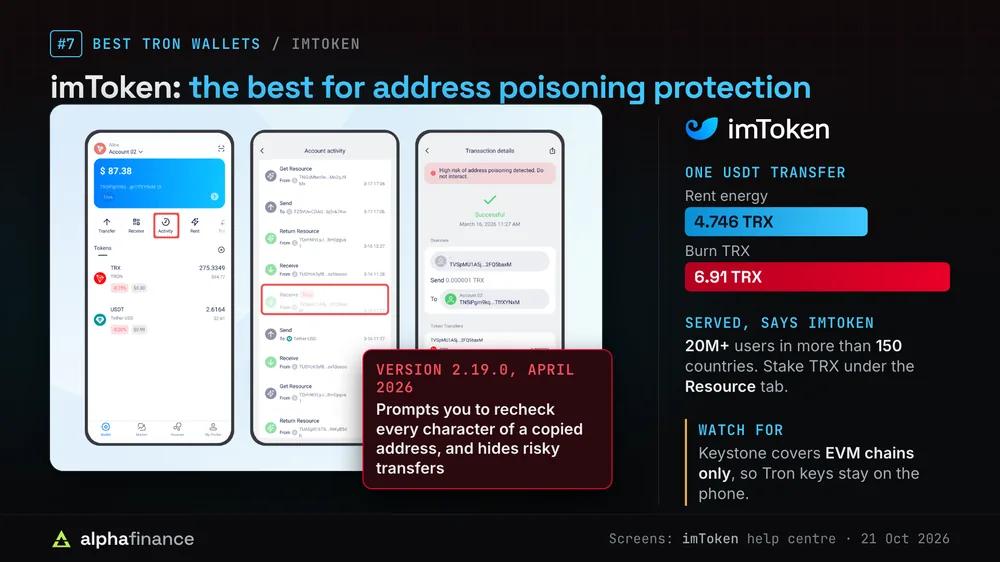
7. imToken: best Tron wallet for address poisoning protection

imToken screens flagging a risky incoming transfer on a Tron account with a high risk of address poisoning warning; version 2.19.0 from April 2026 prompts you to recheck every character of a copied address and hides risky transfers, renting energy for one USDT transfer cost 4.746 TRX against 6.91 TRX to burn, imToken has served 20 million+ users in 150+ countries, and its Keystone pairing covers EVM chains only

Among the wallets we assessed in October 2026, imToken had the most complete built-in protection against Tron address poisoning. Its April 2026 release, version 2.19.0, introduced address poisoning protection for Ethereum and Tron accounts.

Copying an address from transaction history triggers a prompt to check every character, including those in the middle. The wallet also labels suspected scam addresses and hides risky transactions by default.

  • Fees: imToken's one-click energy rental showed a rental cost of about 4.746 TRX for a USDT transfer, compared with about 6.91 TRX to burn for energy.
  • Staking: The Resource tab lets you stake TRX for energy or bandwidth, according to imToken's bandwidth and energy guide.
  • Scale: More than 20 million users across over 150 countries have used imToken, according to its help centre.
  • Watch for: Keystone hardware support is limited to EVM chains. Tron accounts remain on the phone.

Tron wallet fees compared

USDT transfer costs depend on the wallet's source of energy and how often you send. For a monthly transfer, renting energy or using GasFree costs the least. Daily senders may cover most transfers with energy from staked TRX.

MethodWhat you payExample cost per USDT transferWallets that offer it
Burn TRXTRX at 100 sun per energyAbout 6 to 13 TRXAll seven
Stake TRX for energyNothing per transfer once stakedNo fee within the daily energy you holdTronLink, Trezor, Trust Wallet, TokenPocket, imToken
Rent energyA rental fee to an energy providerAbout 4.75 TRX (imToken example)Trust Wallet, TokenPocket, imToken
Fee paid in USDTA fee in the token sent, plus one-time activation where charged1.5 USDT fixed at GuardaTronLink, Guarda, imToken through a partner app

Energy from staking refills fully over 24 hours, according to Tron's bandwidth and energy documentation. The amount you receive depends on your share of all TRX staked for energy across the network. As more holders stake, the same amount of TRX produces less energy.

The average Tron transaction fee was $0.49 in CryptoQuant's July 2026 Tron research report, down 65% from a year earlier following the August 2025 price cut.
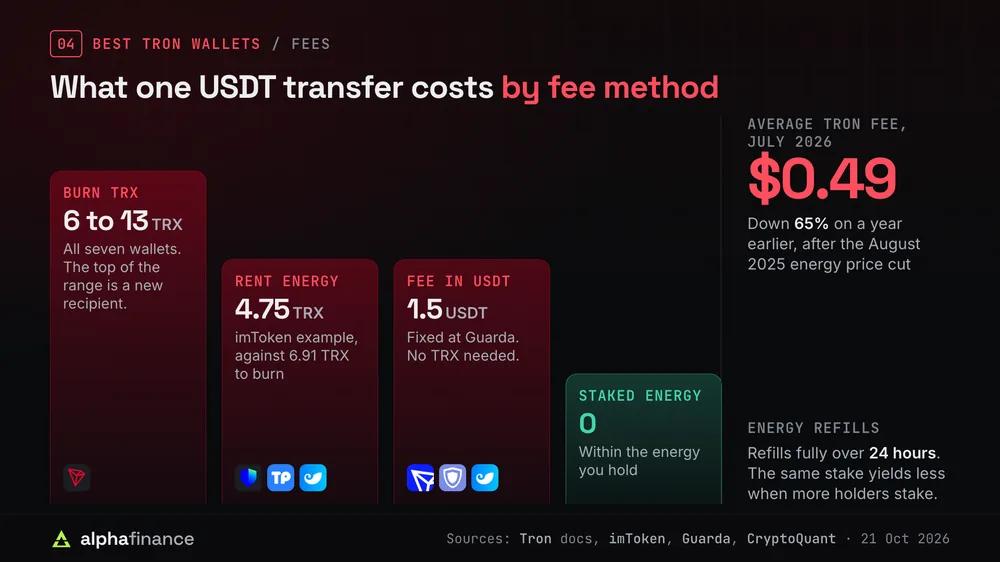
What one USDT transfer costs on Tron by fee method: burning TRX costs 6 to 13 TRX in all seven wallets, renting energy about 4.75 TRX in Trust Wallet, TokenPocket and imToken against 6.91 TRX to burn, paying the fee in USDT 1.5 USDT fixed at Guarda, and staked energy nothing within the energy you hold; the average Tron fee was $0.49 in July 2026, down 65% on a year earlier, and staked energy refills over 24 hours

Changes to Tron wallets in 2026 centred on fee payments, new TRX stakers and scam filtering.
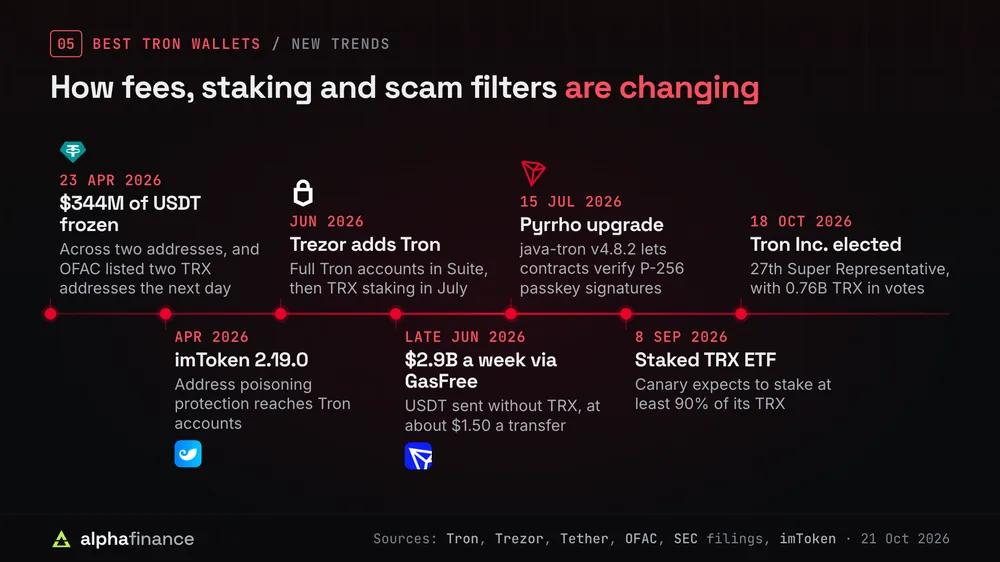
Timeline of changes to Tron wallets: 23 Apr 2026 Tether froze $344 million of USDT across two addresses and OFAC listed two TRX addresses the next day; April 2026 imToken 2.19.0 brought address poisoning protection to Tron; June 2026 Trezor added Tron, then staking in July; late June 2026 $2.9 billion a week moved through GasFree at about $1.50 a transfer; 15 Jul 2026 the Pyrrho upgrade added P-256 passkey signatures; 8 Sep 2026 Canary's staked TRX ETF plans to stake at least 90%; 18 Oct 2026 Tron Inc. elected 27th Super Representative with 0.76 billion TRX in votes

Sending USDT without holding TRX

GasFree users sign a permission message, then a service provider submits the transfer and pays the network fee. The provider collects its fee in the token being sent, according to GasFree's developer documentation. CryptoQuant's report recorded $2.9 billion in weekly GasFree volume in the last week of June 2026, at an average fee of about $1.50.

Each wallet sets its own terms, so charges vary. imToken's GasFree guide quotes about 3 USDT for the first transfer, including activation, and about 1.5 USDT for subsequent transfers.

Hardware wallets adding native Tron staking

With its June and July 2026 releases, Trezor became the latest hardware wallet maker to offer Tron staking and voting in its own software, following Ledger and Tangem.

Staked TRX in ETFs and company treasuries

Large new holders are competing for Super Representative votes. The Canary Staked TRX ETF prospectus, dated 8 Sep 2026, says the exchange-traded fund expects to stake at least 90% of its TRX. It charges a yearly fee of 1.10%.

Tron Inc., a Nasdaq-listed company with TRX on its balance sheet, said it had been elected one of the 27 Super Representatives. It ranked 27th on 18 Oct 2026 with 0.76 billion TRX in votes. People staking from their own wallets now vote alongside these institutions.

Stablecoin freezes on Tron

USDT issuer Tether can freeze the token at any Tron address. On 23 Apr 2026, it said it had frozen $344 million of USDT across two addresses in coordination with US authorities, bringing its total freezes to more than $4.4 billion. The following day, the US Treasury added two TRX addresses to its sanctions list.

Tether, TRON and TRM Labs established the T3 Financial Crime Unit in September 2024. Working with partners in 23 jurisdictions, the unit has frozen over $450 million in illicit assets. Self-custody gives you control of the private key, but Tether retains control of the USDT contract.

Address poisoning protection reaching Tron

Low transaction fees make mass scams cheap on Tron, prompting wallets to build network-specific filters. TRM Labs' study of Tron address poisoning traced a funding address that created up to 4,800 new accounts, likely to send near-worthless TRX from lookalike addresses.

imToken extended this type of protection to Tron accounts in April 2026. Trust Wallet's version does not yet cover them.

Passkey signatures after the Pyrrho upgrade

Released on 15 Jul 2026, java-tron v4.8.2, named Pyrrho, allows Tron smart contracts to verify P-256 signatures. Passkeys and phone security chips use this signature type.

The change could allow Tron wallets to use a phone's face or fingerprint check in place of a seed phrase. None of the seven wallets in this ranking documents using it.

How to secure a Tron wallet

The documented scams on Tron depend on an owner copying, signing or revealing something. These habits help block them:
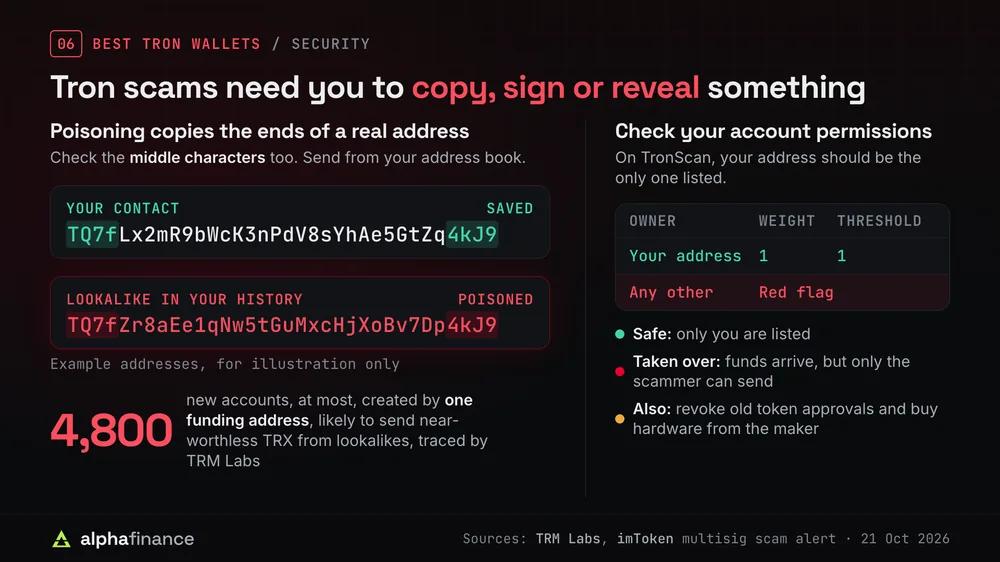
  • Copy addresses from your address book: Never copy a recipient's address from transaction history, where poisoned lookalikes appear after a real transfer. Check the middle characters as well as the first and last few.
  • Read every signing prompt: Stop if a prompt mentions an account permission update or owner permission. imToken's multisig scam alert describes how scammers use a stolen seed phrase to add their own address to an account's permissions. The account can still receive funds, but its owner cannot send them.
  • Check your account permissions: On a block explorer such as TronScan, only your own address should appear under each permission. Both weight and threshold should be set to 1.
  • Revoke old token approvals: Approvals let smart contracts move your tokens. Use TronLink's authorisation check to find unlimited approvals you no longer need and remove them.
  • Buy hardware wallets from the maker: The October 2026 Ledger implant cases involved resellers, and the tampered devices passed a normal setup. Buy through the manufacturer's own shop.
  • Keep the seed phrase offline: Write it on paper or steel. Never photograph it, enter it on a website or save it in cloud notes.
How to secure a Tron wallet: address poisoning copies the first and last characters of a real address, shown with two example addresses that differ only in the middle, and TRM Labs traced one funding address that created up to 4,800 new accounts; on TronScan your own address should be the only one under each account permission, with weight and threshold of 1, and any other address is a red flag; also revoke old token approvals and buy hardware from the maker

The risks of holding TRX in a self-custody wallet

With self-custody, you alone are responsible for your coins. Losing both the seed phrase and the device means losing access to the TRX and tokens permanently. No company can restore them, and a transfer to the wrong address cannot be recalled.

Staked TRX takes 14 days to withdraw. Its price may fall during that wait, while staking returns can also change. The yield displayed in a wallet depends on your Super Representative's share of rewards and the votes it attracts.

Leverage can amplify TRX's already volatile price moves. The Tron liquidation heatmap shows the prices at which leveraged TRX futures positions would be forcibly closed, or liquidated. Those forced sales and purchases can deepen a move. Any USDT in your wallet also remains subject to freezing by Tether, regardless of which wallet you use.
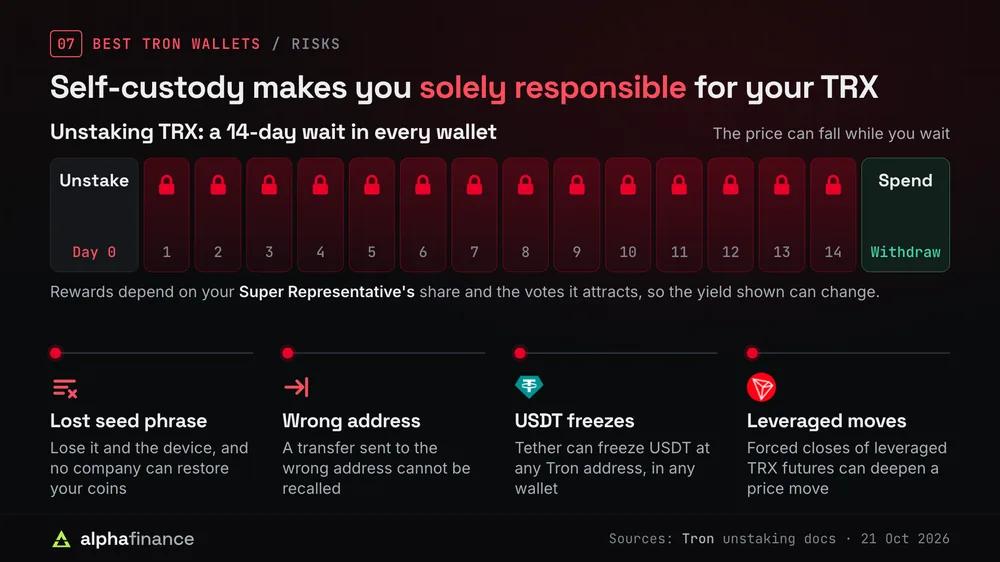
The risks of holding TRX in a self-custody wallet: unstaking means a 14-day wait in every wallet while the price can fall, and rewards depend on your Super Representative's share; a lost seed phrase cannot be restored by any company, a transfer to the wrong address cannot be recalled, Tether can freeze USDT at any Tron address, and forced closes of leveraged TRX futures can deepen price moves

Not investment advice

This article explains market data. Nothing on this page is a recommendation to buy, sell or leverage any asset. Digital assets are volatile and you can lose everything you put in. If you are unsure whether a trade is appropriate for you, a licensed adviser in your jurisdiction is the right next step.

Written by

Alpha Finance Editorial Team

Part of the Alpha Finance research team. Meet the team

Fact checked by

Vince Dioquino

Verifies every figure against primary sources before publication. Meet the team

Questions

What is the best Tron wallet?

TronLink is the best Tron wallet for most TRX holders. It brings staking and Super Representative voting into the same app as GasFree transfers and Ledger signing. For offline storage, Trezor supports native TRX staking in desktop Suite, while Ledger can sign transactions inside TronLink.

Which hardware wallets support Tron?

Trezor, Ledger and Tangem support TRX and TRC-20 tokens and let you stake TRX in their own apps. Trezor introduced full Tron support in June 2026 and staking in July 2026 for the Safe 3, Safe 5, Safe 7 and Model T. On mobile, Ledger also connects to TronLink over Bluetooth.

Can I stake TRX in a wallet?

Most Tron wallets let you stake TRX for energy or bandwidth and use its voting power to elect Super Representatives. Your TRX stays at your address. Voting earns a share of the 128 TRX paid to voters per block, and unstaked TRX becomes spendable after 14 days under Tron's unstaking rules.

Do I need TRX to send USDT on Tron?

Most wallets require TRX or energy because every USDT transfer consumes energy. Some fee services let you pay another way. TronLink and Guarda can charge the fee in USDT, so you do not need TRX. Guarda charges a fixed 1.5 USDT. TokenPocket and Trust Wallet also let you pay for energy rentals in USDT.

Why does my Tron wallet receive tiny transfers I did not expect?

Unexpected, tiny TRX transfers from unknown addresses may be address poisoning. Scammers send near-worthless amounts from addresses resembling ones you have used, hoping you will copy them from transaction history. Ignore these transfers and use a saved address book entry when sending.

What is a Tron multisig scam?

In a Tron multisig scam, someone with your seed phrase takes over the account by changing its permissions so that only they can send funds. The address continues receiving deposits, which may leave the owner unaware until they try to make a transfer. Check the account permissions on a block explorer to see whether another address has been added.