Markets
 BTC
 ETH
 BNB
 XRP
 SOL
 ZEC
 HYPE
 DOGE
 LINK
 TON
 AVAX
 SUI
 TAO
 AAVE
 PUMP
 MORPHO
 ARB
 LIT
--:-- UTC
Research/Market structure
Avalanche (AVAX) statistics on price, supply and staking, C-Chain and L1 activity, DeFi and tokenised assets, and the ETFs, treasury companies and futures built around the token.
 By Alpha Finance Editorial Team
 Fact-checked by Vince Dioquino
Every figure, platform detail and regulatory claim on this page was traced to a primary source by the named fact checker before publication, and is re-checked when those facts change. The review date moves only when a person has re-read the page.
The editorial policy → Editorial policy Report an errorAvalanche statistics for 2026 show growing institutional adoption alongside a falling token price and shrinking retail activity. AVAX, used to pay network fees and stake on Avalanche, traded at $7.97 with a market value of $3.55 billion on 9 Nov 2026. That puts it about 95% below its November 2021 high of $144.96.
Meanwhile, tokenised real-world assets on the C-Chain reached $1.22 billion. Charles Schwab and Janus Henderson moved closer to the network, as did Intercontinental Exchange (ICE). C-Chain daily active addresses fell from about 621,000 in the second quarter of 2026 to about 144,000 in the third.
The table lists the latest dated figure and source for each core Avalanche metric.
| Metric | Figure | Date | Source |
|---|---|---|---|
| AVAX price | $7.97 | 9 Nov 2026 | CoinGecko |
| Market cap (rank) | $3.55B (27th) | 9 Nov 2026 | CoinGecko |
| Circulating supply | 445.8M AVAX | 9 Nov 2026 | CoinGecko |
| Maximum supply | 720M AVAX | 31 Dec 2025 | Blockworks |
| Staked AVAX | About 198M AVAX | 30 Sep 2026 | Blockworks |
| Primary Network validators | 594 | 30 Sep 2026 | Blockworks |
| C-Chain transactions | 191.9M | Q3 2026 | Blockworks |
| C-Chain daily active addresses | About 144,000 (average) | Q3 2026 | Blockworks |
| Active Avalanche L1s | 75 | 31 Dec 2025 | Blockworks |
| DeFi total value locked | $606.4M | 8 Nov 2026 | DefiLlama |
| Stablecoins on Avalanche | $1.18B | 9 Nov 2026 | DefiLlama |
| Tokenised real-world assets, C-Chain | $1.22B | 30 Sep 2026 | Blockworks |
| AVAX futures open interest | $324.6M | 9 Nov 2026 | CoinGlass |
Our crypto prices dashboard tracks live prices and 24 hour changes for AVAX and the 100 largest coins.
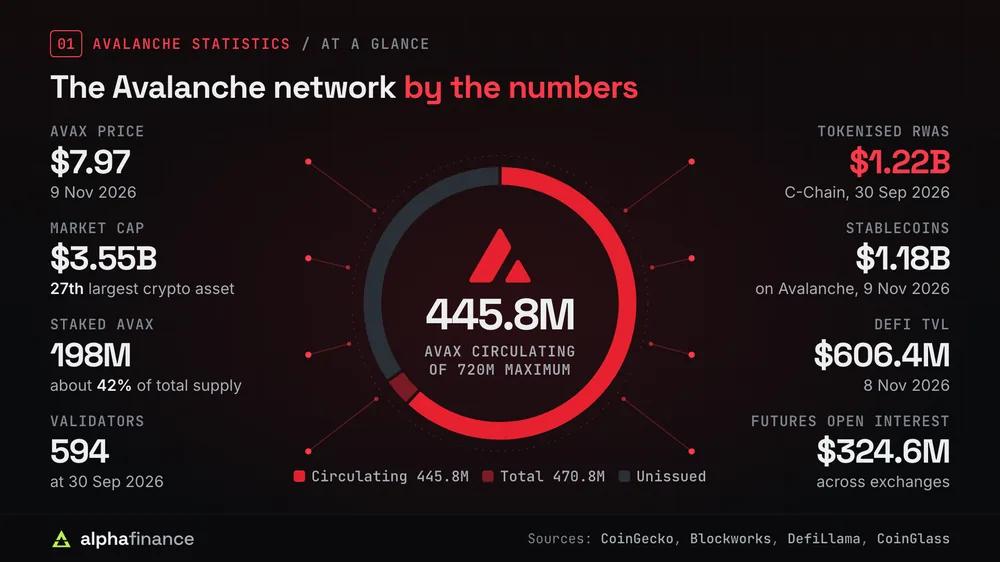
Trackers can report figures that differ by a factor of two or more for the same Avalanche metric. Each counts a different set of chains, tokens or addresses. Compare figures only when their chain coverage, dates and definitions match.
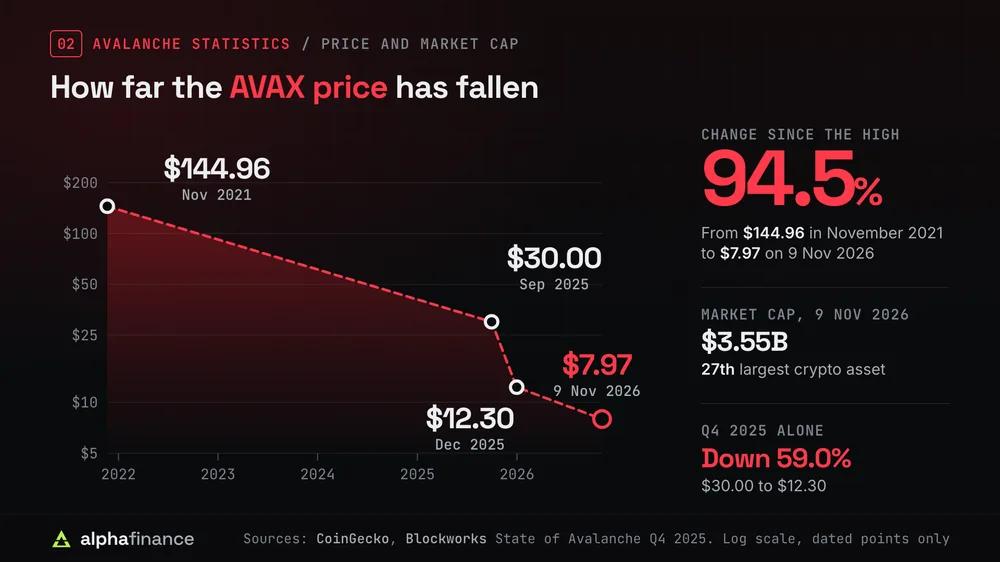
AVAX has lost about a third of its value in 2026 and about 95% since its 2021 peak, despite large financial firms adding Avalanche to their plans. On 9 Nov 2026, its market cap stood at $3.55 billion, the 27th largest of any crypto asset. Market cap is the token price multiplied by circulating supply.
| Date | AVAX price | Change to 9 Nov 2026 |
|---|---|---|
| November 2021 (all-time high) | $144.96 | Down 94.5% |
| End of September 2025 | $30.00 | Down 73.4% |
| End of December 2025 | $12.30 | Down 35.2% |
| 9 Nov 2026 | $7.97 |
Blockworks' State of Avalanche Q4 2025 report supplies the 2025 figures and records a 59.0% price fall in that year's fourth quarter. The all-time high and current price come from CoinGecko. We calculated the percentage changes.
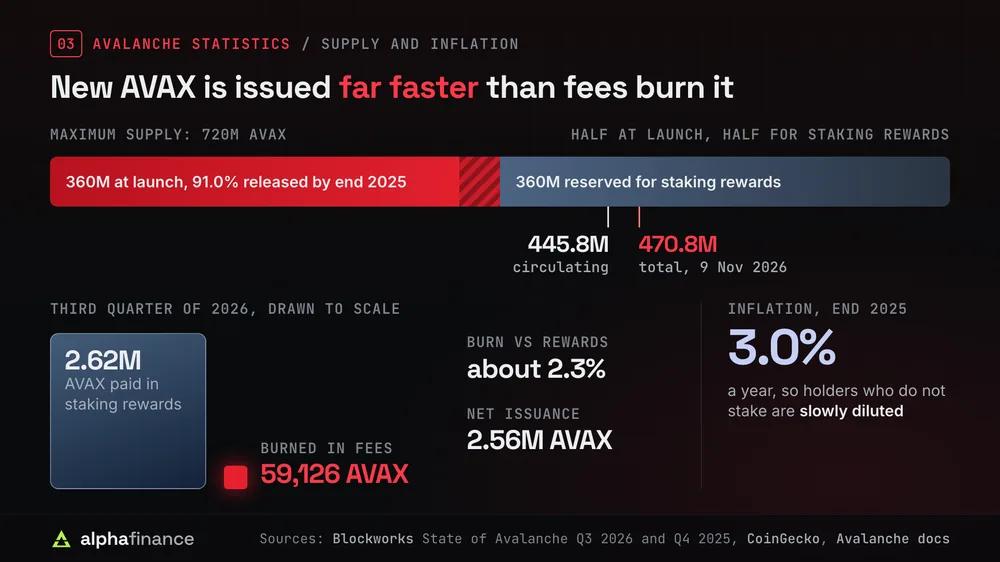
New AVAX enters circulation faster than fees remove it, gradually diluting holders who do not stake. Blockworks put annualised inflation at 3.0% at the end of 2025.
Of the 720 million AVAX maximum supply, 360 million was created at launch. The other half is reserved for staking rewards, released over time.
By the end of 2025, 91.0% of the launch supply had already been released for trading. Token unlocks therefore add little to supply now. These are scheduled releases of tokens that early backers and the team were previously unable to sell. Our token unlock calendar lists upcoming releases for every major token.
Circulating supply was 445.8 million AVAX and total supply 470.8 million on 9 Nov 2026.
Avalanche destroys, or burns, every network fee. This includes both the base fee and the priority fee on the C-Chain, along with fees paid by Avalanche L1s to the Primary Network.
During the third quarter of 2026, stakers received about 2.62 million AVAX (about $19.1 million) in rewards, while the network burned 59,126 AVAX (about $501,000) of C-Chain fees. That burn offset about 2.3% of rewards. Net issuance, the difference between new and burned AVAX, was about 2.56 million.
The report recorded 5.27 million AVAX in rewards for the second quarter. A large group of stakes ended in May, and rewards are paid when each staking period closes.
Fees rose after September's Helicon upgrade. Network fees reached 61,583 AVAX (about $519,000) in the third quarter, up 44%, and all of the increase came in the nine days after activation. From 27 to 30 Sep, base fees averaged about 620 AVAX a day, compared with about 40 a day earlier in the quarter.
About 42% of all AVAX is tied up in staking across a shrinking validator set. Holders lock AVAX to help confirm transactions and receive newly issued AVAX in return.
A validator is a computer that checks and confirms transactions on the Primary Network, which runs the C-Chain and the chain that manages staking. Delegators assign their tokens to a validator and share its rewards.
About 198 million AVAX was staked across 594 validators at the end of September 2026, roughly 42% of total supply. This was down from about 208 million at the end of June. The average stake was about 333,000 AVAX per validator. At the 9 Nov 2026 price, the total stake was worth about $1.58 billion (our calculation).
| Quarter end | Active validators | Staked AVAX |
|---|---|---|
| Q2 2025 | 1,436 | 221.7M |
| Q3 2025 | 855 | 189.2M |
| Q4 2025 | 656 | 185.0M |
| Q3 2026 | 594 | About 198M |
The 2025 figures come from Blockworks' Q3 2025 report, which was commissioned by Ava Labs, and its Q4 2025 report. Between mid-2025 and September 2026, validator numbers fell 58.6%, compared with a roughly 11% decline in total stake.
Under Avalanche's staking rules, validators need at least 2,000 AVAX and delegators need 25 AVAX. The minimum delegation fee is 2%. A validator's total stake cannot exceed 3 million AVAX or five times its own stake, whichever is lower.
Returns depend on the lock-up period and, for funds, the proportion of holdings staked. On 6 Nov 2026, the VanEck Avalanche ETF reported a 5.57% yield on its staked AVAX. It had staked 84.28% of its holdings and reported a net staking yield of 4.51% after fees. Our crypto staking calculator models rewards for any amount.
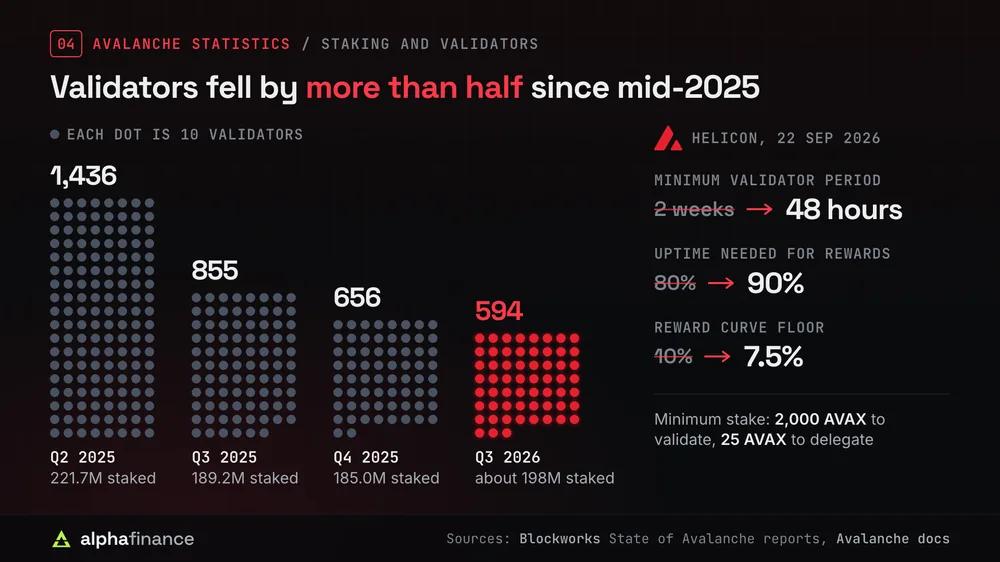
Live since 22 Sep 2026, Helicon allows shorter validator commitments but reduces rewards for short stakes. Avalanche's Helicon documentation details the changes.
Once the change is fully phased in around 21 Dec 2026, Blockworks estimated that the reward for a 14 day stake will fall by about 1.3 percentage points. One-year staking rewards remain unchanged. The proposal's own modelling projects a reduction of 0.5 to 1 percentage point in annual AVAX inflation.
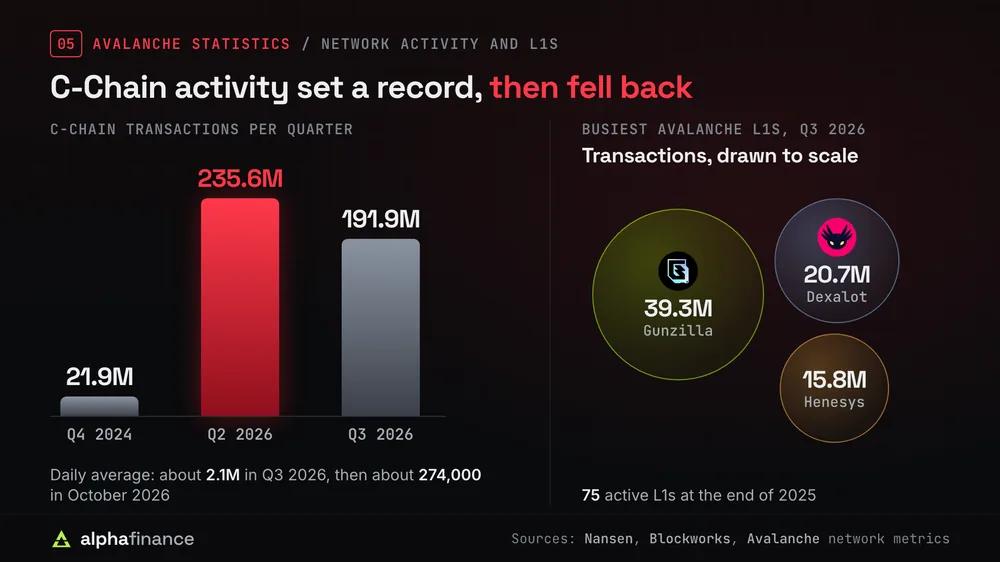
C-Chain activity reached a record in the second quarter of 2026 before falling back. Avalanche's main chain for Ethereum-compatible apps relies on a small number of large apps for much of its usage, as that swing shows.
The C-Chain processed a record 235.6 million transactions in the second quarter of 2026, its seventh consecutive quarter of growth, up from 21.9 million in the fourth quarter of 2024. Daily active addresses rose from under 30,000 in early January to a quarterly average of about 621,000.
Third-quarter C-Chain transactions fell 19% to 191.9 million, while daily active addresses averaged about 144,000. The daily address count dropped from about 304,000 in July to about 23,000 in September. Transactions proved more resilient, averaging about 2.1 million a day (our calculation).
| Period | C-Chain transactions | Average daily active addresses |
|---|---|---|
| Q4 2024 | 21.9M | Not reported |
| Q2 2026 | 235.6M | About 621,000 |
| Q3 2026 | 191.9M | About 144,000 |
Activity continued to fall after the quarter. The C-Chain averaged about 274,000 daily transactions in October 2026, based on Avalanche's own network metrics (our calculation).
Fees remain a tiny fraction of a cent. The median C-Chain fee was $0.000014 in the second quarter of 2026, down 99.6% from a year earlier. An earlier reduction came with the December 2024 Etna upgrade, which cut the C-Chain minimum base fee from 25 nAVAX to 1 nAVAX (billionths of an AVAX), a reduction of nearly 96%.
With the Granite upgrade on 19 Nov 2025, validators gained the ability to adjust block times without waiting for a network upgrade.
Avalanche L1s are separate blockchains with their own validators and rules. Etna replaced the previous 2,000 AVAX stake required of L1 validators with a continuous fee that started at roughly 1.3 AVAX a month.
There were 75 active Avalanche L1s at the end of 2025, up from 68 three months earlier. In that quarter, the C-Chain and all L1s together averaged 38.2 million transactions a day. Just 2.1 million were on the C-Chain, placing most transactions on L1s.
Gunzilla led L1 transaction counts in the third quarter of 2026 with 39.3 million, followed by Dexalot at 20.7 million and MapleStory's Henesys at 15.8 million. L1 validators paid the Primary Network 2,444 AVAX (about $18,000) in continuous fees, down 6% from the second quarter.
Money on Avalanche has shifted from DeFi apps towards tokenised funds and payment products operated by regulated firms. Our blockchain data dashboard compares Avalanche's total value locked with other chains, alongside stablecoins and trading volume.
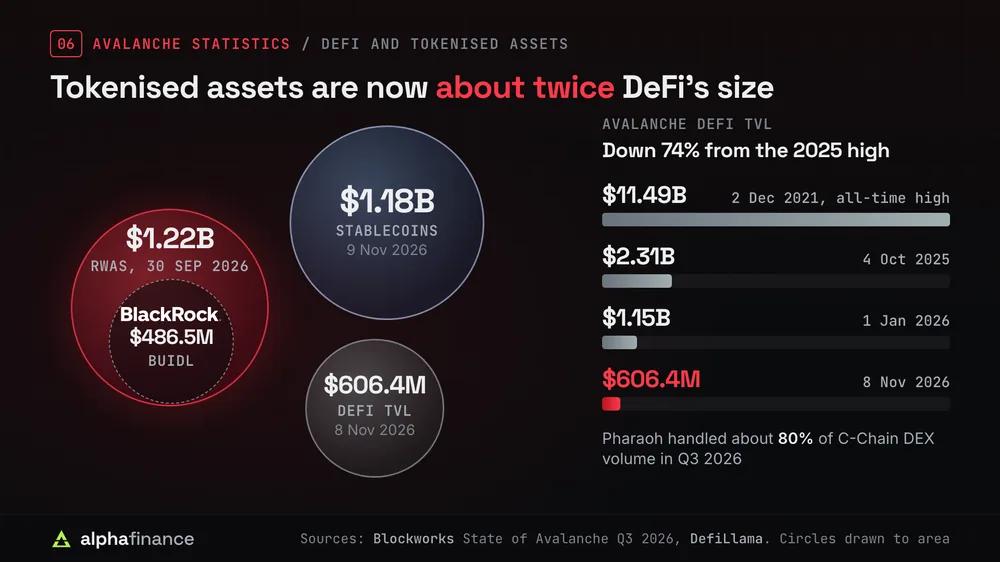
Total value locked (TVL) measures the value of tokens deposited in DeFi apps, including lending markets and trading pools. Avalanche's DeFi TVL stood at $606.4 million on 8 Nov 2026, compared with $1.15 billion on 1 Jan 2026 and a 2025 high of $2.31 billion on 4 Oct 2025. By our calculation, that is a 47% decline this year and a 74% fall from the 2025 high. Its all-time high was $11.49 billion on 2 Dec 2021.
C-Chain lending markets held $622 million in deposits and $234 million in borrowing at the end of September 2026. Third-quarter volume on decentralised exchanges (DEXs), trading apps run on smart contracts, fell 20% to $6.64 billion. Pharaoh accounted for $5.33 billion, or about 80% of the total.
Our DeFi yields dashboard lets readers filter Avalanche lending and trading pool yields by chain. Each pool carries a trust score.
Stablecoins are tokens designed to maintain a fixed value, usually $1. Avalanche held $1.18 billion in stablecoins on 9 Nov 2026, making it the 12th largest stablecoin chain by DefiLlama's count.
During the second quarter of 2026, the C-Chain recorded $84.4 billion in stablecoin transfers. Card spending on Avalanche rose 74% to a record $10.05 million in the third quarter. Axiym's settlement pools also set a record, processing $529 million in cross-border payments, 4.4 times the year-earlier level. Our stablecoin statistics cover supply across every major chain.
Real-world assets (RWAs) are traditional assets issued as blockchain tokens, such as Treasury bills, loans or shares. C-Chain tokenised RWAs reached $1.22 billion at the end of September 2026, ranking fourth among 24 tracked networks. The chain had ranked sixth in June.
BlackRock's BUIDL fund held $486.5 million on Avalanche at quarter end, a 21% increase while the overall fund remained roughly flat. C-Chain tokenised government debt totalled $531.6 million, fifth among 16 networks. Another $407 million of the C-Chain RWA total came from Securitize's own listed shares, issued as the SECZ token.
Across all Avalanche chains, RWA.xyz reported $1.43 billion in distributed real-world assets on 8 Nov 2026, down 17.76% over 30 days. Securitize was the largest issuer, with $636.0 million. Our real-world assets dashboard tracks tokenised stocks and commodities, along with funds, across chains.
Several large institutions moved closer to Avalanche in 2026, although some plans still lack a launch date. Blockworks' State of Avalanche Q3 2026 report is the source for the first four entries.
Listed products give investors AVAX exposure through a brokerage account, though their combined holdings represent only a small share of supply. A spot exchange-traded fund (ETF) holds AVAX for shareholders and trades on a stock exchange. A treasury company is a listed business whose main asset is a large token holding.
| Product | Structure | Holdings | Date |
|---|---|---|---|
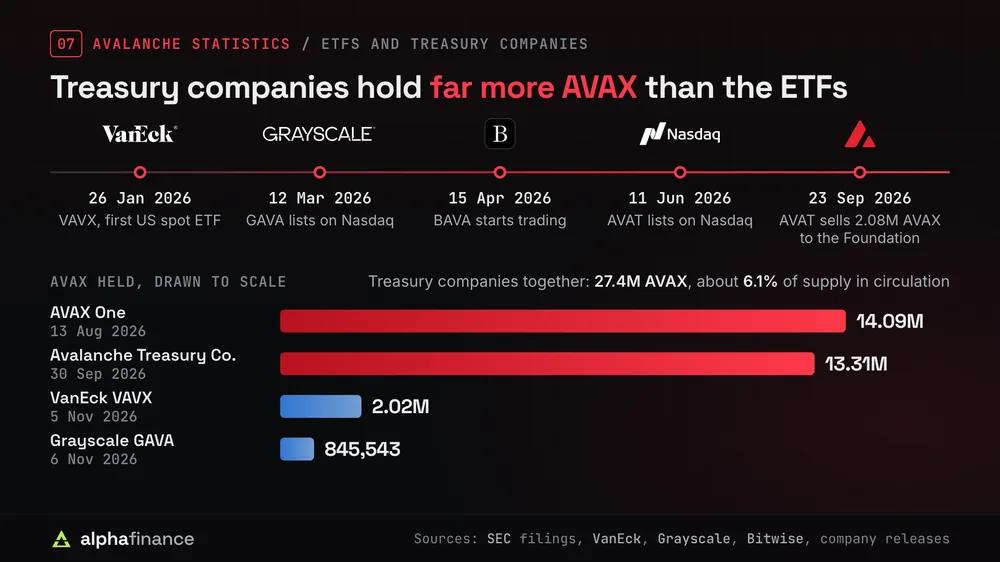
| VanEck Avalanche ETF (VAVX) | Spot ETF, Nasdaq | 2,023,711 AVAX ($16.98M) | 5 Nov 2026 |
| Bitwise Avalanche ETF (BAVA) | Spot ETF, NYSE Arca | $16.67M net assets | 30 Jun 2026 |
| Grayscale Avalanche Staking ETF (GAVA) | Spot ETF, Nasdaq | 845,543 AVAX ($7.06M) | 6 Nov 2026 |
| AVAX One (AVX) | Treasury company, Nasdaq | 14,091,424 AVAX and equivalents | 13 Aug 2026 |
| Avalanche Treasury Co. (AVAT) | Treasury company, Nasdaq | 13.31M AVAX | 30 Sep 2026 |
VanEck launched the first US spot Avalanche ETF on 26 Jan 2026. The fund charges a 0.20% expense ratio.
Grayscale's GAVA listed on Nasdaq on 12 Mar 2026 with a 0.35% management fee. It had staked 77.06% of its AVAX by 6 Nov 2026. Bitwise's BAVA began trading on 15 Apr 2026, charging a 0.34% sponsor fee. Its quarterly filing reported $16.67 million in net assets on 30 Jun 2026.
The two treasury companies hold substantially more AVAX than the ETFs. Their combined 27.4 million AVAX represents about 6.1% of circulating supply, worth roughly $218 million at the 9 Nov 2026 price (our calculation).
Traders use AVAX futures to take a price position or hedge existing holdings without owning the token. A futures contract sets a price for a purchase or sale at a later date. Perpetual futures have no expiry. A funding rate, paid by one side to the other at set intervals, keeps them close to the spot price, the price for immediate purchase.
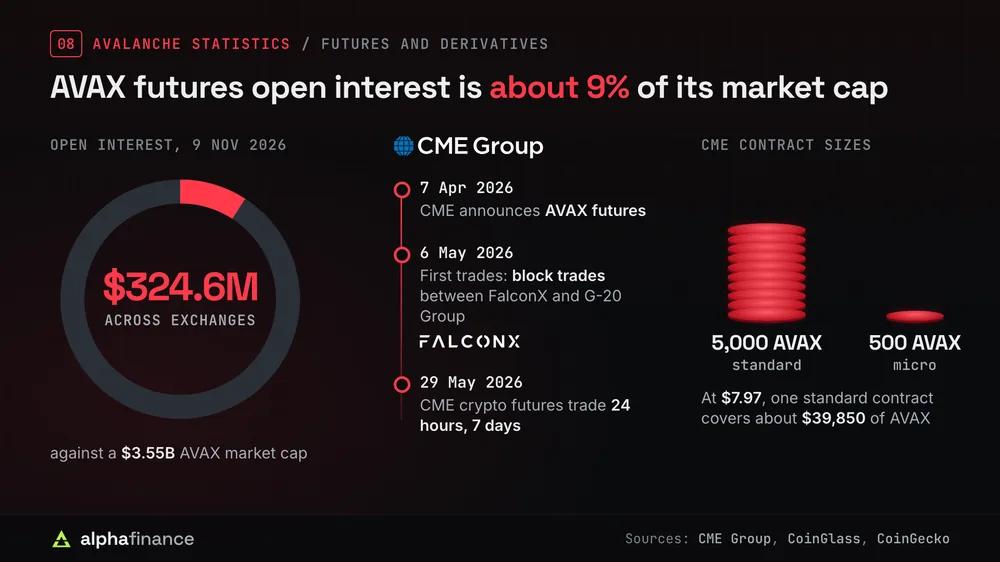
CME Group announced AVAX futures on 7 Apr 2026, offering a standard contract of 5,000 AVAX and a micro contract of 500 AVAX. Its first trades, announced on 6 May 2026, were block trades between FalconX and G-20 Group. Block trades are large deals negotiated privately.
CME's crypto futures moved to 24 hour, seven day trading from 29 May. At an AVAX price of $7.97, a standard contract covers about $39,850 (our calculation).
AVAX futures open interest across exchanges was $324.62 million on 9 Nov 2026. Open interest measures the total value of positions that remain open. This equalled about 9% of AVAX's market cap (our calculation).
Leverage uses borrowed money to trade, magnifying gains and losses from small price moves. If losses grow too large, an exchange forcibly closes the position through liquidation. The AVAX liquidation heatmap estimates where large groups of leveraged AVAX positions would be forced to close.
Our funding rates dashboard shows what traders pay to hold AVAX perpetual futures. The long/short ratio page compares the share of accounts betting on a price rise (long) with those betting on a fall (short).
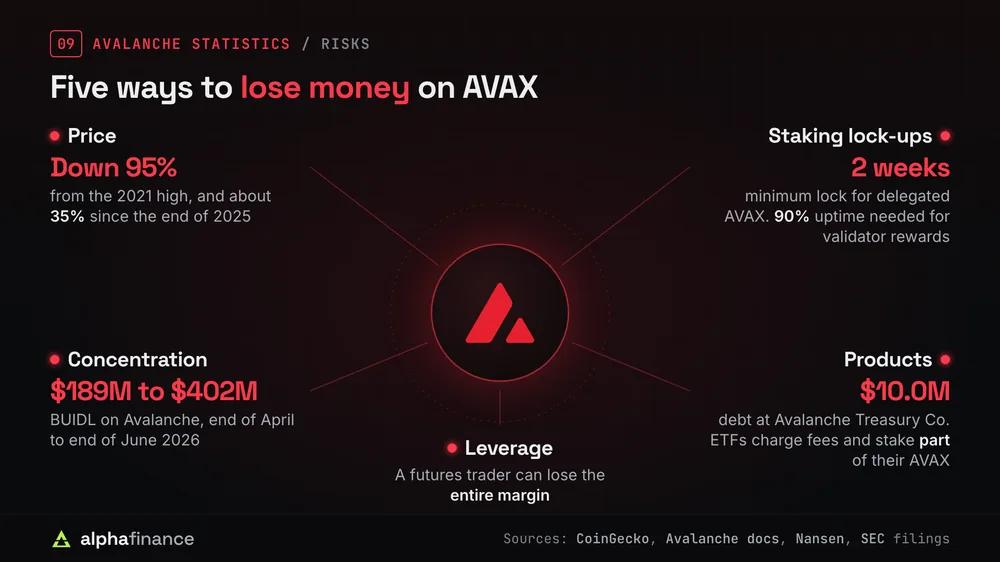
AVAX holders face losses from falling prices, staking restrictions and the products they use to gain exposure. Leverage adds further risk.
Not investment advice
This article explains market data. Nothing on this page is a recommendation to buy, sell or leverage any asset. Digital assets are volatile and you can lose everything you put in. If you are unsure whether a trade is appropriate for you, a licensed adviser in your jurisdiction is the right next step.


Fact checked by
Verifies every figure against primary sources before publication. Meet the team
At the end of September 2026, about 198 million AVAX was staked across 594 validators, representing roughly 42% of total supply. The State of Avalanche Q3 2026 report puts this below the roughly 208 million AVAX staked at the end of June 2026.
AVAX has a maximum supply of 720 million. Half was created at launch. The remainder is released over time as staking rewards, as described in the State of Avalanche Q4 2025 report. Circulating supply stood at about 445.8 million AVAX on 9 Nov 2026.
Yes. Avalanche burns every network fee, including C-Chain base and priority fees, according to Avalanche's C-Chain fee explainer. The third-quarter 2026 burn removed 59,126 AVAX. Supply still grew because staking rewards added a much larger 2.62 million AVAX.
Avalanche's staking rules require 2,000 AVAX to run a validator or 25 AVAX to delegate to one. Helicon reduced the minimum validator staking period to 48 hours, while delegations still require at least two weeks.
Yes. Three trade in the US, and all stake part of their AVAX holdings. VanEck's VAVX began trading on 26 Jan 2026. The Grayscale Avalanche Staking ETF (GAVA) listed on 12 Mar 2026, followed by the Bitwise Avalanche ETF (BAVA) on 15 Apr 2026.
Yes. CME Group offers standard contracts of 5,000 AVAX and micro contracts of 500 AVAX. It announced the first trades on 6 May 2026. Since 29 May 2026, its crypto futures have traded 24 hours a day, seven days a week.