Markets
 BTC
 ETH
 BNB
 XRP
 SOL
 ZEC
 HYPE
 DOGE
 LINK
 TON
 AVAX
 SUI
 TAO
 AAVE
 PUMP
 MORPHO
 ARB
 LIT
--:-- UTC
Research/Market structure
Prediction market statistics on monthly volume, how Kalshi overtook Polymarket, what the companies are worth, what accuracy studies found and which courts will rule on sports contracts.
 By Alpha Finance Editorial Team
 Fact-checked by Vince Dioquino
Every figure, platform detail and regulatory claim on this page was traced to a primary source by the named fact checker before publication, and is re-checked when those facts change. The review date moves only when a person has re-read the page.
The editorial policy → Editorial policy Report an errorPrediction market statistics for 2026 show $120.7 billion in contracts traded in October, up 64% in a month. Kalshi handles about three of every four dollars traded. Most of its volume comes from multi-leg combo contracts.
Exchanges count each contract at its $1 payout, so the cash traders put in is closer to a quarter of the reported volume. The legal basis for sports contracts is now before the US Supreme Court.
Prediction markets trade more than $100 billion in contracts each month, nearly all on US-licensed exchanges. An event contract pays $1 if the specified outcome occurs and zero otherwise. At 62 cents, the price implies a roughly 62% chance of that outcome.
The Alpha Finance prediction markets dashboard tracks those implied probabilities live for crypto, macro and geopolitical events.
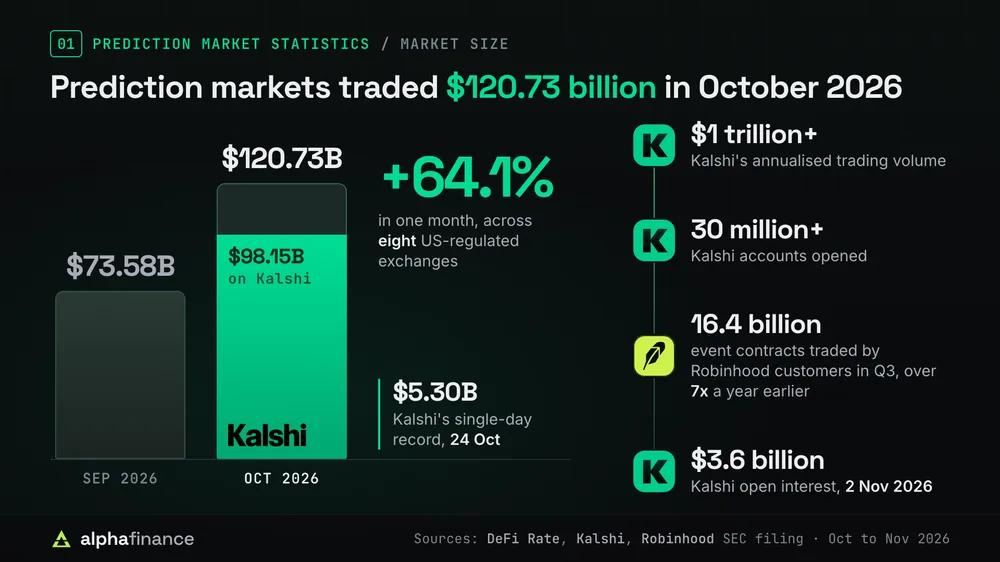
Eight US-regulated exchanges traded $120.73 billion in October 2026, up 64.1% from $73.58 billion in September. Kalshi accounted for $98.15 billion and set a single-day record of $5.30 billion on 24 Oct, according to DeFi Rate's October volume report.
Kalshi says more than 30 million accounts have been opened and its annualised trading volume now exceeds $1 trillion.
Robinhood customers traded a record 16.4 billion event contracts in the third quarter of 2026, more than seven times the count a year earlier, Robinhood's Q3 2026 results show.
Open interest measures the value of contracts still awaiting settlement. It shows how much money is committed at a given moment. DeFi Rate's Kalshi tracker put Kalshi's open interest at about $3.6 billion on 2 Nov 2026, against $345.8 billion in year-to-date contract volume.
| Statistic | Figure | Period | Source |
|---|---|---|---|
| Contract volume, eight US exchanges | $120.7B | Oct 2026 | DeFi Rate |
| Cash paid by traders, nine venues | $30.6B | 4 Oct to 2 Nov 2026 | DeFi Rate |
| Kalshi open interest | $3.6B | 2 Nov 2026 | DeFi Rate |
| Robinhood event contracts traded | 16.4B contracts | Q3 2026 | Robinhood |
| Kalshi accounts opened | 30M+ | 29 Oct 2026 | Kalshi |
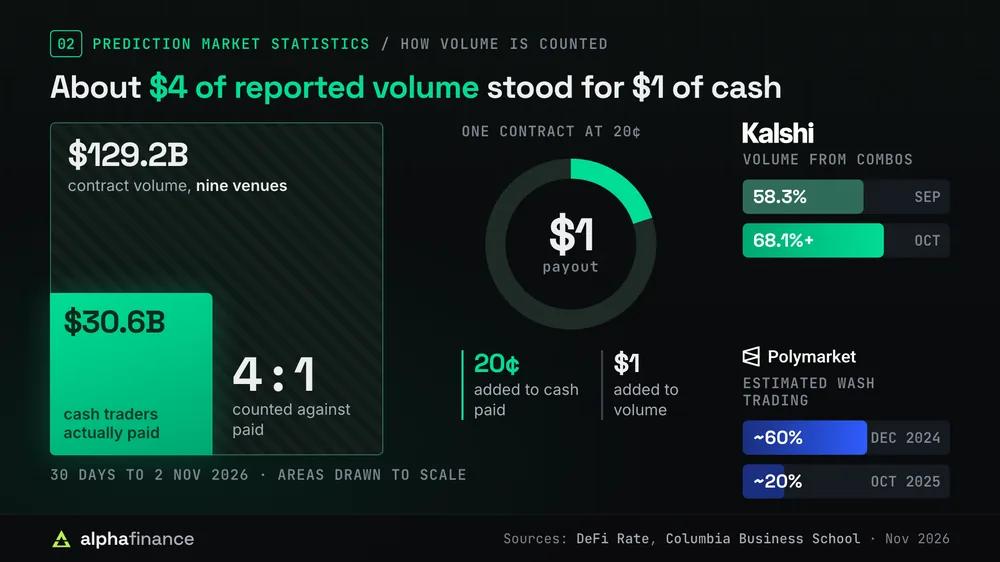
Headline volume overstates the cash at risk because exchanges count each contract at its $1 payout. A contract bought for 20 cents adds $1 to reported volume and 20 cents to cash paid, as DeFi Rate's volume methodology explains.
Across nine venues, traders paid $30.6 billion in cash for $129.2 billion in contract volume in the 30 days to 2 Nov 2026, according to DeFi Rate's 30-day figures.
The one-sentence version
Exchanges count each contract at $1, so every $4 of reported volume in late 2026 represented roughly $1 in cash changing hands.
A combo works like a sportsbook parlay. It bundles several outcomes into one contract that pays only if every leg wins. Combos typically trade at low prices, so they contribute far more in face value than in cash.
The October report put combos at no less than 68.1% of Kalshi's October 2026 volume, up from 58.3% in September.
Wash trading can also inflate volume. It involves buying and selling between accounts under the same control without taking market risk. Activity consistent with wash trading peaked at nearly 60% of Polymarket's volume in December 2024 and still accounted for about 20% in early October 2025, a Columbia Business School study estimated.
Venue coverage explains another discrepancy. The October report puts volume at $120.73 billion across eight exchanges. The live tracker puts it at $129.2 billion for the same month across nine. The tracker includes Polymarket's international exchange, DraftKings Predictions and Rothera. It excludes Crypto.com and ForecastEx.
Kalshi has overtaken Polymarket, which led in 2024 and early 2025. Its share of tracked volume rose from 41.3% in the week of 4 Aug 2025 to 74.7% in the week of 26 Oct 2026, according to DeFi Rate's Kalshi data. Over the same period, the Polymarket tracker shows Polymarket's international exchange falling from 58.7% to about 4%.
| Exchange | Contract volume | Cash paid | Share of volume |
|---|---|---|---|
| Kalshi | $97.3B | $21.7B | 75.3% |
| Polymarket US | $15.0B | $3.4B | 11.6% |
| Polymarket (international) | $5.2B | $2.6B | 4.0% |
| DraftKings Predictions | $4.7B | $751M | 3.6% |
| Novig | $3.3B | $911M | 2.6% |
| Underdog Exchange | $2.0B | $322M | 1.6% |
| Rothera | $1.3B | $635M | 1.0% |
Figures cover the 30 days to 2 Nov 2026, as published on 3 Nov, from the [DeFi Rate prediction market volume tracker](https://defirate.com/prediction-markets/volume/).
Polymarket's US volume comes from a newer, separately licensed exchange. The CFTC issued an amended order of designation in November 2025 that allows US customers to trade through brokers and registered intermediaries. Our guide to Polymarket's restricted countries covers where each exchange is available.
Rothera is a joint venture between Robinhood and Susquehanna International Group. The exchange passed $100 million in annualised revenue in its first full quarter and has traded more than 6.4 billion contracts since launch, according to Robinhood's Q3 release. Our guide to Kalshi's restrictions and regulation covers where Kalshi is available.
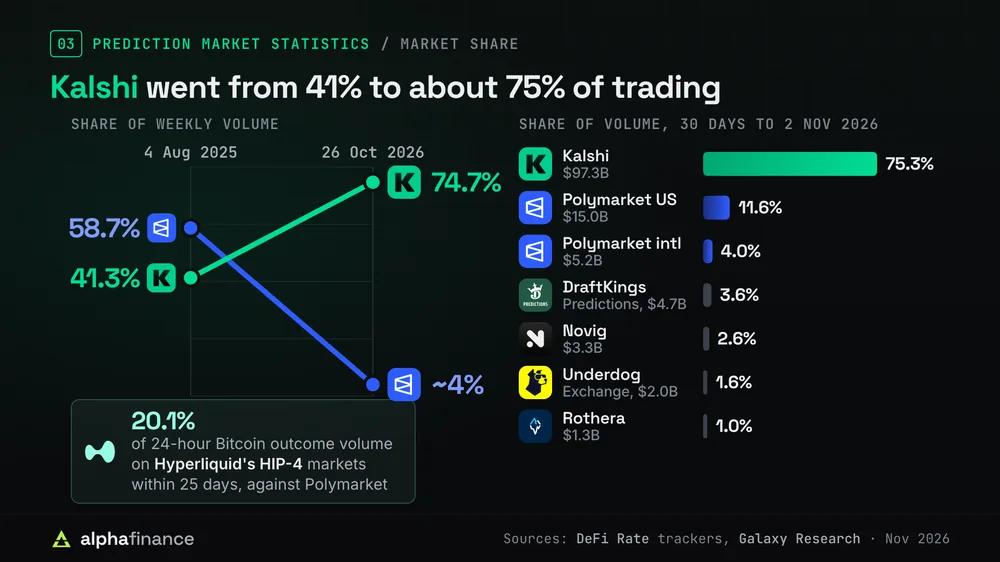
Crypto-native exchanges have begun listing outcome contracts. Hyperliquid launched its HIP-4 outcome markets on 2 May 2026. Within 25 days, those markets accounted for 20.1% of the combined 24-hour Bitcoin prediction market volume on Hyperliquid and Polymarket, according to Galaxy Research.
Galaxy notes that the main HIP-4 markets settle in USDC, a stablecoin designed to hold a $1 value. Our stablecoin statistics track stablecoins by issuer. For figures on the rest of the exchange, see our Hyperliquid statistics.
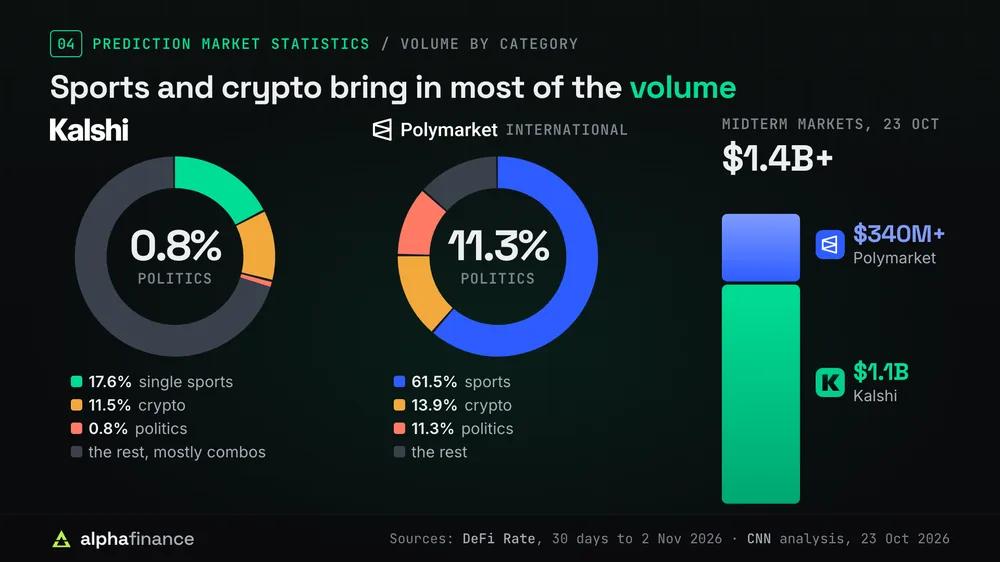
Sports and short-term crypto price contracts account for most prediction market volume. Politics makes up a small share outside election weeks. In the 30 days to 2 Nov 2026, single sports contracts accounted for 17.6% of Kalshi volume. Crypto made up 11.5% and politics 0.8%. Combos accounted for most of the remaining volume and 34% of all cash paid, according to DeFi Rate's category breakdown.
Trading on Polymarket's international exchange was less concentrated over the same period. Sports led with 61.5% of volume. Crypto accounted for 13.9% and politics for 11.3% in the Polymarket category data.
Kalshi says annualised crypto volume reached $140 billion and politics exceeded $8 billion. It also reported about 500 active entities on the exchange in September 2026.
By 23 Oct, traders had put more than $1.4 billion through 2026 midterm markets. About $1.1 billion traded on Kalshi and more than $340 million on Polymarket, according to a CNN analysis.
The latest funding rounds put the combined valuation of the two largest prediction market companies at $61 billion. Those valuations rest on the fees the exchanges collect on trades. On 29 Oct 2026, Kalshi raised a $1 billion Series G at a $40 billion post-money valuation, co-led by Wellington and Sequoia. Kalshi says its non-sports markets alone generate more than $1 billion in annualised revenue.
Less than six months earlier, Coatue led Kalshi's Series F at a $22 billion valuation on 7 May 2026. The October round marked an eightfold increase from its $5 billion valuation in October 2025.
Polymarket, founded by Shayne Coplan, is valued at about half of Kalshi's latest figure. Intercontinental Exchange, which owns the New York Stock Exchange, brought its direct investment to $1.6 billion with a new $600 million investment on 27 Mar 2026. A round of about $1 billion led by 1789 Capital would value Polymarket at $21 billion, Bloomberg reported on 31 Aug 2026.
| Company | Valuation | Date | Lead investor |
|---|---|---|---|
| Kalshi | $40B | 29 Oct 2026 | Wellington, Sequoia |
| Kalshi | $22B | 7 May 2026 | Coatue |
| Polymarket | $21B (reported) | 31 Aug 2026 | 1789 Capital |
Robinhood earned $173 million in event contract revenue in the third quarter of 2026, more than six times the year-earlier figure, as its SEC filing shows.
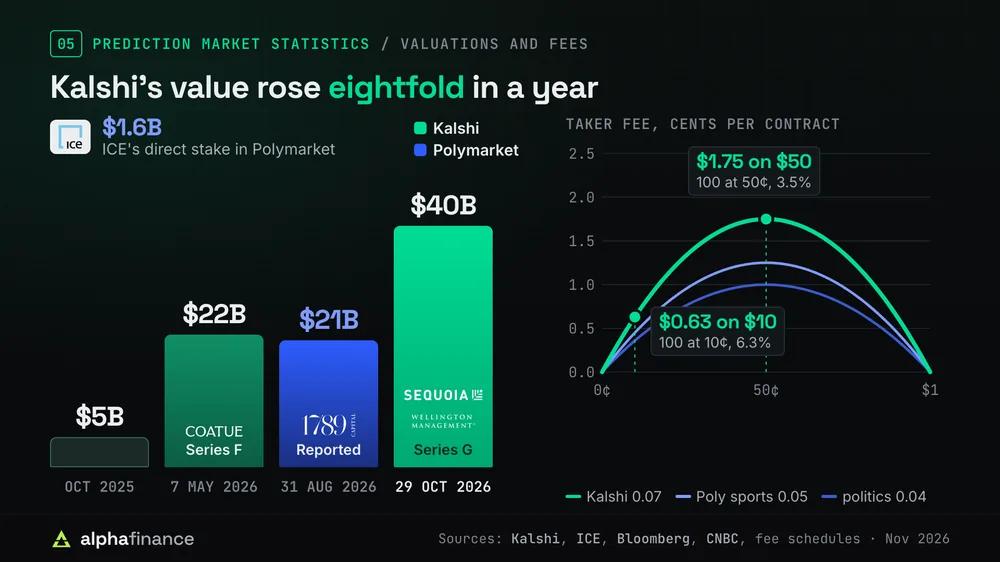
Both exchanges charge takers, whose orders fill immediately against orders already on the book. Most makers, who place those resting orders, pay nothing. Kalshi's fee schedule calculates the taker fee as 0.07 × contracts × price × (1 minus price), rounded up to the next cent.
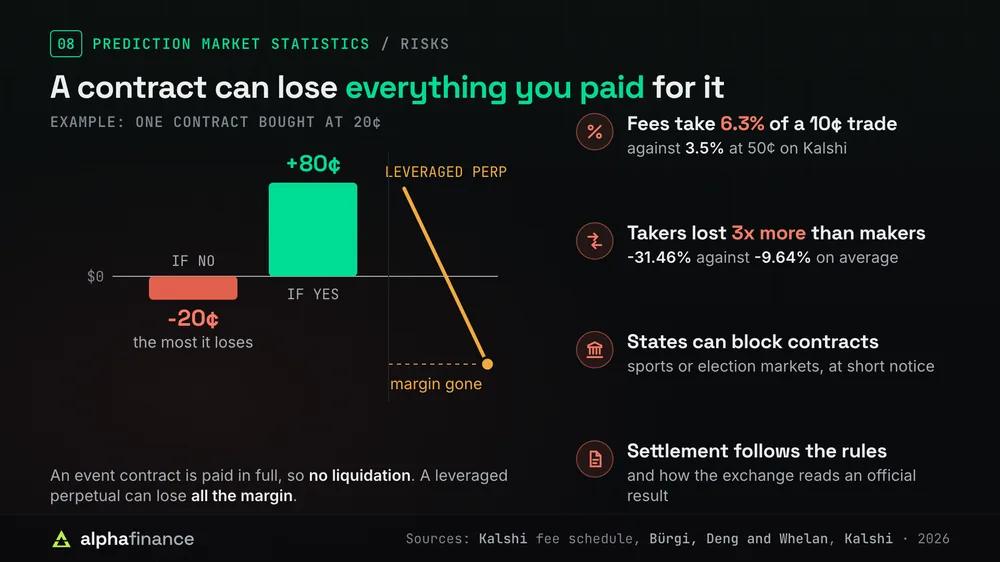
A purchase of 100 contracts at 50 cents costs $50 plus a $1.75 fee, or 3.5%. At 10 cents per contract, the same order costs $10 plus $0.63. The fee falls in dollar terms but rises to 6.3% of the purchase price.
Polymarket uses the same formula structure and varies the rate by market. Polymarket's fee documentation sets a rate of 0.07 for crypto, 0.05 for sports and combos and 0.04 for politics. Geopolitics markets carry no fee. A 100-share sports trade at 50 cents incurs a $1.25 fee.
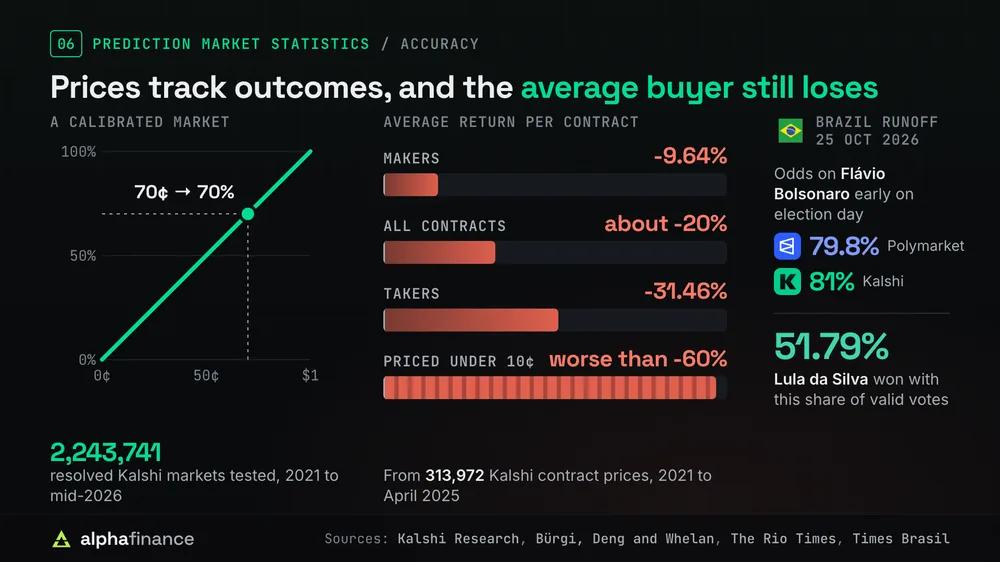
On busy prediction markets, prices closely track how often outcomes occur. A well-calibrated market, for example, prices events at 70 cents when outcomes like those occur about 70% of the time. Individual results can still surprise, and the typical buyer loses money.
Kalshi researchers examined 2,243,741 resolved markets from 2021 to mid-2026. Prices were extremely well calibrated near resolution, and calibration improved with higher volume and more traders. In a separate analysis of more than 1 billion trades, Kalshi found that just 0.15% of takers forecast significantly better than the markets they traded against. Kalshi conducted both studies.
Independent research also found that prices tracked outcomes closely, alongside substantial buyer losses. Economists Constantin Bürgi, Wanying Deng and Karl Whelan examined 313,972 Kalshi contract prices from 2021 to April 2025. The average contract returned about minus 20%. Buyers lost more than 60% of their money on contracts priced below 10 cents. That pattern reflects favourite-longshot bias, where long shots are overpriced and favourites are slightly underpriced. Makers averaged minus 9.64%, compared with minus 31.46% for takers.
A roughly 20% outcome came through in Brazil's presidential runoff on 25 Oct 2026. Early on election day, Polymarket gave Flávio Bolsonaro a 79.8% chance of winning and Kalshi put him at 81%, according to The Rio Times. Luiz Inácio Lula da Silva won with 51.79% of valid votes, Times Brasil reported after Brazil's Superior Electoral Court confirmed the result.
A 20% outcome should occur about once in five comparable cases. Judging calibration takes thousands of resolved markets because an individual result can fall on either side of those odds.
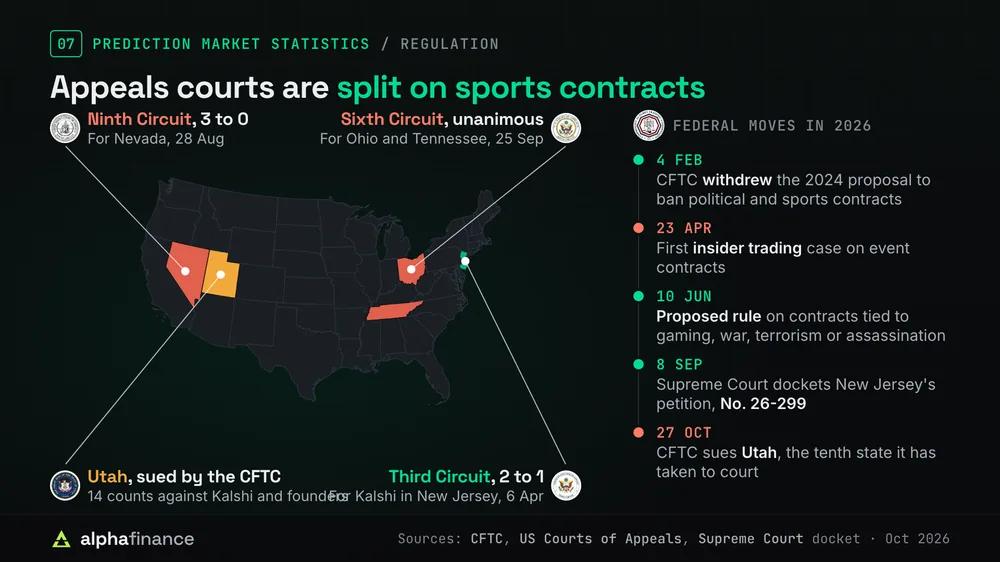
Federal regulators now back prediction markets, while states and two federal appeals courts treat sports contracts as gambling subject to state law. The Commodity Futures Trading Commission (CFTC) oversees US derivatives exchanges known as designated contract markets. On 4 Feb 2026, the agency withdrew a 2024 proposal to ban political and sports event contracts.
The CFTC proposed a rule on 10 Jun 2026 describing how it would assess whether individual event contracts tied to gaming, war, terrorism or assassination are against the public interest. On 27 Oct 2026, it sued Utah to stop the state from enforcing its gambling laws against registered exchanges. Utah is the tenth state the agency has sued over prediction markets.
The dispute turns on whether sports contracts qualify as swaps, a type of derivative under the CFTC's exclusive jurisdiction. If they do, federal law preempts, or overrides, state gambling law. Federal appeals courts have split on that question in rulings from the Third Circuit, the Ninth Circuit and the Sixth Circuit.
| Court | State | Decision date | Result |
|---|---|---|---|
| Third Circuit | New Jersey | 6 Apr 2026 | 2 to 1 for Kalshi |
| Ninth Circuit | Nevada | 28 Aug 2026 | 3 to 0 for Nevada |
| Sixth Circuit | Ohio and Tennessee | 25 Sep 2026 | Unanimous for the states |
On 8 Sep 2026, the Supreme Court docketed New Jersey's petition for review as No. 26-299. States have also pursued criminal cases. In late October 2026, Utah charged Kalshi and its two co-founders with 14 gambling-related counts.
The CFTC filed its first insider trading case involving event contracts on 23 Apr 2026. It alleged that a US Army service member made more than $404,000 trading a Polymarket contract on Nicolás Maduro leaving office. A month later, the agency charged a Google engineer who allegedly used confidential company data to make about $1.2 million trading Year in Search contracts.
Exchanges also enforce their own rules. By late October, Kalshi had suspended six 2026 candidates for betting on their own races, the same CNN midterms analysis reported.
A losing event contract settles at zero. Buyers can therefore lose the full purchase price on any trade. Traders pay for standard event contracts in full upfront, so there is no liquidation risk.
Fees absorb a larger percentage of the price on long shots. Takers also fared worse than makers, losing more than three times as much on average in the Kalshi returns study. Where few orders are waiting on the book, even a small trade can move the price sharply.
A contract's price leaves out legal and platform risks. State action can force exchanges to block sports or election contracts in some states at short notice. Settlement can also catch traders off guard if the contract rules depend on how the exchange interprets an official result.
Some exchanges list perpetual futures alongside event contracts. Kalshi says its perpetual futures business has passed $83 billion in volume. These contracts use leverage, and traders can lose their entire margin. The liquidation price calculator shows how close liquidation can be to the entry price.
Not investment advice
This article explains market data. Nothing on this page is a recommendation to buy, sell or leverage any asset. Digital assets are volatile and you can lose everything you put in. If you are unsure whether a trade is appropriate for you, a licensed adviser in your jurisdiction is the right next step.


Fact checked by
Verifies every figure against primary sources before publication. Meet the team
Kalshi is the largest prediction market by volume. The exchange says it handles more than 75% of prediction market trading volume.
Kalshi alone reports more than $1 trillion in annualised trading volume, equivalent to more than $80 billion per month. It counts each contract at its $1 payout, so the cash traders spend is much lower. Robinhood reported that customers traded 16.4 billion event contracts in the third quarter of 2026.
Liquid markets are generally well calibrated. Events priced at 70 cents happen about 70% of the time. Kalshi's study of 2.24 million resolved markets found that accuracy improved as settlement approached and more traders participated. Individual outcomes can still go against the odds. The candidate priced at about 80% lost Brazil's October 2026 runoff.
The answer varies by state. Federal appeals courts have split, and New Jersey has asked the US Supreme Court to resolve the dispute in case No. 26-299. Several states have brought civil or criminal cases against exchanges.
Both exchanges base their taker fees on price × (1 minus price), which puts the highest fee per contract near 50 cents. Most makers pay nothing on either exchange. Kalshi's standard taker rate is 0.07. Polymarket's rate ranges from zero for geopolitics to 0.07 for crypto.
Volume counts all contracts traded during a period. Open interest measures contracts still held and awaiting settlement, making it a better guide to how much money is at risk at any given moment.