Every figure, platform detail and regulatory claim on this page was traced to a
primary source by the named fact checker before publication, and is re-checked each
quarter. The review date moves only when a person has re-read the page.
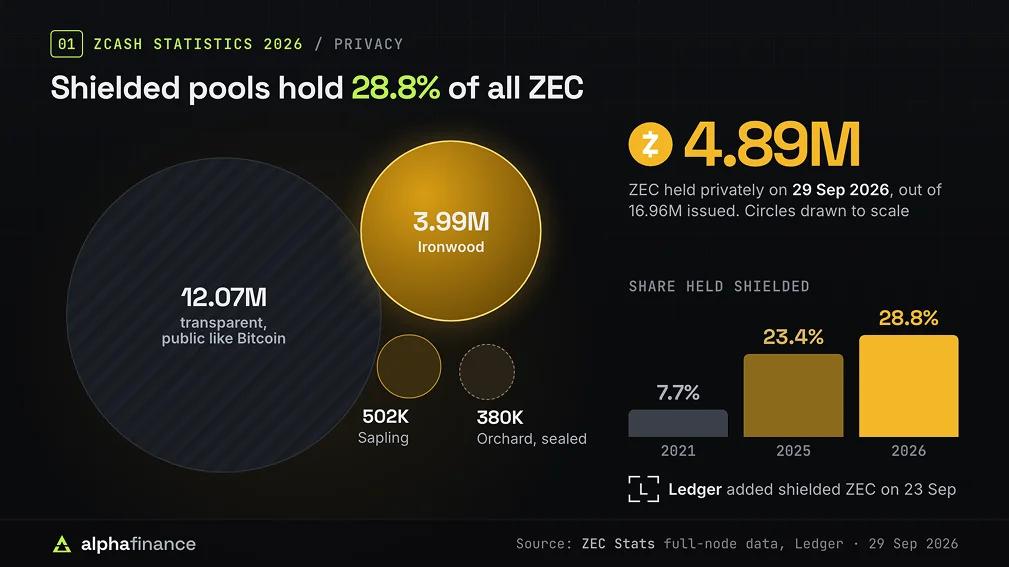
More than a quarter of all ZEC is held privately: Shielded pools held about 4.89 million ZEC on 29 Sep 2026, or 28.8% of issued supply, up from 23.4% a year earlier.
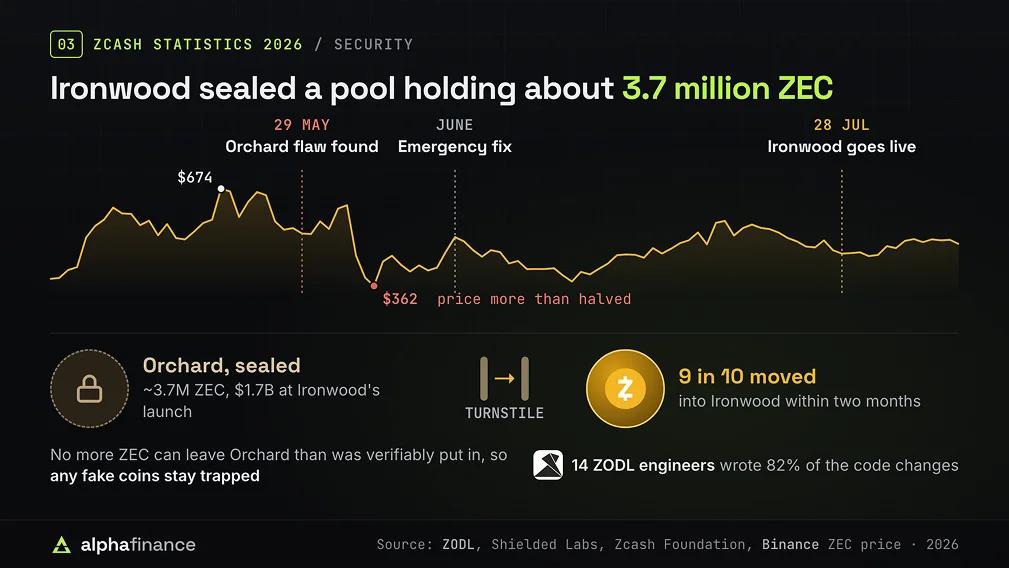
A counterfeiting flaw forced a new shielded pool: A bug discovered on 29 May 2026 could have allowed an attacker to create undetectable ZEC. The Ironwood upgrade sealed the affected pool on 28 Jul 2026, trapping any counterfeit coins inside.
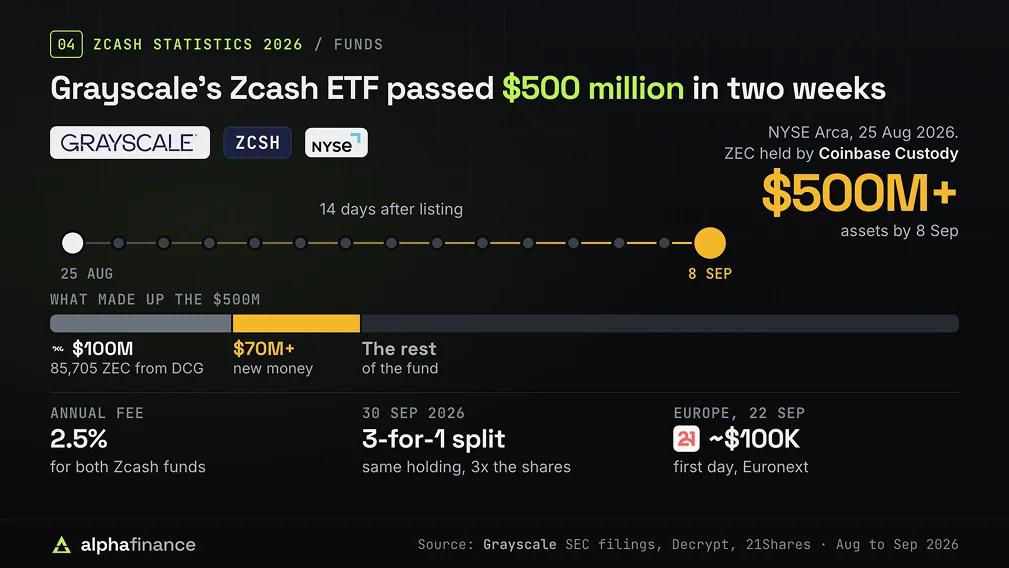
Regulated funds arrived quickly: Grayscale's Zcash ETF exceeded $500 million in assets within two weeks of its 25 Aug 2026 listing. A European exchange-traded product followed on 22 Sep 2026.
ZEC is up about 2,000% in a year: At $1,440 on 30 Sep 2026, ZEC ranked ninth among crypto assets by market value. It remained about 55% below its October 2016 launch-week high.
For most of Zcash's history, few holders used its privacy features. That changed over the past year, just as a counterfeiting flaw forced the network to demonstrate that its fixed supply remained intact.
Zcash is a proof-of-work blockchain secured by miners competing with computing power. Its zero-knowledge proofs can conceal a payment's sender, recipient and amount while confirming that the transaction is valid.
During the same period, regulated funds and a listed corporate buyer entered the market. Futures trading also grew to far exceed spot volume.
Ten Zcash statistics on privacy, security and markets
These ten figures track privacy use, the response to Zcash's worst flaw and the changing ownership and trading of ZEC.
1. Shielded pools hold 28.8% of all ZEC
The amount of ZEC held privately is the clearest test of whether people use Zcash for its intended purpose. Like Bitcoin addresses, transparent addresses are public. Shielded addresses hold coins in an encrypted pool that conceals amounts and the parties involved.
About 4.89 million ZEC sat in shielded pools on 29 Sep 2026, according to ZEC Stats' shielding rate chart. That represented 28.8% of issued supply, compared with 23.4% a year earlier and 7.7% five years earlier.
Ironwood, the newest pool, held most of those coins at 3.99 million ZEC. Sapling held about 502,000, while 379,674 ZEC remained in the sealed Orchard pool.
Why the shielded share matters: Each coin added to a shielded pool makes the others harder to trace by increasing the number of possible senders an observer must consider.
On 23 Sep 2026, Ledger added native shielded ZEC support to its desktop app. Its hardware wallet owners no longer need a separate companion wallet, according to Ledger's product announcement.
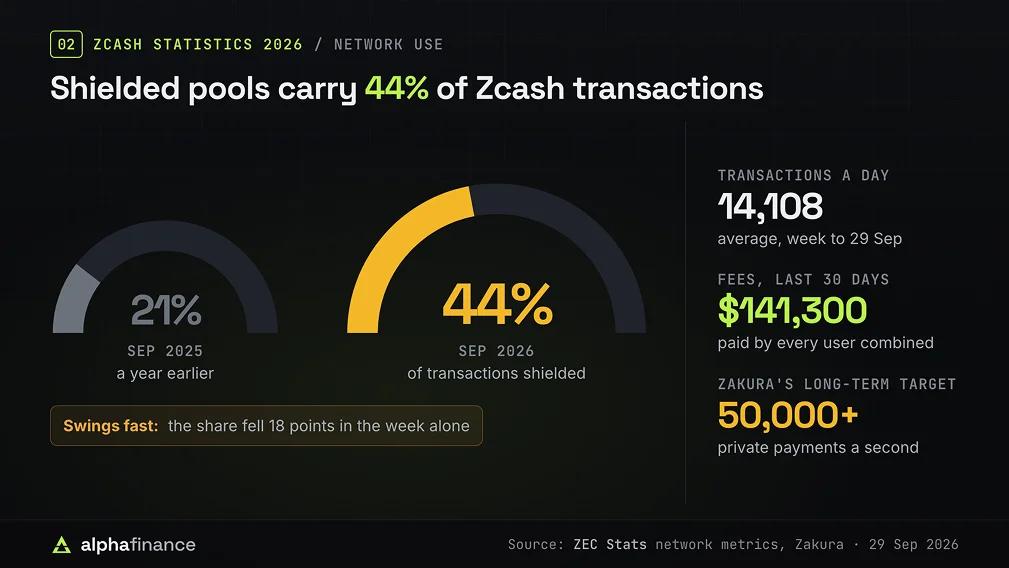
2. Shielded pools carry 44% of Zcash transactions
Zcash averaged 14,108 daily transactions in the week to 29 Sep 2026. Shielded pools were involved in 44% of them, up from 21% a year earlier, per ZEC Stats' network metrics. The share dropped 18 percentage points during that week alone, illustrating how misleading a single reading can be.
Fees remain negligible, with users paying about $141,300 in total over the 30 days to 28 Sep 2026.
Developers are preparing for much heavier use. A new set of Zcash software has a long-term target of more than 50,000 private payments per second, as outlined in Zakura's launch announcement.
3. Ironwood sealed a pool holding about 3.7 million ZEC
A flaw that could have allowed undetectable ZEC creation became Zcash's biggest test of the year.
Orchard's hidden amounts made it impossible to prove retrospectively that no counterfeit coins had been created. Shielded Labs said it believes the flaw was never exploited and that sealing Orchard allows anyone to verify the supply. ZEC lost more than half its value after the disclosure, The Block reported.
An emergency fix, NU6.2, shipped in June. The lasting remedy was Ironwood, or network upgrade NU6.3. It activated on 28 Jul 2026 at block 3,428,143, the height specified in the Zcash Foundation's Zebra 6.0.0 release.
Ironwood introduced a new shielded pool and closed Orchard to deposits. To leave Orchard, coins must pass through a turnstile: an accounting checkpoint that prevents withdrawals from exceeding the amount verifiably deposited. Any counterfeit ZEC stays locked inside.
At activation, Orchard held roughly 3.7 million ZEC worth about $1.7 billion, Yahoo Finance reported. About nine in ten of those coins had moved into Ironwood two months later.
Fourteen ZODL engineers accounted for 82% of merged changes to the protocol and wallet code, according to The Block's report.
ZODL formed after the entire Electric Coin Company team left in January following a dispute with its nonprofit parent, Bootstrap, as Decrypt reported. On 9 Mar 2026, it raised more than $25 million from investors including Paradigm, a16z crypto and Coinbase Ventures, according to its Zcash Community Forum announcement.
4. Grayscale's Zcash ETF passed $500 million in two weeks
An exchange-traded fund (ETF) gives investors ZEC exposure through shares traded on a stock exchange and held in an ordinary brokerage account. Grayscale converted its 2017 Zcash trust into The Zcash ETF, which listed on NYSE Arca as ZCSH on 25 Aug 2026. As its prospectus explains, the fund holds ZEC directly with Coinbase Custody.
Assets exceeded $500 million by Grayscale's 8 Sep 2026 announcement. The total included more than $70 million in new investment and about $100 million from Grayscale affiliate DCG International Investments, which contributed 85,705 ZEC.
The trust's quarterly filing lists an annual sponsor's fee of 2.5%. A 3-for-1 share split was scheduled to take effect before trading opened on 30 Sep 2026, according to Grayscale's SEC filing on the split. It spreads each holder's unchanged investment across three times as many shares.
Europe's first Zcash exchange-traded product followed on 22 Sep 2026. Citing 21Shares' factsheet, Decrypt reported that the 21Shares Zcash ETP listed on Euronext Paris and Amsterdam. It charged 2.5% annually and held about $100,000 in assets on its first day.
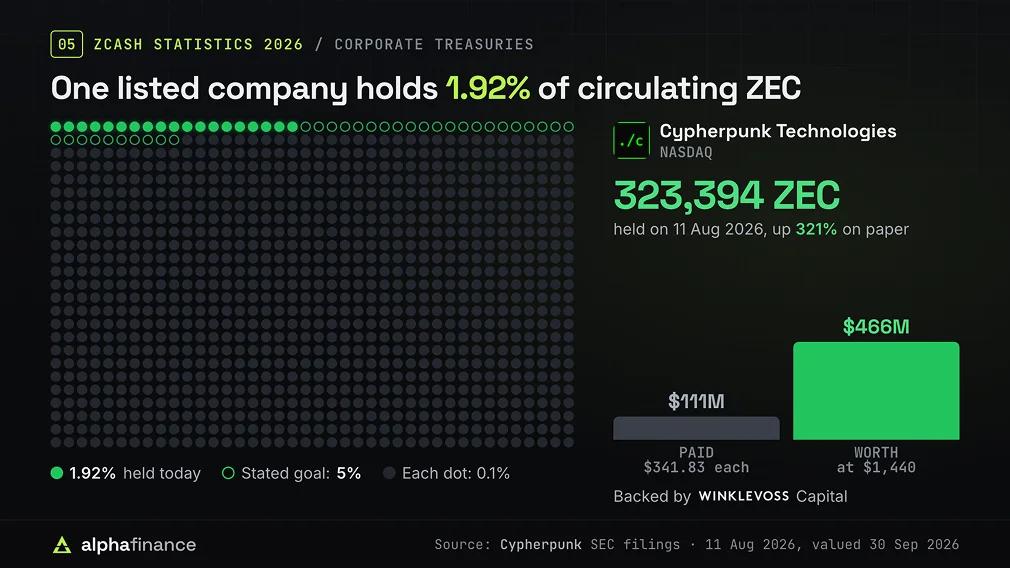
5. One listed company holds 1.92% of circulating ZEC
Nasdaq-listed Cypherpunk Technologies owned 323,394.38 ZEC on 11 Aug 2026, acquired at an average cost of $341.83, according to Cypherpunk's quarterly report. Its holdings represented about 1.92% of circulating supply and were worth roughly $466 million at the 30 Sep 2026 price.
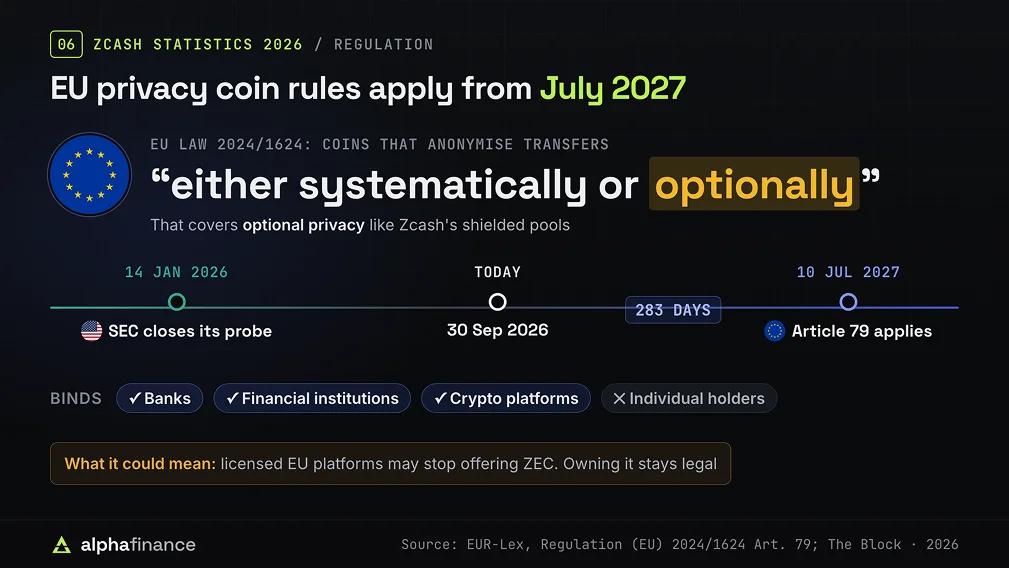
Regulation (EU) 2024/1624, the EU's anti-money laundering law, prohibits crypto-asset service providers from keeping accounts that allow transactions to be anonymised, including through anonymity-enhancing coins.
Its definition covers coins whose built-in features make transfer information anonymous "either systematically or optionally". This wording is broad enough to include Zcash's optional privacy. Article 79 applies from 10 Jul 2027 to banks, financial institutions and crypto-asset service providers, rather than individual holders.
US pressure eased earlier in the year. On 14 Jan 2026, The Block reported that the Zcash Foundation said the SEC had closed its 2023 investigation without recommending enforcement action.
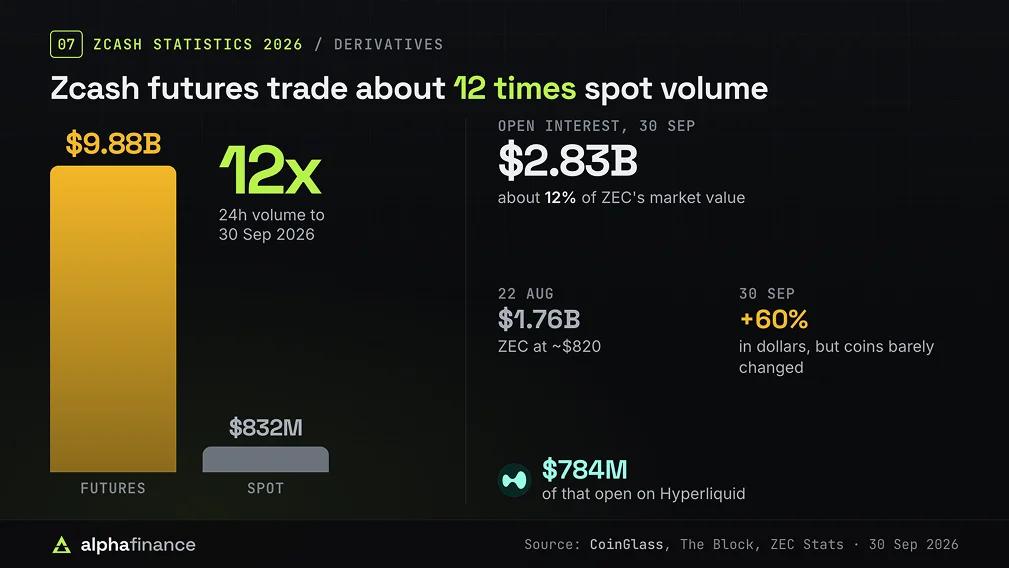
7. Zcash futures trade about 12 times spot volume
Perpetual futures track ZEC's price without an expiry date. Traders often use leverage, or borrowed exposure, to multiply potential gains and losses. Open interest measures the total value of contracts that remain open.
In the 24 hours to 30 Sep 2026, ZEC futures volume reached $9.88 billion, compared with $832 million on spot markets where the coin itself changes hands. CoinGlass's Zcash futures page put open interest at $2.83 billion, about 12% of ZEC's market value.
Dollar-denominated open interest had risen about 60% from the $1.76 billion The Block recorded on 22 Aug 2026. Over those weeks, ZEC's price rose faster, from about $820 to $1,387. The number of coins committed to futures positions therefore barely grew.
Hyperliquid carried about $784 million in ZEC open interest on 29 Sep 2026, per ZEC Stats' Hyperliquid chart. The decentralised perpetual futures exchange runs on its own public blockchain. Our tracker of large Hyperliquid positions lists every open position there worth more than $1 million.
When losses consume a leveraged trader's collateral, the exchange automatically closes the position in a liquidation. The Zcash liquidation heatmap maps prices where large groups of positions would be forced to close. To see whether traders betting on a rise are paying those betting on a fall to maintain their positions, compare funding rates across six exchanges.
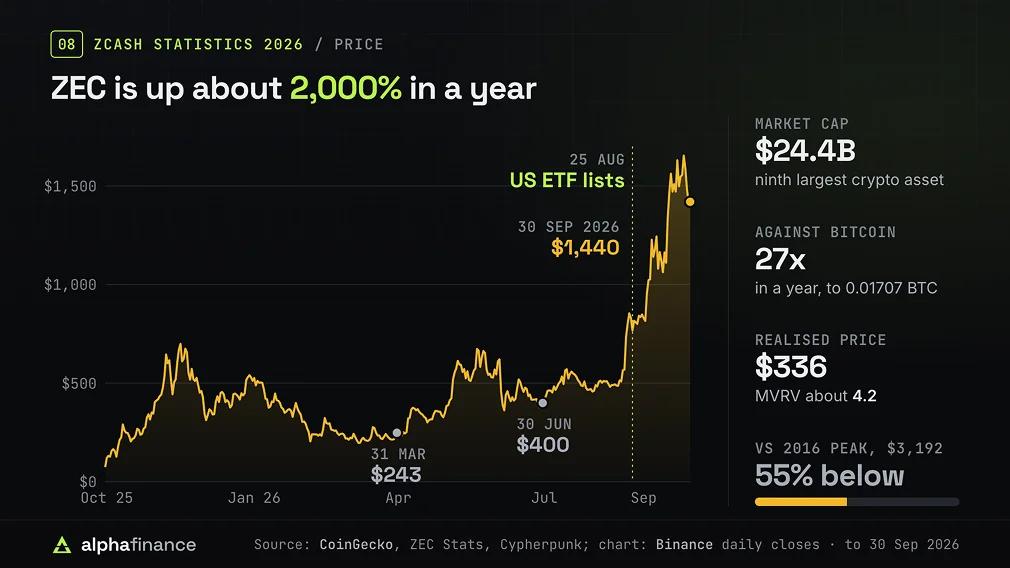
8. ZEC is up about 2,000% in a year
CoinGecko's Zcash market page recorded ZEC at $1,440.02 on 30 Sep 2026, about 2,002% higher than twelve months earlier. Multiplying that price by circulating supply gave a market capitalisation of $24.4 billion, the ninth largest among crypto assets. The page also showed a seven-day high of $1,687.78 and a decline of about 9.5% on 30 Sep alone.
Much of the gain came after June, around the late-August US ETF listing. Cypherpunk Technologies' second-quarter results, which mark its ZEC holdings to market, recorded prices of $243.35 on 31 Mar 2026 and $400.09 on 30 Jun 2026.
ZEC nevertheless remained about 55% below the $3,191.93 launch-week peak recorded in October 2016 by CoinGecko's price history. Our live crypto prices board displays its current price alongside the 100 largest coins.
One ZEC bought 0.01707 BTC on 29 Sep 2026, a 27-fold increase over the year, according to ZEC Stats, a dashboard computed from a Zcash full node. It put ZEC's realised price at $336. This measures the average price at which each coin last crossed between a public and private pool, the nearest Zcash has to an average purchase price.
Dividing market value by realised value produces an MVRV ratio of about 4.2, indicating a large paper gain for the typical ZEC holding. Bitcoin's equivalent reading appears on our MVRV Z-Score dashboard.
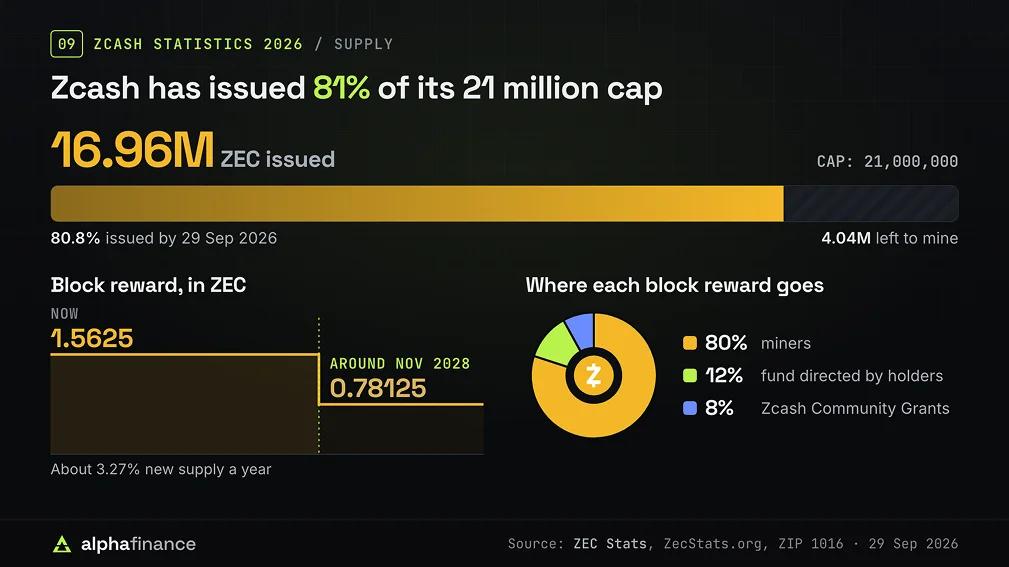
9. Zcash has issued 81% of its 21 million cap
Zcash follows Bitcoin's fixed supply schedule. ZEC Stats' supply chart recorded 16,959,355 ZEC issued by 29 Sep 2026, or 80.8% of the 21 million cap. Annual issuance adds about 3.27% to supply.
Each block creates 1.5625 ZEC. The next halving will cut that reward in half at block 4,406,400, estimated around November 2028 by the ZecStats.org price and supply page.
ZIP 1016, the proposal underpinning the current funding model, allocates 8% of each block reward to Zcash Community Grants. Another 12% goes to a Coinholder-Controlled Fund directed by ZEC holders, leaving 80% for miners.
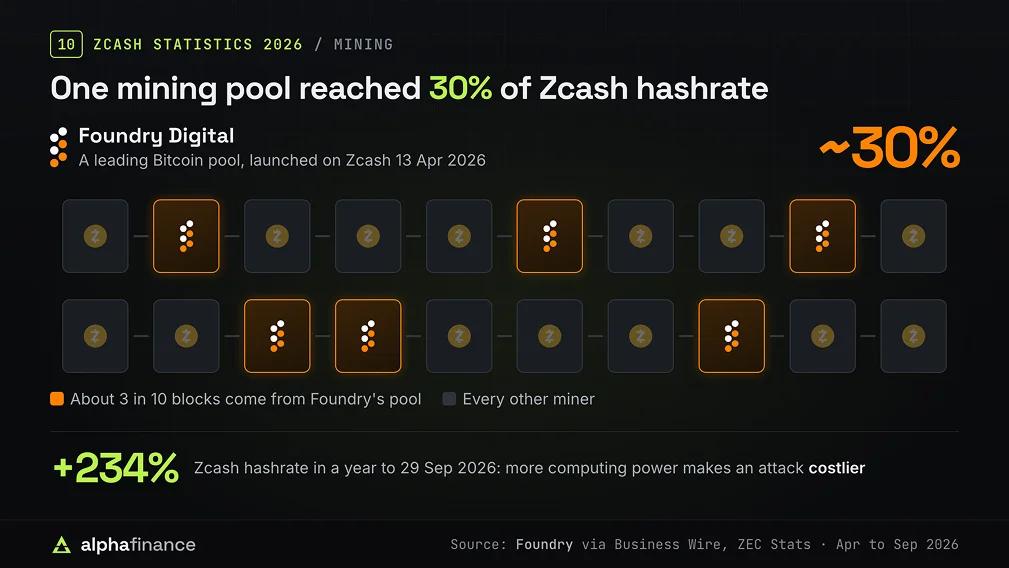
10. One mining pool reached 30% of Zcash hashrate
Hashrate measures the computing power miners commit to a network. Higher hashrate makes an attack more expensive. By 29 Sep 2026, Zcash's hashrate had risen 234% over the year, according to ZEC Stats' hashrate chart.
Foundry Digital, operator of a leading Bitcoin mining pool, launched its Zcash pool on 13 Apr 2026 with about 30% of network hashrate already secured, per Foundry's launch announcement. Pools combine miners' machines and distribute the rewards. At that size, a substantial share of block production also sits under one operator.
Zcash statistics at a glance
The table below brings together the headline figures and their observation dates.
Metric
Figure
Date
ZEC held in shielded pools
4.89 million, 28.8% of supply
29 Sep 2026
Share of transactions using shielded pools
44%
29 Sep 2026
Grayscale Zcash ETF assets
More than $500 million
8 Sep 2026
Largest listed corporate holder
323,394 ZEC
11 Aug 2026
Futures open interest
$2.83 billion
30 Sep 2026
ZEC price
$1,440.02
30 Sep 2026
Market cap
$24.4 billion, ninth largest
30 Sep 2026
One-year price change
+2,002%
30 Sep 2026
Supply issued
16.96 million of 21 million
29 Sep 2026
Annual issuance of new ZEC
3.27%
29 Sep 2026
What Zcash statistics cannot tell you
Trackers use different counting methods, and a private chain leaves some activity unmeasurable.
Treasury tables lag company filings: On 30 Sep 2026, CoinGecko's treasury table listed 294,743 ZEC for Cypherpunk, about 29,000 fewer than the company reported on 11 Aug.
Shielded estimates differ: More than 30% of supply is described as shielded in CoinGecko's Zcash profile, compared with 28.8% in the node-based count.
A shielded balance is not activity: Coins may remain in a shielded pool for years without being spent. Moving them from Orchard to Ironwood changes pool balances without adding a user.
Cost basis is estimated: Realised price uses the last observable crossing between pools because movements within a shielded pool are hidden. It only approximates what holders paid.
The risks of holding or trading ZEC
ZEC can lose much of its value within days. Some of its risks are specific to Zcash.
The June disclosure demonstrated how quickly confidence in a privacy coin can break. Ironwood is formally verified, according to The Block's report. That reduces the chance of a similar flaw, although no audit can prove the absence of every other bug.
Leveraged traders can lose all the margin, or collateral, they post to open a position. Futures volume far exceeds spot volume, leaving ZEC exposed to chains of forced selling in which one liquidation pushes the price into the next. These can produce sharp moves within minutes. Our liquidation price calculator shows where a position would close for a given entry price and leverage.
The EU's 2027 restriction could reduce the number of regulated platforms offering ZEC. Holding an ETF removes the need to manage keys but comes with an annual fee and no direct ownership of the coin.
For self-custody, losing the keys means losing access to shielded ZEC held in a personal wallet. Mistaken payments cannot be reversed.
Not investment advice
This article explains market data. Nothing on this page is a recommendation to buy, sell
or leverage any asset. Digital assets are volatile and you can lose everything you put
in. If you are unsure whether a trade is appropriate for you, a licensed adviser in your
jurisdiction is the right next step.
Written by
Alpha Finance Editorial Team
Part of the Alpha Finance research team. Meet the team
Fact checked by
Vince Dioquino
Verifies every figure against primary sources before publication. Meet the team
Questions
How much Zcash is shielded?
Shielded pools held about 4.89 million ZEC on 29 Sep 2026, or 28.8% of issued supply, according to a full-node Zcash network dashboard. That compares with 23.4% a year earlier. Ironwood now holds most shielded ZEC.
What is the Zcash market cap?
Zcash ranked ninth among crypto assets with a market cap of about $24.4 billion on 30 Sep 2026, based on live Zcash market data. ZEC traded at $1,440, roughly 2,000% above its price a year earlier. A nearly 10% decline that day alone shows how quickly the figure changes.
Is there a Zcash ETF?
Grayscale's Zcash ETF listed on NYSE Arca under ZCSH on 25 Aug 2026. Assets passed $500 million by 8 Sep 2026, Grayscale announced. On 22 Sep 2026, 21Shares launched Europe's first Zcash exchange-traded product.
What happened to Zcash's Orchard pool?
A flaw that could have enabled undetectable counterfeit ZEC led developers to seal Orchard. ZODL's report found no evidence of exploitation. Ironwood introduced a replacement pool on 28 Jul 2026. Coins leaving Orchard pass through a turnstile that prevents more ZEC being withdrawn than was deposited.
When is the next Zcash halving?
Block 4,406,400 will reduce the reward from 1.5625 to 0.78125 ZEC, with activation expected around November 2028, according to a Zcash network data page. Until then, ZIP 1016 directs 20% of each reward to development.
 By Alpha Finance Editorial Team
 Fact-checked by Vince Dioquino