Markets
 BTC
BTC ETH
ETH BNB
BNB XRP
XRP SOL
SOL ZEC
ZEC HYPE
HYPE DOGE
DOGE LINK
LINK TON
TON AVAX
AVAX SUI
SUI TAO
TAO AAVE
AAVE PUMP
PUMP MORPHO
 ARB
ARB LIT
LIT--:-- UTC
Best crypto exchanges in Saudi Arabia, where platforms are licensed abroad or not at all, ranked on riyal prices and deposits.
Find the best exchange for
Europe
Americas
Asia Pacific
Nothing matches yet. Try a country or a region.
 By Alpha Finance Editorial Team
 Data maintained by Vince Dioquino
Every fee, licence and clause behind a score links to the page we read it on. We recheck the platforms' pages and the regulators' registers every quarter, and sooner when a fee, a licence or a set of terms changes.
How we score → Editorial policy Report an errorEvery crypto platform open to Saudi residents is run from another country. A government committee chaired by the Capital Market Authority has said since 2018 that nobody in the Kingdom is licensed to deal in crypto. Owning it isn't banned, but no Saudi body can help if a platform fails. So the real choice is which foreign company gets your riyals.
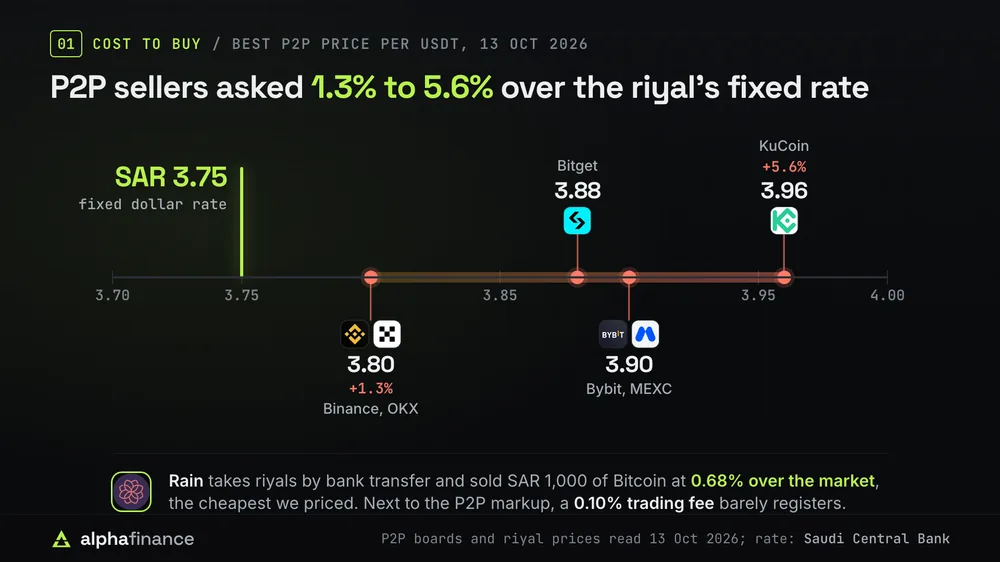
Two things catch people out. Most global exchanges take no riyal transfers, so buyers get USDT on a P2P board, paying a stranger by bank transfer while the exchange holds the coins. Sellers there charge more than the riyal's fixed dollar rate. The licence is the other trap: one advertised in Dubai or Abu Dhabi often covers only UAE residents, while Saudis sign with a company that may hold none.
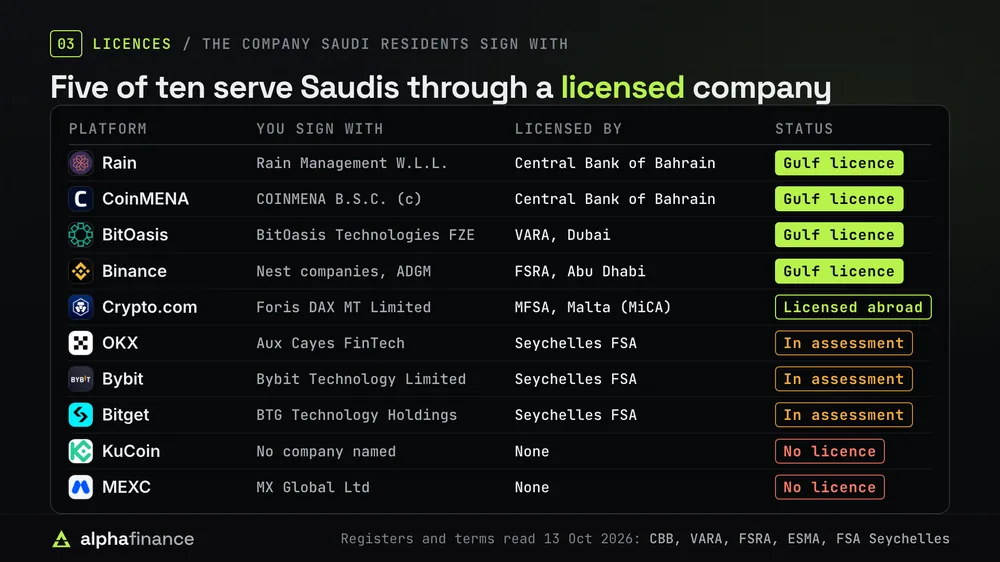
Of the ten below, five sign Saudis up through a company with a crypto licence, four of them from a Gulf regulator. The remaining five are held to 4.0 at most. The order also weighs Bitcoin's real price in riyals, how easily riyals move, and security, so it won't match our worldwide ranking. Each fee and rule links to its source, and every platform gets a full review further down.
Only two of the ten score 7.0 or more, so only two earn a pick, each on its own figures.
5 of 10 licensed where Saudis sign up5 held to 4.0 with no licenceRiyal prices read 13 Oct 2026
| # | Exchange | Score | Feestaker / maker | SAR deposits | Proof of reserveslatest published | |
|---|---|---|---|---|---|---|
| 1 |  Binance#2 worldwide Binance#2 worldwide | 9.0 | 0.10% / 0.10%Spot, no SAR pair | No SAR transfersP2P or card only | Merkle + zk | Visit |
| 2 |  RainNot on worldwide list RainNot on worldwide list | 8.7 | 0.5% in the quoted priceRain app, buying with riyals | SAR transfer freeBank transfer only | None | Visit |
| 3 |  CoinMENANot on worldwide list CoinMENANot on worldwide list | 5.8 | 0.75% trading feeCoinMENA app, buying with riyals | SAR transfer freeCard or Apple Pay 4% | None | Visit |
| 4 |  Crypto.com#14 worldwide Crypto.com#14 worldwide | 5.3 | Not publishedCrypto.com App, card purchases | No SAR transfersCard, Apple Pay, Google Pay | Out of dateLast Dec 2022 | Visit |
| 5 |  BitOasisNot on worldwide list BitOasisNot on worldwide list | 4.3 | 0.58% / 0.38%BitOasis Pro, crypto-fiat pairs | No SAR depositsPaused for Saudi accounts | None | Visit |
| 6 |  Bitget#8 worldwide Bitget#8 worldwide | 4.0 | 0.10% / 0.10%Spot, no SAR pair | No SAR transfersP2P only | Merkle | Visit |
| 7 |  Bybit#5 worldwide Bybit#5 worldwide | 4.0 | 0.10% / 0.10%Spot, no SAR pair | No SAR transfersP2P only | Audited Merkle | Visit |
| 8 |  OKX#1 worldwide OKX#1 worldwide | 4.0 | 0.10% / 0.08%Spot, no SAR pair | No SAR transfersP2P only | Merkle + zk | Visit |
| 9 |  KuCoin#11 worldwide KuCoin#11 worldwide | 4.0 | 0.10% / 0.10%Spot, no SAR pair | No SAR transfersP2P only | Audited Merkle | Visit |
| 10 |  MEXC#9 worldwide MEXC#9 worldwide | 4.0 | 0.05% / 0.00%Spot, no SAR pair | No SAR transfersP2P only | Audited Merkle | Visit |
Score: out of 10, judged as a Saudi resident who pays in riyals, keeps coins on the platform and wants riyals back. Whoever scores highest is set to 9.0, and everyone else keeps the same distance below. A platform whose Saudi-facing company has no crypto licence stops at 4.0. Point at a score and its six marks open up. Fees: what each trade costs at the starting tier. On platforms without a riyal market this is the BTC/USDT fee, and the P2P markup is counted in the cost check. Listing here can't be bought, and the ranking doesn't know your situation, so treat it as general information. See how we're funded.
At Rain, SAR 1,000 of Bitcoin came in SAR 6.75 above the market price, while the same order at KuCoin P2P cost SAR 58.14 extra. The market price, SAR 312,122 a Bitcoin, is its dollar price of US$83,233 at the riyal's fixed 3.75. Each bar adds the fee to the markup.
Extra you pay to buy SAR 1,000 of BitcoinOver the market price, on each platform's quoted riyal price or its P2P board and BTC/USDT book
Rain0.68%SAR 6.75Rain app (quoted price)Binance P2P1.56%SAR 15.57P2P, then order bookBitget P2P3.70%SAR 36.99P2P, then order bookOKX P2P4.24%SAR 42.36P2P, then order bookBybit P2P4.24%SAR 42.38P2P, then order bookMEXC P2P5.50%SAR 55.03P2P, then order bookKuCoin P2P5.81%SAR 58.14P2P, then order bookCoinMENA, Crypto.com and BitOasis show no riyal price before you sign in, or take no riyals from Saudi accounts, so there's nothing public to chart. Their cost marks use the worst price we found, at KuCoin P2P, unless a platform's own fee is worse.
The Saudi Central Bank has held the riyal at 3.75 to the US dollar for more than three decades. The cheapest P2P sellers asked SAR 3.80 at Binance and OKX, 3.88 at Bitget, 3.90 at Bybit and MEXC and 3.96 at KuCoin per USDT, 1.3% to 5.6% over that rate. Next to that, a 0.10% trading fee barely registers.
A P2P order also goes to a single seller, so the best price only counts if that seller's limits take your amount. Many of the cheapest ads start at SAR 5,000 or more, which is why small orders can cost more than large ones. Binance's board was the deepest, with SAR 3.2M of USDT offered within 0.5% of its best price.
For each platform we found the company a Saudi resident signs with, checked that company's licence on the regulator's own register or notice, and read its terms and fee pages. Each card names that company and what its licence covers.
Best for buyers who want the deepest riyal P2P board, at an exchange licensed in Abu Dhabi. It takes no riyal transfers, and USDT from other users cost about 1.6% over the market.
Good for
Incidents in the last five years
USDe, wBETH and BNSOL lost their pegs on Binance's own order books in the 10 Oct crash; Binance paid about US$283M to users liquidated as a result.
AUSTRAC ordered an external audit of Binance Australia's anti-money-laundering controls.
Pleaded guilty in the US to anti-money-laundering and sanctions violations and agreed to pay about US$4.3B.
Cheapest to buy · Not on worldwide list
Best for paying in riyals by bank transfer to a Bahrain-licensed platform, with the cheapest Bitcoin we priced. Riyal withdrawals cost SAR 50, and it publishes no proof of reserves.
Good for
Not on worldwide list
For riyal deposits by bank, card or Apple Pay at a Bahrain-licensed broker. Its 0.75% fee is the highest stated here, and VARA fined its Dubai sister company in June 2026.
Good for
For buyers who want a MiCA-licensed company and 400+ coins in one app. It takes no riyals, so you pay by card at a fee shown only in the app.
Good for
Incidents in the last five years
A US judge let Nevada's cease-and-desist stand, so sports event contracts were pulled for Nevada residents.
An employee was phished and some users' personal data was exposed; it became public only through Bloomberg in September 2025.
Attackers bypassed 2FA and drained 483 accounts of about US$34M; Crypto.com reimbursed the affected users.
and 1 more
Since 2015 · Not on worldwide list
For Saudis who already hold crypto and want a VARA-licensed Gulf platform. Riyal wires, cards and withdrawals are paused for Saudi accounts, so you can't buy with riyals today.
Good for
For P2P buyers paying by Saudi bank or Mobily Pay, with a protection fund that has paid out before. It was hacked on 24 Sep 2026, and its Seychelles company isn't licensed yet.
Good for
Watch out for
Incidents in the last five years
About US$388M was taken from hot and warm wallets on 24 Sep 2026. Its protection fund covered the loss and user balances were untouched; withdrawals were paused until 28 Sep for BTC and 2 Oct for everything.
Suspected manipulation of the VOXEL perp; Bitget rolled back trades and compensated users who lost money.
For traders who want an audited proof of reserves and a US$10,000 floor in its terms. Its Seychelles company isn't licensed yet, and its riyal P2P board was thin.
Good for
Watch out for
For P2P buyers who want a busy riyal board and a monthly proof of reserves. Saudis sign with a Seychelles company that isn't licensed yet, which holds it to 4.0.
Good for
Watch out for
Incidents in the last five years
For coin hunters willing to pay more for USDT: 815 coins on spot. Its terms name no company, and Dubai's regulator fined its operator in June 2026.
Good for
Incidents in the last five years
Dubai's VARA fined its operator, Peken Global, for serving Dubai customers without a licence, after a March 2026 alert.
Dubai's regulator ordered it to stop serving Dubai residents, and Japan's regulator sent a warning letter.
Austria's regulator banned KuCoin EU from new business after key compliance posts went vacant; operations are still not cleared.
and 5 earlier
For the longest coin list here, 1,415, at 0% maker and 0.05% taker. Its riyal P2P board was the thinnest we read, and two regulators acted against its operator in 2026.
Good for
Watch out for
Incidents in the last five years
Dubai's regulator fined MEXC's operator for serving Dubai customers without a licence and ordered it to stop.
The Seychelles regulator began enforcement against MEXC's operator for running an exchange without a licence.
Froze about US$3M of one trader's funds over alleged automated trading, and released it three months later.
and 1 earlier
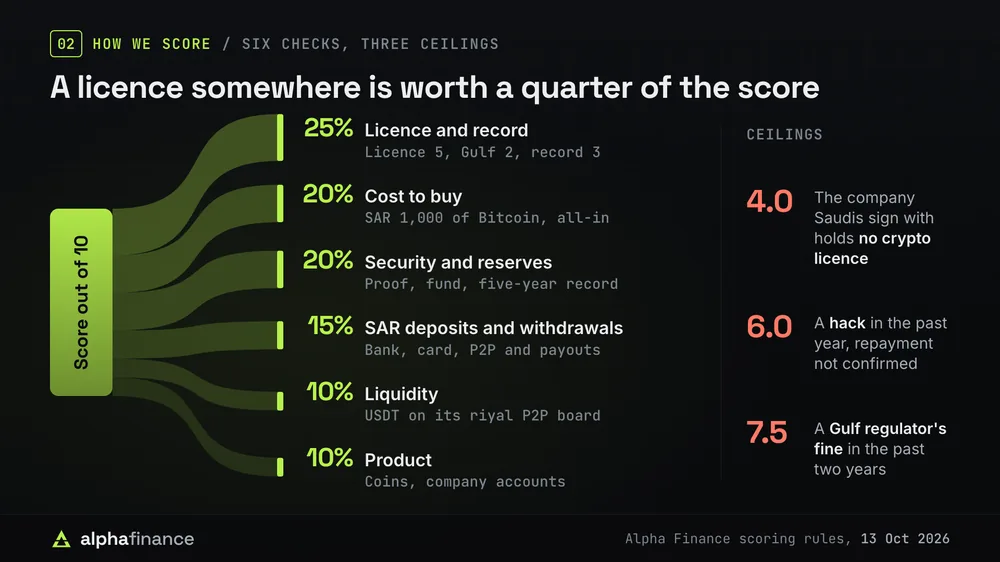
We checked each platform's Saudi-facing company on its regulator's register, read its terms, and captured every riyal price and P2P board together on 13 Oct 2026. Price, licence, the cost of moving riyals and each platform's past are what set the order.
| Check | Weight | How it is marked |
|---|---|---|
| Cost to buy | 20% | Saudi accounts can't fund a riyal order book anywhere, so the market price is Bitcoin's US dollar price, the middle of three large BTC/USD books, at the Saudi Central Bank's fixed rate of 3.75 riyals. Every platform's public price was read in the same minute on 13 Oct 2026, and each was priced on a SAR 1,000 purchase made its cheapest published way, fee included. A purchase that lands 0.2% or less above the market price scores 10, losing 0.8 for every extra tenth of a percent. Where a riyal price only appears after sign-up, or riyals can't be paid in at all, the platform gets that day's worst measured cost, or its own fee if that is worse. |
| Licence and record | 25% | No Saudi regulator licenses crypto platforms, so we look at the company you actually sign with. A crypto licence from a real regulator anywhere is worth 5, and 2 more if that regulator sits in the Gulf: Bahrain's central bank, Dubai's VARA or Abu Dhabi's FSRA. Then 3 marks ride on the brand's dealings with Gulf regulators since October 2021, of which a warning or suspension leaves 1.5 and any fine leaves none. |
| Security and reserves | 20% | The same rule as our worldwide list. Reserves earn up to 4: the full 4 for a proof you can find your own balance in, or for SEC-audited accounts kept by the platform or its parent, 3 for an audit of the reserves alone and 2 for an accountant's attestation. Keeping a fund to repay customers is worth 1, and naming its size another 1. History carries the last 4 marks, counted back to October 2021. Customers losing money in a hack or failure costs 3, or 1 if every one of them was repaid. A data breach costs 1, a regulator's action anywhere costs 1, and market failures cost 1 each up to 2. |
| Liquidity | 10% | No platform runs a riyal order book a Saudi account can fund, so we measure the riyal market each one does run: its P2P board. We add up the riyals' worth of USDT offered within 0.5% of the board's best price in the 13 Oct 2026 snapshot. Marks rise with each tenfold step: SAR 10,000 or less gives 0 and SAR 10 million or more gives 10, with SAR 100,000 near 3.3 and SAR 1 million near 6.7. No public riyal board means no liquidity marks. |
| SAR deposits and withdrawals | 15% | Paying riyals by bank transfer directly into the platform is worth 4 if it's free and 1 if it's charged. A card or Apple Pay adds 1, and a riyal P2P board adds 1 more. Free riyal withdrawals to your bank earn 2, and 2 more go to a platform whose banks have kept handling riyals for the past two years. |
| Product | 10% | Thirty coins on offer earn 1, a hundred earn 2 and three hundred earn 3. Accounts for companies add 2. Last come three smaller features at 1 mark each, namely staking, block trades through an OTC desk, and withdrawing coins to a wallet you hold. |
Three ceilings sit on top of the checks. A platform whose Saudi-facing company has no crypto licence can't pass 4.0. Two more limits follow from a platform's record: 6.0 after a hack in the past year whose victims aren't confirmed repaid, and 7.5 after a Gulf regulator's fine in the past two years.
Every licence, fee and clause above was read on 13 Oct 2026. The next comes within three months, or sooner if a licence, fee or set of terms changes.
Sign-up asks for your national ID or iqama, and riyals must come from a Saudi bank account in your own name.
Holding it isn't banned, but no Saudi authority regulates or licenses it.
In August 2018 the Standing Committee on unlicensed Forex and digital currency trading, chaired by the Capital Market Authority with the Saudi Central Bank as a member, said virtual currencies are not regulated inside the Kingdom and no one there is licensed to deal in them.
The CMA had already warned that buyers are hard to protect because the activity sits outside the Kingdom's control, and that many sites falsely claim to be licensed.
That is still the position. In September 2026 the Saudi Central Bank's governor said it had deepened its work with global regulators on stablecoins and virtual assets, but announced no licence or timetable.
So the licences that matter belong to the company abroad that serves you. Bahrain's central bank licenses Rain and CoinMENA, Dubai's VARA licenses BitOasis, Abu Dhabi's FSRA oversees Binance's exchange companies, and Malta licenses Crypto.com under the EU's MiCA rules. The Seychelles regulator lists the companies OKX, Bybit and Bitget use as still under assessment, with none licensed yet.
No Saudi body takes crypto complaints, so complain to the platform first and in writing. What happens next depends on the company you signed with.
CoinMENA's Bahrain terms let you take an unresolved complaint to the Central Bank of Bahrain's Consumer Protection Directorate within 30 days of its final reply. Rain's terms go to arbitration in Bahrain, and BitOasis's to Dubai's DIAC.
The global exchanges send disputes to arbitration abroad, usually in English: Hong Kong for OKX, Bitget and MEXC, Singapore for Bybit and Malta for Crypto.com. An arbitration claim can cost more than a small balance is worth.
Nothing in Saudi law steps in if a platform abroad loses your coins. What protects you is that company's licence, terms and track record.
Rain shows what that looks like. Attackers took funds from its wallets in April 2024, and the company said its group covered any losses and that customers' money stayed held one-for-one. Had it not, no Saudi scheme would have paid out.
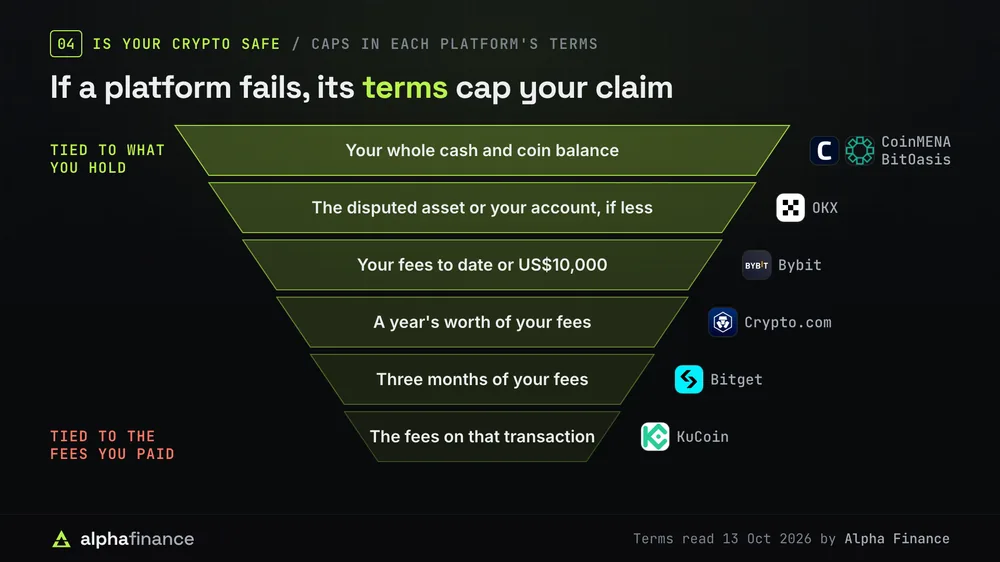
Most terms limit what you can claim if a platform's failure costs you money.
| Platform | The most its terms let you claim |
|---|---|
| CoinMENA | The cash and coins in your account. |
| BitOasis | The coins and balance in your account. |
| OKX | The asset in dispute or your account's value, whichever is less. |
| Bybit | Your fees to date or US$10,000, whichever is larger. |
| Crypto.com | A year's worth of your fees. |
| Bitget | Three months of your fees. |
| KuCoin | The fees on the transaction in question. |
Platforms publish a proof of reserves to show their coins cover every customer's balance. 6 of the ten, all of them global exchanges, publish one with your own balance in it. None of the three Gulf-founded platforms publishes one, though Rain says it holds assets one-for-one.
Not investment advice
This page is general information. Nothing on it is a recommendation to buy, sell or trade any asset or to use any exchange, and it does not take your situation into account. Digital assets are volatile and you can lose everything you put in. See the affiliate disclosure for how the site is funded.
For six of the ten, a P2P board is the main way riyals get in, and it carries risks a bank transfer to the platform doesn't.
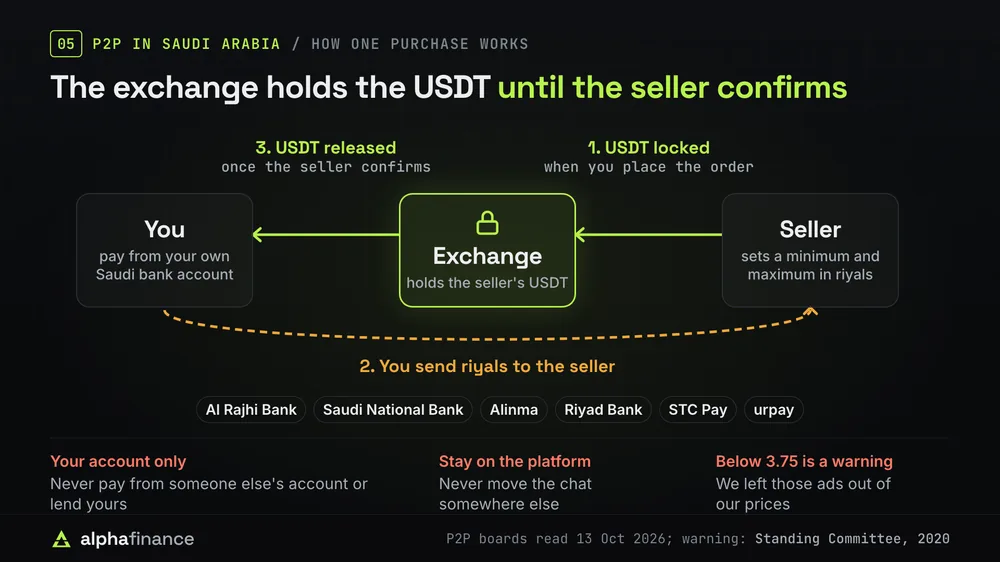
On the boards we read, sellers took payment through Al Rajhi Bank, the Saudi National Bank, Alinma, Riyad Bank and other banks, and through wallets such as STC Pay and urpay. When you place an order, the exchange holds the seller's USDT until you mark the payment sent and the seller confirms it.
Saudi income tax doesn't reach individuals investing their own money, and ZATCA has published no crypto guidance.
The Zakat, Tax and Customs Authority's income tax rules reach resident companies' non-Saudi shareholders and non-residents earning income in the Kingdom, not individuals investing for themselves.
Zakat on personal wealth is voluntary, paid through ZATCA's Zakaty platform, whose calculator covers cash, gold, silver, shares, funds and property but doesn't list crypto. If you trade as a business, or you're not resident in the Kingdom, ask a tax adviser.
Coins in a wallet you control don't depend on a company abroad staying solvent, but a lost seed phrase can't be recovered by anyone.
All ten let you send coins to your own wallet. BitOasis charges 0.0005 BTC to send Bitcoin out, so check each platform's withdrawal fee first. Try a small amount first and pick the same network at both ends.
Investment scams aimed at people in the Kingdom often borrow the names and faces of officials and well-known companies.
The Standing Committee has warned that scammers use government logos, fake news stories and paid influencers to make unlicensed offers look official. In December 2023 it warned again about impersonated officials, fake aid offers and promises of quick profit tied to unlicensed digital currencies.
If you've been targeted, the committee asks people to report it at a police station. Call your bank straight away to try to stop the transfer.
Binance, at 9.0 out of 10, is the highest-scoring platform for Saudi residents. For other needs, Rain is the cheapest to buy.
Send riyals by bank transfer to a platform that takes them and buy at its published price. Rain was cheapest for a SAR 1,000 order on 13 Oct 2026, SAR 6.75 above the market. USDT from a P2P board cost more, as sellers charge over the riyal's fixed rate.
Owning it isn't banned, but it isn't regulated either. Since 2018 a committee led by the Capital Market Authority has said virtual currencies aren't regulated in the Kingdom and nobody is licensed to deal in them. Saudis buy through companies abroad, licensed or not.
Saudi income tax doesn't reach individuals investing their own money, and ZATCA has published no crypto rules. Zakat on personal wealth is voluntary through the Zakaty platform.
No. No platform is licensed in the Kingdom. Binance's exchange companies are licensed in Abu Dhabi by the ADGM's Financial Services Regulatory Authority, which is the licence our score counts.
Both sign Saudi residents up through Seychelles companies that the Seychelles regulator still lists as under assessment, not licensed. Their licences in Dubai and Abu Dhabi cover UAE residents only.