Markets
 BTC
BTC ETH
ETH BNB
BNB XRP
XRP SOL
SOL ZEC
ZEC HYPE
HYPE DOGE
DOGE LINK
LINK TON
TON AVAX
AVAX SUI
SUI TAO
TAO AAVE
AAVE PUMP
PUMP MORPHO
 ARB
ARB LIT
LIT--:-- UTC
Best crypto exchanges in New Zealand for Kiwis paying in NZD, judged on the FSPR, Bitcoin's real price and who owns your coins.
Find the best exchange for
Europe
Americas
Asia Pacific
Nothing matches yet. Try a country or a region.
 By Alpha Finance Editorial Team
 Data maintained by Vince Dioquino
Every fee, register entry and clause behind a score links to the page we read it on. We go back over the platforms' New Zealand pages and the register every quarter, and sooner when a fee, a registration or a set of terms changes.
How we score → Editorial policy Report an errorNew Zealanders have fewer places to buy crypto than they did a year ago. Two well-known local exchanges have stopped trading, one after its customers moved to an Australian rival. No law licenses crypto exchanges here either, so who you sign up with matters more than the brand on the app.
The register is what trips people up. A firm serving New Zealanders should be on the Financial Service Providers Register (FSPR) and in a free complaints scheme. Registration isn't a licence, and some of the biggest names advertised here aren't on it at all. Check how money moves too. Some platforms take no NZD bank transfers, and a few never let your coins leave the app.
Of the nine below, four have a company on the register. The other five serve New Zealanders without one, so we hold their scores to 4.0. We ranked them on the real cost of Bitcoin in NZD, whether their terms keep your coins legally yours, and how cheaply dollars move to and from your bank, which is why the order differs from our worldwide ranking. Each fee or rule carries a small arrow to the page it came from, and the reviews fill in the rest.
Where each of the leaders comes out ahead, measured on its own numbers.
 SwyftxNZ$1,000 of Bitcoin cost NZ$9.47 over the market price, the least of the two registered platforms we could price. Only Independent Reserve, off the register, came in lower.9.0 out of 10
 Binance507 coins for New Zealand accounts, more than any other registered platform. Kraken, off the register, lists more.7.4 out of 10
 RevolutThe highest mark for New Zealand regulation, 10.0 of 10. Level with Sharesies on this, and ranked higher.7.4 out of 10
 SharesiesThe only platform here that offers crypto in Kids Accounts.7.4 out of 10
4 of 9 on the FSPR5 held to 4.0 for not being on itNZD prices read 13 Oct 2026
| # | Exchange | Score | Feestaker / maker | NZD deposits | Proof of reserveslatest published | |
|---|---|---|---|---|---|---|
| 1 | SwyftxNot on worldwide list | 9.0 | 0.6% + spreadApp, Regular tier | Bank transfer freeCard 1.99% | None | Visit |
| 2 | RevolutNot on worldwide list | 7.4 | 1.49% + spreadApp, Standard plan | Bank transfer freeCard free | None | Visit |
| 3 | SharesiesNot on worldwide list | 7.4 | 0.8% + 0.5% FXApp, priced in USD | Bank transfer freeInstant 0.95% | None | Visit |
| 4 | Binance#2 worldwide | 7.4 | 0.10% / 0.10%Spot, no NZD pair | No NZD transfersCard or P2P only | Merkle + zk | Visit |
| 5 |  Coinbase#4 worldwide Coinbase#4 worldwide | 4.0 | Not publishedDebit card, fee at checkout | No NZDDebit card buys only | Audited accountsNo per-user proof | Visit |
| 6 |  Independent ReserveNot on worldwide list Independent ReserveNot on worldwide list | 4.0 | 0.50% / 0.50%BTC/NZD order book | SWIFT NZ$20No local NZD transfer listed | None | Visit |
| 7 |  Kraken#6 worldwide Kraken#6 worldwide | 4.0 | 0.80% / 0.40%Kraken Pro, BTC/USD | No NZDUSD by SWIFT only | Audited Merkle | Visit |
| 8 |  OKX#1 worldwide OKX#1 worldwide | 4.0 | 0.10% / 0.08%Spot, no NZD pair | No NZDP2P only | Merkle + zk | Visit |
| 9 |  Crypto.com#14 worldwide Crypto.com#14 worldwide | 3.5 | Not publishedFee shown in the app | No NZDCard or AUD by PayID | Out of dateLast Dec 2022 | Visit |
Score: out of 10, for a New Zealander putting NZD in, holding coins and taking dollars back out. The top platform gets 9.0 and every other score is scaled against it, with a ceiling of 4.0 for any platform missing from the register. Each score opens into its six checks when you hover over it. Fees: what a first-time customer is charged on each trade, with no volume discount yet. Where there's no NZD market, the fee shown is for the crypto pair you end up trading on, and the cost check adds what it takes to get there. Nobody pays to appear here, and none of it is personal advice. See how we're funded.
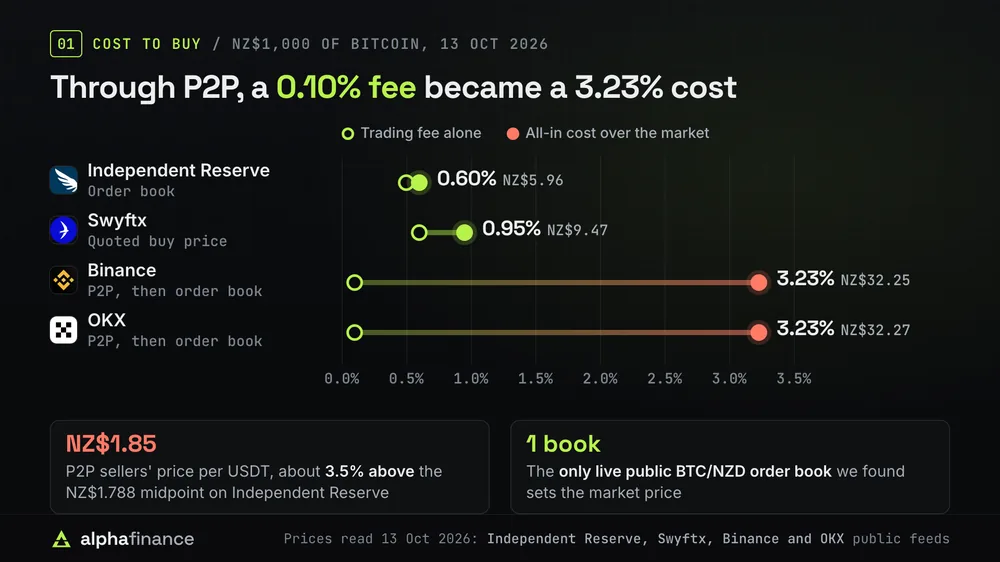
Buying NZ$1,000 of Bitcoin came to NZ$5.96 above the market price at Independent Reserve, against NZ$32.27 at OKX P2P. The market price, NZ$146,816 a Bitcoin, is halfway between the best bid and offer on Independent Reserve's BTC/NZD book, the only live public one. Each bar shows fee and markup.
Extra you pay to buy NZ$1,000 of BitcoinOver the market price, on the order book, the quoted buy price or the P2P route each platform publishes
Independent Reserve0.60%NZ$5.96Order bookSwyftx0.95%NZ$9.47Swyftx (instant price)Binance P2P3.23%NZ$32.25P2P, then order bookOKX P2P3.23%NZ$32.27P2P, then order bookRevolut, Sharesies, Coinbase, Kraken and Crypto.com keep their price behind a login or a checkout screen, which leaves nothing public to chart. Each takes the highest cost we measured, OKX P2P's, in its score.
New Zealand's Bitcoin market is thin. Independent Reserve runs the one public BTC/NZD order book we found still trading, with NZ$364k of Bitcoin offered within 0.5% of the market price. Kiwi-Coin's book stopped trading when it closed on 1 January 2026.
Where a platform has no NZD market, the dollars have to become something else first. On Binance and OKX that means buying USDT from other users. Their cheapest sellers asked NZ$1.85 per USDT, about 3.5% more than the NZ$1.788 midpoint of Independent Reserve's USDT/NZD book. That markup dwarfs either exchange's 0.10% trading fee.
For every platform we looked up its company on the register, read its New Zealand fees, terms and complaints process, and priced Bitcoin wherever a live NZD price was public. Each card says who you'd actually sign with.
Top score · Not on worldwide list
Best for a long coin list in NZD: over 410 coins with free bank deposits and withdrawals. Every buy costs 0.6% plus a spread, and its terms let it stake your coins.
Good for
Watch out for
Incidents in the last five years
NoneNo hacks, fines or market failures in the last five years.
Strongest regulation · Not on worldwide list
For Revolut customers who want some crypto beside their everyday account, under New Zealand law with FSCL for complaints. Buys cost 1.49% plus a spread, and the coins can never leave Revolut.
Good for
Incidents in the last five years
NoneNo hacks, fines or market failures in the last five years.
Not on worldwide list
For Sharesies investors who want Bitcoin and six other large coins in the same app, held on bare trust. It costs 0.8% plus 0.5% to change dollars, and the coins can't be moved out.
Good for
For traders who want Binance's long coin list from a registered New Zealand company, at 0.10% a trade. There's no NZD bank transfer: buying USDT from other users cost about 3.2% over the market.
Good for
Watch out for
Incidents in the last five years
USDe, wBETH and BNSOL lost their pegs on Binance's own order books in the 10 Oct crash; Binance paid about US$283M to users liquidated as a result.
AUSTRAC ordered an external audit of Binance Australia's anti-money-laundering controls.
Pleaded guilty in the US to anti-money-laundering and sanctions violations and agreed to pay about US$4.3B.
Only for buying with a debit card and holding. New Zealand accounts can't deposit, sell to or withdraw NZD, and Coinbase has no company on the New Zealand register.
Good for
Incidents in the last five years
A faulty update took down transfers and trading for about 50 minutes.
Fined EUR 21.5M by the Central Bank of Ireland for transaction-monitoring failures.
Bribed overseas support contractors stole personal data of 69,461 customers.
and 1 earlier
Not on worldwide list
The only live BTC/NZD order book in New Zealand and the cheapest Bitcoin we priced. Its New Zealand company left the register on 28 Aug 2026, and complaints go to Australia's AFCA.
Good for
Incidents in the last five years
NoneNo hacks, fines or market failures in the last five years.
For experienced traders willing to fund in US dollars: over 600 coins and BTC/USD at 0.40% maker. It has no NZD at all, no New Zealand company, and excludes liability above US$100.
Good for
Incidents in the last five years
Disclosed an extortion attempt after support staff viewed limited data on about 2,000 client accounts. Kraken says there was no breach of its systems and no client funds were at risk.
Ordered by Australia's Federal Court to pay A$8M after ASIC action over its margin product.
A deposit bug let security researchers withdraw about US$3M from Kraken's own treasury, not from client accounts; the funds were returned.
and 1 earlier
For OKX users who already hold USDT. It has no NZD market and no New Zealand company, and buying from other users on P2P cost about 3.2% over the market on our NZ$1,000 test.
Good for
Watch out for
Incidents in the last five years
For existing Crypto.com users only. New Zealanders get no NZD account: the app offers an AUD account topped up by Australia's PayID, or card buys with the fee shown only in the preview.
Good for
Incidents in the last five years
A US judge let Nevada's cease-and-desist stand, so sports event contracts were pulled for Nevada residents.
An employee was phished and some users' personal data was exposed; it became public only through Bloomberg in September 2025.
Attackers bypassed 2FA and drained 483 accounts of about US$34M; Crypto.com reimbursed the affected users.
and 1 more
We searched the Financial Service Providers Register for every platform and read each one's New Zealand terms in full. Every public NZD price was taken in the same minute on 13 Oct 2026. Rank turns on that price, the register and the terms, the cost of moving dollars, and the platform's record.
| Check | Weight | How it is marked |
|---|---|---|
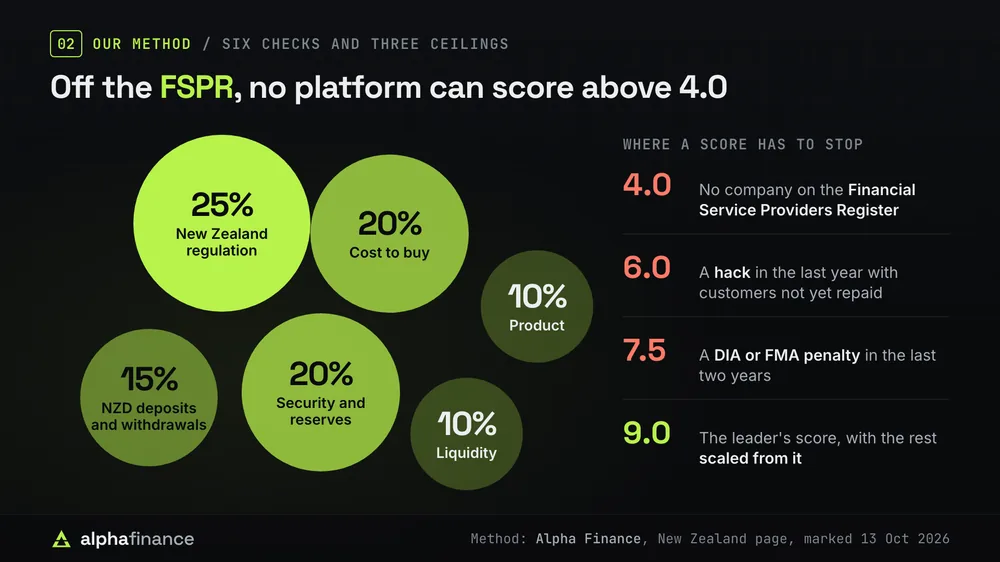
| Cost to buy | 20% | On 13 Oct 2026 we read every public New Zealand dollar price for Bitcoin in the same minute. Independent Reserve runs the country's only live BTC/NZD order book, so its midpoint is the market price. Next comes a NZ$1,000 Bitcoin purchase at every platform, made the cheapest way it publishes, with its fee counted in. Up to 0.2% above the midpoint keeps all 10 marks, and every further 0.1% costs 0.8. Where the price sits behind a login there's nothing to compare in advance, so the platform takes the worst cost found that day, or its own stated fee when that's higher. |
| New Zealand regulation | 25% | Having the company you sign with on the Financial Service Providers Register is worth 5. Terms that leave your coins legally yours, held on trust or as your nominee, add 2, since that decides who gets them if the platform collapses. A clean record with the DIA and the FMA over the past five years is worth 3. A warning with no penalty halves that, and a penalty removes it. |
| Security and reserves | 20% | Shared with the worldwide list. Reserves carry up to 4. A platform reaches 4 if you can look up your own balance in its proof, or if it or its parent publishes SEC-audited accounts. It gets 3 when an auditor checked only the reserves, and 2 for an accountant's sign-off. Some platforms keep a dedicated fund to meet customers' losses: having one adds 1, and publishing its size adds another. The last five years are worth 4: 3 off for a hack or collapse that cost customers (1 once they were repaid), 1 for a data breach, 1 for a regulator's action anywhere and 1 for each market failure, at most 2. |
| Liquidity | 10% | We add up the Bitcoin for sale on a platform's own BTC/NZD book at no more than 0.5% above the market price, from the 13 Oct 2026 snapshot. On a logarithmic scale, NZ$10,000 earns 0, NZ$100,000 about 3.3, NZ$1 million about 6.7 and NZ$10 million the full 10. Platforms that don't run a public BTC/NZD book, which is all but one of those listed, score 0 here. |
| NZD deposits and withdrawals | 15% | A way to send New Zealand dollars from your bank that the platform doesn't charge for earns 4: a plain transfer, or paying by bank through Akahu or POLi. A charged one earns 1. A free instant pay-by-bank option adds 1, and a card, Apple Pay or Google Pay adds 1. A platform that hands NZD back to your bank free of charge picks up 2, and one whose banks and payment firms have all stayed on board through the two years before our check picks up 2 more. |
| Product | 10% | Coins on offer count too: 30 earns 1, 100 earns 2 and 300 earns 3. Running its own BTC/NZD order book is worth 2, as is letting companies open accounts. Finally, staking adds 1, as does an OTC desk for large orders, and so does letting you move coins to your own wallet. |
Three limits apply on top. Missing from the register caps a platform at 4.0. One hacked in the past year that hasn't repaid its customers stops at 6.0. If the DIA or the FMA has penalised it in the past two years, 7.5 is the most it can reach.
Fees, terms and register entries here are as we found them on 13 Oct 2026. We read them again every three months, and at once if a registration lapses, a fee changes or new terms appear.
Have three things ready: photo ID, your IRD number and an NZ bank account in your name.
Only lightly. No law licenses crypto exchanges, so the rules that apply are about registration, money laundering and fair dealing.
A business providing financial services here generally has to join the FSPR, and one serving retail clients usually has to belong to an approved dispute resolution scheme. The register's own guidance says being on it doesn't mean a firm is licensed or regulated, and it isn't an endorsement.
Since 1 July 2026 the Department of Internal Affairs has been New Zealand's only anti-money laundering supervisor, and its list of supervised firms includes virtual asset service providers. On 9 July 2026 the Government dropped a planned ban on crypto ATMs and chose powers to limit cash payments for virtual assets instead.
Your first complaint has to go to the platform, and a written one leaves a record the scheme can read later.
If that fails, a registered platform's scheme can look at it for free. Swyftx, Revolut and Sharesies belong to FSCL, and Binance to IFSO. Since 18 July 2024 all four approved schemes can award up to NZ$500,000 plus GST. IFSO usually wants your complaint within 3 months of the firm telling you it has reached deadlock.
The five platforms with no company on the register name no New Zealand scheme. Independent Reserve sends complaints to Australia's AFCA, and Kraken, Coinbase, Crypto.com and OKX resolve disputes under foreign law, mostly by arbitration abroad.
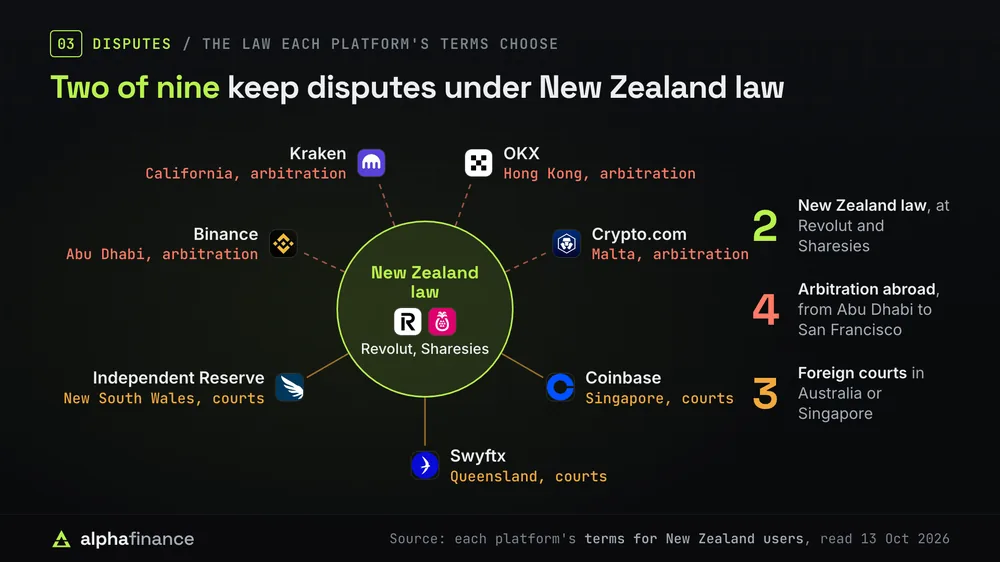
Only Revolut and Sharesies put their terms under New Zealand law. The other seven choose the law of Queensland, New South Wales, Abu Dhabi, California, Malta, England or Singapore, and four of them send disputes to arbitration abroad.
No government guarantee covers crypto held on a platform, as Binance's New Zealand terms point out, so what the terms say about ownership is what protects you.
New Zealand learned that the hard way. In January 2019 hackers took about NZ$30 million of coins from Cryptopia, and the exchange went into liquidation that May. In 2020 the High Court ruled that the coins were property held on express trusts for account holders, so they belonged to customers rather than creditors.
Getting them back is slow. Cryptopia's claims closed on 30 September 2025, and its liquidators were back in the High Court in May 2026 asking to accept late claims and settle what happens to unclaimed coins. Dasset, another local exchange, has been in liquidation since August 2023.
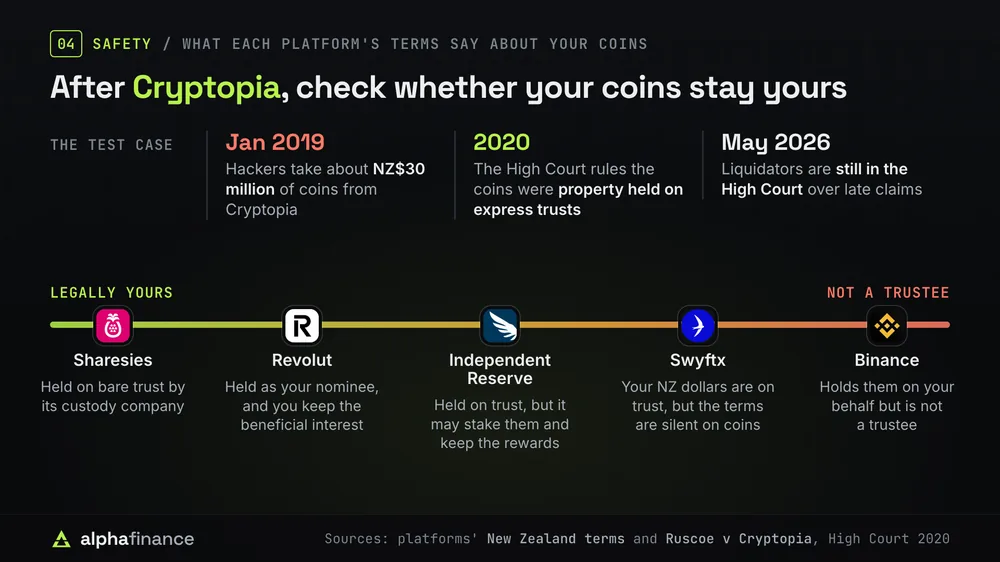
Terms that hold your coins on trust, or as your nominee, keep them out of the platform's own estate if it fails.
| Platform | What its terms say |
|---|---|
| Sharesies | Coins and US dollars are held on bare trust for you by its custody company. |
| Revolut | It holds coins as your nominee, and you keep the beneficial interest. |
| Independent Reserve | Coins are held on trust, but it may stake them and keep the rewards. |
| Swyftx | Your NZ dollars sit in a bank trust account. The terms don't say the same of your coins, and let it stake them for its own benefit. |
| Binance | It holds coins on your behalf but says it is not a trustee of them. |
A proof of reserves lets you check that a platform holds the coins it owes. Of the nine, 3 publish one you can look your own balance up in, and Coinbase's audited SEC accounts earn Coinbase the same top reserves mark.
Not investment advice
This page is general information. Nothing on it is a recommendation to buy, sell or trade any asset or to use any exchange, and it does not take your situation into account. Digital assets are volatile and you can lose everything you put in. See the affiliate disclosure for how the site is funded.
None of the banks below publishes an outright ban on paying a crypto platform, but each checks, caps or blocks payments it thinks look risky.
| Bank | What it says |
|---|---|
| ANZ | Blocks Visa Debit and credit card payments to some exchanges it sees as high risk. |
| Kiwibank | May block a payment it thinks risks fraud, and suggests New Zealand based platforms where possible. |
| BNZ | Allows one-off app payments up to NZ$50,000 and checks the payee's name first. |
| ASB | Allows up to NZ$100,000 a day from a Netcode-verified phone, or NZ$1,000 if unverified. |
Paying by open banking has its own caps. Stacked, a Bitcoin-only app, lists them on its fees page as NZ$10,000 a payment at ANZ and ASB, NZ$50,000 a day at BNZ and NZ$30,000 a day at Westpac, and lists none for Kiwibank.
Confirmation of Payee, live since April 2025, checks that the account name matches the number before you pay. Only three of the nine pay NZD back to your bank without a fee.
New Zealand taxes most crypto profits as income.
| Rule | What it means for you |
|---|---|
| Crypto is property | Buying and selling it isn't subject to GST. |
| Bought to sell means taxable | If your main purpose when you bought was to sell or swap, the profit is income. |
| Income tax 10.5% to 39% | Profits are added to your other income and taxed at your usual rates. |
| FIFO or average cost | You work out the cost of what you sold by first-in first-out or weighted average. |
| Staking and lending | Rewards and crypto interest count as income too. |
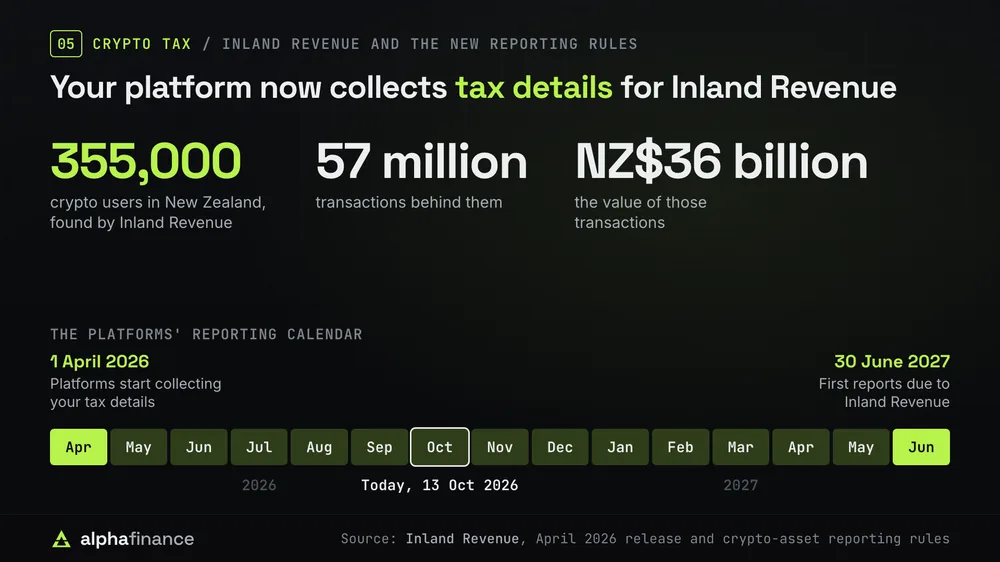
Inland Revenue is looking. In April 2026 it said it had found 355,000 crypto users in New Zealand behind about 57 million transactions worth NZ$36 billion, and had begun writing to some of them.
Platforms here began collecting users' tax details on 1 April 2026, and their first reports to Inland Revenue are due by 30 June 2027. Penalties can apply if you don't give the details when asked.
You can't buy coins directly inside KiwiSaver, but at least one scheme offers a Bitcoin fund.
Kōura lets members put up to 20% of their balance in its Bitcoin Fund, which invests through exchange-traded products. Outside KiwiSaver, the Smart Bitcoin ETF has traded on the NZX since 24 October 2024. Neither involves a wallet, and Kōura warns that the fund's value could fall significantly or even go to zero.
Coins in a wallet you control can't be caught up in a platform's liquidation, where Cryptopia's customers have waited since 2019, but nobody can recover a lost seed phrase.
Swyftx charges only the network fee to send coins out, and Independent Reserve 0.0001 BTC. Revolut and Sharesies don't let coins leave at all, so check this before you buy if a wallet of your own is the plan. Send a small test amount first.
Scammers target crypto buyers here as they do everywhere, so a few checks before you pay are worth the time.
Banks reported NZ$265 million taken from customers' accounts by scammers in the year to November 2025. In April to June 2026 the National Cyber Security Centre logged 348 scam and fraud incidents with about NZ$860,000 in reported losses. Signs to stop at:
Already sent money? Ring your bank first, then report the scam to Police on 105 or online.
Swyftx comes out on top here with 9.0 out of 10 across our six checks. For other needs, Binance lists the most coins of the registered platforms, Revolut shares the top regulation mark and Sharesies is our pick for Kids Accounts.
Pay in NZD from your own bank and buy on an order book or at a published price, rather than by card or from other users. On 13 Oct 2026, Independent Reserve came closest to the market for a NZ$1,000 order, at NZ$5.96 over it.
It's legal, but only lightly regulated. Platforms register on the Financial Service Providers Register and belong to a free complaints scheme, and the Department of Internal Affairs supervises them for money laundering. No crypto licence exists.
Usually, yes. Inland Revenue treats crypto as property, and if you bought it mainly to sell or swap, the profit is income taxed at your normal rate of 10.5% to 39%. Buying and selling it carries no GST.
Not coins themselves. Kōura's KiwiSaver scheme offers a Bitcoin Fund that can take up to 20% of your balance, invested through exchange-traded products.
Easy Crypto stopped trading on 30 March 2026, and its customers moved to Swyftx. Bybit has a company on the register under another name, but its site shows no New Zealand terms or fees to readers outside the country, so we couldn't check its facts.