Markets
 BTC
BTC ETH
ETH BNB
BNB XRP
XRP SOL
SOL ZEC
ZEC HYPE
HYPE DOGE
DOGE LINK
LINK TON
TON AVAX
AVAX SUI
SUI TAO
TAO AAVE
AAVE PUMP
PUMP MORPHO
 ARB
ARB LIT
LIT--:-- UTC
Crypto exchanges in Kenya compared for M-Pesa users: the company you sign with, its licence, Bitcoin's shilling cost and safety.
Find the best exchange for
Europe
Asia Pacific
Nothing matches yet. Try a country or a region.
 By Alpha Finance Editorial Team
 Data maintained by Vince Dioquino
Every fee, licence and clause behind a score links to the page we read it on. We go back over the platforms' pages, the CMA's and CBK's notices and every P2P board each quarter, and sooner when a fee, a licence or a set of terms changes.
How we score → Editorial policy Report an errorMost Kenyans who buy crypto never send shillings to an exchange. They pay another user by M-Pesa on a P2P board, while the exchange holds that seller's coins until the money lands. Just a couple of apps let you deposit by M-Pesa into an account of your own. So the first choice is a busy global P2P market or a smaller app that holds your shillings.
The rules are changing. Kenya's Virtual Asset Service Providers Act requires a licence from the Capital Markets Authority or the Central Bank, but nobody holds one yet, and platforms already serving Kenyans have until early November to comply. Until then, no Kenyan law protects your coins if a platform fails. On P2P, the risky step is paying: use an M-Pesa line in your own name and only the details inside the order.
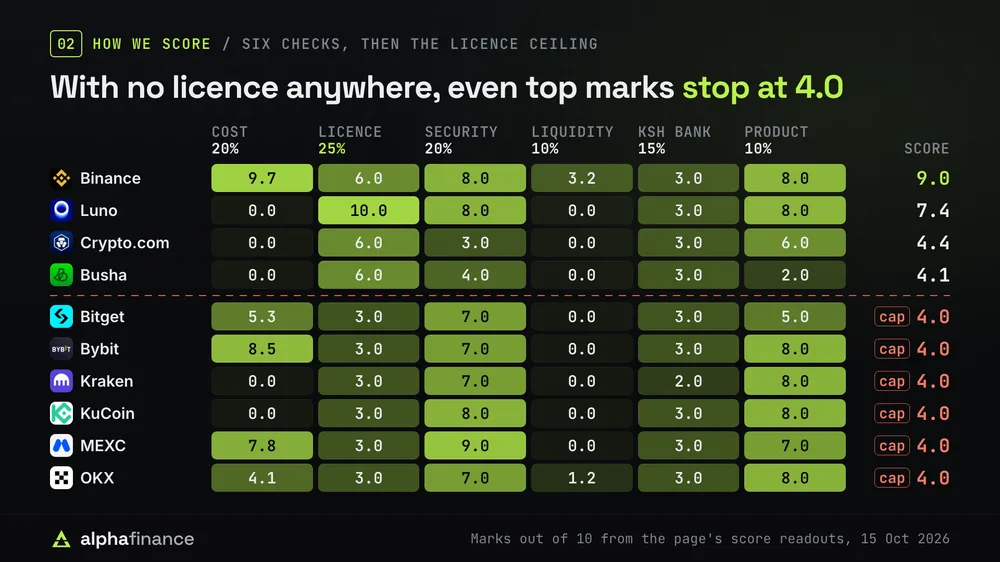
Just one of the ten below signs Kenyans up through a Kenyan company, and three more through companies licensed abroad. The other six have no crypto licence anywhere, so they stop at 4.0 however cheap their P2P markets. Below that, cheap Bitcoin, cheap M-Pesa and a clean safety record decide the order, which departs from our worldwide ranking. To check a figure, open the small arrow beside it. To go deeper, read a platform's review.
Just two of the ten reach the 7.0 a pick needs. Most of the rest are held at 4.0 by the licence rule.
1 of 10 sign Kenyans up through a Kenyan company6 held to 4.0 with no licence anywhereShilling prices read 15 Oct 2026
| # | Exchange | Score | Feestaker / maker | KSh deposits | Proof of reserveslatest published | |
|---|---|---|---|---|---|---|
| 1 |  Binance#2 worldwide Binance#2 worldwide | 9.0 | 0.10% / 0.10%Spot BTC/USDT, no KES pair | No KSh depositsP2P by M-Pesa | Merkle + zk | Visit |
| 2 |  LunoNot on worldwide list LunoNot on worldwide list | 7.4 | 0.10% / -0.01%Luno Exchange, Tier 1 | M-Pesa 1%M-Pesa only | Audited Merkle | Visit |
| 3 |  Crypto.com#14 worldwide Crypto.com#14 worldwide | 4.4 | Not publishedCrypto.com App, card purchases | No KSh depositsCard only | Out of dateLast Dec 2022 | Visit |
| 4 |  BushaNot on worldwide list BushaNot on worldwide list | 4.1 | Not publishedBusha app, buying with shillings | M-Pesa PaybillM-Pesa only | None | Visit |
| 5 |  Bitget#8 worldwide Bitget#8 worldwide | 4.0 | 0.10% / 0.10%Spot BTC/USDT, no KES pair | No KSh depositsP2P by M-Pesa | Merkle | Visit |
| 6 |  Bybit#5 worldwide Bybit#5 worldwide | 4.0 | 0.10% / 0.10%Spot BTC/USDT, no KES pair | No KSh depositsP2P by M-Pesa | Audited Merkle | Visit |
| 7 |  Kraken#6 worldwide Kraken#6 worldwide | 4.0 | 0.80% / 0.40%Kraken Pro, Tier 1 | No KSh depositsCrypto only | Audited Merkle | Visit |
| 8 |  KuCoin#11 worldwide KuCoin#11 worldwide | 4.0 | 0.10% / 0.10%Spot BTC/USDT, no KES pair | No KSh depositsP2P by M-Pesa | Audited Merkle | Visit |
| 9 |  MEXC#9 worldwide MEXC#9 worldwide | 4.0 | 0.05% / 0.00%Spot BTC/USDT, no KES pair | No KSh depositsP2P by M-Pesa | Audited Merkle | Visit |
| 10 |  OKX#1 worldwide OKX#1 worldwide | 4.0 | 0.10% / 0.08%Spot BTC/USDT, no KES pair | No KSh depositsP2P by M-Pesa | Merkle + zk | Visit |
Score: out of 10, from the point of view of someone in Kenya buying with M-Pesa, storing coins on the platform and cashing out to M-Pesa later. The leader's raw total is set to 9.0 and every other total is scaled by the same factor. With no crypto licence anywhere behind the company Kenyans sign with, a platform stops at 4.0. Put your cursor on any score to split it into the six checks below. Fees: the starting-tier trading charge. On the P2P platforms it is what swapping USDT into Bitcoin costs. The seller's price for the USDT is in the cost check. No exchange paid for its place here. It can't know your circumstances, so use it as a general guide. See how we're funded.
Binance P2P put the smallest markup on KSh 10,000 of Bitcoin, KSh 23.66, and Luno Exchange the largest, KSh 496.26. The Central Bank of Kenya's rate of KSh 129.79 turns Bitcoin's US$81,489 into our market price of KSh 10,576,464. Each bar shows fees beside the price gap.
Extra you pay to buy KSh 10,000 of BitcoinAbove the market price: M-Pesa P2P sellers then BTC/USDT, Luno's USDT/KES and BTC/USDT books, or Busha's posted price
Binance P2P0.24%KSh 23.66P2P, then order bookBybit P2P0.39%KSh 39.10P2P, then order bookMEXC P2P0.47%KSh 47.35P2P, then order bookBitget P2P0.79%KSh 78.70P2P, then order bookOKX P2P0.94%KSh 93.92P2P, then order bookKuCoin P2P1.93%KSh 193.41P2P, then order bookBusha2.93%KSh 292.70Busha app (quoted price)Luno Exchange4.96%KSh 496.26Order bookCrypto.com and Kraken accept no shillings at all, so no shilling price exists to plot. Each is scored as if it cost as much as Luno Exchange, the dearest we priced, or more where its own fee says so.
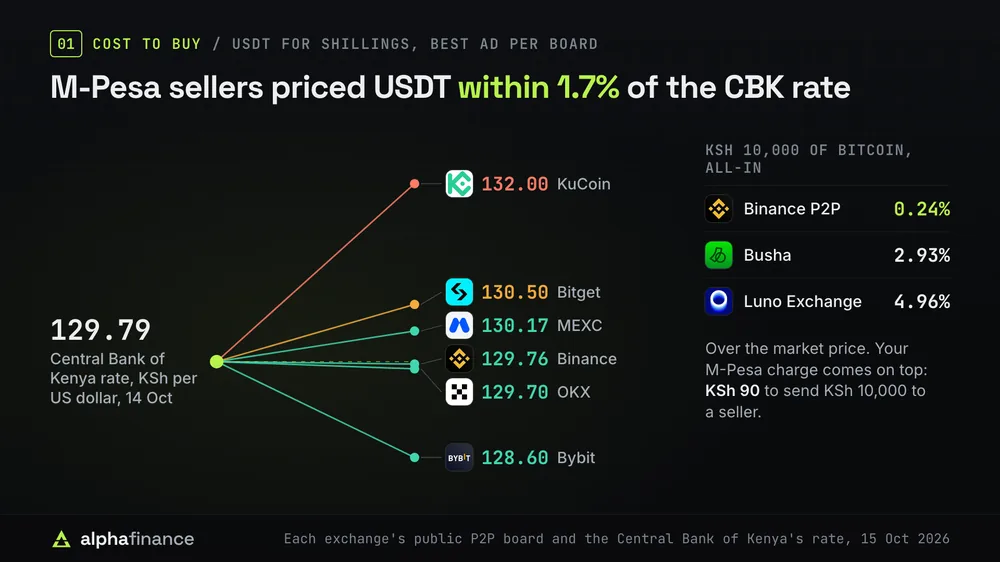
On the P2P boards the best USDT sellers asked KSh 128.60 at Bybit, 129.70 at OKX, 129.76 at Binance, 130.17 at MEXC, 130.50 at Bitget and 132.00 at KuCoin. Against the Central Bank of Kenya's rate for 14 Oct 2026, that runs from 0.9% under the rate to 1.7% over it. A busy board keeps the markup near zero, so a quiet one costs more than any trading fee.
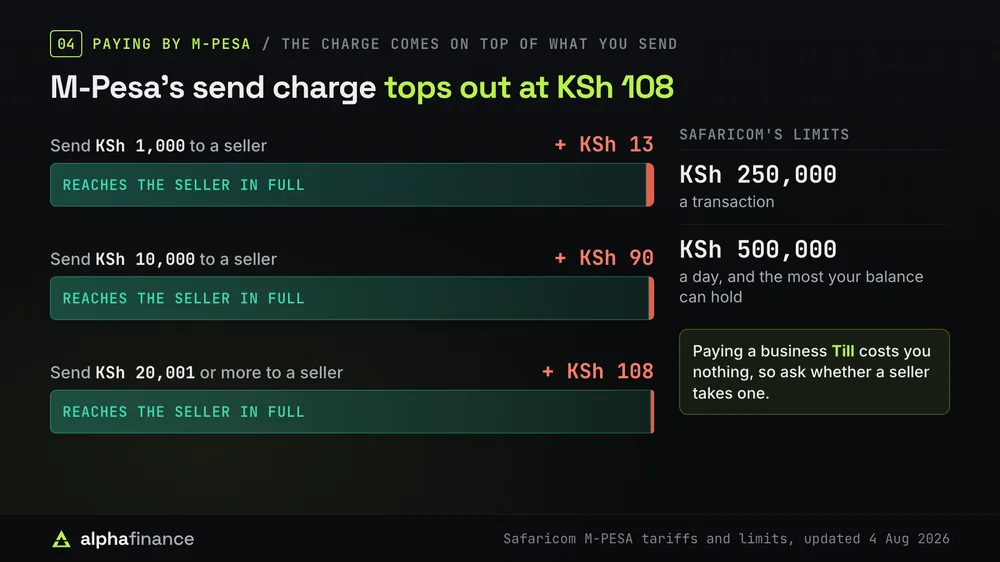
Your M-Pesa charge comes on top. Safaricom's consumer tariff takes KSh 90 to send KSh 10,000 to another M-Pesa user, while paying a business Till costs you nothing. Scores leave it out because it depends on how each seller takes payment. Depth matters for larger orders: within 0.5% of its best ad, Binance's board held KSh 9.4M of USDT, more than any other.
We read each platform's terms to find the company behind a Kenyan account, then looked that company up with whichever regulator claims it, and read its fee pages and its live shilling market. Each card then says whether that company is Kenyan, which regulator stands behind it, and how your shillings get there.
Best for buying with M-Pesa close to the market price: its shilling P2P board was the deepest and cheapest we priced. Kenyans sign with its Abu Dhabi companies, and no Kenyan licence covers them yet.
Good for
Incidents in the last five years
USDe, wBETH and BNSOL lost their pegs on Binance's own order books in the 10 Oct crash; Binance paid about US$283M to users liquidated as a result.
AUSTRAC ordered an external audit of Binance Australia's anti-money-laundering controls.
Pleaded guilty in the US to anti-money-laundering and sanctions violations and agreed to pay about US$4.3B.
Strongest regulation · Not on worldwide list
Best for keeping your shillings with a Kenyan company: Luno Kenya takes M-Pesa directly, answers to Kenyan courts and has its reserves checked monthly. Its thin shilling books made Bitcoin the dearest we priced.

Good for
Incidents in the last five years
NoneNo hacks, fines or market failures in the last five years.
Best for buying by card when you'd rather skip P2P, through a company authorised in Malta under the EU's MiCA rules. It takes no shillings and shows no shilling price, and its terms don't mention Kenya.
Good for
Incidents in the last five years
A US judge let Nevada's cease-and-desist stand, so sports event contracts were pulled for Nevada residents.
An employee was phished and some users' personal data was exposed; it became public only through Bloomberg in September 2025.
Attackers bypassed 2FA and drained 483 accounts of about US$34M; Crypto.com reimbursed the affected users.
and 1 more
Not on worldwide list
Best for a simple M-Pesa app run by an African company, with its shilling price on show. Bitcoin cost 2.93% over the market, and its only published terms put you under Nigerian law and courts.
Good for
Incidents in the last five years
NoneNo hacks, fines or market failures in the last five years.
Best for P2P buyers who want a large protection fund behind the platform. Its Seychelles company holds no licence, so it stops at 4.0, and its cheapest M-Pesa ads start at KSh 3,000.
Good for
Incidents in the last five years
About US$388M was taken from hot and warm wallets on 24 Sep 2026. Its protection fund covered the loss and user balances were untouched; withdrawals were paused until 28 Sep for BTC and 2 Oct for everything.
Suspected manipulation of the VOXEL perp; Bitget rolled back trades and compensated users who lost money.
Best for small M-Pesa buys at a tight price, with no P2P fee for buyers. Its Seychelles company holds no licence, so it stops at 4.0, and disputes go to one arbitrator in Singapore.
Good for
Best for experienced traders who already hold crypto: 628 coins and an audited reserves proof. It takes no shillings at all, and Kenyans sign with a British Virgin Islands company that holds no licence.
Good for
Incidents in the last five years
Disclosed an extortion attempt after support staff viewed limited data on about 2,000 client accounts. Kraken says there was no breach of its systems and no client funds were at risk.
Ordered by Australia's Federal Court to pay A$8M after ASIC action over its margin product.
A deposit bug let security researchers withdraw about US$3M from Kraken's own treasury, not from client accounts; the funds were returned.
and 1 earlier
Best for picking from 814 coins with M-Pesa as the way in. Its terms name no company, so it stops at 4.0, and its shilling board was thin, at 1.93% over the market.
Incidents in the last five years
Dubai's regulator ordered it to stop serving Dubai residents, and Japan's regulator sent a warning letter.
Austria's regulator banned KuCoin EU from new business after key compliance posts went vacant; operations are still not cleared.
The Turks and Caicos regulator said KuCoin is not licensed there, after Seychelles had rejected its licence application.
and 4 earlier
Best for traders after obscure coins: 1,487 of them and the lowest published taker fee here. Kenyans sign with a Comoros company that holds no licence, so it stops at 4.0.
Good for
Incidents in the last five years
Dubai's regulator fined MEXC's operator for serving Dubai customers without a licence and ordered it to stop.
The Seychelles regulator began enforcement against MEXC's operator for running an exchange without a licence.
Froze about US$3M of one trader's funds over alleged automated trading, and released it three months later.
and 1 earlier
Best for P2P buyers who want step-by-step M-Pesa guidance, on the second-deepest board here. Its Seychelles company holds no licence, so it stops at 4.0.
Good for
Incidents in the last five years
Every shilling price, P2P board and Luno order book was read in the same minutes on 15 Oct 2026, and each platform's terms and fee pages were read that day. Bitcoin's real price, who stands behind your account, how shillings move and each platform's past set the order.
| Check | Weight | How it is marked |
|---|---|---|
| Cost to buy | 20% | Luno's thin BTC/KES book can't set a fair price, so we take the median of three large BTC/USD books and convert it at the Central Bank of Kenya's published dollar rate. On 15 Oct 2026 we read every platform's public price in one sweep and priced KSh 10,000 of Bitcoin bought the cheapest way each one publishes, fees in. A cost of 0.2% or less above the market is a perfect 10, and each 0.1% beyond that removes 0.8. Platforms that take no shillings get the day's dearest measured cost, unless their own fees come to more. |
| Kenyan company, licence and record | 25% | Nobody holds a Kenyan licence yet, so this check starts with who you sign with. A Kenyan company earns 5, because it is the company the new Act will license and Kenyan courts can reach, and 2 more when its group already holds a crypto licence elsewhere. A company abroad with a real crypto licence earns 3. Up to 3 more reflect the past five years in Kenya: all 3 with no regulator or court action, 1.5 after an order or warning, none after a penalty. |
| Security and reserves | 20% | The rule from our worldwide list. Reserves earn up to 4: all 4 for a proof you can find your own balance in once an outside auditor or zero-knowledge maths backs it, as at Binance, OKX, Bybit, KuCoin, MEXC, Kraken and Luno, 3 for a lookup nobody has checked or an audit of reserves alone, and 2 for an accountant's attestation. Holding money aside to repay customers adds 1, and saying how much adds a second. Four marks cover what has gone wrong since October 2021: a loss to customers through a hack or collapse costs 3, or 1 where everyone was paid back, and a data breach, any regulator's action worldwide and each market failure, up to 2, cost 1 apiece. |
| Liquidity | 10% | Depth is measured where shillings change hands on each platform: its P2P board, or Luno's own shilling book. In the 15 Oct 2026 snapshot we total everything on offer within 0.5% of each market's best price, in shillings. Marks climb on a log scale from 0 at KSh 1 million to 10 at KSh 1 billion. A platform with neither earns 0. |
| KSh deposits and withdrawals | 15% | Four marks go to a free way to put shillings into your own account by M-Pesa or bank, and 1 to a way the platform charges for. A shilling P2P board, where sellers take M-Pesa, adds 1, and a card or Airtel Money adds another. M-Pesa or bank withdrawals at no charge earn 2, and the last 2 depend on no bank or payment firm having cut the platform off in the past two years. |
| Product | 10% | Coin range is worth 3 at 300 or more, falling to 2 below 300 and 1 below 100, and nothing under 30. A Bitcoin market priced in shillings that anyone can see adds 2, as do accounts for businesses. Three extras earn a mark apiece: staking, an OTC desk for buys too large for P2P sellers, and wallet withdrawals. |
Three limits sit above the checks. With no crypto licence anywhere behind the company Kenyans sign with, a platform tops out at 4.0. If hack victims from the past year haven't been confirmed repaid, the ceiling is 6.0. Two years must pass after any Kenyan regulator's penalty or court finding before a platform can score above 7.5.
We read everything above on 15 Oct 2026. We'll read it all again once the licensing deadline passes on 4 November 2026, and at least every three months after that.
You'll need your national ID or passport, and an M-Pesa line registered in the same name as your exchange account.
Yes. Buying and holding crypto is legal, and platforms that serve Kenyans now need a licence to do so.
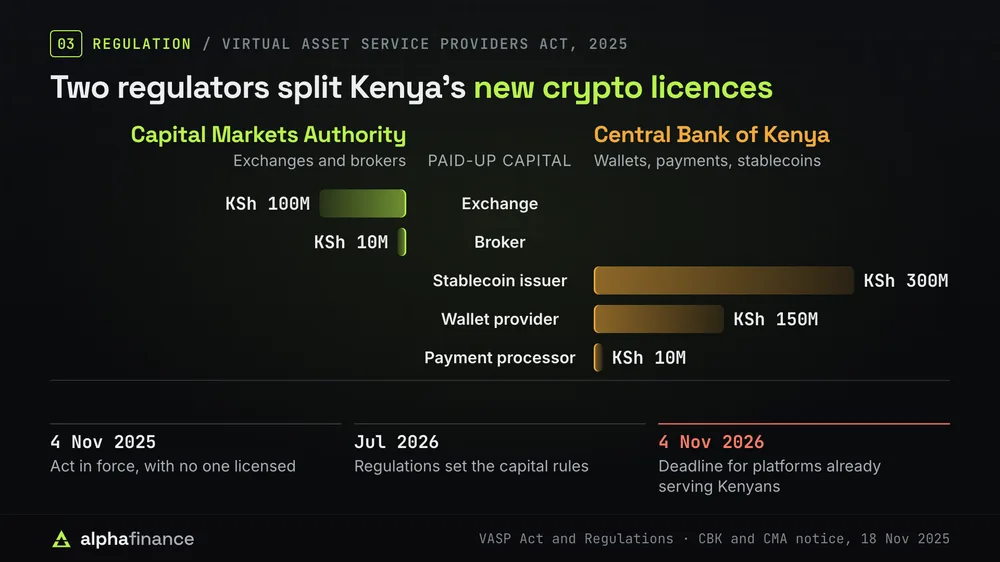
The Virtual Asset Service Providers Act, 2025 came into force on 4 November 2025. It splits the work between two regulators: the Capital Markets Authority licenses exchanges, trading platforms and brokers, and the Central Bank of Kenya licenses custodial wallets, payment processors and stablecoin issuers.
The Regulations that followed in July 2026 reach platforms based abroad. Any firm that targets Kenyans or earns money from Kenya counts as operating here, office or no office. An exchange must hold KSh 100 million in paid-up capital, a custodial wallet provider KSh 150 million and a stablecoin issuer KSh 300 million, while a broker or payment processor needs KSh 10 million.
Section 47 gave platforms already serving Kenyans one year to comply, which ends on 4 November 2026. In their joint notice, the CBK and CMA said they had not licensed anyone. Running a platform without a licence after that can cost a company a fine of up to KSh 25 million.
Before the Act, the Central Bank's December 2015 notice warned that Bitcoin wasn't legal tender or regulated, and told the public to stay away from it.
Until a platform is licensed, no Kenyan regulator supervises how it handles complaints, so put yours to the platform in writing first. Once licensed, each platform must run a complaints process that updates you within 21 days, under regulation 110.
After that, the terms decide. Luno's are the only ones here governed by Kenyan law, with disputes going to Kenya's courts. Busha's go to Nigeria's courts, and the global exchanges send disputes to arbitration in Abu Dhabi, Hong Kong, Singapore, Malta or San Francisco, which can cost more than a small balance is worth.
Not under Kenyan law yet. No deposit insurance or compensation fund covers coins on a crypto platform.
The Central Bank's 2015 notice put it plainly: no protection exists if a platform that holds your crypto fails. Once licensed, platforms must keep enough of each coin to cover customers, hold clients' coins apart from their own and keep them out of reach of creditors, under section 31 of the Act. A licensed wallet provider may not lend or pledge them either (regulation 66).
For now, each platform's own terms set the ceiling on any payout if it loses your money.
| Platform | The most its terms let you claim |
|---|---|
| OKX | No more than the disputed asset, or your whole OKX balance if that's less. |
| Bybit | Whichever is bigger: every fee you've paid it, or US$10,000. |
| Crypto.com | A year of your fees. |
| Luno | Six months of the fees Luno earned from you. |
| Busha | Six months of the fees Busha earned from you. |
| Bitget | Three months of your fees. |
| MEXC | Three months of your trading fees. |
| KuCoin | Only the fee on the deal that went wrong. |
| Kraken | US$100. |
Reserve proofs are the one check you can run yourself today. 8 of the 10 let you find your own balance in theirs, Luno among them through monthly checks by an outside accountant. Busha publishes none.
Not investment advice
This page is general information. Nothing on it is a recommendation to buy, sell or trade any asset or to use any exchange, and it does not take your situation into account. Digital assets are volatile and you can lose everything you put in. See the affiliate disclosure for how the site is funded.
M-Pesa is how shillings reach almost every platform here, either straight into your account or to a P2P seller.
Safaricom's limits apply either way: at most KSh 250,000 a transaction, KSh 500,000 a day and a KSh 500,000 balance, according to its tariffs and limits page. Sending money to another M-Pesa user costs KSh 13 for KSh 1,000, KSh 90 for KSh 10,000 and KSh 108 for anything from KSh 20,001 up. Luno applies the same caps to deposits and withdrawals. The M-Pesa GlobalPay virtual Visa card won't help, as Safaricom blocks cryptocurrency merchants on it.
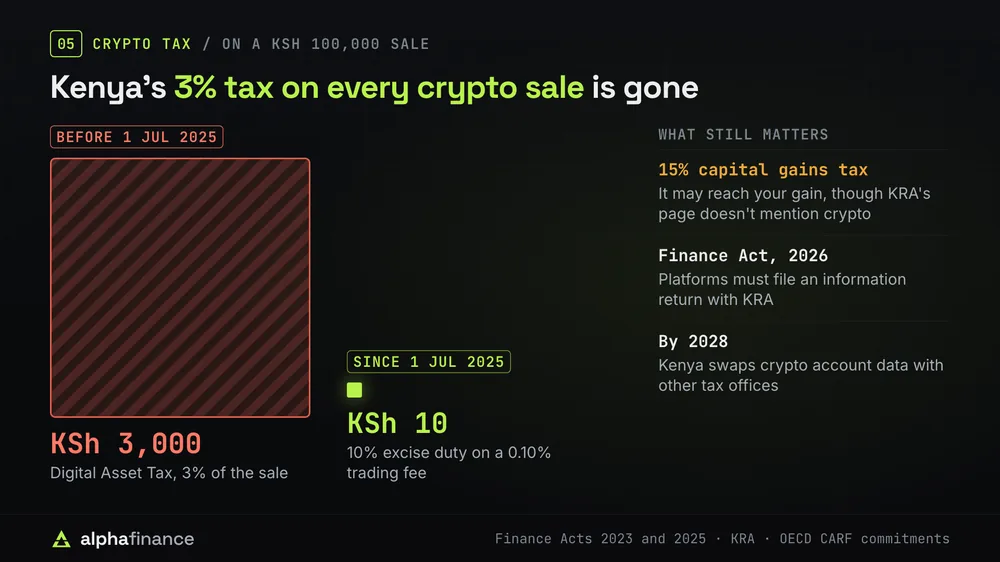
Kenya no longer has a tax on each crypto sale, but platforms' fees carry a tax and capital gains rules may still reach you.
From 1 September 2023 a 3% Digital Asset Tax was taken from the value of each transfer, under section 12F of the Income Tax Act. The Finance Act, 2025 repealed it from 1 July 2025. The same Act put a 10% excise duty on the fees platforms charge for crypto transactions. On a KSh 100,000 sale the old tax took KSh 3,000, while the duty on a 0.10% trading fee comes to KSh 10.
Capital gains tax runs at 15% of the net gain on property in Kenya, and it's a final tax, says the Kenya Revenue Authority. Its page doesn't mention crypto, so ask a tax adviser before treating a gain as tax-free.
Expect KRA to see your trades. The Finance Act, 2026 makes platforms file an information return, and Kenya is among the countries due to swap crypto account data with other tax offices by 2028.
Moving coins into a wallet only you control takes them out of a platform's hands, including any account freeze, but a lost seed phrase means they're gone for good.
Every platform on this list allows withdrawals to your own wallet. Send a small amount first, check the network matches at both ends, and compare each platform's withdrawal fee, which is set in the coin itself and often costs more than the trade.
Fake investment schemes reach Kenyans through WhatsApp groups and social media, often dressed up as crypto trading or mining.
In September 2026 the Capital Markets Authority named fifteen entities it said were fraudulently taking the public's money, among them CBEX, Wealth Sharing Group (Opticoin), Ultima Cryptocurrency and Bitblock Capital. It said the Directorate of Criminal Investigations is investigating them.
If you've lost money, the CMA asks you to report it at your nearest DCI office. Call Safaricom straight away if the money went by M-Pesa.
Binance, on 9.0 out of 10, comes out on top for people buying from Kenya. For other needs, Luno is the most strongly regulated.
Buy USDT on a busy P2P board, paying by M-Pesa, then swap it for Bitcoin. On 15 Oct 2026 that route through Binance P2P put KSh 10,000 of Bitcoin just KSh 23.66 above the market price, plus whatever M-Pesa charges you to pay the seller.
Yes. The Virtual Asset Service Providers Act, in force since November 2025, makes platforms get a licence from the Capital Markets Authority or the Central Bank. None has one yet, and those already operating have until 4 November 2026.
The 3% Digital Asset Tax on each sale was repealed from 1 July 2025. Platforms' fees now carry 10% excise duty, and KRA's 15% capital gains tax may reach your gains, though its guidance doesn't name crypto.
Not yet, and neither is any other platform. The Binance companies Kenyans contract with sit in Abu Dhabi Global Market, and our score gives credit for the licence they hold there.
Coinbase's Kenyan company now lets people sign in only to withdraw what they hold, and its agreement says you won't become a customer. Yellow Card now serves only businesses.