Markets
 BTC
BTC ETH
ETH BNB
BNB XRP
XRP SOL
SOL ZEC
ZEC HYPE
HYPE DOGE
DOGE LINK
LINK TON
TON AVAX
AVAX SUI
SUI TAO
TAO AAVE
AAVE PUMP
PUMP MORPHO
 ARB
ARB LIT
LIT--:-- UTC
Research/Platform guides
Gate restricted countries in full, which licensed Gate company serves the US, Europe, Dubai and Australia instead, and how regulators have treated Gate.
 By Alpha Finance Editorial Team
 Fact-checked by Vince Dioquino
Every figure, platform detail and regulatory claim on this page was traced to a primary source by the named fact checker before publication, and is re-checked when those facts change. The review date moves only when a person has re-read the page.
The editorial policy → Editorial policy Report an errorGate's global exchange bars residents of 32 countries and territories, plus three regions of Ukraine, under clause 2.5 of its User Agreement. The United States, the United Kingdom, Japan, India and six EU states are among them. Gate says the list is incomplete.
Residents of several restricted markets can use a separate, licensed Gate company. Gate US lists licences in 37 US jurisdictions, and a Malta company serves the European Economic Area under the EU's crypto law. Their product ranges are narrower than those of the global exchange, whose terms also cover margin trading and perpetual futures.
Gate is one of six exchanges in our live funding rates comparison. Funding rates are fees paid between traders holding perpetual futures. These contracts follow a coin's price without expiring and are usually traded with borrowed money.
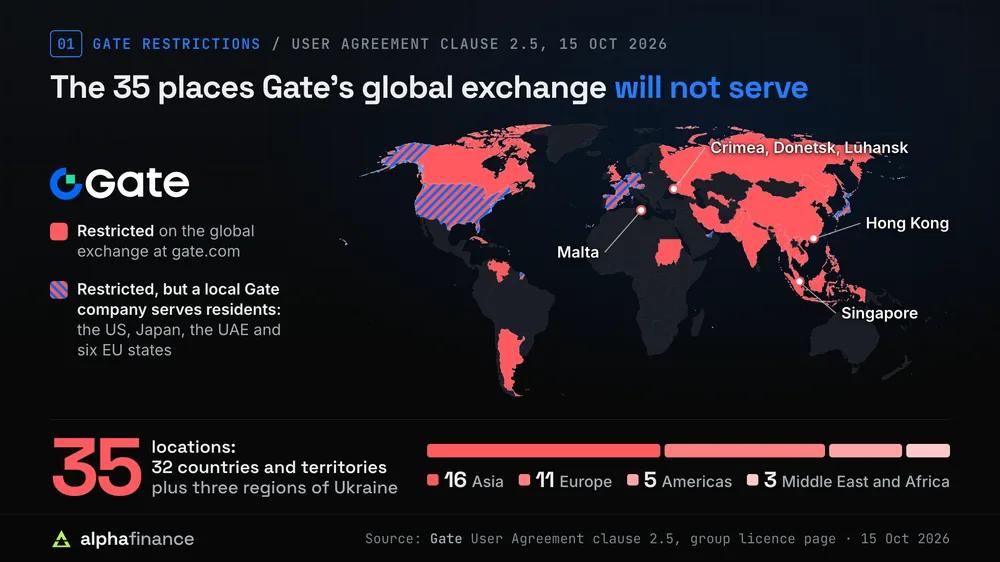
Gate's terms prohibit residents of the following 35 locations from opening or using an account on gate.com.
This is the list published in clause 2.5 on 15 Oct 2026. It also serves as the Gate.io restricted countries list, since Gate moved its main domain from gate.io to gate.com on 19 May 2025.
| Region | Restricted locations named in clause 2.5 |
|---|---|
| Americas | United States; Canada; Cuba; Venezuela; Argentina |
| Europe | United Kingdom; France; Germany; Spain; Netherlands; Austria; Malta; Russia; the Crimea, Luhansk and Donetsk regions of Ukraine |
| Asia | Mainland China; Hong Kong; Japan; South Korea; North Korea; Singapore; Malaysia; Indonesia; Thailand; Vietnam; Cambodia; Myanmar; Philippines; India; Pakistan; Uzbekistan |
| Middle East and Africa | United Arab Emirates; Iran; Sudan |
The one-sentence version
Gate's global exchange is closed to the United States, Canada, the UK, Japan, India, mainland China, Hong Kong, Singapore, South Korea and 26 other named locations.
Under the clause, users must check the list regularly and stop using Gate if they are in a restricted location. Further country restrictions may apply to Gate's TradFi products, which track stocks, gold and other traditional assets.
An older list remains on Gate's help centre page on restricted locations, dated 22 Nov 2024. It names 32 places, including Bolivia, but leaves out the Philippines, Pakistan, Vietnam and Russia.
The help page directs readers to the User Agreement. Its list of 35 governs eligibility because the agreement is the contract every account holder signs.
What residents can use instead, if anything, depends on why Gate restricts their country.
Your account's Gate company determines the products available to you, the law governing your contract and where you can take a complaint.
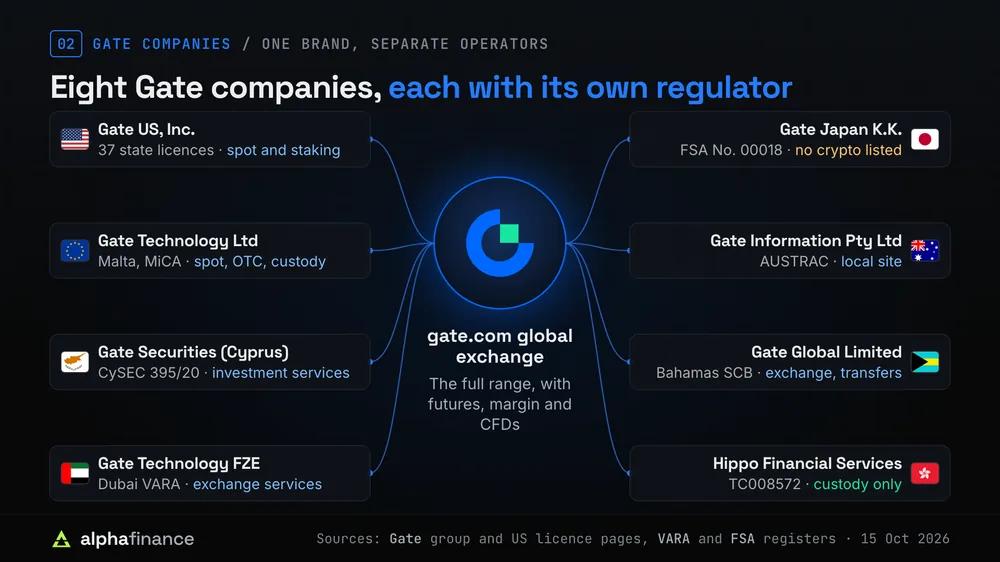
| Region | Gate company | Regulator and licence | What residents get |
|---|---|---|---|
| United States | Gate US, Inc. | State money transmitter licences in 37 jurisdictions | Spot trading, conversions and staking |
| European Economic Area | Gate Technology Ltd | Malta Financial Services Authority, MiCA crypto licence and payment institution | Spot trading, conversions, OTC trades and custody |
| European Economic Area | Gate Securities (Cyprus) Ltd | Cyprus Securities and Exchange Commission, investment firm licence 395/20 | Investment services such as order execution |
| Dubai | Gate Technology FZE | Virtual Assets Regulatory Authority, licence VL/25/04/007 | Exchange services, including for retail investors |
| Japan | Gate Japan K.K. | Financial Services Agency, registration No. 00018 | No crypto assets listed on the register |
| Australia | Gate Information Pty Ltd | AUSTRAC, digital currency exchange registration | A local site at gate.com/en-au |
| Bahamas | Gate Global Limited | Securities Commission of The Bahamas, digital asset business | Exchange and transfer services |
| Hong Kong | Hippo Financial Services Limited | Trust or company service provider licence TC008572 | Custody only, with no trading licence |
The sources for these details are Gate's group licence page, the Gate US licence disclosures, the VARA public register and the FSA's register of crypto exchanges.
Buying a coin outright for immediate delivery is spot trading. OTC, or over the counter, means arranging a trade directly with the company rather than through the order book. That book is the public list of buy and sell orders awaiting a match.
MiCA stands for the EU's Markets in Crypto-Assets Regulation. NMLS is the Nationwide Multistate Licensing System, which US states use to issue money transmitter licences.
According to Gate's licence page, several independently operated companies use the Gate brand. Panama's law governs the global agreement. The EU agreement falls under Maltese law, while Wyoming law governs the Gate US agreement.
Gate's full product range is available only on the global exchange. The global User Agreement covers perpetual futures and TradFi assets, as well as margin trading, where users borrow money from the exchange to trade. The product menu also includes contracts for difference (CFDs). These pay the change in an asset's price without delivering the asset itself.
The global exchange ranks third in our worldwide exchange ranking, which weights trading volume and futures.
Americans can access Gate only through Gate US. This separate company offers spot crypto under state licences and lists no futures among its products.
Every global exchange user must confirm under clause 2.10 that they are not a "US person". The clause explains that US regulators may claim jurisdiction over overseas exchanges serving Americans. It names the Securities and Exchange Commission (SEC), which regulates securities, and the Commodity Futures Trading Commission (CFTC), which regulates derivatives. Derivatives are contracts whose value follows another asset.
Gate US, Inc. (NMLS ID 2272810) lists money transmitter licences in 37 jurisdictions, including Washington DC and Puerto Rico, on its licence disclosures page. These state permits allow a business to hold and move customers' money.
Its disclosures also identify seven places where Gate US does not operate:
Residents of these locations can compare US-licensed alternatives in our ranking of crypto exchanges in the United States.
The Gate US User Agreement updated on 13 Oct 2026 states that trades are executed on a spot basis. Customer assets have no Federal Deposit Insurance Corporation or Securities Investor Protection Corporation cover. Those US schemes protect bank deposits and brokerage accounts.
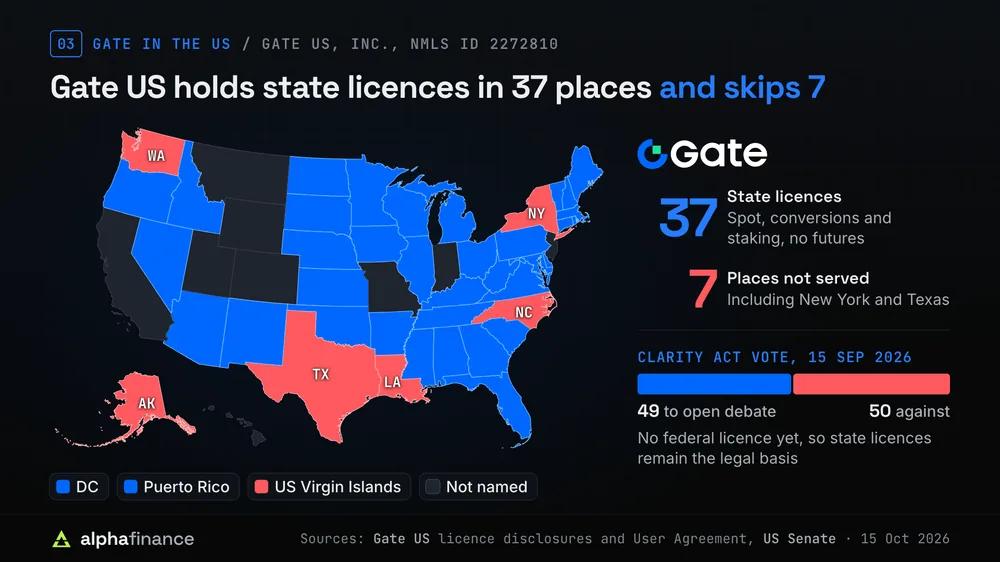
State money transmitter licences remain the legal basis for Gate US because no federal licence yet exists for US spot crypto exchanges. The Clarity Act would create one, but a Senate vote to open debate failed by 49 votes to 50 on 15 Sep 2026. Our guide to the Clarity Act explains the proposal.
Gate Technology Ltd in Malta serves EU residents under a MiCA licence, offering spot crypto only.
ESMA's interim MiCA register records the Malta Financial Services Authority's authorisation of Gate Technology Limited on 29 Sep 2025. ESMA, the European Securities and Markets Authority, is the EU-wide markets regulator.
A company can use a MiCA licence across the European Economic Area through passporting, which requires notice to each other national regulator. Gate's licence page lists 29 passported states, covering every EEA country apart from Malta itself.
Updated on 23 Sep 2026, Gate's EU agreement says the company serves all EU and EEA states. ESMA's register lists the same 29 host states.
Gate's EU platform scores 6.6 out of 10 in our ranking of MiCA-licensed crypto exchanges in Europe, placing eighth among the ten exchanges covered.
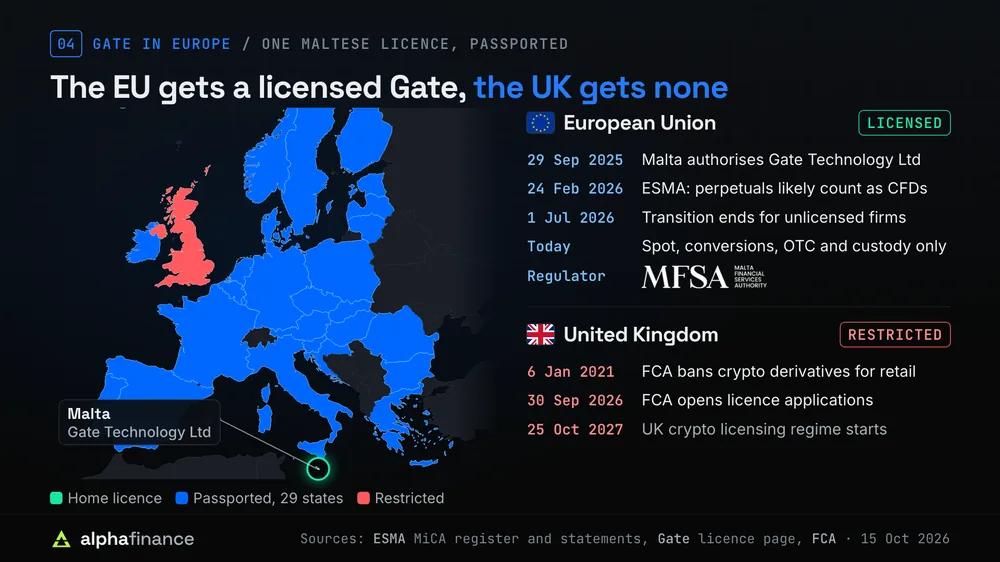
Unlicensed crypto firms lost the right to serve EU clients when the MiCA transition period ended on 1 Jul 2026, according to ESMA's statement of 23 Jun 2026. The statement also says firms based outside the EU cannot provide MiCA services to EU clients or solicit them.
Reverse solicitation is the sole exception. This applies when a client approaches a firm on their own initiative, under what ESMA describes as a narrow regime. Clients using unauthorised firms receive none of MiCA's client asset protections.
ESMA warned on 24 Feb 2026 that derivatives marketed as perpetual futures are likely to qualify as CFDs under national rules. Those rules limit leverage and require risk warnings. They also prevent retail clients from losing more than the money in their account.
Gate faced action in Italy before MiCA. On 16 Dec 2021, securities regulator Consob ordered gate.io to stop offering crypto futures to Italian residents because it lacked authorisation to provide investment services.
Gate restricts the United Kingdom, and its licence page lists no Gate company for the UK. Since 6 Jan 2021, the Financial Conduct Authority (FCA), the UK's financial regulator, has banned the sale of crypto derivatives to retail consumers.
The full UK crypto licensing regime takes effect on 25 Oct 2027. The FCA opened authorisation applications on 30 Sep 2026, and firms operating crypto trading platforms for UK customers will need that authorisation from the start date.
Japan and Hong Kong residents cannot use Gate's global exchange. Australia is absent from the restricted list and has a locally registered Gate company.
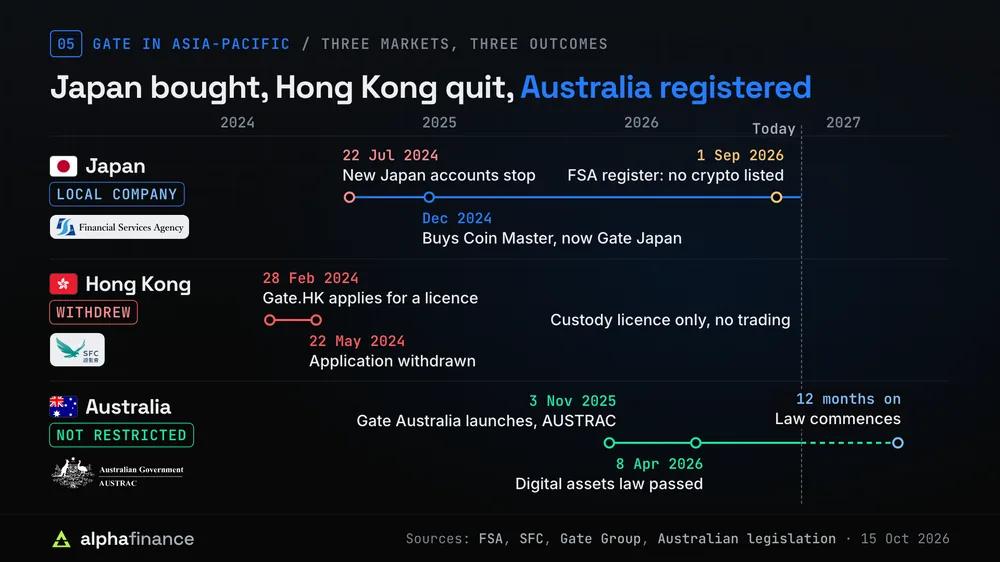
On 22 Jul 2024, Gate stopped opening accounts for Japanese residents. It later bought registered Japanese exchange Coin Master Co., Ltd. in December 2024 and renamed it Gate Japan K.K., according to Gate Group's acquisition announcement.
The FSA's register of crypto asset exchange service providers, dated 1 Sep 2026, records Gate Japan under registration No. 00018, with an initial registration date of 27 Nov 2019. Its entry lists no crypto assets handled.
Gate Digital Limited, which operated Gate.HK, applied for a Hong Kong trading platform licence on 28 Feb 2024. It withdrew that application on 22 May 2024, according to the Securities and Futures Commission's list of virtual asset trading platforms.
The SFC page also urges investors to use only SFC-licensed trading platforms.
Gate Australia launched on 3 Nov 2025 through Gate Information Pty Ltd, a digital currency exchange registered with AUSTRAC, Australia's anti-money laundering regulator. The details appear in Gate Group's launch announcement.
The Corporations Amendment (Digital Assets Framework) Act 2026 became law on 8 Apr 2026 and commences 12 months after royal assent. It brings platforms holding customers' digital assets into the financial services licence regime administered by corporate regulator ASIC, as the Parliamentary Library's Bills Digest explains.
Our ranking of crypto exchanges in Australia compares locally available, AUSTRAC-registered platforms.
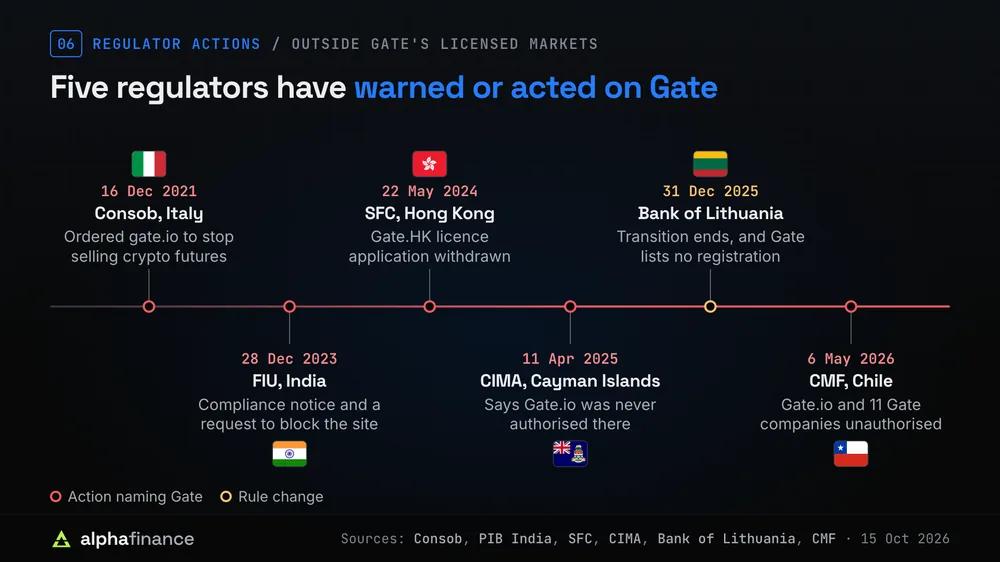
Since 2021, Gate has faced warnings, notices and closures involving five regulators outside the markets where it holds licences.
| Date | Regulator | Action |
|---|---|---|
| 16 Dec 2021 | Consob, Italy | Ordered gate.io to stop offering crypto futures to Italians without authorisation |
| 28 Dec 2023 | Financial Intelligence Unit, India | Compliance notice to Gate.io and eight other offshore exchanges |
| 22 May 2024 | Securities and Futures Commission, Hong Kong | Gate.HK licence application withdrawn |
| 11 Apr 2025 | Cayman Islands Monetary Authority | Said Gate.io and Gate Global Corp have never been authorised there |
| 6 May 2026 | Financial Market Commission (CMF), Chile | Named Gate.io and 11 affiliates as unauthorised |
India's Financial Intelligence Unit issued notices to nine exchanges for serving Indian users without registering under the Prevention of Money Laundering Act. The government's press release of 28 Dec 2023 also says the unit asked India's IT ministry to block their websites.
The Cayman Islands Monetary Authority issued a public notice on 11 Apr 2025 after complaints about Gate's claimed regulation in the territory. It said Gate.io and Gate Global Corp have never been registered, licensed or authorised to run a virtual asset business in or from the Cayman Islands.
Although Chile is not on Gate's restricted list, the CMF's notice of 6 May 2026 names GATE.IO and 11 Gate companies as neither registered nor authorised to provide services it supervises. The companies include Gate Technology Ltd, Gate Japan K.K. and Gate Global UAB.
Gate Global UAB is Lithuanian, but Gate's licence page shows no Lithuanian registration. The country's transition period for unlicensed crypto providers ended on 31 Dec 2025. After that date, the Bank of Lithuania says, providing unlicensed crypto services constitutes illegal financial activity.
Gate uses identity documents and proof of residence to decide who can trade. Its terms allow it to close accounts that breach eligibility rules.
The know your customer (KYC) checks in clause 19 of the global agreement require users' names, addresses, dates of birth and nationalities. Users must also supply official identity documents and a photo of themselves holding them. Extra checks apply to users from countries under increased monitoring by the Financial Action Task Force (FATF), the global anti-money laundering standard setter.
Breaching eligibility rules gives Gate several powers under the agreement:
A virtual private network (VPN) hides the internet address visible to a website. It does not change the passport or address Gate holds on file. Clause 8.7 allows Gate to suspend accounts whose holders attempt to bypass its controls.
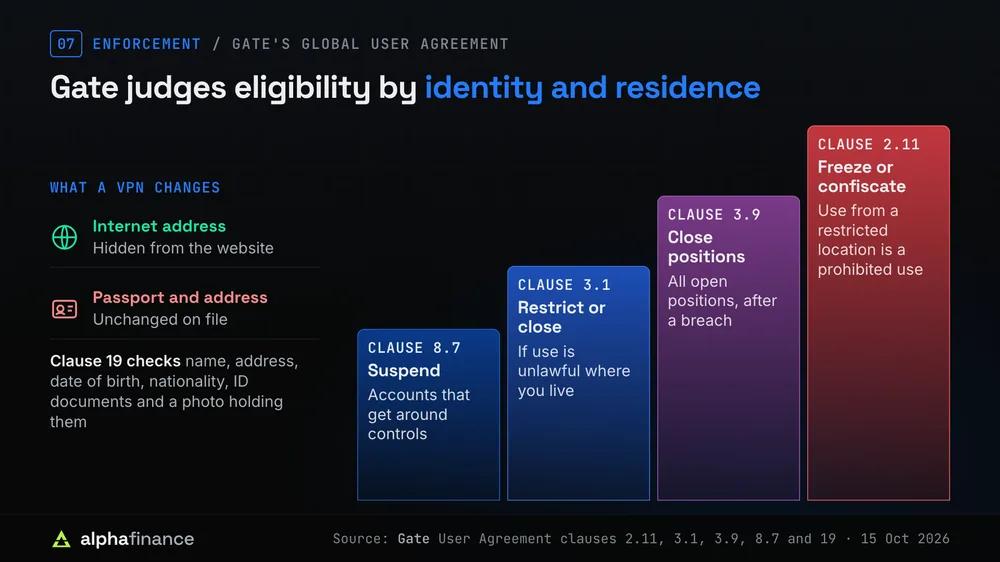
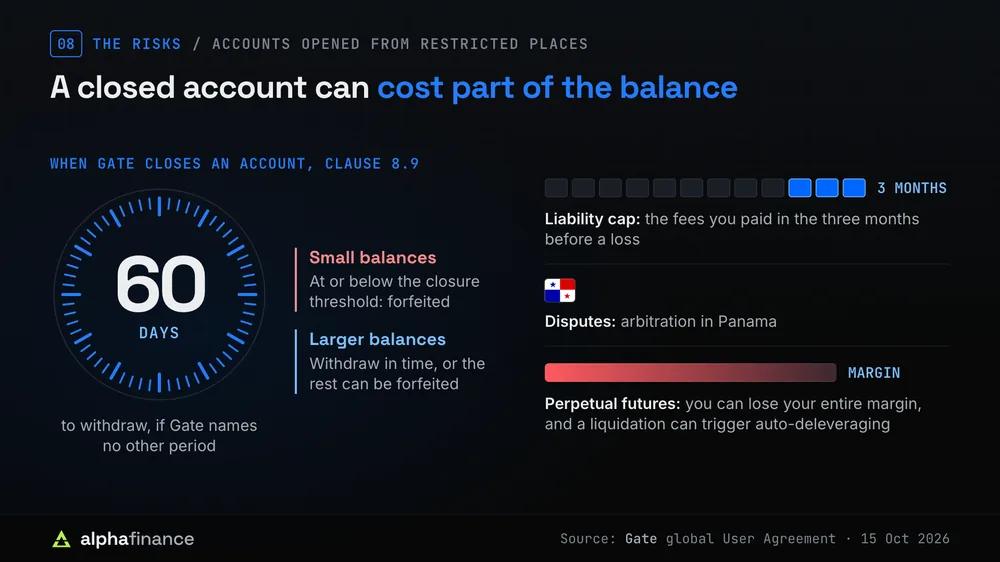
Gate can close an account opened from a restricted location at any time, potentially causing the holder to lose part of the balance.
Clause 8.9 of the global agreement says that when Gate initiates an account closure, balances at or below a minimum closure threshold are forfeited. Users can withdraw larger balances within Gate's stated period, or within 60 days if no period is specified. Any balance left after that deadline can also be forfeited.
Disputes under the global agreement go to arbitration in Panama. Gate's liability is capped at the fees the user paid during the three months before a loss.
Leverage lets traders hold a position larger than the money they put up, known as margin. Small price changes therefore produce larger gains or losses. Gate's terms warn that perpetual futures traders may lose their entire margin.
A forced position closure, or liquidation, can also trigger auto-deleveraging. This automatically cuts profitable positions on the opposing side.
Our liquidation price calculator shows where an exchange would close a position for a given entry price, leverage and margin.
Not investment advice
This article explains market data. Nothing on this page is a recommendation to buy, sell or leverage any asset. Digital assets are volatile and you can lose everything you put in. If you are unsure whether a trade is appropriate for you, a licensed adviser in your jurisdiction is the right next step.


Fact checked by
Verifies every figure against primary sources before publication. Meet the team
Gate's User Agreement names 35 locations in clause 2.5. These include the United States, Canada, the UK, Japan, India, mainland China, Hong Kong, Singapore, South Korea, the UAE and six EU states, plus the Crimea, Luhansk and Donetsk regions of Ukraine. Gate says the list is not exhaustive and may change without notice.
Access is available only through Gate US, Inc., whose licence disclosures page lists money transmitter licences in 37 US jurisdictions. Gate US does not operate in Alaska, Louisiana, New York, North Carolina, Texas, Washington or the US Virgin Islands. It offers spot trading, with no futures or margin.
The Malta Financial Services Authority authorised Gate Technology Ltd under MiCA on 29 Sep 2025, according to ESMA's register. The company provides spot trading, conversions and custody across the European Economic Area. It offers no futures.
Gate is unavailable in the UK, which appears on its restricted list. Its licence page names no UK company. Applications for the FCA's new crypto licensing regime opened on 30 Sep 2026, ahead of its start on 25 Oct 2027.
A VPN does not change eligibility. It changes only the internet address visible to a website, while Gate checks identity documents and residence. Under its terms, Gate can suspend accounts that attempt to bypass controls, close positions and freeze funds belonging to users in restricted locations.