Markets
 BTC
 ETH
 BNB
 XRP
 SOL
 ZEC
 HYPE
 DOGE
 LINK
 TON
 AVAX
 SUI
 TAO
 AAVE
 PUMP
 MORPHO
 ARB
 LIT
--:-- UTC
Research/Market structure
Decentralized lending lets anyone lend or borrow crypto through code instead of a bank. Learn how collateral, interest rates and liquidations work, who the largest protocols are and what can go wrong.
 By Alpha Finance Editorial Team
 Fact-checked by Vince Dioquino
Every figure, platform detail and regulatory claim on this page was traced to a primary source by the named fact checker before publication, and is re-checked when those facts change. The review date moves only when a person has re-read the page.
The editorial policy → Editorial policy Report an errorDecentralized lending is borrowing and lending crypto through software on a blockchain instead of through a bank or broker. Lenders deposit tokens into a program called a smart contract, and borrowers take loans from it after posting collateral.
Decentralized lending apps carried $20.43 billion of outstanding loans on 30 Jun 2026, according to Galaxy Research's quarterly leverage report. Most of that debt is in stablecoins, which are tokens pegged to the US dollar.
Live deposit and borrowing rates for each protocol are on our DeFi yields page.
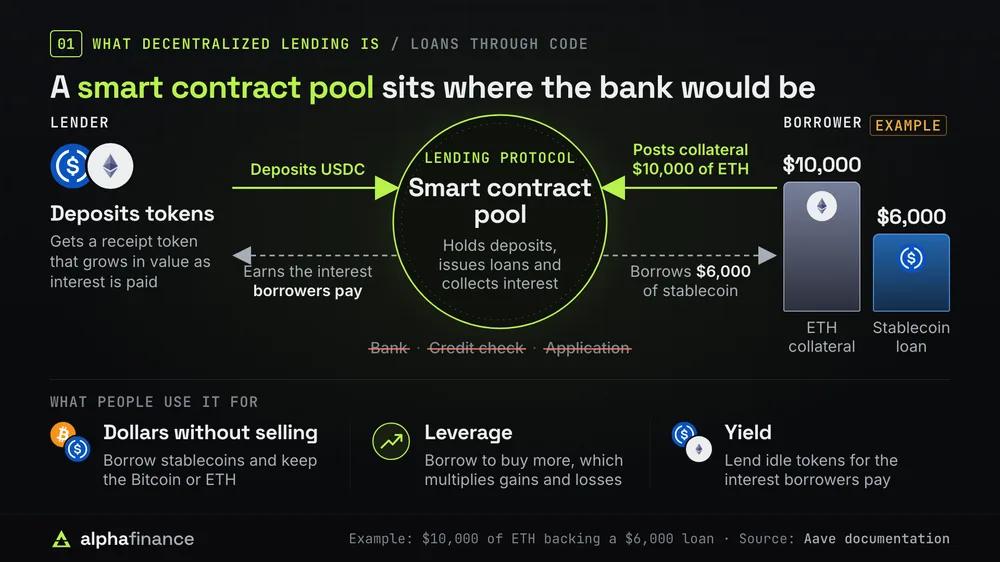
Decentralized lending lets you earn interest on crypto you own, or borrow against it, without asking anyone for approval. It is one branch of decentralized finance (DeFi), the set of financial services that run as open software on blockchains.
A lending protocol is a group of smart contracts that holds deposits, issues loans and collects interest under fixed rules. Aave, the largest, describes itself in its documentation as a non-custodial protocol, which means users keep control of their funds through their own wallets.
The protocol cannot see who a borrower is or what they earn, so it relies on collateral. A Bank for International Settlements bulletin put it this way in 2022: "Due to the anonymity of borrowers, overcollateralisation is pervasive in DeFi lending."
Overcollateralization means the borrower locks up assets worth more than the loan. Someone holding $10,000 of Ether (ETH) might borrow $6,000 of a stablecoin, spend or trade it, and get the ETH back on repayment.
Common uses include:
A centralized lender is a company that takes custody of your collateral and decides the terms. A decentralized protocol publishes its rules in code and shows every loan on a public ledger.
| Feature | Decentralized lending | Centralized crypto lending |
|---|---|---|
| Who holds the collateral | A smart contract | The lending company |
| Who sets the rate | A formula based on pool usage | The company |
| Identity checks | Usually none | Required |
| Visibility of loans | Public, in real time | Private company accounts |
| Missed margin | Automatic sale by third parties | The company's own process |
A decentralized loan has no fixed term and no monthly payment on most protocols. It stays open for as long as the collateral is worth enough to cover it.
The usual sequence is:
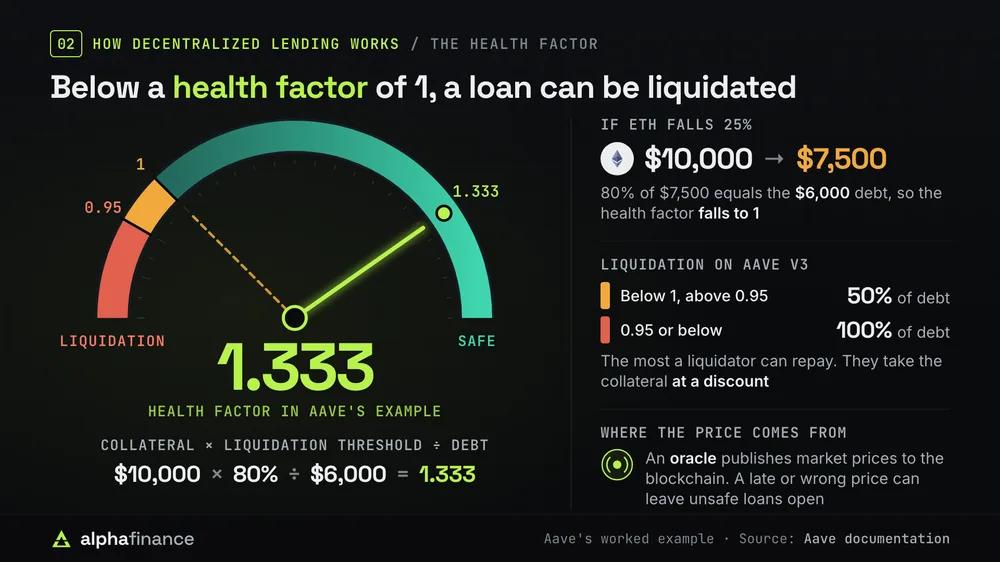
Each loan carries a score that shows how close it is to a forced sale. Aave calls it the health factor and defines it as collateral value multiplied by the liquidation threshold, divided by the amount borrowed.
The liquidation threshold is the share of the collateral's value at which the loan stops being safe. In Aave's own example, $10,000 of ETH with an 80% threshold and a $6,000 loan gives a health factor of 1.333.
A health factor below 1 makes the loan eligible for liquidation. In that example, ETH would need to fall by 25% for $10,000 of collateral to become $7,500, the point where 80% of it equals the $6,000 debt.
Liquidation is the forced repayment of a loan that has become unsafe. Anyone can act as the liquidator by repaying part of the debt and receiving the borrower's collateral at a discount, called the liquidation bonus.
On Aave V3, a liquidator can repay up to 50% of the debt when the health factor is above 0.95, and up to 100% at 0.95 or below. Aave V4 replaced the fixed bonus with a Dutch auction, in which the discount grows as the health factor falls.
Morpho, the second-largest protocol, expresses the same idea as a single number per market. Its documentation gives the example of an 86% liquidation loan-to-value for USDC loans against Coinbase's wrapped Bitcoin, so a $100 deposit supports at most $86 of debt.
A protocol can only liquidate on time if it knows what the collateral is worth. That price comes from an oracle, a service that publishes market prices to the blockchain, and Aave reads it through a dedicated oracle contract.
An oracle that is late or wrong can leave unsafe loans open or close healthy ones.
Lenders and borrowers on most protocols get a variable rate that changes with every block.
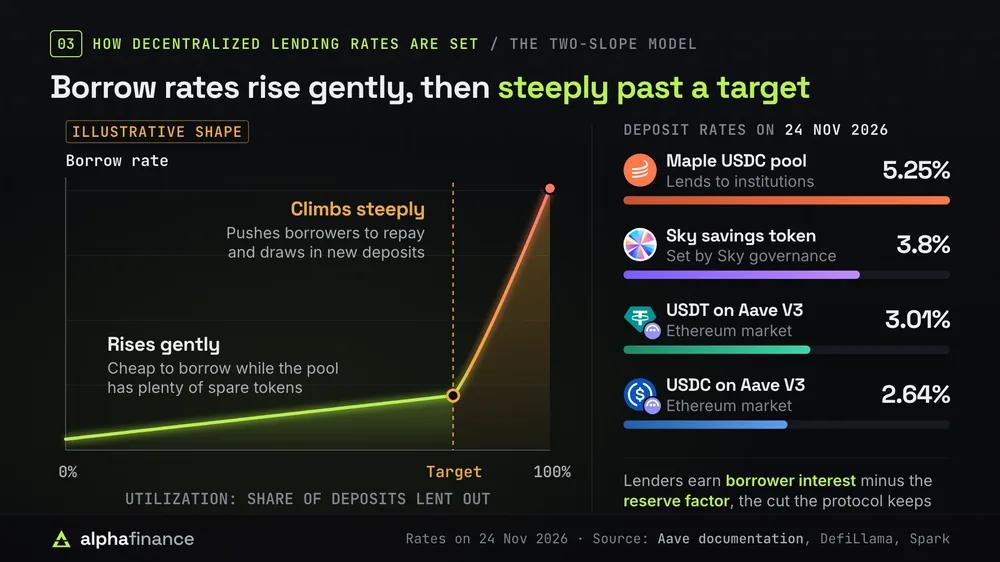
The key input is utilization, the share of a pool's deposits that is currently lent out. Aave V3 uses a two-slope model. The borrowing rate rises gently until utilization reaches a target, then climbs steeply beyond it.
The steep part of the curve protects lenders. A pool at 100% utilization has no spare tokens for withdrawals, so a high rate pushes borrowers to repay and attracts new deposits.
Lenders earn what borrowers pay, minus a cut the protocol keeps. Aave's documentation calls this cut the reserve factor and says supplier yields are "funded by borrower interest net of the reserve factor."
The one-sentence version
Deposit rates in decentralized lending are paid by borrowers, so they fall when few people want loans and rise when a pool is nearly empty.
On 24 Nov 2026, USDC deposits on Aave V3's Ethereum market earned 2.64% a year and USDT earned 3.01%, according to DefiLlama's yield tracker. Maple's main USDC pool, which lends to institutions, paid 5.25%.
Some rates are set by governance, meaning a vote of token holders. Sky's savings token paid 3.8% on the same day, and Spark's documentation says the Sky Savings Rate is "funded by borrowing fees accrued by the Sky Protocol and is set by Sky Governance."
Quoted yields often combine a base rate paid by borrowers with a reward rate paid in a protocol's own token, which can end without notice.
A handful of protocols hold most of the money. Their designs differ in who chooses the collateral a lender is exposed to.
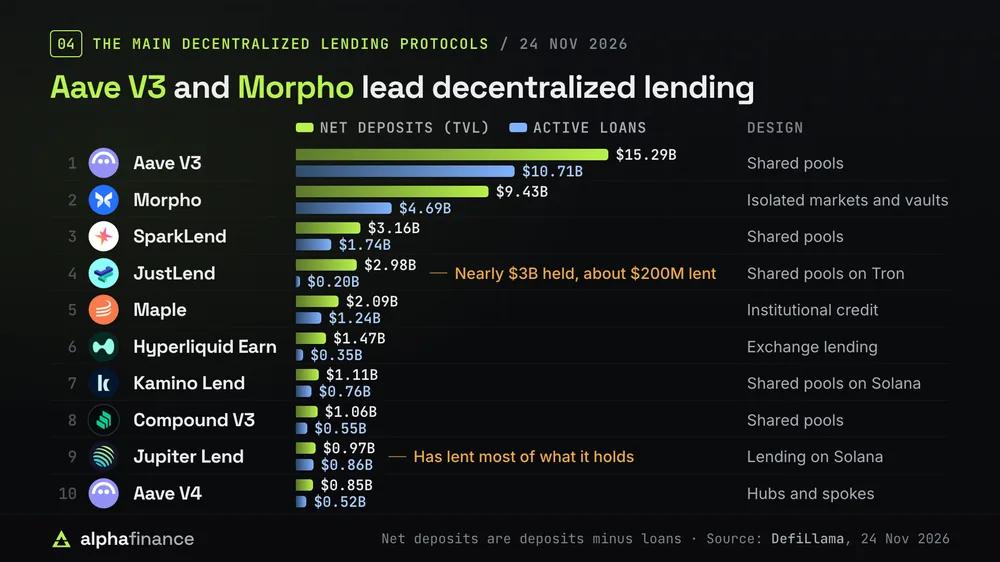
The table shows deposits net of loans, the measure DefiLlama reports as total value locked (TVL), next to active loans on 24 Nov 2026.
| Protocol | Design | Net deposits (TVL) | Active loans |
|---|---|---|---|
| Aave V3 | Shared pools | $15.29B | $10.71B |
| Morpho | Isolated markets and vaults | $9.43B | $4.69B |
| SparkLend | Shared pools | $3.16B | $1.74B |
| JustLend | Shared pools on Tron | $2.98B | $0.20B |
| Maple | Institutional credit | $2.09B | $1.24B |
| Hyperliquid Earn | Exchange lending | $1.47B | $0.35B |
| Kamino Lend | Shared pools on Solana | $1.11B | $0.76B |
| Compound V3 | Shared pools | $1.06B | $0.55B |
| Jupiter Lend | Lending on Solana | $0.97B | $0.86B |
| Aave V4 | Hubs and spokes | $0.85B | $0.52B |
JustLend holds nearly $3 billion but lends out about $200 million, a gap our Tron statistics explain, while Jupiter Lend has lent most of what it holds.
Protocols also count themselves differently. Morpho's own count of total deposits exceeded $17 billion in early October 2026, a gross figure that includes money already lent out.
Decentralized lending is a market of tens of billions of dollars that shrank through the first half of 2026. The size matters to users because deep pools mean steadier rates and easier withdrawals.
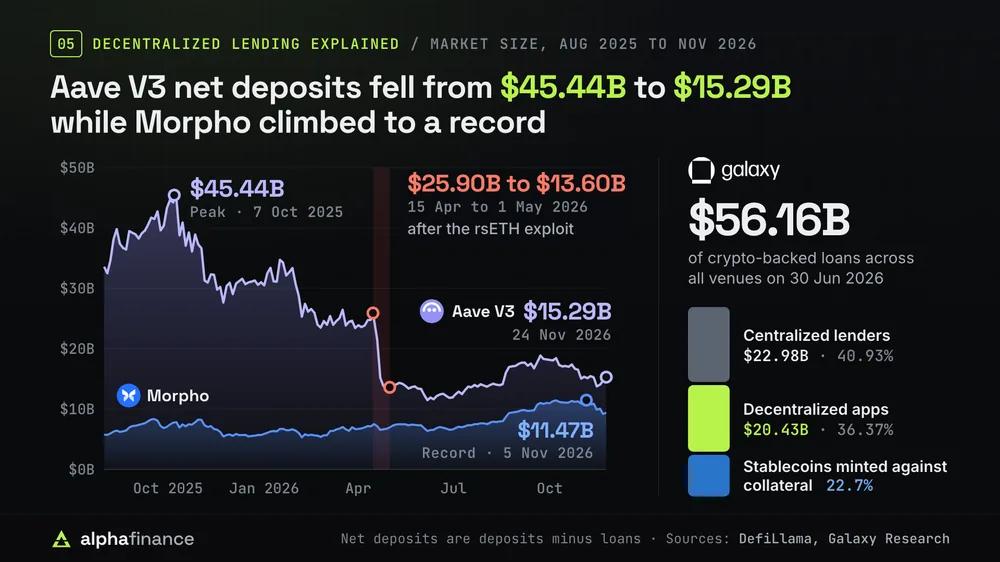
Galaxy Research counted $56.16 billion of crypto-backed loans across all venues on 30 Jun 2026, which was 40.13% below the $78.69 billion record set in the third quarter of 2025. Decentralized lending apps held $20.43 billion of it, a 36.37% share.
Centralized lenders held $22.98 billion, or 40.93%. Galaxy noted it was the first quarter since the third quarter of 2023 in which centralized loans exceeded those on decentralized apps.
The remaining 22.7% was stablecoins minted against crypto collateral, a structure called a collateralized debt position. Counting those, onchain venues still held 59.07% of the market.
Aave's V3 net deposits peaked at $45.44 billion on 7 Oct 2025 and stood at $15.29 billion on 24 Nov 2026, based on DefiLlama's history for the protocol.
Lower crypto prices explain part of the drop, because collateral is counted in dollars. The sharpest fall followed April's rsETH exploit, when net deposits went from $25.90 billion on 15 Apr 2026 to $13.60 billion on 1 May. Our DeFi statistics track the wider market.
Morpho set a record of $11.47 billion in net deposits on 5 Nov 2026. The company says one in every five dollars borrowed onchain is now borrowed through it.
Visa said on 8 Sep 2026 that more than $694 billion of stablecoin loans had passed through onchain lending protocols since 2020, and our stablecoin statistics show where that supply sits.
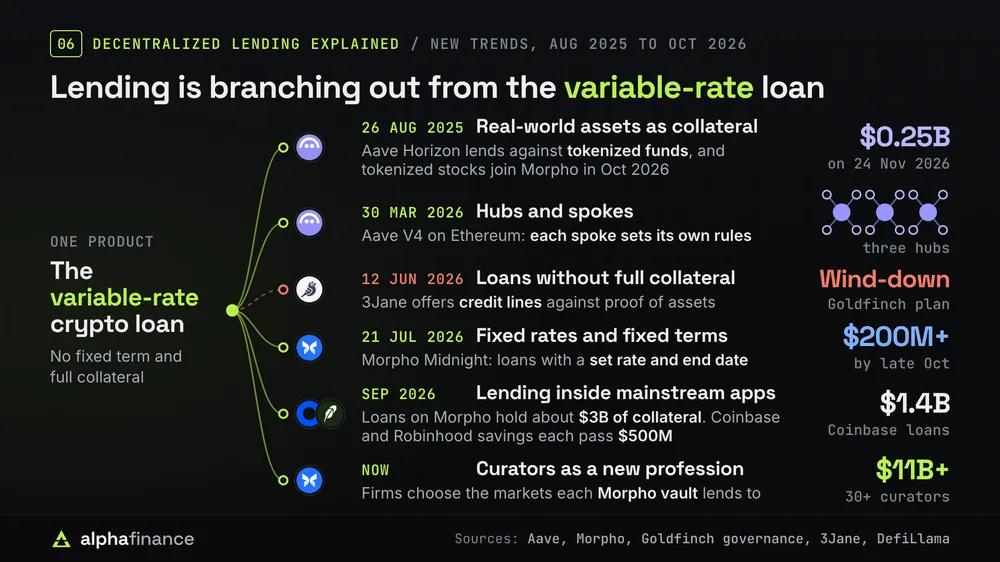
Decentralized lending in 2026 is moving from a single product, the variable-rate crypto loan, to several.
Tokenized collateral is still small next to the assets issued. Our tokenization statistics measure that market, and the tokenized real-world assets board lists the stocks and funds trading onchain.
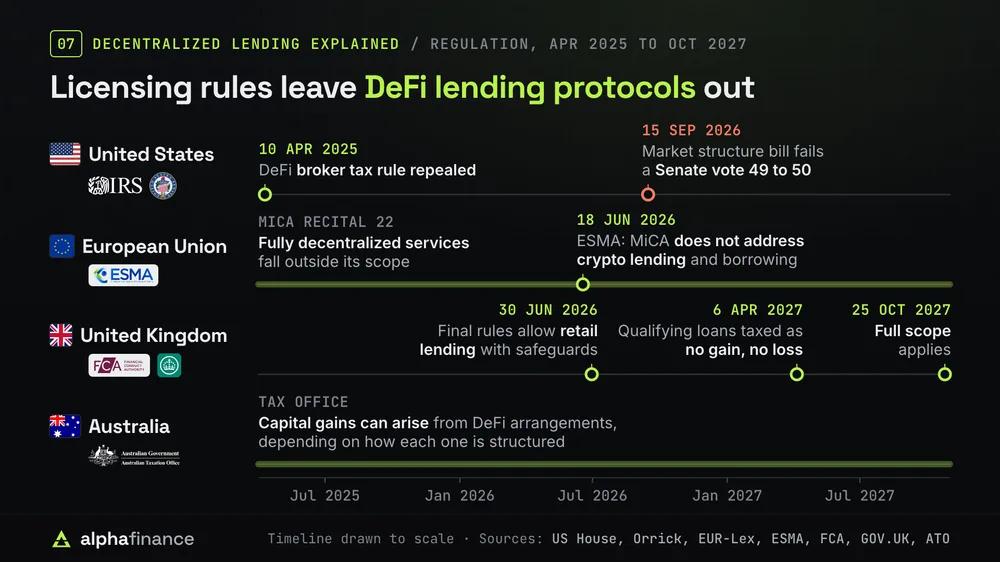
Fully decentralized lending protocols sit outside the main crypto licensing regimes in the US, EU and UK, so users have fewer protections than bank or broker customers. The rules that exist apply mostly to companies that sit between users and the code.
The UK tax authority plans to treat qualifying crypto loans as no gain, no loss from 6 Apr 2027, which defers capital gains tax until the asset is sold.
The European Commission's 2026 review of MiCA asked whether lending, borrowing and DeFi should be brought into scope, according to Freshfields' summary of the consultation.
Lenders and borrowers in decentralized lending can lose part or all of their money, and no deposit insurance scheme covers them.
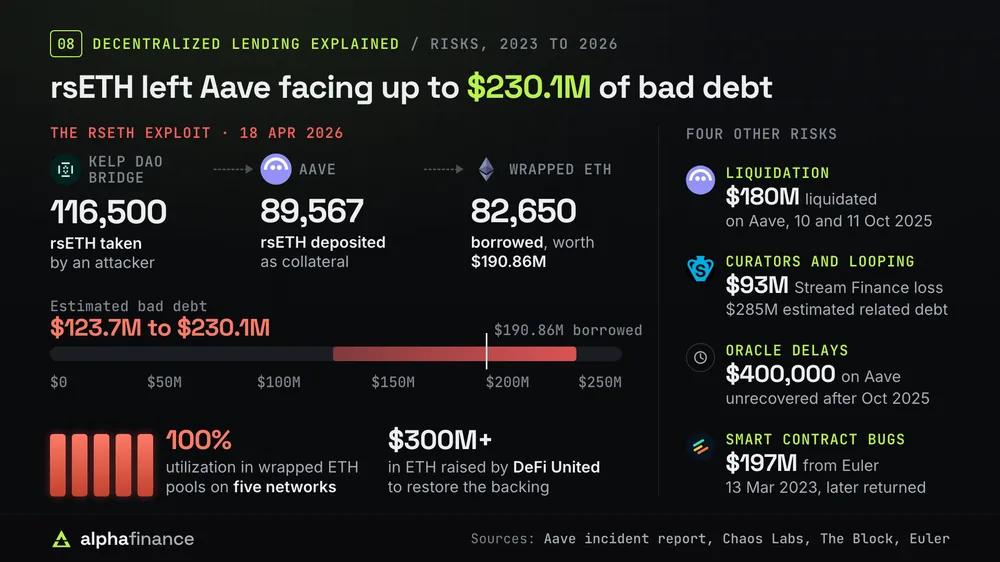
The rsETH case shows how one asset can freeze a whole pool. The incident report says "Aave's smart contracts were not compromised at any point during this event," yet it estimated $123.7 million to $230.1 million of bad debt, the term for loans that collateral can no longer cover.
Wrapped ETH pools on five networks reached 100% utilization, so lenders could not withdraw until borrowers repaid. A group of protocols called DeFi United raised over $300 million in ETH to restore the token's backing, The Block reported on 12 May 2026.
A Bank of Canada staff paper on Aave found in April 2026 that "many users engage in recursive leverage despite overcollateralization requirements" and that liquidations arrive in concentrated waves.
Aave said in a February 2026 review that its Umbrella fund held over $250 million of staked assets that can be used to cover bad debt in its main market, while Morpho vaults pass any loss to depositors in proportion to their share.
Not investment advice
This article explains market data. Nothing on this page is a recommendation to buy, sell or leverage any asset. Digital assets are volatile and you can lose everything you put in. If you are unsure whether a trade is appropriate for you, a licensed adviser in your jurisdiction is the right next step.


Fact checked by
Verifies every figure against primary sources before publication. Meet the team
Decentralized lending is lending and borrowing crypto through smart contracts instead of a bank. Lenders deposit tokens into a pool and earn interest, and borrowers take loans from the pool against collateral worth more than the loan.
Decentralized lending carries risks that bank deposits do not, and no deposit insurance covers it. Lenders can lose money if collateral fails or code is exploited, as happened when the rsETH exploit of 18 Apr 2026 left Aave with an estimated $123.7 million to $230.1 million of bad debt. Borrowers can lose their collateral if its price falls.
Lenders earn the interest that borrowers pay, minus a share kept by the protocol. The rate rises when more of a pool is borrowed and falls when demand for loans drops. On 24 Nov 2026, USDC deposits on Aave V3's Ethereum market earned 2.64% a year.
Almost all decentralized lending requires collateral worth more than the loan, because the protocol cannot check a borrower's identity or income. A few projects, such as 3Jane, offer credit lines without full collateral against proof of a borrower's assets. Maple lends to institutions that pass identity and credit checks, and its loans are still overcollateralized.
A liquidator repays part or all of the debt and receives the borrower's collateral at a discount. On Aave V3 this can happen once the loan's health factor falls below 1, and up to 100% of the debt can be repaid when it reaches 0.95 or lower. The borrower keeps the borrowed tokens and loses the collateral that was sold.
Fully decentralized lending protocols sit outside the main crypto licensing regimes in the US, EU and UK. The EU's MiCA regulation excludes fully decentralized services and does not cover crypto lending, and a US bill that addressed DeFi failed a Senate vote on 15 Sep 2026. The UK will regulate firms that offer crypto lending from 25 Oct 2027.