Markets
 BTC
BTC ETH
ETH BNB
BNB XRP
XRP SOL
SOL ZEC
ZEC HYPE
HYPE DOGE
DOGE LINK
LINK TON
TON AVAX
AVAX SUI
SUI TAO
TAO AAVE
AAVE PUMP
PUMP MORPHO
 ARB
ARB LIT
LIT--:-- UTC
Research/Founders
Hayden Adams' path from a Siemens layoff to building Uniswap, how his UNI fee switch burns tokens, what is known about his net worth and why he is pitching Uniswap to stock markets.
 By Alpha Finance Editorial Team
 Fact-checked by Vince Dioquino
Every figure, platform detail and regulatory claim on this page was traced to a primary source by the named fact checker before publication, and is re-checked when those facts change. The review date moves only when a person has re-read the page.
The editorial policy → Editorial policy Report an errorHayden Adams is the founder and chief executive of Uniswap Labs, the company behind Uniswap. The decentralised exchange lets people swap tokens directly from their crypto wallets. Adams wrote its first version in 2017 and 2018 after losing his first job out of university.
Eight years after launch, his priorities are linking Uniswap's trading fees to UNI and winning trading in tokenised shares and funds. Both efforts gained momentum in 2026. Both also face criticism.
Adams is most closely associated with the automated market maker (AMM), a trading design that uses software to quote prices instead of a professional dealer. Anyone can become a liquidity provider (LP) on Uniswap by depositing two tokens into a shared pool and earning a share of the fees on each trade.
Smart contracts, programs stored on a blockchain, execute trades automatically on a decentralised exchange (DEX). No company holds users' money. Uniswap Labs writes the contracts and builds the app and wallet most people use. These products have served millions of users, according to Adams' profile at the Tech:NYC industry group. Our DEX screener tracks new pairs on Uniswap and rival DEXs across 21 chains.
On 16 Oct 2026, DefiLlama's Uniswap dashboard showed $3.91 billion in total value locked (TVL), the value of tokens deposited in its pools. Ethereum accounted for 64%. Our blockchain data dashboard shows TVL and trading volume for each network where Uniswap operates.
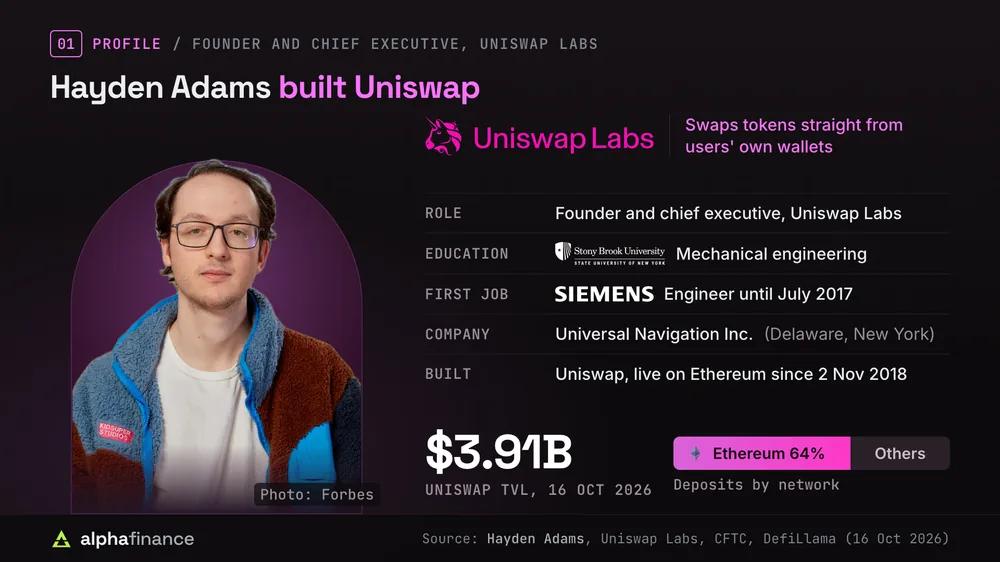
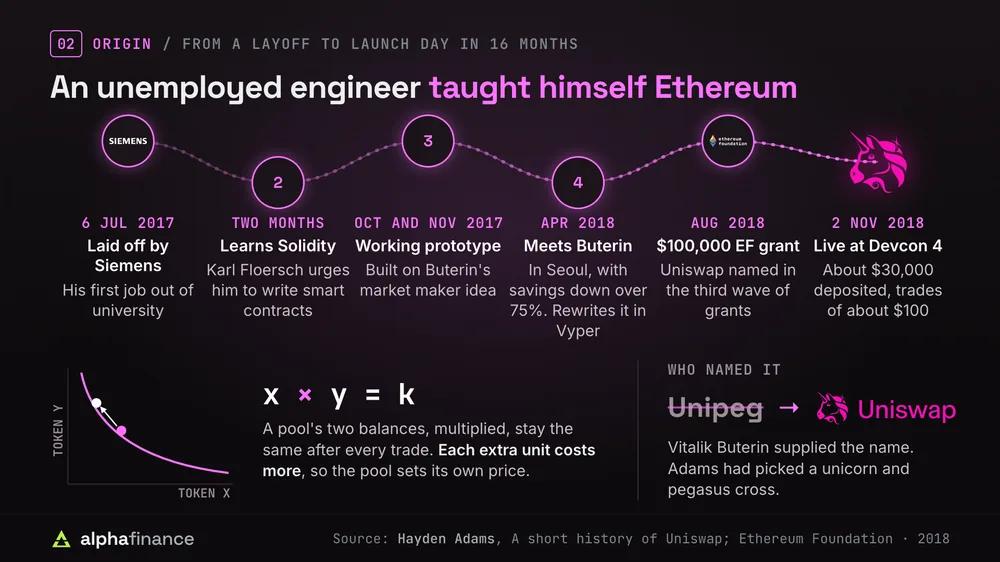
Uniswap began as a learning project while Adams was unemployed. In his history of the project, he dates his Siemens layoff to 6 Jul 2017. Karl Floersch, a friend then working at the Ethereum Foundation, encouraged him to learn smart contract development.
For two months, Adams studied Solidity, Ethereum's main programming language, alongside JavaScript. Floersch then suggested building an automated market maker like the one Ethereum co-founder Vitalik Buterin had described in a June 2017 blog post. Adams credits Gnosis' Alan Lu with first proposing the idea for Ethereum.
The design is known as x*y=k. Multiplying a pool's two token balances must produce the same number after every trade. A purchase reduces one token's balance, making each additional unit more expensive. This rule sets prices without an order book, the list of buy and sell orders used by most exchanges.
A working prototype followed in October and November 2017. Adams lived off crypto he had bought earlier that year, but by April 2018 those savings had fallen more than 75%. At a conference in Seoul, Floersch introduced him to Buterin. Buterin read the contract on his phone and suggested applying for an Ethereum Foundation grant.
Then 24, Adams rewrote the contracts in Vyper, another Ethereum language, on Buterin's advice. In August 2018, the Ethereum Foundation named Uniswap among its third wave of grant recipients, with a $100,000 grant. Buterin also supplied the name. Adams had chosen Unipeg, a cross between a unicorn and a pegasus.
On 2 Nov 2018, the final day of Devcon 4 in Prague, Uniswap went live. According to Adams' account of the launch, a single LP deposited about $30,000 across three tokens, enough to support trades of about $100. Callil Capuozzo, his friend since primary school, designed the interface.
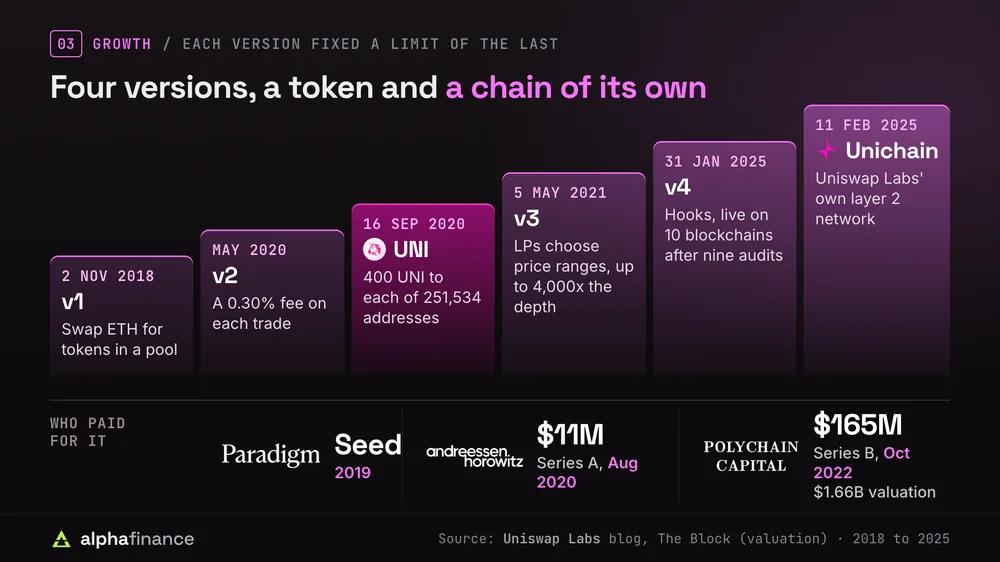
Venture funding paid for the team as successive versions of Uniswap addressed the limits of earlier designs. Paradigm provided seed funding in 2019. Andreessen Horowitz then led an $11 million Series A announced on 6 Aug 2020, funding work on version 3.
UNI launched on 16 Sep 2020, giving holders a vote on protocol changes and treasury spending. Each of the 251,534 addresses that had used Uniswap could claim 400 UNI, according to Uniswap's launch announcement. Of the 1 billion tokens minted, 60% went to the community. Team members and future employees received an allocation of 21.266%, released over four years.
Concentrated liquidity arrived with version 3 on 5 May 2021. LPs could now choose the price range in which their deposits were used. The design announcement said a deposit could provide up to 4,000 times the trading depth of the same amount in version 2, which launched in May 2020.
On 13 Oct 2022, Adams announced a $165 million Series B led by Polychain Capital. His post also noted that UNI holders had voted to create the Uniswap Foundation, with at least $60 million for grants. The funding round valued Uniswap Labs at $1.66 billion, The Block reported.
Version 4 launched across 10 blockchains on 31 Jan 2025 after nine audits and a $15.5 million bug bounty, Uniswap Labs said. Its main addition was hooks, small programs developers can use to change how pools set fees or manage deposits. Pool creation also became up to 99.99% cheaper.
Uniswap Labs launched its own layer 2, Unichain, on 11 Feb 2025. The network processes transactions cheaply and records the results on Ethereum. In October 2025, the company acquired Guidestar, a team developing new AMM and trade-matching technology.
| Date | Event | What it changed |
|---|---|---|
| Jul 2017 | Siemens lays Adams off | He starts learning Ethereum |
| Nov 2018 | Uniswap v1 launches at Devcon 4 | Anyone can swap ETH for tokens in a pool |
| Sep 2020 | UNI token airdropped | Users gain a vote over the protocol |
| May 2021 | Uniswap v3 launches | LPs pick their own price ranges |
| Jan 2025 | Uniswap v4 launches | Hooks let developers customise pools |
| Feb 2025 | SEC closes its investigation | The largest legal threat ends |
| Dec 2025 | UNIfication passes | Fees start burning UNI |
| Aug 2026 | Adams publishes his tokenisation essay | He pitches AMMs for stock markets |
| Oct 2026 | SMBC Nikko signs a Japan DeFi deal | A major broker builds on Uniswap v4 |
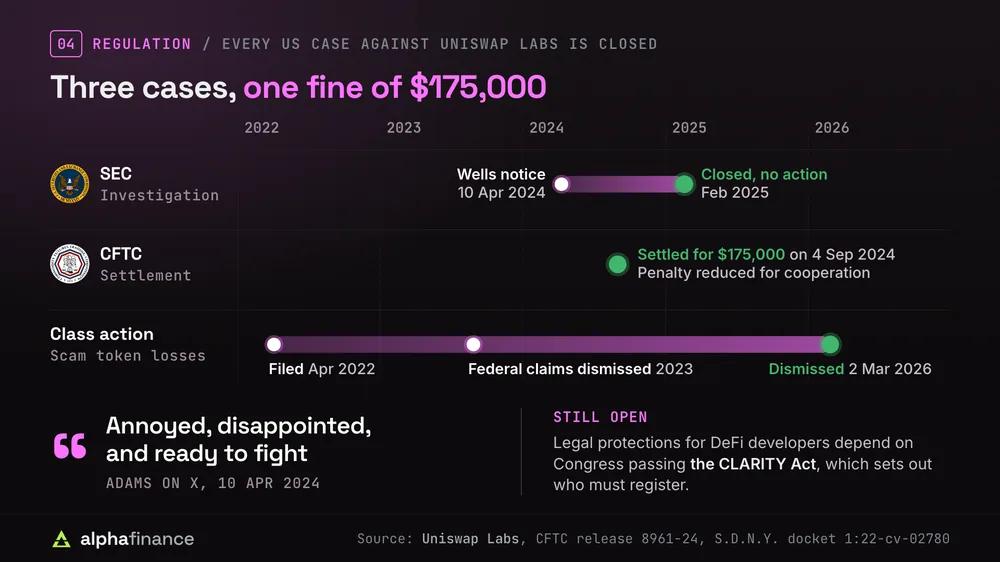
After years of legal disputes, every US case brought against Uniswap Labs is now closed. The most serious threat came from the Securities and Exchange Commission (SEC), which oversees US securities markets.
The SEC sent Uniswap Labs a Wells notice on 10 Apr 2024, formally warning that its staff planned to recommend charges. Adams posted on X that he was "annoyed, disappointed, and ready to fight".
The agency alleged that Uniswap Labs ran an unregistered securities exchange, acted as an unregistered broker or issued an unregistered security. Following a change in SEC leadership, it closed the investigation without action in February 2025, Uniswap Labs said.
A separate case led to a penalty. The Commodity Futures Trading Commission (CFTC), the US derivatives regulator, fined Uniswap Labs $175,000 on 4 Sep 2024. Its interface had offered leveraged tokens from an unrelated issuer that gave retail users about twice the price exposure to bitcoin or ether. Uniswap Labs' cooperation reduced the fine.
The longest dispute began in April 2022. Investors who had lost money on scam tokens traded through Uniswap sued the company and Adams. Federal securities claims were dismissed in 2023, and an appeals court upheld the ruling. Judge Katherine Polk Failla then dismissed the remaining state claims with prejudice on 2 Mar 2026, comparing Uniswap to stock exchanges that are not liable for frauds carried out on them.
In his November 2025 governance proposal, Adams described a "hostile regulatory environment under Gensler's SEC" that had since eased. Legal protections for developers of decentralised finance (DeFi), financial apps built on smart contracts, still depend on Congress passing the CLARITY Act. The market structure bill defines who must register and who is exempt.
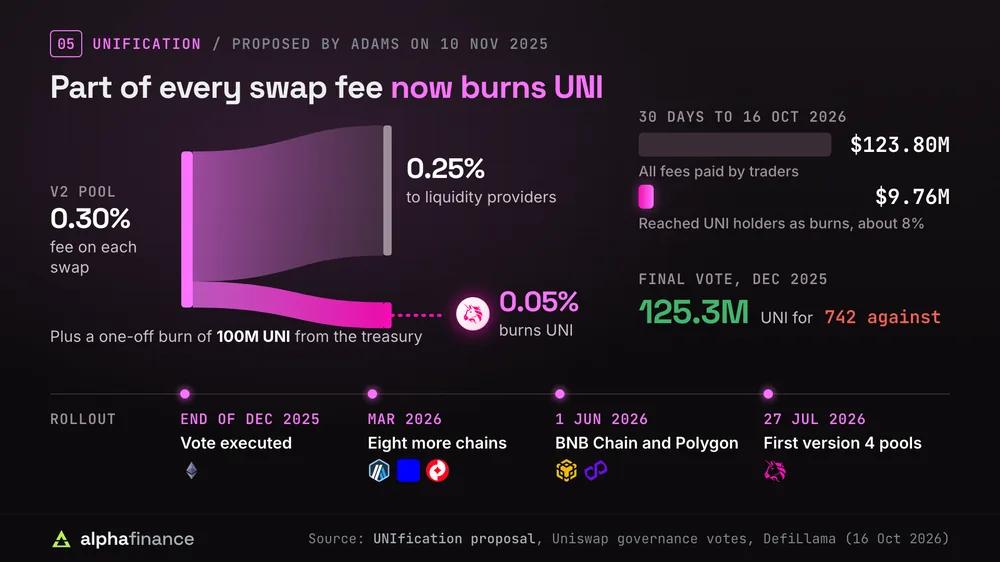
Part of each trading fee began funding UNI burns in late 2025, marking Adams' biggest change to Uniswap's economics. Previously, LPs received all swap fees. UNI holders earned nothing from the trading they governed.
The fee switch had existed since UNI's launch in 2020. It allowed a share of fees to go to the protocol, but activation required a token holder vote. On 10 Nov 2025, Adams and Uniswap Foundation leaders Ken Ng and Devin Walsh published the UNIfication proposal.
Most Foundation staff would move to Uniswap Labs, while Adams and Capuozzo would join the Foundation's board. The final onchain vote closed with about 125.3 million UNI in favour and 742 against. It was executed at the end of December 2025.
Votes executed in March 2026 extended protocol fees to eight more chains, including Arbitrum, Base and OP Mainnet. A proposal executed on 1 Jun 2026 added BNB Chain and Polygon. The first set of version 4 pools began charging protocol fees on 27 Jul 2026.
The one-sentence version
Part of each Uniswap swap fee funds UNI burns, leaving each remaining token as a larger share of a smaller supply.
Burns remain small relative to total fees. In the 30 days to 16 Oct 2026, pools generated $123.80 million in fees, of which $9.76 million reached UNI holders through burns, DefiLlama data shows. Over the past year, pools earned $948.60 million in fees, and holders have received $57.57 million since the fee switch went live. Our highest-earning crypto projects ranking shows Uniswap's position.
Tokenised assets, shares and funds recorded as blockchain tokens, are central to Adams' argument that AMMs can attract the world's biggest markets. He outlined that case in Correlated Pairs: How AMMs Win the Biggest Markets, published on 18 Aug 2026, writing that "tokenization's folly moment is ending".
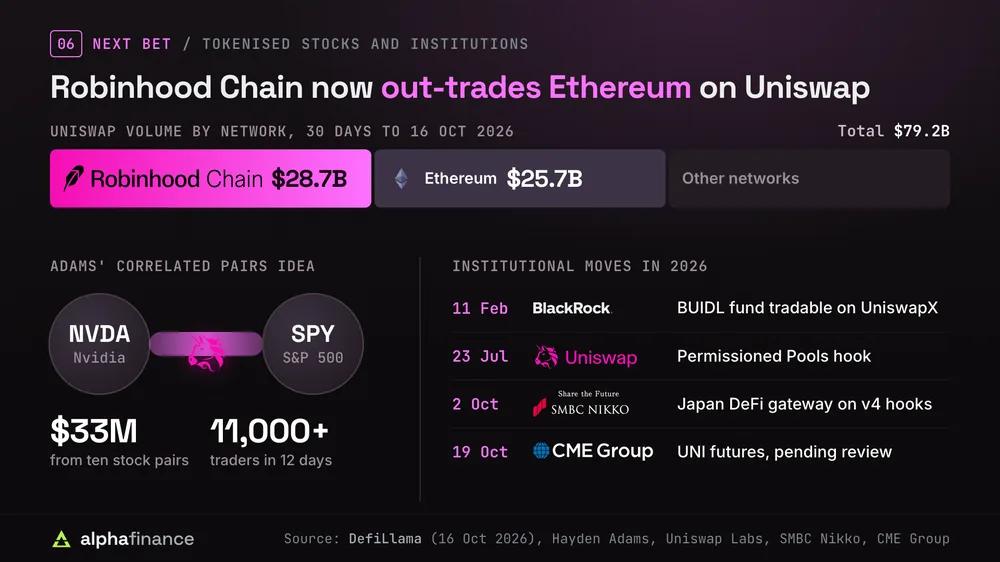
Pools work best when their two tokens move together, limiting the LP's loss when one price diverges from the other. Adams expects tokenised stocks to trade against index funds rather than dollars, pairing Nvidia with the S&P 500 fund SPY, for example. Someone holding both could supply liquidity cheaply and undercut trading firms that pay to hedge, or offset, their price risk.
He cited ten tokenised stocks paired against SPY on Robinhood Chain as evidence. In their first 12 days, the pools handled $33 million in volume from more than 11,000 traders. By mid-October, Robinhood Chain accounted for $28.7 billion of Uniswap's $79.2 billion in 30-day volume, exceeding Ethereum's $25.7 billion, according to DefiLlama. Our real-world assets dashboard tracks the market value of tokenised stocks, commodities and funds.
Pons, a rival token launch platform, said Uniswap Labs bought its token "for long-term alignment", The Defiant reported. The purchase came about four weeks after Uniswap Labs opened its own launchpad on Robinhood Chain. Its size was not disclosed.
On 11 Feb 2026, BlackRock's tokenised Treasury fund, BUIDL, became tradable through UniswapX, Uniswap Labs' order-matching system. Investors need at least $5 million in assets to access it. BlackRock also bought an undisclosed amount of UNI, Fortune reported.
Our tokenisation statistics collect growth figures for tokenised assets.
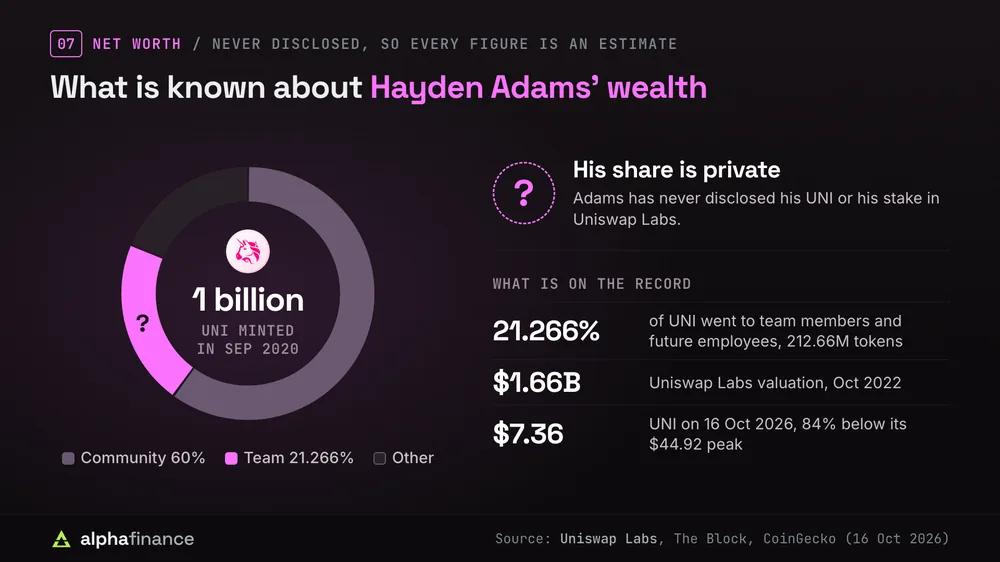
Hayden Adams has never disclosed his UNI holdings or his ownership stake in Uniswap Labs. Nobody outside the company knows his net worth, and published figures are estimates.
His UNI allocation came from the 212.66 million tokens reserved for team members and future employees. That pool represented 21.266% of the original supply and was released over four years from September 2020. Its division has never been published. The annual 20 million UNI growth budget goes to the company itself.
The October 2022 funding round last priced his equity, valuing Uniswap Labs as a whole at $1.66 billion.
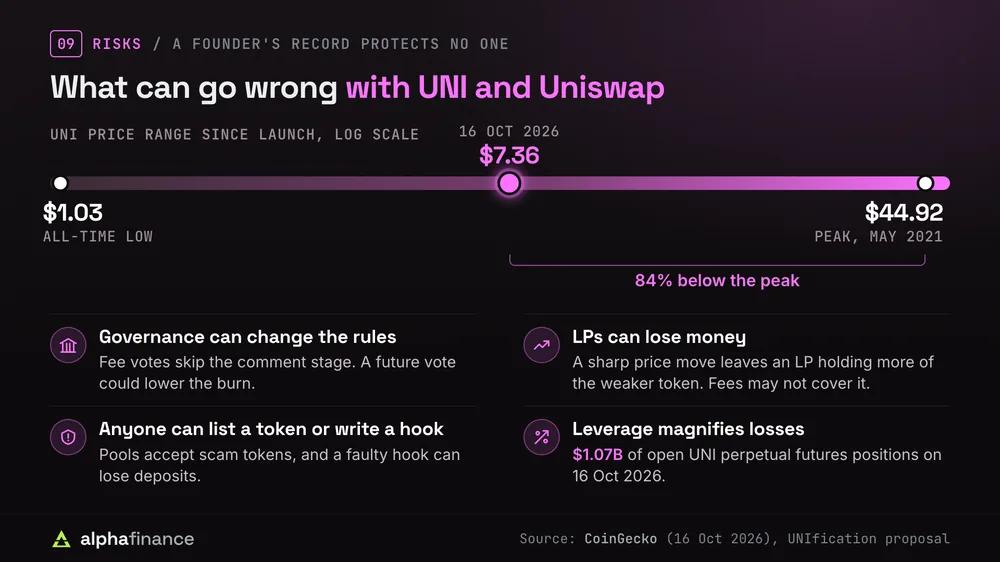
According to CoinGecko's UNI page, UNI traded at $7.36 on 16 Oct 2026. Its $4.59 billion market value placed it 25th among crypto assets, with the price 84% below its May 2021 peak of $44.92. Our prices page ranks UNI among the 100 largest coins by market value.
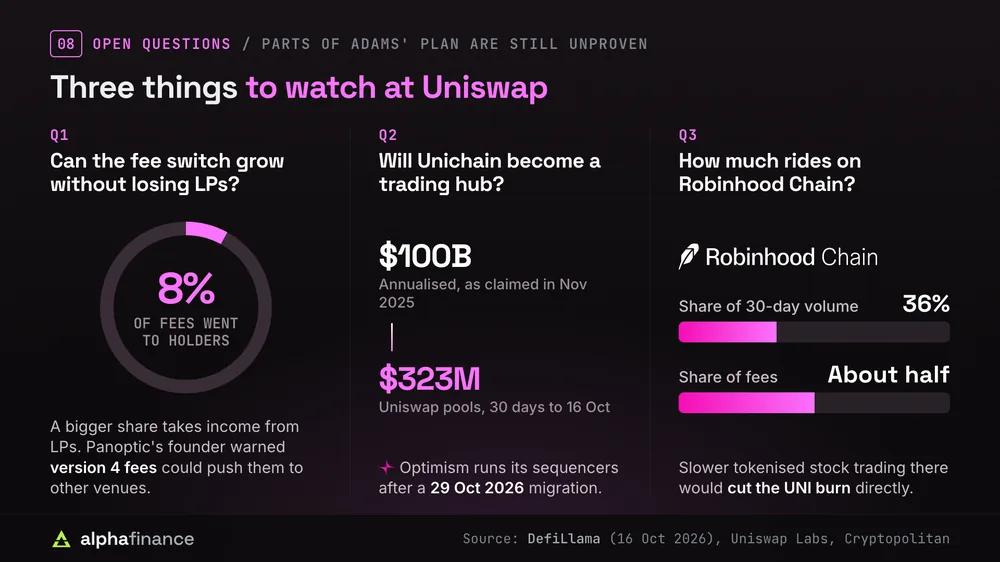
How much the fee switch can capture before LPs leave remains unproven.
About 8% of fees reached holders in the latest 30 days. Increasing that share would reduce LP income. In July 2026, Panoptic founder Guillaume Lambert warned that protocol fees on version 4 could drive LPs to other venues, Cryptopolitan reported.
Unichain has yet to become the trading hub Uniswap Labs intended. In November 2025, the company said the network handled about $100 billion in annualised trading across its exchanges. Uniswap's own pools on the network recorded $323 million in the 30 days to 16 Oct 2026, DefiLlama data shows. Following a migration on 29 Oct 2026, Optimism will operate Unichain's sequencers, the computers that order transactions.
Growth also depends heavily on Robinhood Chain. The network generated 36% of 30-day volume and about half of the $123.80 million in fees, according to DefiLlama's chain breakdown. Slower tokenised stock trading there would directly reduce burns.
A founder's track record offers no protection to someone buying UNI or depositing tokens in a pool.
Not investment advice
This article explains market data. Nothing on this page is a recommendation to buy, sell or leverage any asset. Digital assets are volatile and you can lose everything you put in. If you are unsure whether a trade is appropriate for you, a licensed adviser in your jurisdiction is the right next step.


Fact checked by
Verifies every figure against primary sources before publication. Meet the team
Hayden Adams founded Uniswap Labs and serves as its chief executive. The company builds the Uniswap decentralised exchange. He previously worked as a mechanical engineer at Siemens and taught himself Ethereum smart contract development after being laid off in 2017, according to his own account. Uniswap launched on 2 Nov 2018.
Hayden Adams built Uniswap using an automated market maker design Vitalik Buterin had written about. Karl Floersch introduced him to Ethereum, while Callil Capuozzo designed the interface. An Ethereum Foundation grant funded the project's formal security review.
Adams has not disclosed his net worth. Published figures estimate the value of his UNI holdings and stake in Uniswap Labs, which was last valued at $1.66 billion in 2022. Team members and future employees shared 21.266% of UNI's original supply, but his allocation remains private.
Adams remains Uniswap Labs' founder and chief executive, according to his Tech:NYC profile. He also joined the Uniswap Foundation's board under the UNIfication proposal.
The SEC did not sue Uniswap Labs. It issued a Wells notice in April 2024 warning of possible charges, then closed the investigation without action in February 2025. Uniswap Labs settled a separate CFTC case concerning leveraged tokens for $175,000 in 2024.
The fee switch directs part of each swap fee to the protocol rather than LPs. Those fees have funded UNI burns since UNIfication passed in December 2025. According to DefiLlama, holders received $9.76 million through burns in the 30 days to 16 Oct 2026.