Markets
 BTC
BTC ETH
ETH BNB
BNB XRP
XRP SOL
SOL ZEC
ZEC HYPE
HYPE DOGE
DOGE LINK
LINK TON
TON AVAX
AVAX SUI
SUI TAO
TAO AAVE
AAVE PUMP
PUMP MORPHO
 ARB
ARB LIT
LIT--:-- UTC
Research/Platform guides
Pump.fun's restricted countries, how the block works, why UK users are shut out, and what a New York court, Québec's regulator and EU law mean for traders elsewhere.
 By Alpha Finance Editorial Team
 Fact-checked by Vince Dioquino
Every figure, platform detail and regulatory claim on this page was traced to a primary source by the named fact checker before publication, and is re-checked when those facts change. The review date moves only when a person has re-read the page.
The editorial policy → Editorial policy Report an errorPump.fun's restricted countries are the United Kingdom, Russia, Belarus and every comprehensively sanctioned country, and users there cannot access its memecoin launchpad. The United States, the European Union, Canada and Australia are not on its prohibited list.
Anyone can create a memecoin on the Solana blockchain through Pump.fun in a few clicks. These tokens derive their price from attention and community, without giving holders a claim on a business's income.
Regulatory scrutiny includes warnings and lawsuits, alongside rules that may apply to the products Pump.fun keeps adding. Québec's regulator warned against the platform on 25 Sep 2026, weeks after a New York judge allowed racketeering claims against its founders to proceed.
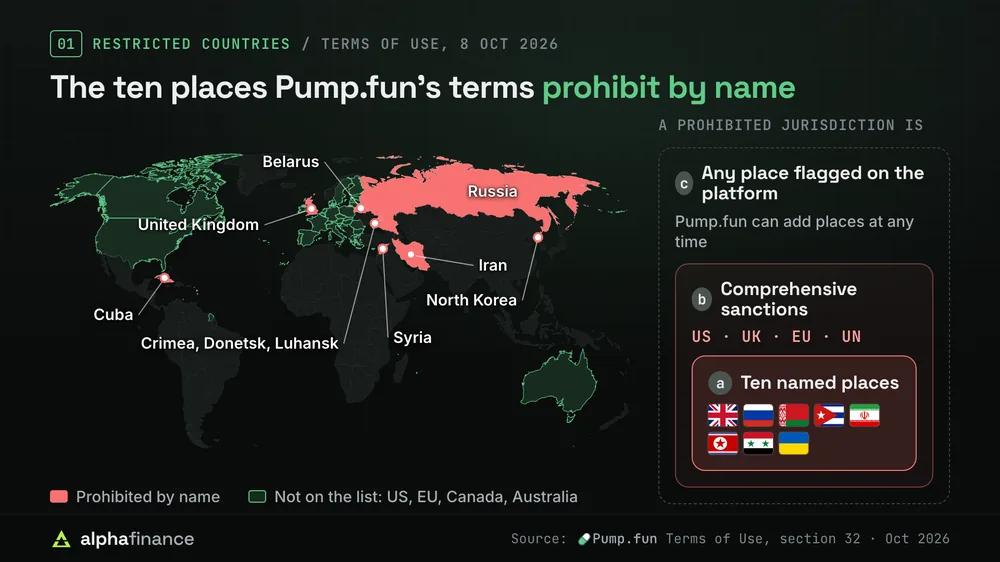
Pump.fun's terms name ten prohibited jurisdictions. Anyone located, resident or incorporated in one of them cannot use the platform.
Last updated on 8 Oct 2026, Pump.fun's Terms of Use define a Prohibited Jurisdiction in three parts. Alongside the named list, the definition covers any country or territory under comprehensive US, UK, EU or UN sanctions. It also includes places Pump.fun marks as prohibited on its platform.
| Jurisdiction | Reason it is excluded | Named in the terms? |
|---|---|---|
| United Kingdom | Regulatory, after an FCA warning | Yes |
| Russia and Belarus | Sanctions | Yes |
| Cuba, Iran, North Korea and Syria | Comprehensive sanctions | Yes |
| Crimea, Donetsk and Luhansk regions of Ukraine | Comprehensive sanctions | Yes |
| Other comprehensively sanctioned places | US, UK, EU or UN sanctions | Described only |
| Places flagged on the platform | Pump.fun's own decision | Not listed |
All users must be at least 18 and of legal age in their country. Local law still applies, so the absence of a country from the list does not permit users to access Pump.fun if doing so would be unlawful.
The operator, Baton Corporation Ltd, was incorporated in England on 20 Mar 2023 and has its registered office in Mildenhall, Suffolk, according to Companies House records. Its terms are governed by British Virgin Islands law.
Pump.fun uses technical signals to determine a user's location and treats its decision as final. Its terms allow it to assess eligibility using geolocation, IP address, device, wallet and transaction data.
Certain products, called Restricted Features, have separate country limits. Access to the platform therefore does not guarantee access to every feature.
Token holder rewards undergo sanctions and anti-money laundering screening. Wallets linked to a Prohibited Jurisdiction or to people on US, UK, EU or UN sanctions lists permanently lose those rewards. Pump.fun is not required to explain why it excluded a wallet.
A virtual private network (VPN) hides where a connection originates. Using one to bypass Pump.fun's controls is prohibited by its terms.
The restrictions cover VPNs, proxies, location spoofing and linked accounts used to evade jurisdiction or sanctions checks. A separate clause prohibits accessing a Restricted Feature through someone else's wallet or a nominee.
Restricted users who connect through a VPN breach the contract they accepted. Pump.fun can suspend their access and cancel undistributed rewards.
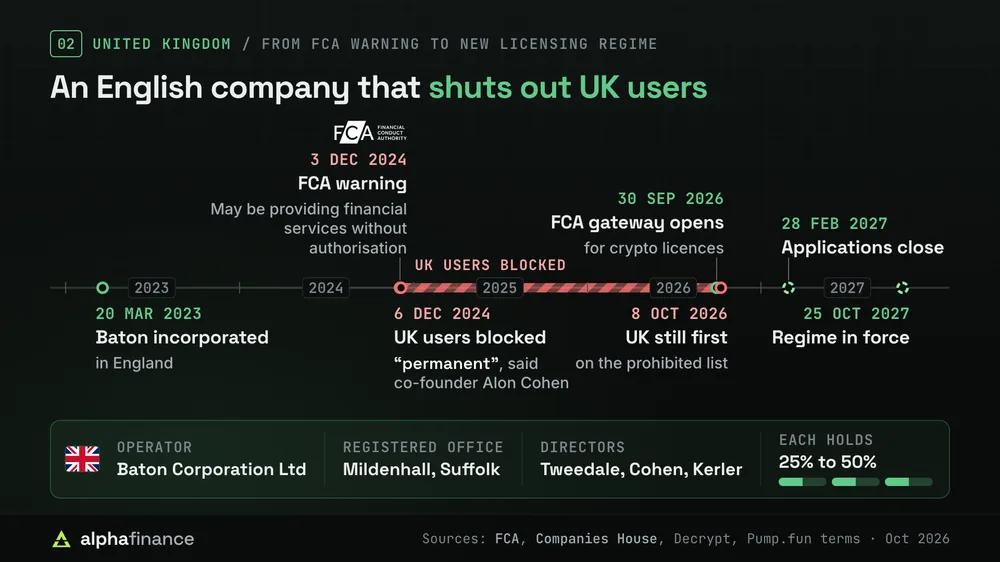
Pump.fun blocked UK users after the country's financial regulator said it lacked permission to operate there.
On 3 Dec 2024, the Financial Conduct Authority (FCA) added Pump.fun to its warning list, saying the platform may be providing financial services without authorisation. UK users therefore cannot complain to the Financial Ombudsman Service or claim compensation if it fails.
The platform blocked UK access and revised its terms on 6 Dec 2024, three days after the warning. Co-founder Alon Cohen told Decrypt the UK block was "permanent". The United Kingdom remains first on the named list in the October 2026 terms.
Pump.fun's operator is itself an English company. Companies House records show that each of its three directors, Noah Tweedale, Alon Cohen and Dylan Kerler, holds between 25% and 50% of its shares.
For the UK's new crypto licensing regime, the FCA opened its authorisation gateway on 30 Sep 2026. Applications close on 28 Feb 2027, and the regime takes effect on 25 Oct 2027. Crypto trading platforms serving UK customers will need FCA authorisation. The new rules will also cover insider dealing and market manipulation.
UK readers can compare the crypto exchanges available in the UK in the meantime.
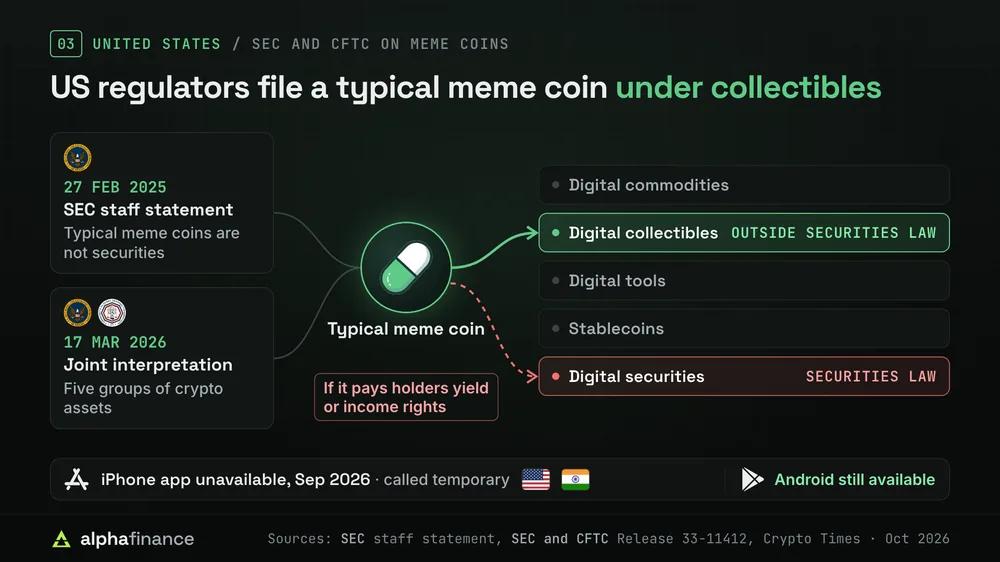
A typical memecoin is currently treated by US regulators as a collectible outside securities law. Pump.fun's terms do not restrict Americans.
Staff at the Securities and Exchange Commission (SEC) said on 27 Feb 2025 that transactions in typical meme coins do not involve securities. Their statement on meme coins warned that buyers consequently receive no protection under federal securities laws. Staff statements have no legal force.
A formal SEC interpretation followed on 17 Mar 2026, joined by the Commodity Futures Trading Commission (CFTC). The joint SEC and CFTC interpretation divides crypto assets into digital commodities, digital collectibles, digital tools, stablecoins and digital securities. Stablecoins are tokens pegged to a currency such as the dollar.
Under the interpretation, meme coins are typically bought for artistic, entertainment, social and cultural reasons. Digital collectibles generally fall outside securities laws.
Both documents draw a boundary relevant to Pump.fun's newer reward features. Tokens that pay holders yield or grant rights to future income start to resemble securities again.
In September 2026, Pump.fun's iPhone app became unavailable to download from the US and Indian App Stores. A mobile lead at Pump.fun described the removal as temporary on 10 Sep 2026, without giving a cause, according to Crypto Times' report. Existing users retained their apps and funds. The app remained available to Android users through Google Play.
Congress has yet to settle these categories in law. Our explainer on the CLARITY Act covers the market structure bill that would do so.
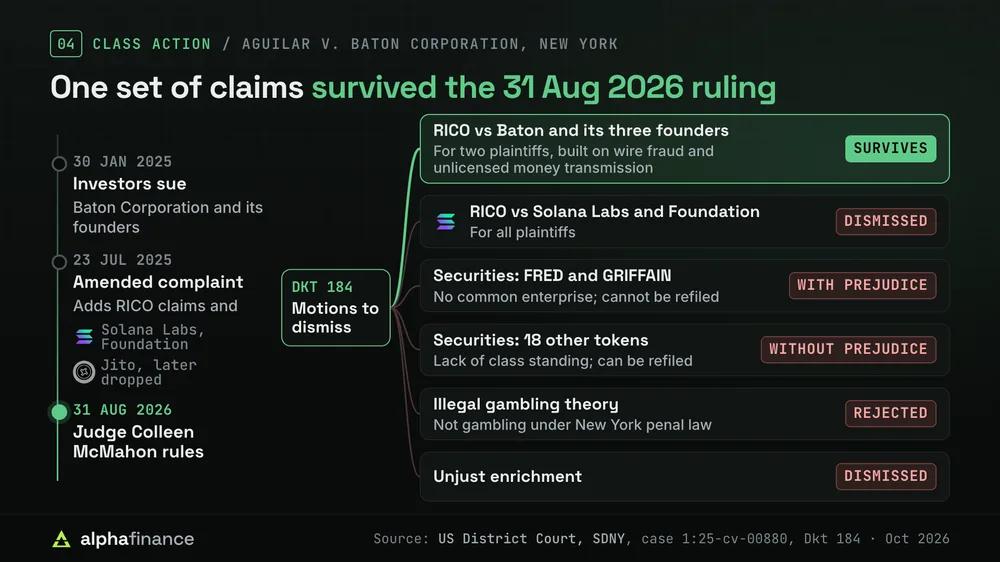
In 2026, a federal judge in New York allowed racketeering claims against Pump.fun's operator and founders to proceed while dismissing the remaining claims.
Investors who lost money on Pump.fun tokens brought the case against Baton Corporation and its founders in the Southern District of New York in January 2025. Filed on 30 Jan 2025, the Aguilar complaint alleged that tokens sold through the platform were unregistered securities.
The consolidated amended complaint, filed on 23 Jul 2025, added Solana Labs, the Solana Foundation and Solana infrastructure company Jito. It also introduced claims under the Racketeer Influenced and Corrupt Organizations Act (RICO), a federal law against organised fraud that allows private plaintiffs to sue. Plaintiffs later dropped Jito.
Judge Colleen McMahon ruled on the motions to dismiss in an opinion and order filed on 31 Aug 2026.
| Claim | Outcome |
|---|---|
| Securities claims over FRED and GRIFFAIN tokens | Dismissed with prejudice, so they cannot be refiled; no common enterprise under the Howey test for investment contracts |
| Securities claims over 18 other tokens | Dismissed without prejudice, so they can be refiled; lack of class standing |
| RICO claims against Solana Labs and Solana Foundation | Dismissed for all plaintiffs |
| RICO claims against Baton and its three founders | Survive for two plaintiffs, built on wire fraud and unlicensed money transmission |
| Illegal gambling theory | Rejected under New York law |
| Unjust enrichment | Dismissed |
For Pump.fun's regulation, the gambling ruling matters most. Plaintiffs characterised the platform as an illegal casino, but the court held that the token trades were not gambling under New York's penal law.
The decision determines which claims can proceed, without establishing liability. No court has found Pump.fun or its founders liable. In a 2 Sep 2026 update, plaintiff co-counsel Wolf Popper listed the case as pending.
Pump.fun's terms allow users in Canada, the EU and Australia to access the platform. Québec has warned residents against it, while its status under EU law remains unclear.
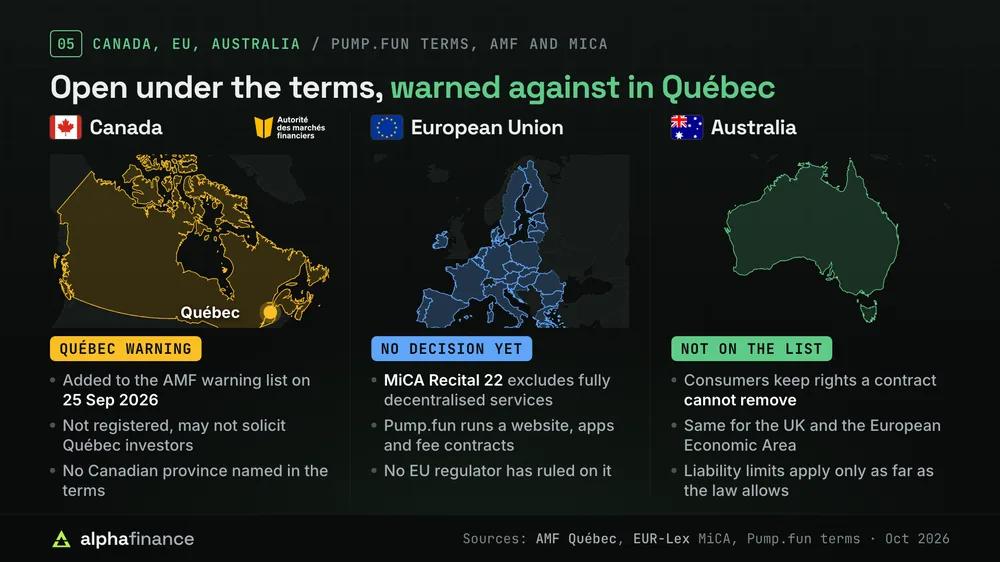
On 25 Sep 2026, Québec's Autorité des marchés financiers (AMF) added Pump.fun to its warning list as a high-risk crypto-asset platform.
The AMF says Pump.fun is not registered with it and may not solicit Québec investors. Its warning also identifies Baton Corporation as another name the platform uses. No Canadian province is named in Pump.fun's terms.
The EU's Markets in Crypto-Assets Regulation (MiCA) governs licensing for crypto firms in the bloc. Recital 22 of MiCA excludes services operated in a fully decentralised way without an intermediary.
Crypto-assets without an identifiable issuer are also exempt from its rules for issuers and public offers. Firms providing services in those assets remain covered.
An EU regulator could argue that Pump.fun acts as an intermediary because it operates a website, apps and fee-collecting contracts. No EU regulator has published a decision on the platform. EU readers can compare MiCA-licensed crypto exchanges.
Consumers in the UK, the European Economic Area and Australia retain any legal rights that a contract cannot remove, according to Pump.fun's terms. Its liability limits apply only to the extent those laws permit.
Pump.fun's newer products give memecoins features that bring them closer to securities or regulated investments.
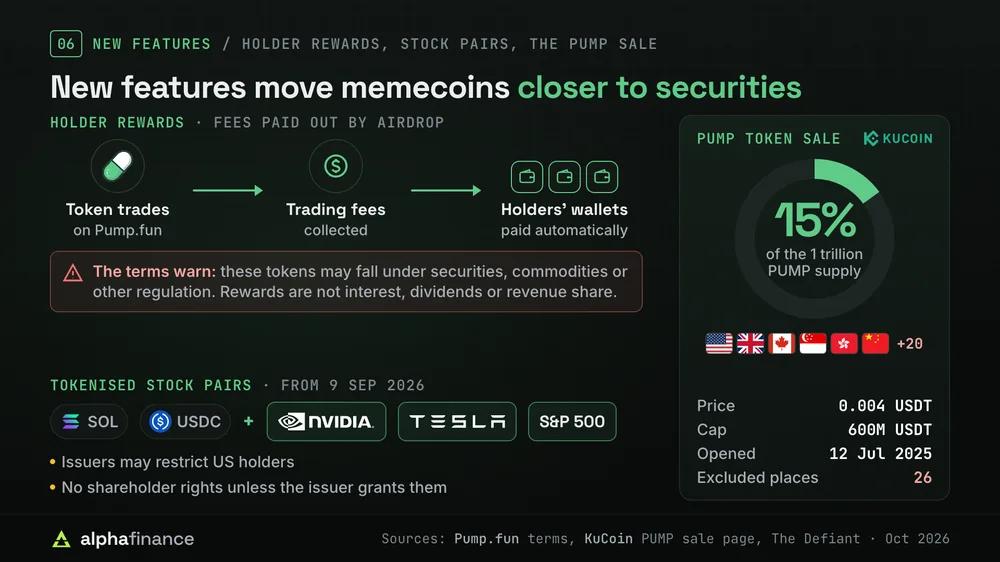
Holder rewards automatically distribute a token's trading fees to wallets holding it. Pump.fun's terms warn that tokens with these rewards may fall under securities, commodities or other regulation. The terms also state that rewards are not interest, dividends or revenue share, and can be withheld at any time.
Both the SEC's 2025 staff statement and its 2026 interpretation link income paid to holders with securities, matching the boundary reflected in Pump.fun's warning.
New tokens can no longer launch in Pump.fun's earlier cashback mode, which paid fees to a token's eligible users.
From 9 Sep 2026, creators could price new Pump.fun tokens in assets beyond SOL, Solana's native token, and the dollar stablecoin USDC. Options include tokenised versions of Nvidia, Tesla and the S&P 500, according to The Defiant's report on custom pairs. A tokenised stock claims to track a share price.
Issuers of these stock tokens may restrict who can hold them, including people in the United States, the terms warn. Pump.fun leaves users to confirm their eligibility rather than checking it. Holding a stock token confers no shareholder rights unless the issuer grants them.
The PUMP token sale restricted more countries than the platform. KuCoin's PUMP sale page offered tokens from 12 Jul 2025 at 0.004 USDT each. USDT is another dollar stablecoin.
The sale capped purchases at 600 million USDT for 15% of PUMP's 1 trillion supply. Among its 26 excluded places were the United States, the United Kingdom, Canada, Singapore, Hong Kong and mainland China.
Our upcoming token unlocks tracker covers PUMP's later supply releases. To compare Pump.fun's fee income with other protocols, see our crypto project revenue rankings.
Token creators can broadcast live video under Pump.fun's livestream moderation policy. The policy prohibits streamers under 18 and bans sexual content, violence, harassment, publishing people's private details and illegal activity.
A breach can result in a stream being ended or an account being banned. Pump.fun may also report it to law enforcement.
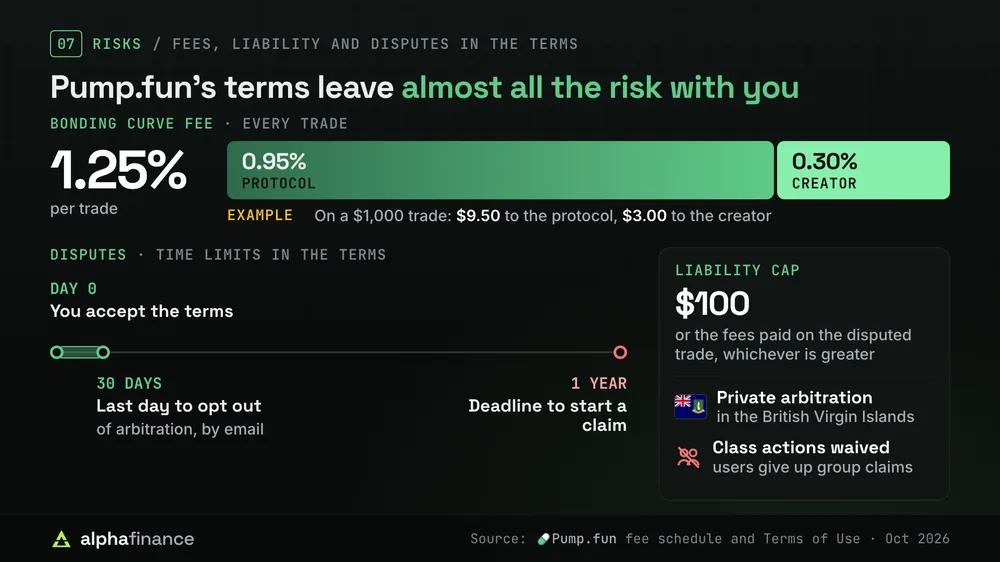
Most memecoins can quickly lose all their value. Pump.fun's terms place almost all of that risk on the user.
According to Pump.fun's fee schedule, each trade on a token's bonding curve costs 1.25%. The bonding curve is the pricing formula that increases the price as more tokens are bought. Of the fee, 0.95% goes to the protocol and 0.30% to the token's creator.
Our DEX screener flags risks on new token pairs across decentralised exchanges (DEXs), where users trade directly from a wallet.
Pump.fun caps its liability at the greater of $100 or the fees paid on the disputed trade. Its terms require private arbitration in the British Virgin Islands and waive class actions. Claims must begin within one year. Users can opt out of arbitration by emailing Pump.fun within 30 days of accepting the terms.
Some exchanges also offer PUMP perpetual futures. These contracts track the token's price without an expiry date and allow traders to borrow to enlarge a position, known as leverage.
When a leveraged position is forcibly closed in a liquidation, traders can lose their entire margin, the collateral used to open it. The PUMP liquidation heatmap shows where leveraged positions in the token would be forced to close.
Not investment advice
This article explains market data. Nothing on this page is a recommendation to buy, sell or leverage any asset. Digital assets are volatile and you can lose everything you put in. If you are unsure whether a trade is appropriate for you, a licensed adviser in your jurisdiction is the right next step.


Fact checked by
Verifies every figure against primary sources before publication. Meet the team
Pump.fun blocks UK users and lists the United Kingdom first among its prohibited jurisdictions. The block began on 6 Dec 2024, three days after the FCA warned that the platform was operating without authorisation. UK users of an unauthorised firm cannot access the Financial Ombudsman Service or compensation scheme.
US residents can use Pump.fun under its terms dated 8 Oct 2026, which do not list the United States as a prohibited jurisdiction. In February 2025, SEC staff said typical meme coins are not securities. Pump.fun's iPhone app was removed from the US App Store in September 2026, a removal the platform described as temporary.
Using a VPN, proxy or location spoofing to bypass country or sanctions checks violates Pump.fun's terms. Users from prohibited places who connect this way breach those terms. The platform can suspend their wallet and cancel unpaid rewards.
The UK's FCA issued a warning on 3 Dec 2024. Québec's AMF followed on 25 Sep 2026. Both said Pump.fun lacked permission to serve local users. A US court is separately hearing a private class action against the operator.
Investors sued Baton Corporation, Pump.fun's operator, and its founders in New York in January 2025. They later added racketeering claims. On 31 Aug 2026, the judge dismissed the securities claims and all claims against Solana Labs and the Solana Foundation. Racketeering claims against Baton and its three founders remain pending. No court has found them liable.