Markets
 BTC
 ETH
 BNB
 XRP
 SOL
 ZEC
 HYPE
 DOGE
 LINK
 TON
 AVAX
 SUI
 TAO
 AAVE
 PUMP
 MORPHO
 ARB
 LIT
--:-- UTC
Research/Founders
Anatoly Yakovenko's path from Qualcomm engineer to Solana co-founder, how proof of history works, what the Alpenglow upgrade changed and how his net worth is estimated.

 By Alpha Finance Editorial Team
 Fact-checked by Vince Dioquino
Every figure, platform detail and regulatory claim on this page was traced to a primary source by the named fact checker before publication, and is re-checked when those facts change. The review date moves only when a person has re-read the page.
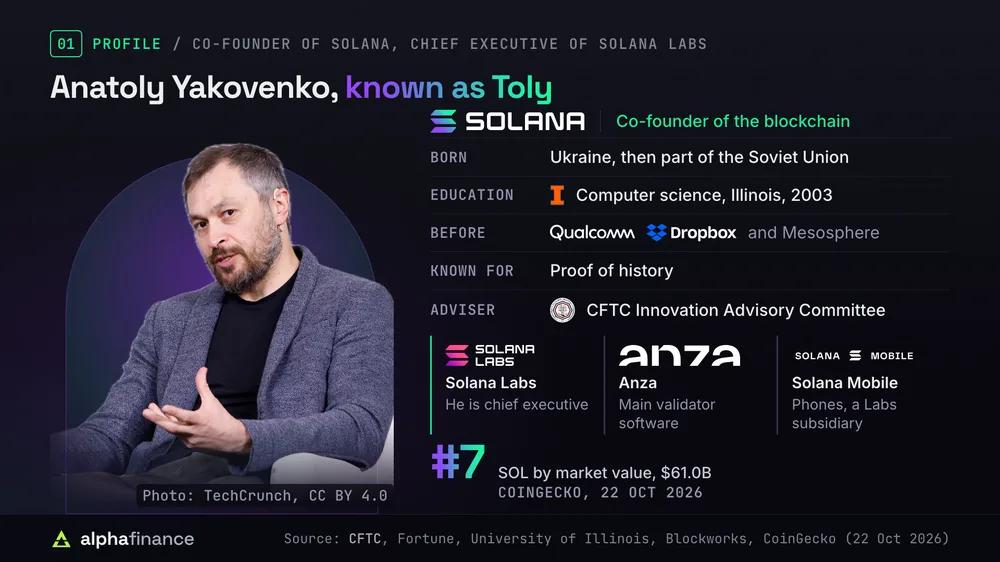
The editorial policy → Editorial policy Report an errorAnatoly Yakovenko co-founded Solana and serves as chief executive of Solana Labs, the company that wrote the blockchain's first software. Known to developers and traders as Toly, he proposed the cryptographic clock called proof of history in 2017. It gave Solana both its speed and its identity.
Solana replaced the voting system built around that clock on 21 Oct 2026. According to the Solana Foundation's Alpenglow page, the upgrade cut the time to final settlement from about 12.8 seconds to a target of 150 milliseconds. Yakovenko supported the change, though he argued the day before launch that it could have shipped in half the time.
Yakovenko's engineering decisions continue to shape Solana's operation and what it promises users. Solana is a layer 1 blockchain, a base network that records and settles its own transactions. Under its proof-of-stake system, validators, the computers that check and record transactions, lock up SOL as a security deposit.
On 22 Oct 2026, SOL ranked seventh among crypto assets, with a market value of $61.0 billion, according to CoinGecko's Solana page. Our live crypto prices table tracks it alongside the other 99 largest coins.
Responsibility for Solana is spread across several organisations. Yakovenko leads Solana Labs, where the Commodity Futures Trading Commission lists him as chief executive. The main validator software is now built by Anza, a developer firm that former Solana Labs engineers and executives formed in January 2024, The Block reported. Phone maker Solana Mobile remains a Solana Labs subsidiary.
Our blockchain data dashboard compares Solana with other networks using total value locked (TVL), stablecoin supply and decentralised exchange (DEX) volume. TVL measures the value of tokens deposited in its apps.
Long before Solana, Yakovenko worked on making phones and servers run faster. That experience shaped his approach to blockchains.
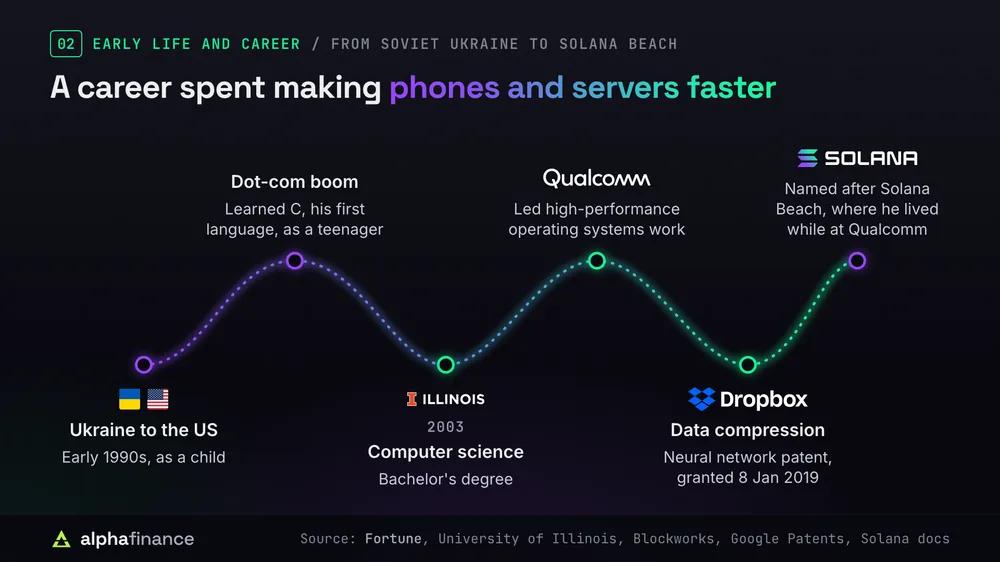
He moved from Ukraine to the US in the early 1990s. As a teenager during the dot-com boom, he learned C, his first programming language, Fortune reported. The profile also records that he has completed an Ironman triathlon and plays underwater hockey.
His Blockworks biography describes almost two decades spent building high-performance operating systems, including leading that work at Qualcomm.
At Dropbox, his focus was data compression. He is named as a co-inventor on a patent for compressing files using a neural network, granted on 8 Jan 2019 and assigned to Dropbox. The name Solana comes from Solana Beach, the coastal town where he and two Qualcomm colleagues lived, according to Solana's own project history.
With proof of history, Yakovenko proposed a way for computers that do not trust each other to agree on the order of events without constantly exchanging messages. A shared, verifiable clock could reduce the time they spent establishing what happened first.
Fortune traces the idea to a night in 2017 when two coffees and a beer kept him awake until 4 a.m. working it out. He set out the design in his whitepaper, Solana: A new architecture for a high performance blockchain.
The Solana Foundation's explainer describes proof of history as a verifiable delay function, a calculation that must proceed one step at a time. Each block producer repeatedly runs the SHA-256 hash function, feeding the result of each calculation into the next. The step count proves that time has passed. Other computers can check the sequence quickly and in parallel.
On 13 Feb 2018, Qualcomm colleague Greg Fitzgerald began building the first open source prototype, according to Solana's project history. Initially called Loom, the project adopted the Solana name on 28 Mar 2018. Raj Gokal joined as a co-founder. Fortune later photographed the two co-founders together in Miami in April 2022.
The main network launched under the Mainnet Beta label on 16 Mar 2020, according to Helius's history of Solana outages.

Real demand tested Solana's design during its first years. The collapse of its loudest backer then put Solana Labs under pressure.
Solana Labs raised $314.15 million through a private SOL sale in June 2021, led by Andreessen Horowitz and Polychain Capital, according to the company's announcement. Buyers included Alameda Research, the trading firm run by FTX founder Sam Bankman-Fried. In the announcement, Yakovenko said that "the next phase is onboarding a billion users".
The software struggled to keep up with demand. Since launch, Solana has suffered seven separate outages, according to Helius's outage history. Validator software bugs caused five. Floods of spam transactions caused the other two. On 14 Sep 2021, bots targeting a token sale halted block production for more than 16 hours.
Its most recent full stop occurred on 6 Feb 2024. A bug in the way validators compiled programs halted block finalisation at 09:53 UTC. Validators holding more than 95% of staked SOL were running the affected software version, according to Anza's outage report.
FTX's November 2022 bankruptcy exposed Solana's close ties to the exchange. Citing a Foundation disclosure, Decrypt reported that FTX and Alameda had bought more than 50.5 million SOL from the Solana Foundation. Solana Labs had separately sold Alameda over 7.56 million SOL. Yakovenko said Labs held no funds on FTX, but SOL fell from about $32 at the start of November to below $10 by year-end, according to CoinGecko's price history.
After the crisis, Solana Labs took on a narrower role. Former employees formed Anza, which forked the Solana Labs validator software into its own client, Agave, on 2 Mar 2024.

| Date | Event | What it changed |
|---|---|---|
| 2017 | Yakovenko writes the proof of history whitepaper | Solana's design takes shape |
| 16 Mar 2020 | Mainnet Beta launches | SOL begins trading on a live network |
| Jun 2021 | $314.15 million private token sale | Funds ecosystem investment |
| Sep 2021 | Network stalls for more than 16 hours | Reliability becomes the main criticism |
| Nov 2022 | FTX collapses | SOL ends the year below $10 |
| Mar 2024 | Anza forks the validator client as Agave | Core development leaves Solana Labs |
| Oct 2025 | First US spot SOL ETF lists | Stock market investors can buy SOL |
| Feb 2026 | Named to the CFTC advisory committee | Yakovenko gains a formal policy role |
| Aug 2026 | Pump.fun claims against him dismissed | Removes his largest legal exposure |
| Oct 2026 | Alpenglow goes live | Finality drops to a target of about 150 ms |
Alpenglow brings almost immediate settlement to Solana and removes proof of history's role in pacing new blocks. Anza designed it to replace TowerBFT, the voting system under which validators recorded each vote as a blockchain transaction.
The upgrade went live at about 13:36 UTC on 21 Oct 2026, according to the Solana Foundation's upgrade page. This marked the start of epoch 1064, one of the fixed periods used to schedule validators. Of the network's 654 validators, 446 signed the certificate handing over control. The handoff took about 900 milliseconds.
Previously, finality, the point at which a transaction can no longer be reversed, took about 12.8 seconds. Alpenglow targets roughly 150 milliseconds. Validators send votes directly to one another and combine them into certificates, allowing a block to become final after one or two voting rounds. The Foundation says the system can continue operating if validators holding 20% of staked SOL act maliciously while another 20% are offline.
The one-sentence version
Since 21 Oct 2026, direct validator votes determine when a Solana block is final, while proof of history no longer sets the pace of block production.
Removing vote transactions from blocks caused headline transactions-per-second figures to fall sharply, even though real use did not decline. Instead of paying the old vote fees, each voting validator now pays a flat 0.8 SOL per epoch, which is burned. A separate series of changes, completed in October 2026, reduced block times from 400 to 200 milliseconds.
Client diversity also suffered a setback. This is the effort to operate Solana using more than one independent software codebase. Jump Crypto's Firedancer client and its hybrid version, Frankendancer, were not supported for the migration, requiring their operators to switch to Agave-based software.
Yakovenko supported Alpenglow while questioning its development process. At Consensus Miami in May 2026, he said the upgrade would bring confirmations close to the physical limit of how fast information travels around the globe. On 20 Oct, he argued that a simpler adjustment to the existing vote program could have halved the development time.
A second phase, Rotor, will replace the way block data spreads across the network. It has no release date yet.

This year, Yakovenko's work spans transaction ordering and crypto phones. He is also examining how wallets can remain secure as cryptography changes.

A single leader validator currently chooses which transactions enter Solana during its turn. Reordering those trades can earn the leader a profit, a practice known as maximal extractable value (MEV).
The Internet Capital Markets roadmap seeks to give applications greater control over transaction ordering. Leaders from six Solana organisations, including Anza and the Solana Foundation, co-wrote it in July 2025.
Multiple concurrent proposers (MCP) would allow several validators to propose transactions in parallel, preventing any single leader from holding them back or reordering them. Blockworks attributes the architecture to Yakovenko and researcher Max Resnick and notes that Alpenglow had to go live first. In its 2026 roadmap, Anza commits to releasing an initial version this year that enforces transaction order within each batch.
Solana Mobile had shipped more than 200,000 Seeker phones by March 2026. Those devices had processed over $5 billion in onchain transactions across more than 500 apps, according to the Solana Mobile blog. The company offered its software stack to other Android makers on 2 Mar 2026.
SKR, the ecosystem's token, launched on 21 Jan 2026. Almost 2 billion tokens were distributed to at least 100,000 users and 188 developers, Cointelegraph reported. Yakovenko responded to the launch-date announcement with the comment that "it only takes 10 years to build an ecosystem", according to The Block.
On 15 Oct 2026, Ledger said its Atom Android device would include the Seeker app when it ships in summer 2027, The Block reported.
Yakovenko published code for a perpetual futures exchange called Percolator on GitHub in October 2025. Perpetual futures let traders bet on prices using borrowed money through contracts with no expiry date.
He later explained that he had been experimenting with Anthropic's Claude and made the repository public by accident. He invited other developers to take the idea and build it. The Percolator repository describes the code as an unaudited educational research project.
The post prompted speculation about a Solana competitor to Hyperliquid, whose growth is tracked on our Hyperliquid statistics page.
In May 2026, Yakovenko warned that AI could break post-quantum signature schemes before the industry hardens them. These schemes are intended to resist future quantum computers. His proposed response was a wallet requiring two of three different signature types, BeInCrypto reported.
Over the past year, Yakovenko has gone from being a named defendant to holding an official advisory role in Washington.
The Commodity Futures Trading Commission (CFTC), which regulates US futures and other derivatives, appointed him to its Innovation Advisory Committee on 12 Feb 2026. The panel examines how AI and blockchains are changing derivatives markets. Among its 35 members are Uniswap founder Hayden Adams, Coinbase's Brian Armstrong and Ripple's Brad Garlinghouse, The Block reported. Yakovenko also appears in the transcript of its first meeting, held on 20 Aug 2026.
Separately, the SEC eased the process for launching Solana funds. Its approval of generic listing standards on 17 Sep 2025 allowed exchanges to list qualifying crypto exchange-traded funds (ETFs) without submitting a separate rule filing for each one. ETFs are funds that trade like shares.
Bitwise's Solana Staking ETF began trading on 28 Oct 2025. Bitwise described it as the first US spot Solana fund. The fund stakes its holdings to earn network rewards.
The Pump.fun case concerned investors who lost money on tokens launched through the Solana meme-coin creation app. In 2025, they added Solana Labs, the Solana Foundation, Yakovenko and Gokal to their class action, alleging violations of the Racketeer Influenced and Corrupt Organizations Act (RICO). That law was written to pursue organised crime.
Judge Colleen McMahon dismissed every claim against the Solana defendants on 31 Aug 2026. Racketeering claims against Pump.fun operator Baton Corporation and three of its executives remain ongoing. Our guide to Pump.fun's legal status by country explains where the app is restricted.

No public disclosure establishes how much SOL or Solana Labs stock Yakovenko owns. All published net-worth figures are outside estimates.
In February 2026, analytics firm Arkham put his wealth between $500 million and $1.2 billion. Its calculation combines likely token holdings with an estimated value for his company stake. Arkham cautions that the wallets commonly linked to him are rumoured and unconfirmed.
The estimate changes with SOL's price. On 22 Oct 2026, the token traded at $103.39, about 65% below its $293.31 all-time high, according to CoinGecko.
US spot Solana ETFs hold SOL directly. They had $1.687 billion in net assets on 21 Oct 2026, after investors put in a net $1.549 billion since launch, Tokenpost reported using SoSoValue data. Our Solana ETF dashboard shows the daily money moving in and out of each fund.
Among listed companies holding SOL, Forward Industries was the largest. It held 8,501,298 SOL on 30 Sep 2026, roughly 1.4% of circulating supply, after making purchases at an average price of $83 during the quarter, according to its filing with the SEC. Our Solana corporate treasuries page ranks every listed holder by size and cost.
Staking allows SOL holders to earn newly issued tokens by locking up their holdings to help secure the network. Our staking rewards calculator estimates those rewards at live rates.

Buying SOL carries risks regardless of its founder's record. Those risks also apply to staking and trading with borrowed money.

Not investment advice
This article explains market data. Nothing on this page is a recommendation to buy, sell or leverage any asset. Digital assets are volatile and you can lose everything you put in. If you are unsure whether a trade is appropriate for you, a licensed adviser in your jurisdiction is the right next step.


Fact checked by
Verifies every figure against primary sources before publication. Meet the team
Anatoly Yakovenko co-founded Solana and is chief executive of Solana Labs. The Ukrainian-born software engineer worked on operating systems at Qualcomm before setting out proof of history in a 2017 whitepaper. In February 2026, the CFTC appointed him to its Innovation Advisory Committee.
Yakovenko remains chief executive of Solana Labs. The CFTC listed him in that role in February 2026, and The Block identified him as co-founder and CEO on 15 Oct 2026. Development of Solana's core validator software is now led by Anza, a separate firm.
Proof of history is the cryptographic clock Yakovenko designed for Solana. Validators run the SHA-256 hash function sequentially, using the number of steps to prove how much time has passed. Others can verify the work in parallel. Following the Alpenglow upgrade on 21 Oct 2026, proof of history no longer paces block production.
Yakovenko has not disclosed his net worth. Estimates published in February 2026 placed it between $500 million and $1.2 billion, based on likely SOL holdings and his stake in Solana Labs. The figures rise and fall with SOL's price.
He graduated from the University of Illinois Urbana-Champaign in 2003 with a bachelor's degree in computer science, according to the university's Siebel School. Before starting Solana, he worked at Qualcomm, Mesosphere and Dropbox.
Solana takes its name from Solana Beach, the coastal town north of San Diego where Yakovenko and two Qualcomm colleagues lived, according to Solana's project history. Originally called Loom, the project changed its name in March 2018 to avoid confusion with the Ethereum project Loom Network.