Markets
 BTC
 ETH
 BNB
 XRP
 SOL
 ZEC
 HYPE
 DOGE
 LINK
 TON
 AVAX
 SUI
 TAO
 AAVE
 PUMP
 MORPHO
 ARB
 LIT
--:-- UTC
Research/Platform guides
How Pons turns an idea into a tradable token on Robinhood Chain, how its fees pay for PONS buybacks and burns, and why activity fell sharply after its September peak.
 By Alpha Finance Editorial Team
 Fact-checked by Vince Dioquino
Every figure, platform detail and regulatory claim on this page was traced to a primary source by the named fact checker before publication, and is re-checked when those facts change. The review date moves only when a person has re-read the page.
The editorial policy → Editorial policy Report an errorPons is a token launchpad on Robinhood Chain, the blockchain network Robinhood opened to the public on 1 Jul 2026. Launchpads let users create a cryptocurrency and open a market for it in a few clicks. Within weeks, Pons had become the chain's busiest launchpad, Decrypt reported.
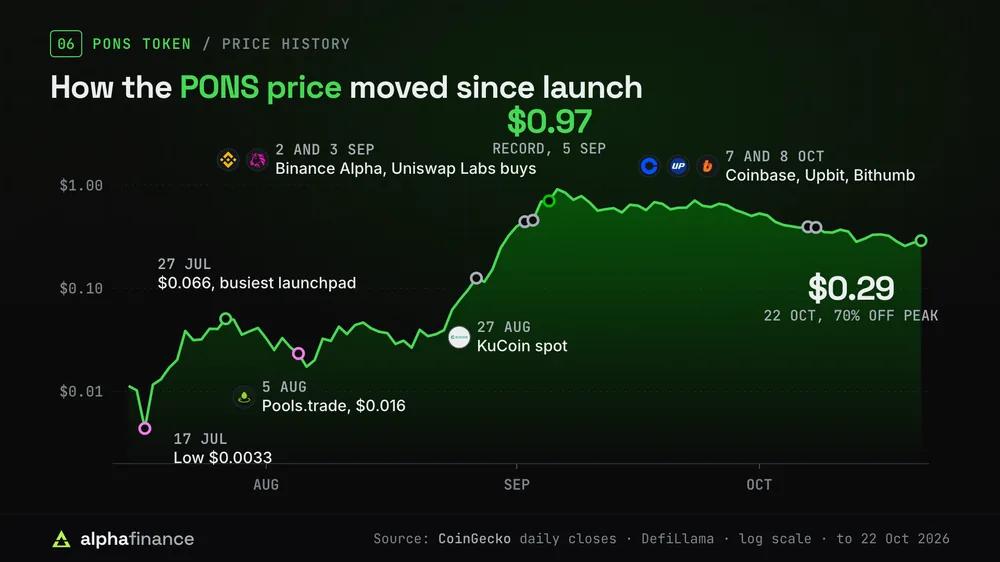
Its token, PONS, climbed from a low of $0.0033 in mid-July 2026 to a record $0.97 on 5 Sep 2026, according to DefiLlama's Pons dashboard. By 22 Oct 2026, it traded at $0.29, 70% below that record. Trading activity, which funds its buybacks, had also slowed.
Creating a token on Pons requires no coding. Anyone with a crypto wallet can trade the tokens launched through the app.
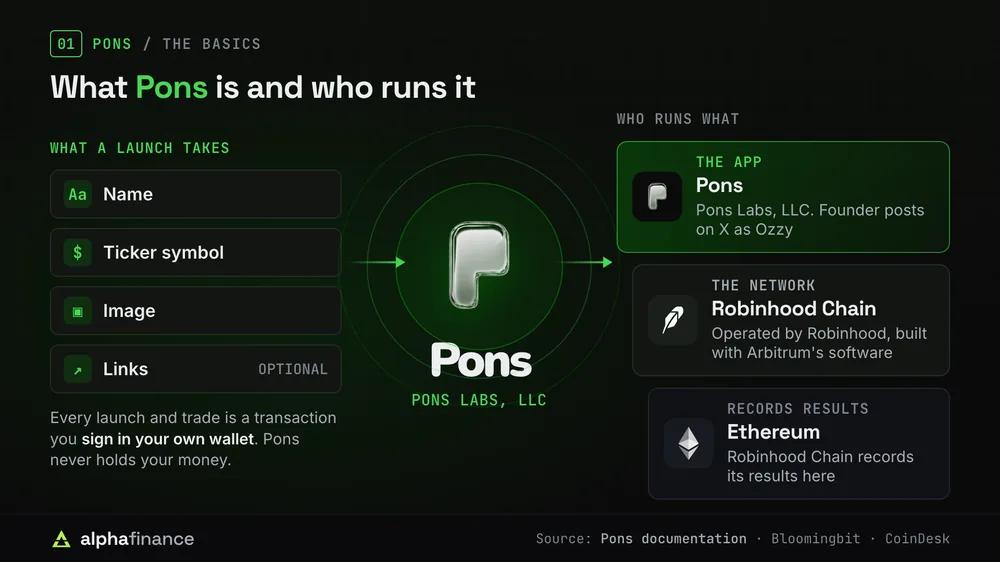
To create one, users provide a name, ticker symbol and image, with the option to add links. Every launch and trade requires a transaction signed in the user's own wallet. Pons's documentation says the app therefore never holds users' money.
Most of these tokens are memecoins, built around jokes, characters or internet trends without a product behind them. Decrypt described Pons as the chain's biggest memecoin factory, comparing its role with Pump.fun's on Solana.
Pons Labs, LLC operates the app, according to the documentation. Its founder posts on X as Ozzy, Bloomingbit reported. CoinDesk's report on Pons's fees describes the company as independent of Robinhood, which runs the network.
The platform launched PONS through its first version. Its documentation lists the token's Robinhood Chain contract address as 0x39dBED3a2bd333467115dE45665cC57F813C4571. Checking that address matters because anyone can create another token with the same name.
The one-sentence version
Pons creates a token and its trading market in one transaction, collects a fee on every trade, and uses most of its share to buy and destroy PONS.
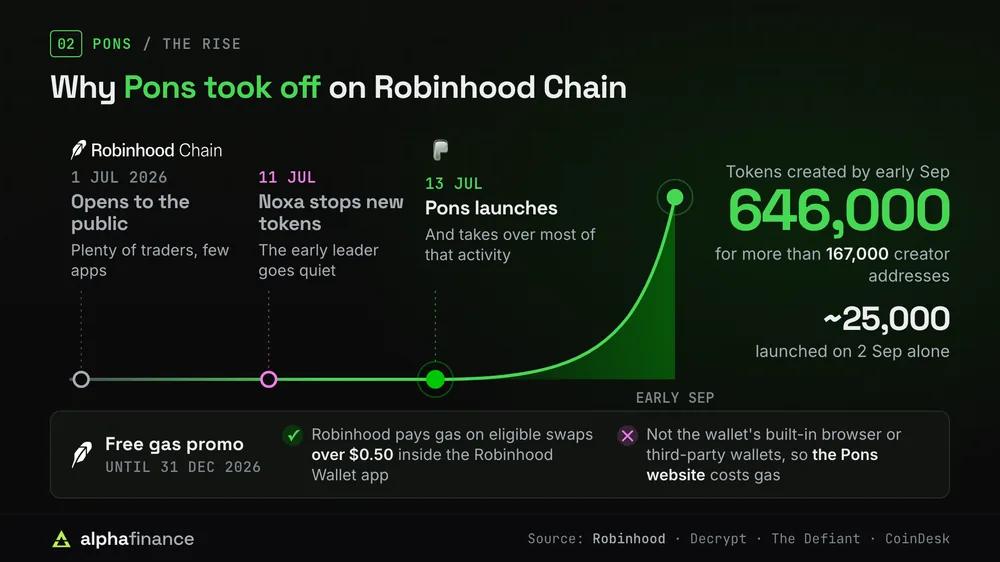
Robinhood Chain gave Pons access to plenty of traders on a new network with few established apps.
Built with Arbitrum's software, the chain is a layer 2 that processes transactions on its own and records the results on Ethereum. Robinhood describes it as purpose-built for real-world assets, including its tokenised stocks. Users pay network fees, known as gas, in ETH, Ethereum's currency.
Until 31 Dec 2026, Robinhood covers gas for eligible swaps over $0.50 inside the Robinhood Wallet app, according to its promotion terms. Third-party wallets and outside apps accessed through the wallet's built-in browser are excluded. Traders on the Pons website must therefore pay their own gas.
Noxa, the chain's early leading launchpad, stopped accepting new tokens on 11 Jul 2026, Decrypt reported. Pons launched two days later, on 13 Jul 2026, according to The Defiant, and absorbed most of that activity.
Although the chain was intended to showcase tokenised stocks, memecoins generated most of its early traffic. Our tokenised real-world assets board tracks those assets by sector and issuer. By early September, more than 167,000 creator addresses had launched about 646,000 tokens on Pons, CoinDesk reported, citing onchain data. Nearly 25,000 launched on 2 Sep 2026 alone.
Our blockchain data dashboard compares decentralised exchange (DEX) volume across major networks alongside total value locked (TVL), the money deposited in each network's apps.
A token's pricing and trading arrangements depend on which version of Pons created it.
Tokens issued through the version 1 contracts continue to trade, but that launch factory no longer creates new ones, according to Bitquery's Pons integration guide. New launches use version 2. Public launches remain closed, so only whitelisted addresses can create tokens for now, Pons's version 2 documentation says.
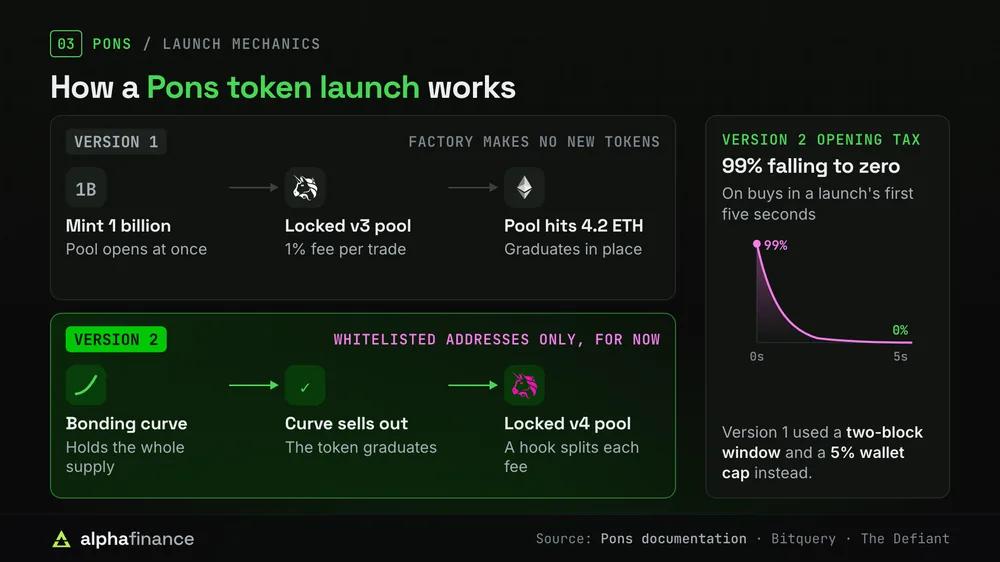
Version 1 creates a fixed supply of 1 billion tokens and opens a Uniswap v3 trading pool in the same transaction. This pool holds the new token alongside WETH, or wrapped ether, a token version of ETH. Traders swap against those holdings, and each trade moves the price.
The funds lock automatically, preventing the creator from withdrawing them. Launching costs 0.0005 ETH, and the pool charges 1% on every trade. Once its holdings reach 4.2 ETH, the token graduates, though trading continues in that same pool.
During the first two blocks, only the creator's opening purchase can execute. No wallet can hold more than 5% of the supply. Creators receive 70% of each trading fee and Pons takes 30%. Tokens from the original factory retain the older split of 90% for creators and 10% for Pons.
Version 2 went live on 3 Aug 2026, The Defiant reported. Tokens start on a bonding curve, a contract that holds the entire supply and continuously quotes a price. Buying pushes that price up, and selling brings it down.
Graduation occurs when the curve sells out. Its proceeds and a reserved allocation of tokens then fund a Uniswap v4 pool, according to Pons's version 2 documentation. The pool's funds are locked permanently. Pons says the contracts contain no function that would let anyone, including its own team, withdraw them.
There is no fee charged by the pool itself. Instead, an attached program called a hook collects the trading fee. It splits that fee among Pons, the creator and any creator buyback that has been switched on.
| Feature | Pons v1 | Pons v2 |
|---|---|---|
| How a launch starts | Token goes straight into a Uniswap v3 pool against WETH | Whole supply sits on a bonding curve |
| When it graduates | Pool holds 4.2 ETH | Curve sells out |
| Where it trades afterwards | Same locked pool | New permanently locked Uniswap v4 pool |
| Protection from bots | Two-block window, 5% holding cap | 99% buy tax falling to zero in five seconds |
| Quote asset | WETH only | ETH or an approved token |
Creators using version 2 can price their tokens in approved assets other than ETH. Bitquery's guide lists the dollar stablecoin USDG and Coinbase's bitcoin token cbBTC, along with tokenised stocks and funds including TSLA, NVDA and SPY.
For a token paired with tokenised Nvidia, buyers and sellers transact in that stock token, which also pays the creator's fees. Even if the new token's price holds steady against its paired asset, its dollar value can fall when that asset declines, the documentation warns.
Pons added pairs including UPS, Snap, Lululemon, Pfizer and Johnson & Johnson on 3 Sep 2026, The Defiant reported. The concept also spread to Solana, where Stonk Fun prices new coins in tokenised stocks.
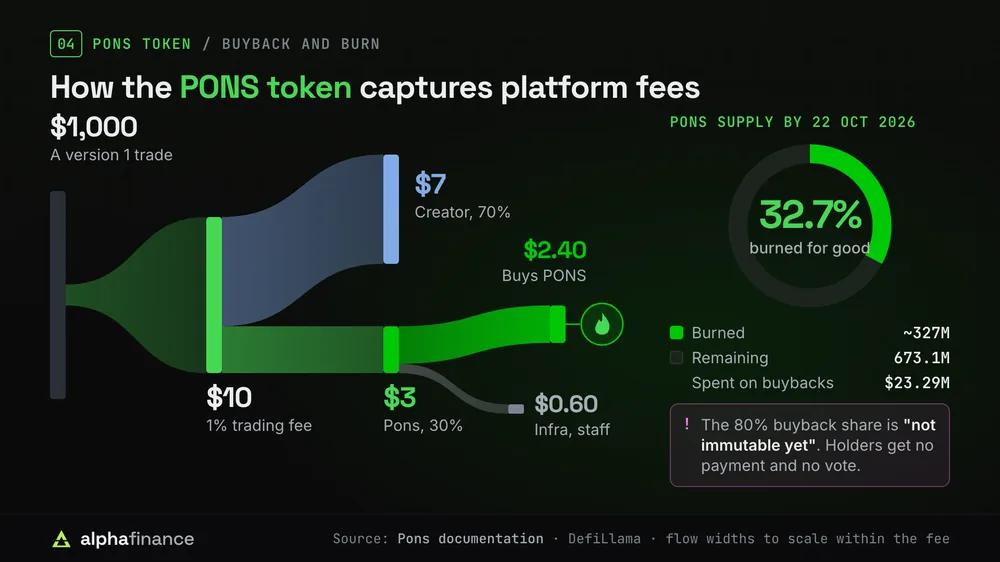
PONS holders receive no direct payments. The token captures value only through Pons's purchases on the open market and the subsequent destruction of those tokens.
According to the documentation, 80% of Pons's fee share funds PONS buybacks, while 20% covers infrastructure and staff. Buying follows a TWAP, or time-weighted average price, schedule that spreads purchases into small amounts over time. The purchased tokens go to a burn address, a wallet nobody controls, permanently removing them from supply.
For example, a $1,000 trade in a token from the current version 1 factory incurs a $10 fee at the 1% rate. The creator gets $7 and Pons receives $3, of which $2.40 goes towards buying PONS.
That 80% allocation is "not immutable yet", Pons says. The team plans to make buybacks fixed, decentralised and automated in a future release. For now, Pons Labs controls how they operate. Its documentation gives PONS holders no voting role.
DefiLlama showed 673.1 million PONS remaining on 22 Oct 2026, meaning 32.7% of the original 1 billion had been burned. Recorded buyback spending since launch totalled $23.29 million. At a price of $0.29, the token's market capitalisation, calculated by multiplying its price by circulating supply, was $194.7 million.
What a burn does for a holder
Each remaining PONS represents a larger share of a smaller supply. Holders receive no payment, and the documentation states that burning does not guarantee a higher price.
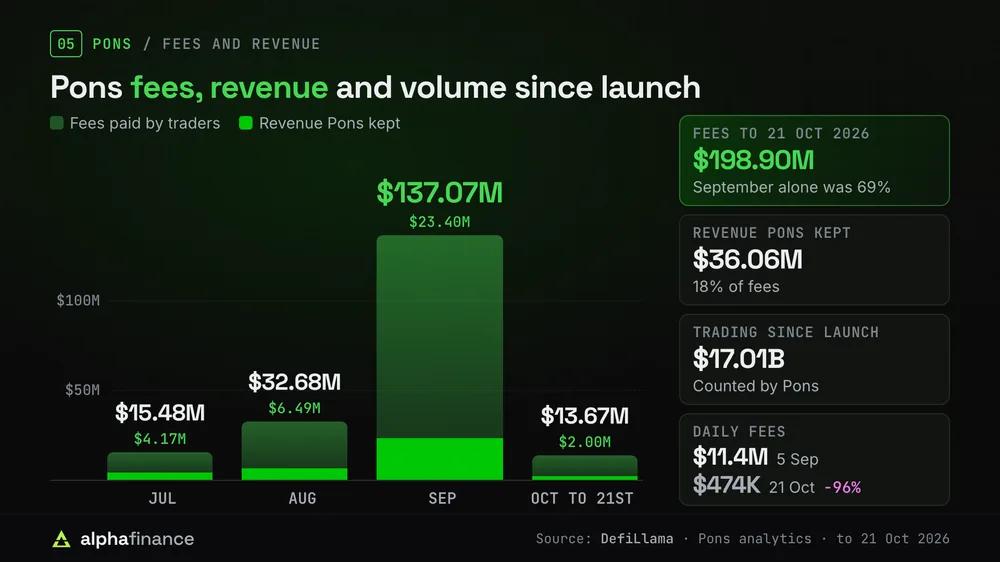
Nearly $200 million in fees has passed through Pons. Most arrived in September, and most went to token creators.
Fees measure everything traders paid. Revenue is what Pons retains after the creators' share. The figures below come from DefiLlama's monthly records, with October covering the period to 21 Oct 2026.
| Month | Fees | Revenue | Spent on PONS |
|---|---|---|---|
| Jul 2026 | $15.48M | $4.17M | $2.01M |
| Aug 2026 | $32.68M | $6.49M | $1.65M |
| Sep 2026 | $137.07M | $23.40M | $16.61M |
| Oct 2026 to date | $13.67M | $2.00M | $3.02M |
September accounted for 69% of fees to date. Buyback spending exceeded revenue in October because the TWAP schedule delays some purchases until after the fees arrive.
By 21 Oct 2026, cumulative fees stood at $198.90 million. Pons retained $36.06 million as revenue, or 18%. During the third quarter, creators received $137.38 million of the $185.23 million in fees, about 74%, through their trading share and optional taxes. The platform's analytics page records $17.01 billion in token trading since launch.
Daily fees peaked at about $11.4 million on 5 Sep 2026, according to DefiLlama. Traders paid about $474,000 on 21 Oct 2026, roughly 96% below that high. Our crypto project revenue rankings compare launchpads with other protocols over periods from 24 hours to a year.
PONS experienced sharp swings in its first three months. Each major move followed news about competing platforms, exchange listings or trading activity on Pons.
| Date | Event | Why it mattered |
|---|---|---|
| 11 Jul 2026 | Noxa stops accepting new launches | Left Pons as the chain's main launchpad |
| 13 Jul 2026 | Pons launches | First fees recorded the same day |
| 17 Jul 2026 | PONS hits its low of $0.0033 | Lowest price on record |
| 27 Jul 2026 | PONS reaches about $0.066 | Pons becomes the chain's busiest launchpad |
| 5 Aug 2026 | Uniswap Labs opens Pools.trade | PONS falls to about $0.016, Decrypt reported |
| 27 Aug 2026 | KuCoin opens PONS spot trading | Spot market on a large centralised exchange |
| 2 Sep 2026 | Binance Wallet adds PONS to Binance Alpha | Access through Binance's wallet |
| 3 Sep 2026 | Pons says Uniswap Labs bought PONS | The company behind its main rival takes a stake |
| 5 Sep 2026 | Record day for fees, PONS peaks at $0.97 | High point for price and activity |
| 7 Oct 2026 | Coinbase opens PONS-USD trading | Spot market in US dollars on Coinbase |
| 8 Oct 2026 | Upbit and Bithumb add PONS | Direct access in Korean won |
| 22 Oct 2026 | PONS trades at $0.29 | 70% below its peak |
Over the 30 days to 22 Oct 2026, PONS fell 50.9%.
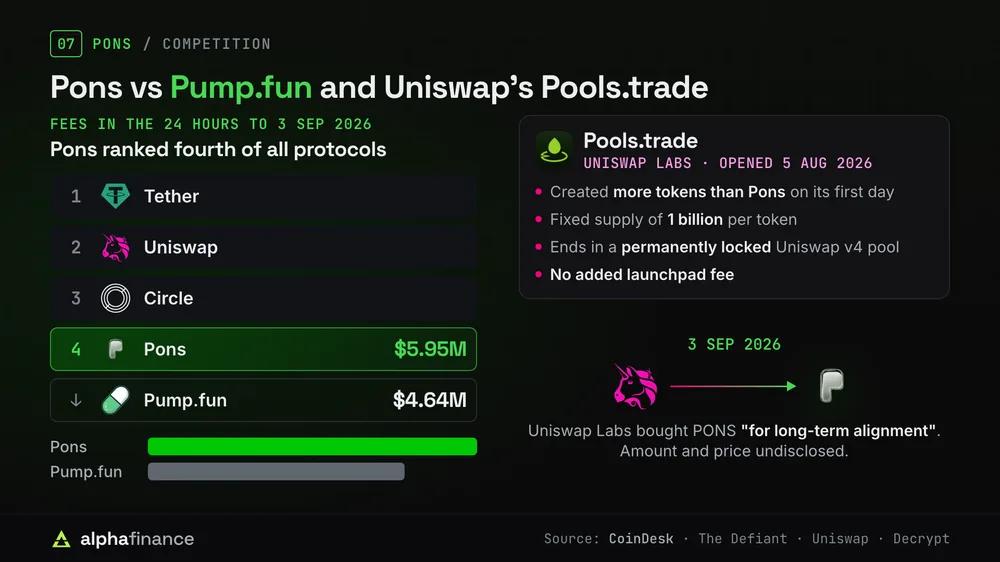
On Robinhood Chain, Pons competes with other launchpads for creators. Solana's Pump.fun competes for traders' attention.
During its September peak, Pons generated about $5.95 million in fees over the 24 hours to 3 Sep 2026, compared with Pump.fun's $4.64 million, CoinDesk reported. Pons ranked fourth among all protocols that day, behind Tether, Uniswap and Circle. Our guide to how regulators treat Pump.fun covers the separate legal questions facing that platform.
Uniswap posed the stronger challenge. Decrypt described it as Robinhood Chain's default exchange, and its developer, Uniswap Labs, launched Pools.trade on 5 Aug 2026. The new launchpad created more tokens than Pons on its first day, The Defiant reported.
Each Pools.trade token has a fixed supply of 1 billion and ends in a permanently locked Uniswap v4 pool. Pools.trade collects no additional launchpad fee, according to Uniswap's guide to Pools.trade.
Four weeks later, on 3 Sep 2026, Pons announced that Uniswap Labs had bought PONS "for long-term alignment", The Defiant reported. Neither company disclosed the purchase amount or price. Because every token graduating from a Pons version 2 curve enters a Uniswap v4 pool, increased Pons trading also adds volume to Uniswap. Uniswap Labs founder Hayden Adams has recently focused on tokenised stocks.
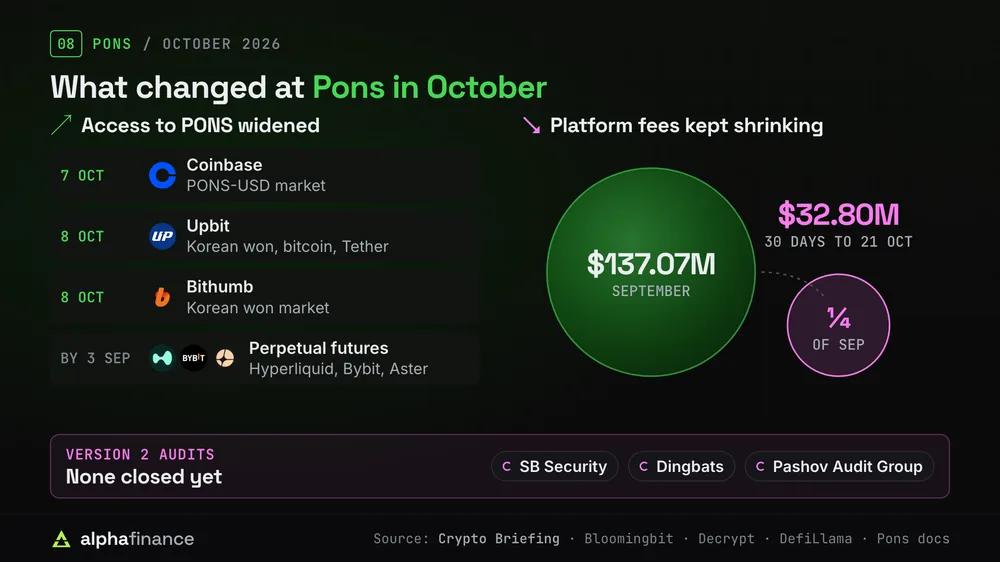
Large exchange listings expanded access to PONS in October, even as trading on the platform continued to contract.
Coinbase opened its PONS-USD market on 7 Oct 2026, Crypto Briefing reported. On 8 Oct 2026, Upbit listed PONS against the Korean won, bitcoin and the Tether stablecoin. Bithumb added a Korean won market the same day, according to Bloomingbit.
By 3 Sep 2026, PONS perpetual futures were also trading on Hyperliquid, Bybit and Aster, Decrypt reported. These contracts have no expiry date, and traders often fund positions with borrowed money.
In the 30 days to 21 Oct 2026, platform fees totalled $32.80 million, about a quarter of September's total. Activity declined while Robinhood continued covering gas for eligible wallet swaps under a promotion extended to the end of the year.
On 22 Oct 2026, a banner in Pons's documentation warned that launches and market data might load slowly as the team upgraded its systems ahead of a new rollout. The version 2 documentation names SB Security, Dingbats and Pashov Audit Group as the three firms reviewing its contracts. All three audits remain open. Pons tells developers to treat version 2 as unaudited until the reports are published.
Anyone buying tokens launched on Pons, including PONS itself, can lose their entire investment.
Before trading a newly launched token, use our DEX screener to view new pairs across 21 chains and check flags for common token risks.
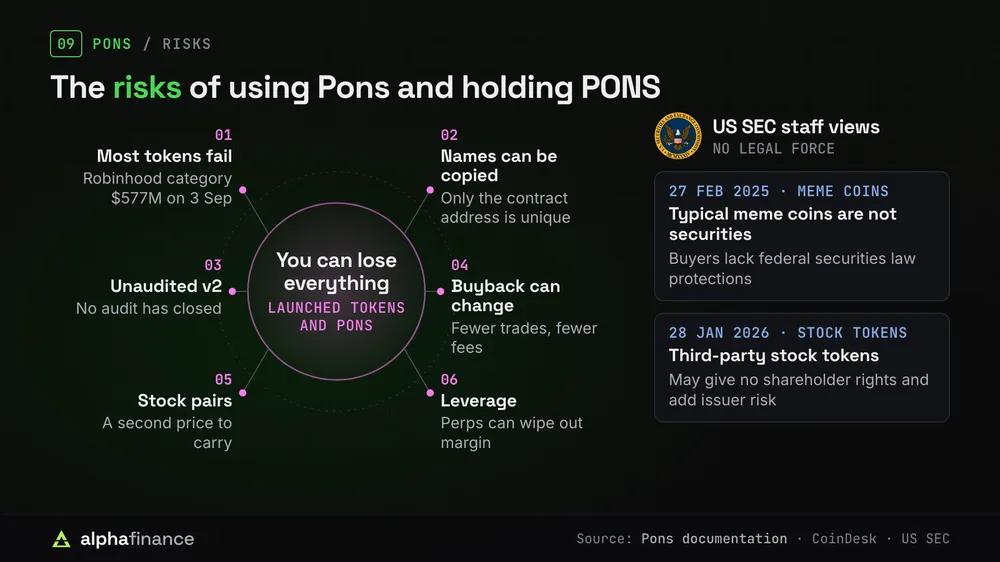
US securities regulator staff have addressed both the memecoin and stock-token components of a stock-paired Pons token.
The US Securities and Exchange Commission (SEC) staff statement on meme coins, dated 27 Feb 2025, says transactions in typical meme coins do not involve securities. Their buyers and holders therefore lack federal securities law protections. Fraud involving meme coins can still be prosecuted under other laws, staff added.
A separate SEC staff statement on tokenized securities, dated 28 Jan 2026, addresses the assets used to price those tokens. A stock token issued by a firm other than the underlying company may confer no shareholder rights. Holders may also face risks tied to the issuing firm, including bankruptcy. Both statements express staff views and have no legal force.
Not investment advice
This article explains market data. Nothing on this page is a recommendation to buy, sell or leverage any asset. Digital assets are volatile and you can lose everything you put in. If you are unsure whether a trade is appropriate for you, a licensed adviser in your jurisdiction is the right next step.


Fact checked by
Verifies every figure against primary sources before publication. Meet the team
Pons is a launchpad on Robinhood Chain where users create and trade tokens from their own wallets. According to the Pons documentation, each version 1 launch creates a fixed supply of 1 billion tokens and a locked trading pool in one transaction. The platform's own token is PONS.
Pons spends 80% of its share of trading fees buying back and burning PONS. Infrastructure and staff receive the remaining 20%. Holders get no direct payments, and the documentation assigns them no voting role.
Pons Labs, LLC runs Pons. Robinhood operates the underlying network, Robinhood Chain. CoinDesk described Pons as independent of Robinhood.
Pons collects a small launch fee and keeps a share of trading fees on its tokens. Current version 1 tokens charge 1% per trade, split 30% to Pons and 70% to the creator. Each launch costs 0.0005 ETH.
Although Pons never takes custody of users' funds, tokens launched through it are high risk and can lose all their value. Three audits of its version 2 contracts remain open, according to its version 2 documentation. The contract address is the only reliable way to identify a token because names can be copied.
Pons operates only on Robinhood Chain, while Pump.fun runs on Solana. Version 2 Pons tokens can be priced in tokenised stocks and graduate into permanently locked Uniswap v4 pools. CoinDesk reported that Pons generated more daily fees than Pump.fun on 3 Sep 2026.