Markets
 BTC
BTC ETH
ETH BNB
BNB XRP
XRP SOL
SOL ZEC
ZEC HYPE
HYPE DOGE
DOGE LINK
LINK TON
TON AVAX
AVAX SUI
SUI TAO
TAO AAVE
AAVE PUMP
PUMP MORPHO
 ARB
ARB LIT
LIT--:-- UTC
Research/Market structure
Pearl (PRL) pays miners for the matrix multiplication that runs AI models. We explain the mechanism, the supply schedule, the dispute over whether the work is useful, and the risks.

 By Alpha Finance Editorial Team
 Fact-checked by Vince Dioquino
Every figure, platform detail and regulatory claim on this page was traced to a primary source by the named fact checker before publication, and is re-checked when those facts change. The review date moves only when a person has re-read the page.
The editorial policy → Editorial policy Report an errorPearl (PRL) is a proof-of-work cryptocurrency mined by multiplying matrices on graphics cards, the same arithmetic used to run AI models. The network launched on 27 Apr 2026. About 340 million of its fixed 2.1 billion PRL supply had been mined by 10 Oct 2026, although an independent study found that most mining produced no AI output.
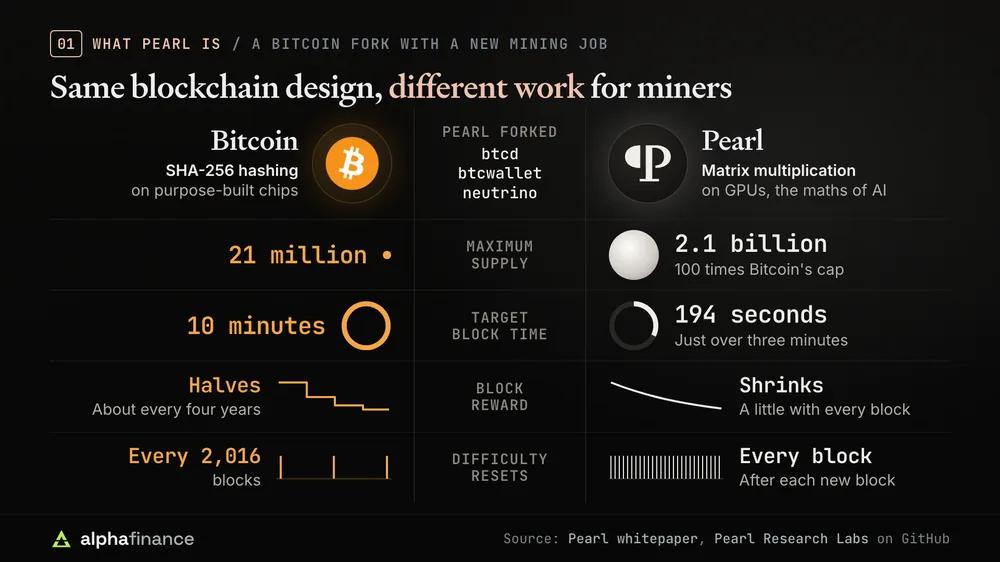
Pearl runs a standalone blockchain with its own coin, PRL. It follows Bitcoin's design in every respect except the work miners perform. The core software was forked from Bitcoin software called btcd, btcwallet and neutrino.
Under proof of work, computers spend computing power competing to add the next block of transactions. The winner receives newly issued coins. Bitcoin uses hashing, a guessing game with no other output. Pearl instead uses matrix multiplication, which multiplies large grids of numbers.
Matrix multiplication is the main cost of running AI. The research paper behind Pearl estimates that it accounts for at least 50% of the computing load in neural network training, and often 70 to 80%.
The one-sentence version
Pearl pays PRL for matrix multiplication, allowing a GPU running an AI model to enter the mining lottery with calculations it was already doing.
| Feature | Pearl (PRL) | Bitcoin (BTC) |
|---|---|---|
| Mining work | Matrix multiplication on GPUs | SHA-256 hashing on purpose-built chips |
| Maximum supply | 2.1 billion | 21 million |
| Target block time | 194 seconds | 10 minutes |
| Issuance | Reward falls slightly every block | Reward halves about every four years |
| Difficulty adjustment | Every block | Every 2,016 blocks |
Pearl's figures come from the original Pearl whitepaper.
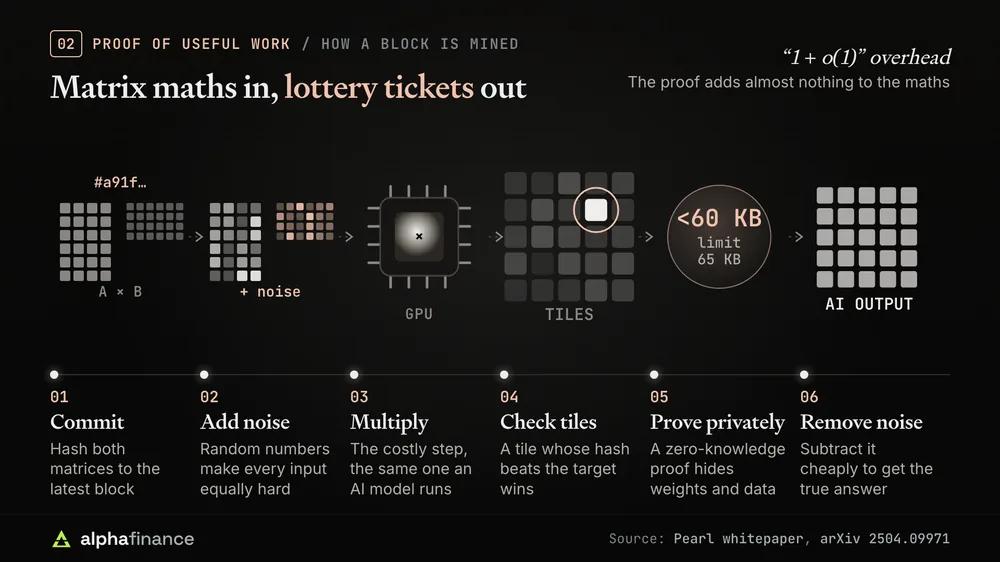
Miners choose two matrices and multiply them. The protocol then uses pieces of the answer as lottery tickets for the next block. When the work serves an AI model, those matrices are usually the model's stored weights and the data passing through it. The whitepaper sets out six steps.
The authors describe the additional cost of the mining proof as almost negligible, writing it as "1 + o(1) multiplicative overhead". Their security argument relies on a conjecture, an unproven mathematical assumption that nobody can compute the noised product faster than by performing the full multiplication.
For privacy, Pearl uses Plonky2, a proof system built only on hash functions. Three rounds of compression reduce each block's proof to below 60 kilobytes, according to the whitepaper, within a 65-kilobyte limit. Zcash uses the same family of proofs to conceal payment details and is covered in our Zcash network statistics.
Mining difficulty, or how hard it is to find a block, adjusts after every block. Pearl accepts only Taproot, Bitcoin's newest address format, and its wallets carry a dormant backup key for XMSS, a signature scheme designed to resist quantum computers.
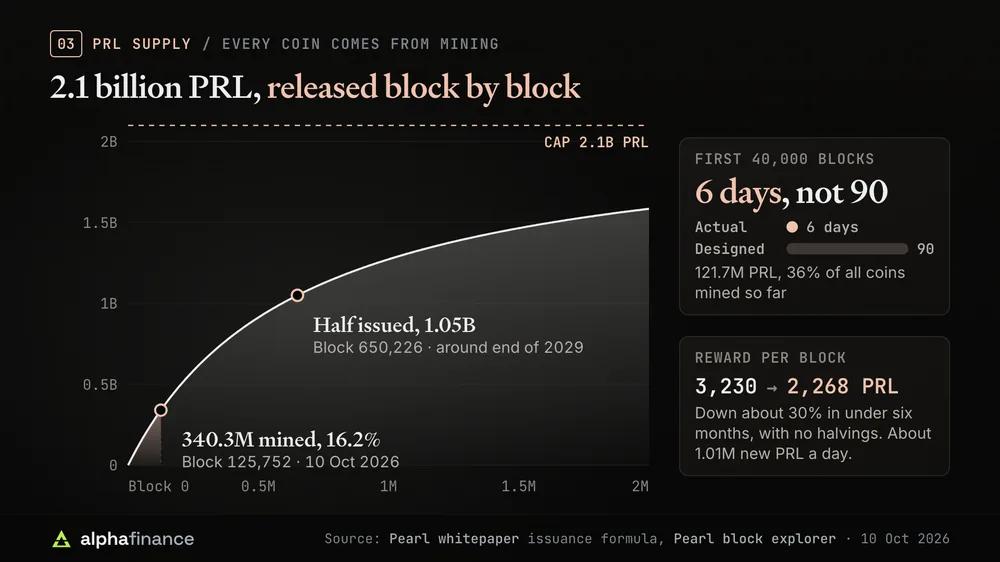
Block rewards created every PRL in existence. Each reward is slightly smaller than the last. The whitepaper fixes total supply at 2.1 billion PRL. Cumulative issuance at block t follows the formula 2.1 billion × t ÷ (t + 650,226).
Using the block number displayed on Pearl's block explorer on 10 Oct 2026 produces the following figures.
| Measure | Figure at block 125,752 |
|---|---|
| PRL mined | About 340.3 million |
| Share of 2.1 billion cap | 16.2% |
| Reward per block | About 2,268 PRL |
| Daily issuance at 194-second blocks | About 1.01 million PRL |
| Block where half the supply is issued | 650,226 |
At the target block pace, half the supply will have been issued around the end of 2029. The first block paid about 3,230 PRL. Rewards have therefore fallen roughly 30% in under six months.
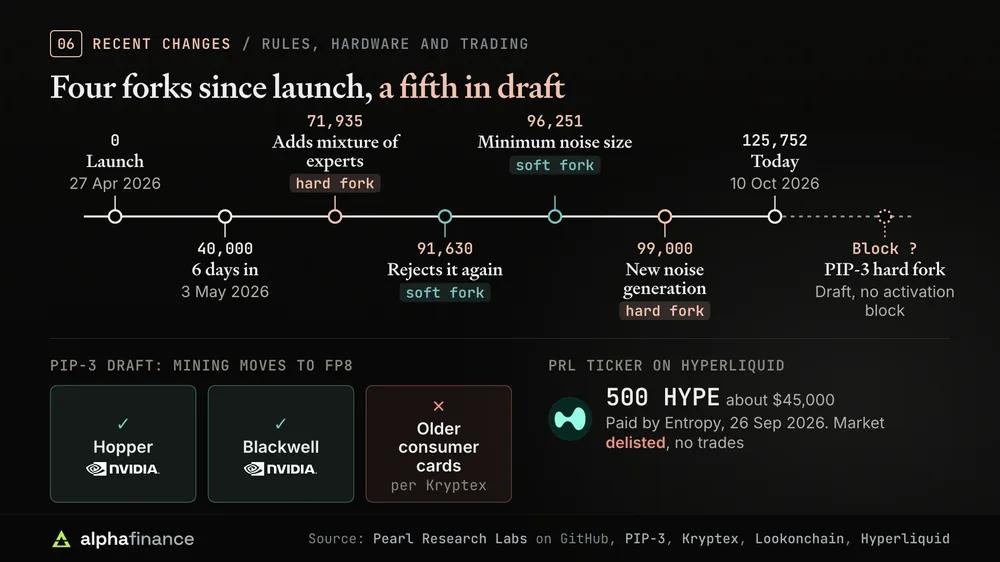
The issuance formula contains no investor or team allocation, so PRL has none of the vesting dates listed on our token unlock calendar. Its launch distribution was nevertheless uneven. The explorer places block 40,000 on 3 May 2026, just six days after launch. At the target interval of 194 seconds, those blocks should have taken about 90 days.
Early miners received about 121.7 million PRL from those blocks, equivalent to 36% of all coins mined to date and 5.8% of the final supply. The whitepaper says difficulty started low to give early miners a fair opportunity and to "ensure the core team has minimal resources needed to support the massive research, development and infrastructure" the project requires. The team has not published its holdings.
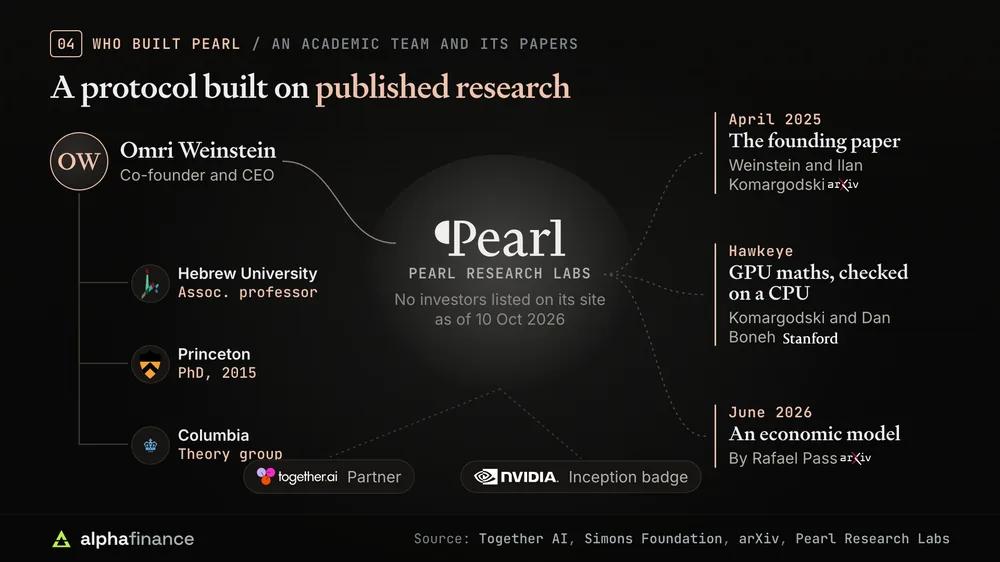
Pearl Research Labs is led by an academic computer scientist, so the project's credibility rests on published research. Together AI's partnership announcement names Omri Weinstein as co-founder and chief executive. He is an associate professor of computer science at the Hebrew University of Jerusalem.
According to his Simons Foundation profile, Weinstein completed his PhD at Princeton in 2015 before joining Columbia University's theoretical computer science group. He co-authored Pearl's founding paper with cryptographer Ilan Komargodski in April 2025.
Komargodski also co-authored Hawkeye with Stanford cryptographer Dan Boneh. That paper shows how an ordinary processor can reproduce a GPU's exact arithmetic. In June 2026, cryptographer Rafael Pass published an economic model of proof of useful work.
When we checked Pearl Research Labs' website on 10 Oct 2026, it listed no investors. The site displays an Nvidia Inception startup program badge. The company also sells AI inference, the process of running a trained model to produce answers, as a commercial service.
The protocol verifies matrix multiplication without checking whether anyone wanted the answer. Its founding paper lets miners choose their own inputs and defines usefulness by whether someone will pay for the result.
Abhinaba Basu examined miners' behaviour in a preprint titled The Usefulness Gap in Proof-of-Useful-Work, published in June 2026.
Running a real model requires time and memory. Basu estimated that loading one would reduce mining output by 10 to 30%, leaving a miner paid only in PRL better off skipping it.
Pearl's commercial evidence comes from Together AI. On 15 May 2026, the company launched a version of Google's Gemma 4 model running on Pearl's protocol at more than 25% below its usual price. Together AI said the discount is "offset by the future value of crypto emissions" earned by those same GPUs.
Basu describes this as a financial subsidy funded by mining income. Paid AI work runs on Together AI's machines, he argues, while the wider mining network contributes nothing to it. Pearl's whitepaper acknowledges part of that criticism, stating that the network "attracts compute that does not necessarily have useful work".
Pass's model finds that block rewards can provide a rebate on AI prices once enough paid work is mined. The cost of attacking the chain remains tied to the block reward. Reaching that state would require paid AI work to become the cheapest way to mine Pearl.
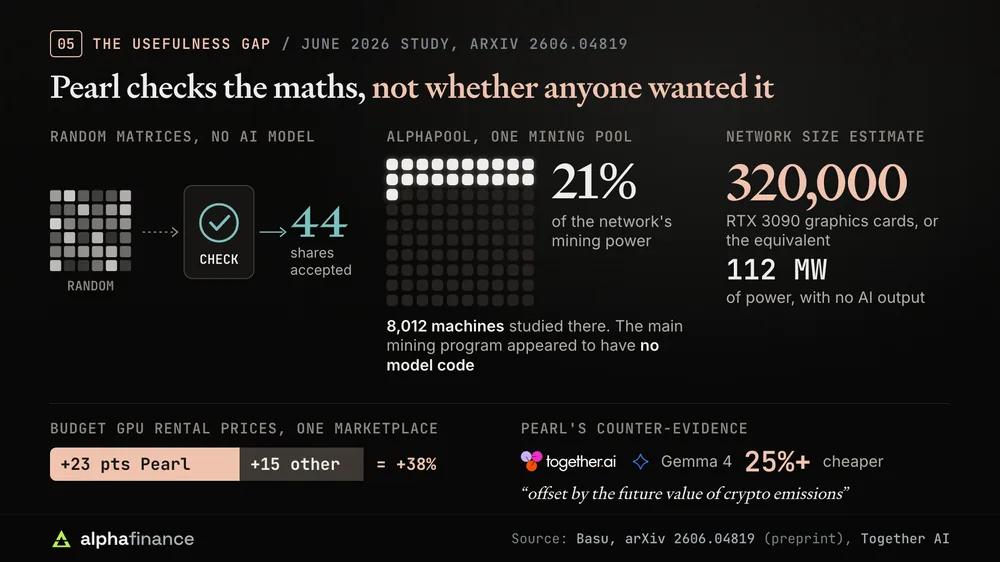
Changes to Pearl's rules, hardware requirements and trading venues affect who earns PRL.
In a 10 Oct 2026 report, Chinese-language outlet TechFlow placed Pearl among the most discussed projects at the Token2049 conference. Supporters called it the Bitcoin of AI, while critics cited the usefulness gap.
Pearl Research Labs' direct inference service listed seven open models from Qwen, Z.AI, DeepSeek and Google on its pricing page on 10 Oct 2026. Customers pay in US dollars per unit of text processed, so the service creates no direct demand for PRL.
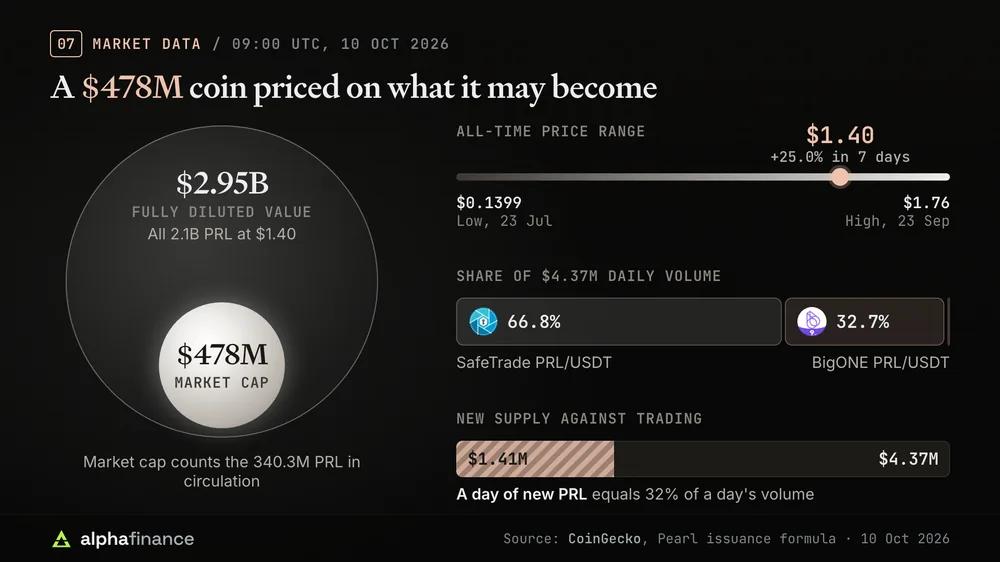
A handful of small exchanges list PRL. Its price reflects expectations far more than current use. CoinGecko's Pearl page reported these figures at 09:00 UTC on 10 Oct 2026.
| Measure | Figure on 10 Oct 2026 |
|---|---|
| Price | $1.40 |
| 7-day change | +25.0% |
| All-time high | $1.76 (23 Sep 2026) |
| All-time low | $0.1399 (23 Jul 2026) |
| 24-hour trading volume | $4.37M |
| Market capitalisation | $478M |
| Fully diluted valuation | $2.95B |
Fully diluted valuation multiplies the price by all 2.1 billion PRL that will ever exist. Market capitalisation uses the 340.3 million PRL in circulation, which matches the figure the issuance formula gives.
The whitepaper describes the coin's store-of-value role as "completely dependent on the expectation of its future adoption as a means of payment".
Because PRL runs on its own blockchain, it has no contract address. Perle, a separate token on Solana, shares its PRL ticker. A PRL pair on a decentralised exchange, including one found through our DEX screener, is therefore a different asset. Check both the project name and ticker on any price list, including our live crypto prices.
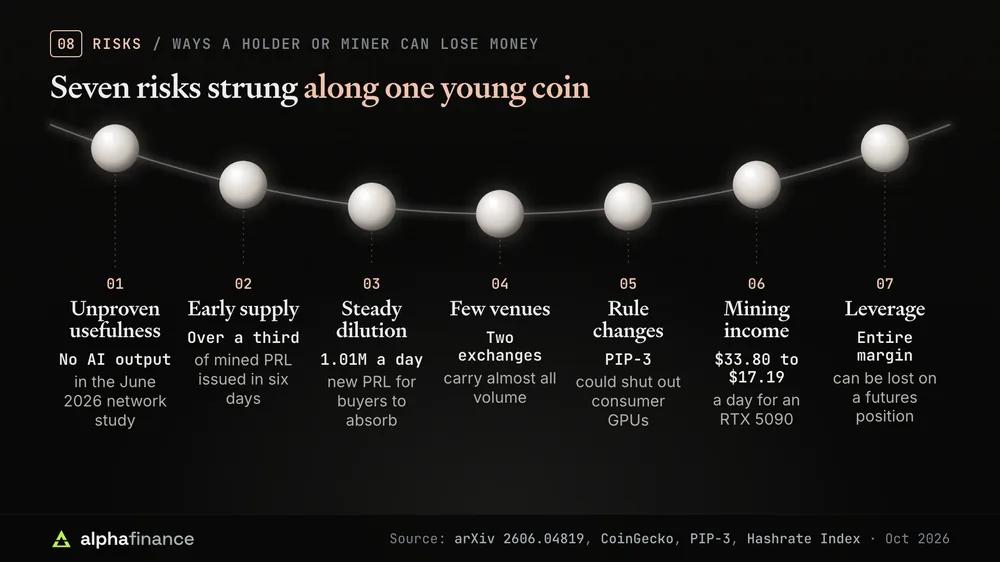
PRL is a young coin with heavy issuance, and its main claim remains unproven on its own network. Holders and miners face several ways to lose money.
Not investment advice
This article explains market data. Nothing on this page is a recommendation to buy, sell or leverage any asset. Digital assets are volatile and you can lose everything you put in. If you are unsure whether a trade is appropriate for you, a licensed adviser in your jurisdiction is the right next step.


Fact checked by
Verifies every figure against primary sources before publication. Meet the team
Pearl (PRL) is a cryptocurrency mined through matrix multiplication on graphics cards, the calculation that powers AI models. It copies Bitcoin's design, including proof-of-work mining and a fixed supply. According to its whitepaper, the network launched on 27 Apr 2026. The same GPU calculation can serve an AI model while competing for block rewards.
PRL's maximum supply is 2.1 billion, or 100 times Bitcoin's 21 million. The whitepaper's issuance formula puts mined supply at about 340 million PRL at block 125,752 on 10 Oct 2026. Half the total is scheduled to be issued by block 650,226.
The issuance formula allocates nothing to founders or investors. All PRL is mined, but low starting difficulty made the launch uneven. Miners produced the first 40,000 blocks in six days and received about 121.7 million PRL. The whitepaper says funding the core team was part of the reason for setting difficulty low.
Most mining has not been. A June 2026 study found no AI models in the dominant mining software and showed that random-number calculations were accepted. Useful work is allowed but not required. Its share of mining depends on how many miners also serve paying AI customers.
No. Pearl's PRL is the native coin of its own blockchain, with addresses beginning "prl1". Tokens using the PRL name or ticker on Solana, Base or other networks are unrelated to Pearl Research Labs' coin.