Markets
 BTC
BTC ETH
ETH BNB
BNB XRP
XRP SOL
SOL ZEC
ZEC HYPE
HYPE DOGE
DOGE LINK
LINK TON
TON AVAX
AVAX SUI
SUI TAO
TAO AAVE
AAVE PUMP
PUMP MORPHO
 ARB
ARB LIT
LIT--:-- UTC
Research/Market structure
Justin Drake's path from Cambridge maths to the Ethereum Foundation, the ideas behind lean Ethereum and the strawmap, and why his bunker mode warning split cryptographers.
 By Alpha Finance Editorial Team
 Fact-checked by Vince Dioquino
Every figure, platform detail and regulatory claim on this page was traced to a primary source by the named fact checker before publication, and is re-checked when those facts change. The review date moves only when a person has re-read the page.
The editorial policy → Editorial policy Report an errorJustin Drake is a researcher at the Ethereum Foundation, the non-profit that funds the blockchain's research and development. He has worked on Ethereum's core design since 2017 and helps maintain the draft plan for its next seven upgrades.
He coined ultra sound money, the phrase for Ether's ability to shrink in supply, and proposed lean Ethereum, a multi-year plan to rebuild the network's core. He also works on defences against quantum computers and co-wrote a Google paper on quantum attacks in March 2026.
On 7 Oct 2026 he asked the crypto industry to plan for "bunker mode", a gradual move of coins into addresses that have never sent a transaction. Other cryptographers challenged the advice within hours.
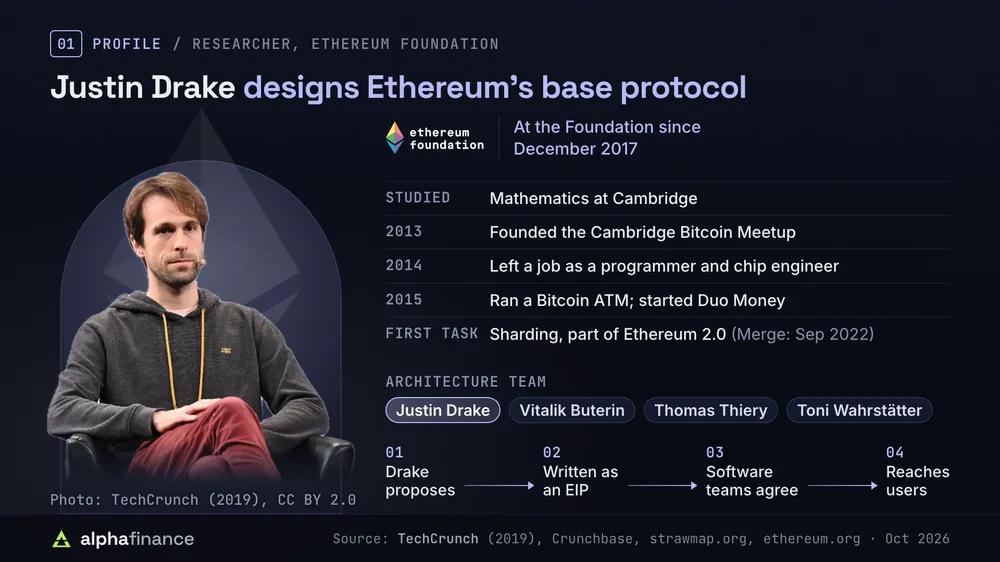
Drake proposes designs for Ethereum's base protocol for other teams to test and adopt. A speaker biography published by TechCrunch in 2019 says he studied mathematics at Cambridge and founded the Cambridge Bitcoin Meetup in 2013. In 2014, he left his job as a programmer and chip engineer to study blockchains.
The same biography describes how he ran a Bitcoin ATM in 2015 and started a company building a web interface for OpenBazaar, a peer-to-peer marketplace. Crunchbase's profile of Drake identifies the company as Duo Money and dates his arrival at the Ethereum Foundation to December 2017.
His first assignment was sharding, a plan to spread Ethereum's workload across many parallel chains. Sharding formed part of Ethereum 2.0, the upgrade plan that brought the network to proof of stake at The Merge in September 2022. Under proof of stake, people lock up Ether as a deposit, called staking, to earn the right to confirm transactions.
The strawmap site lists Drake among the four members of the Foundation's Architecture team, alongside Ethereum co-founder Vitalik Buterin, Thomas Thiery and Toni Wahrstätter. They maintain a draft plan for the network's next seven upgrades. His X profile now describes him as a "Bitcoin security researcher", a label Decrypt also used in March 2026.
The position carries influence without authority. Ethereum has no chief executive, and proposed changes are documented as Ethereum Improvement Proposals (EIPs). They reach users only when the separate teams building Ethereum's software agree to ship them. As the strawmap site explains, an official roadmap representing every Ethereum stakeholder is effectively impossible.
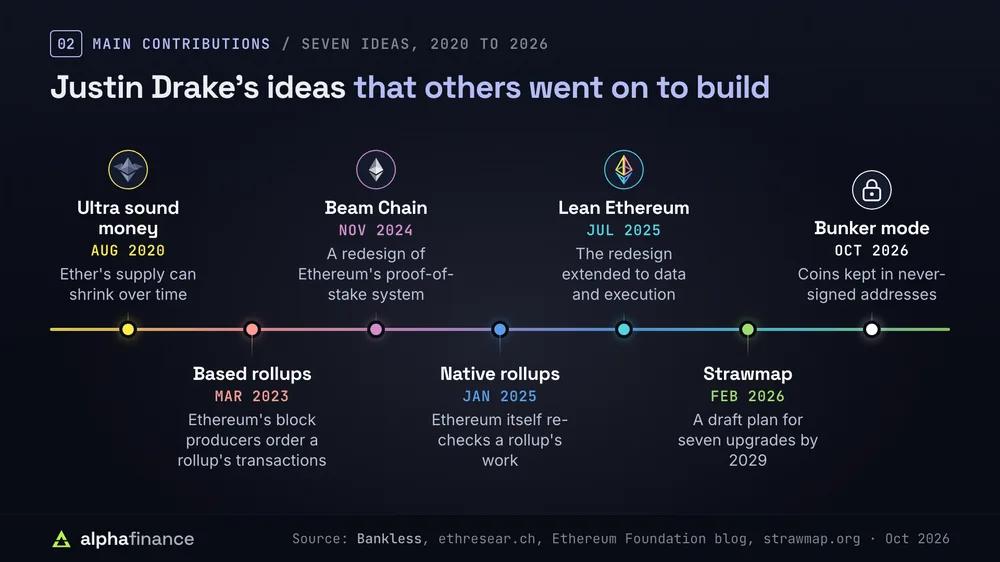
Other teams have built on Drake's ideas, giving his research influence over Ethereum's development. Several of those ideas now shape how Ether is valued.
| Idea | First proposed | What it means |
|---|---|---|
| Ultra sound money | 2020 | Ether's supply can shrink over time |
| Based rollups | Mar 2023 | Ethereum's block producers order a rollup's transactions |
| Beam Chain | Nov 2024 | A redesign of Ethereum's proof-of-stake system |
| Native rollups | Jan 2025 | Ethereum itself re-checks a rollup's work |
| Lean Ethereum | Jul 2025 | The redesign extended to data and execution |
| Strawmap | Feb 2026 | A draft plan for seven upgrades by 2029 |
| Bunker mode | Oct 2026 | Coins kept in addresses that have never signed |
Drake suggested the phrase ultra sound money in a private Telegram chat on 31 Aug 2020, after Vitalik Buterin floated "supersonic money", according to Bankless's history of the term. It plays on the sound money label Bitcoin supporters use. Ethereum destroys part of every transaction fee, allowing Ether's supply to fall over time.
A rollup processes transactions cheaply on a separate network and posts the results back to Ethereum. Drake's March 2023 proposal for based rollups puts transaction ordering in the hands of the computers that assemble Ethereum's blocks, replacing a single company-run server. He followed it with native rollups in January 2025, which let Ethereum itself re-check a rollup's work.
Zero-knowledge proofs are another focus of his research. These compact mathematical receipts show that a batch of transactions was processed correctly without repeating the work. In July 2025, the Foundation set a real-time proving target of proving 99% of Ethereum blocks within 10 seconds.
Our blockchain data dashboard compares Ethereum with other major chains through fees, dollar-pegged stablecoin balances and the value deposited in applications.
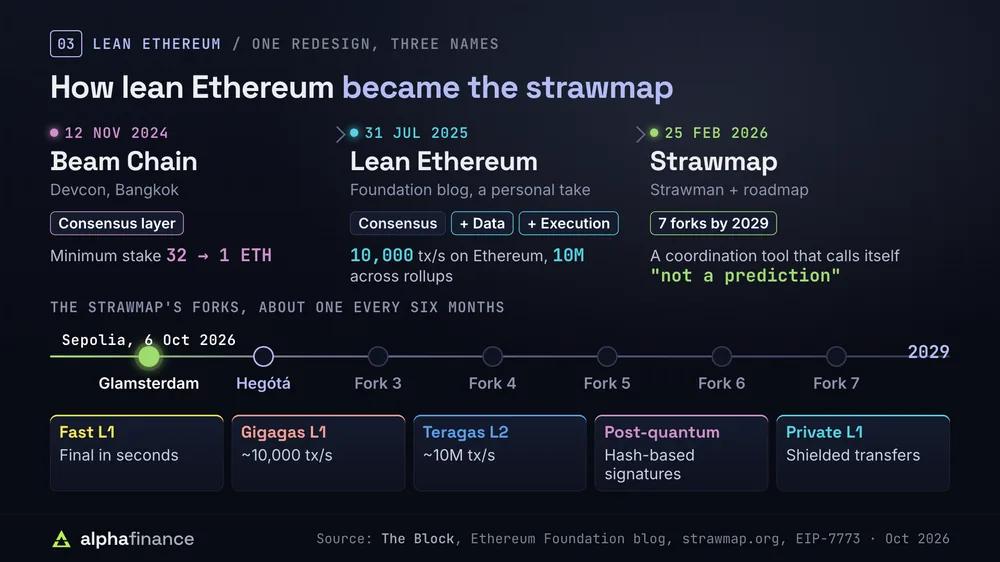
Drake's largest project is a multi-year rebuild of Ethereum's core, intended to bring block confirmation down to seconds and make its cryptography resistant to quantum computers.
At the Devcon conference in Bangkok on 12 Nov 2024, he presented the first version as Beam Chain. It focused on the consensus layer, which orders blocks and manages staking. The proposal called for faster blocks and quantum-resistant cryptography, while reducing the minimum stake from 32 ETH to 1 ETH.
The five-year timetable drew objections from some long-standing developers, Unchained reported that week. They argued that half the changes could arrive sooner through separate upgrades.
Drake expanded the redesign to data storage and transaction execution on 31 Jul 2025, the day after Ethereum's tenth anniversary. He renamed it lean Ethereum in a Foundation blog post, labelled as his personal take. Its targets are 10,000 transactions a second on Ethereum and 10 million across rollups.
The strawmap, introduced by Drake on 25 Feb 2026, is the current version. Its name combines strawman and roadmap. The document outlines seven upgrades, known as forks, by 2029, roughly one every six months. It describes itself as a coordination tool and "not a prediction".
Its long-term goals use shorthand. L1 refers to layer 1, Ethereum's main chain, while L2 refers to the rollups built on top.
Glamsterdam is the strawmap's first fork. It went live on the Sepolia test network on 6 Oct 2026, as the Foundation's 28 Sep announcement planned. No date has been set for mainnet, the live network holding real funds.
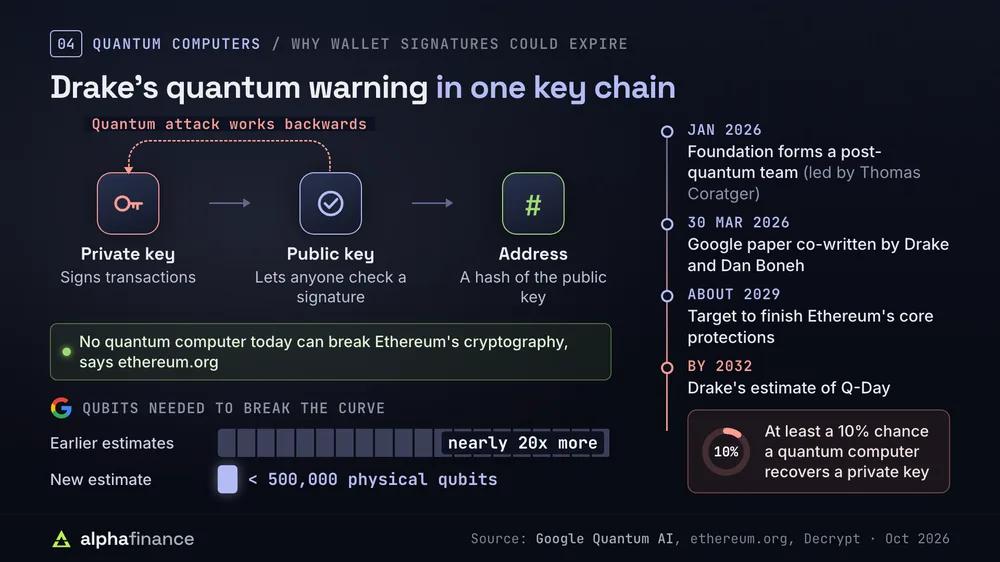
Drake believes the signatures securing Bitcoin and Ethereum wallets have a limited lifespan, and he has published estimates of when they might fail.
Both networks approve transactions using ECDSA, the Elliptic Curve Digital Signature Algorithm. A wallet's private key signs transactions, while its public key allows anyone to check those signatures. With a sufficiently large quantum computer, an attacker could work backwards from the public key to recover the private key.
In January 2026, the Foundation formed a dedicated post-quantum team led by Thomas Coratger. The roadmap aims to complete the core protections by about 2029.
Drake and Stanford cryptographer Dan Boneh are co-authors of a Google Quantum AI whitepaper dated 30 Mar 2026. It estimates that fewer than half a million physical qubits, the basic units of a quantum computer, would be needed to break the curve used by Bitcoin and Ethereum. That is nearly 20 times fewer than earlier estimates.
After publication, Drake wrote that he saw at least a 10% chance of a quantum computer recovering such a private key by 2032, Decrypt reported. Researchers refer to that moment as Q-Day.
His work also includes co-authoring EIP-8310, a draft standard for storing the hash-based keys validators would use under lean Ethereum. Validators are the computers that stake Ether and confirm blocks.
The same Ethereum.org page states that no quantum computer today can break Ethereum's cryptography. Its official guidance says users need to do nothing for now.
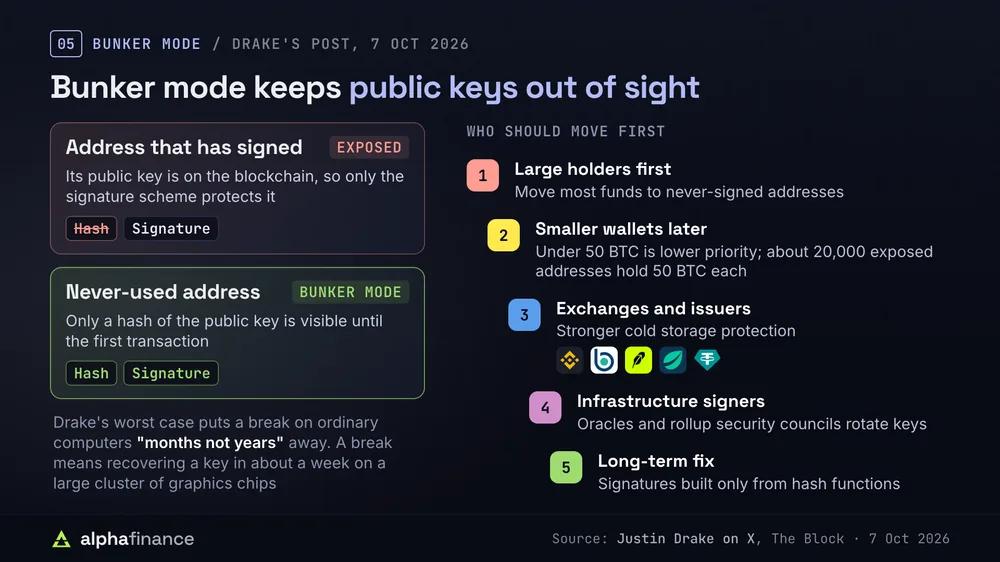
Bunker mode means keeping coins in addresses that have never sent a transaction. Drake presents it as cheap insurance against a sudden failure of wallet signatures.
On Ethereum and most Bitcoin address types, the wallet address is a hash of its public key, a scrambled fingerprint. The public key becomes visible on the blockchain when that address first sends a transaction. Until then, the hash provides protection in addition to the signature scheme.
The Block's account of Drake's post says he considered it reasonable to prepare for ECDSA being broken on ordinary computers, with a worst case arriving in "months not years". He defined a break as recovering a private key in about a week using a large cluster of graphics chips.
A set of 722 mathematical manuscripts released that week by OpenAI from an internal model prompted the warning. Drake reasoned that elliptic curves have more mathematical structure than hash functions, giving an AI system more to attack.
He set out the following advice for holders and infrastructure operators.
Drake also wrote that the strawmap's timelines "must now be revisited and accelerated".
The advice concerns balances left untouched for long periods. Our dashboards track how much Ether each exchange holds. On 12 Oct 2026, the 31 listed companies with Ether treasuries held 8.03 million ETH, equivalent to 6.58% of circulating supply. The funds on our Ethereum ETF dashboard hold Ether and trade on stock exchanges. Their custodians face the same question.
Vitalik Buterin agreed that AI-accelerated mathematics poses a real risk, but wrote that he does not recommend anyone "scramble to move their funds to new wallets today". He also cautioned that AI could weaken lattice-based schemes, a leading candidate for quantum-safe signatures.
Coinbase's head of cryptography, Yehuda Lindell, said there was no evidence that the assumptions underpinning elliptic curve cryptography were close to failing, The Defiant reported. Former Foundation researcher Dankrad Feist argued that hiding keys would not protect coins' value if the curve really broke.
As the debate spread, Bitcoin slipped below $83,000 on 8 Oct 2026. Drake's post had received almost 4 million views, according to CoinDesk.
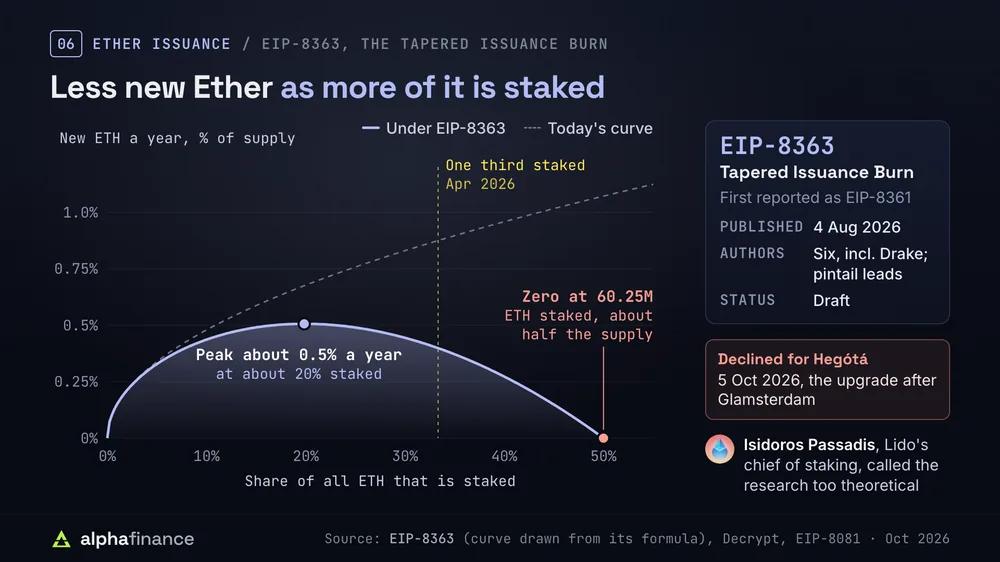
Once enough Ether is staked, Drake wants Ethereum to spend less on security. That would reduce income for everyone who stakes.
New Ether created to reward validators is called issuance. On 4 Aug 2026, Drake and five other authors published EIP-8363, the Tapered Issuance Burn, first submitted and reported as EIP-8361. A researcher known as pintail is the lead author.
Under the draft, a growing share of validator rewards would be destroyed as the amount of staked Ether rises. Issuance rewards would fall to zero at 60.25 million staked ETH, about half the supply, according to Decrypt's summary. Total issuance would peak at roughly 0.5% of supply a year when about 20% of Ether is staked.
The share of Ether staked passed one third in April 2026, the same report says. Isidoros Passadis, chief of staking at staking provider Lido, criticised the supporting research as too theoretical and objected to the timing.
Lower issuance is the other half of ultra sound money. Creating less new Ether allows supply to shrink faster. On 5 Oct 2026, core developers declined EIP-8363 for Hegotá, the upgrade planned after Glamsterdam, so it remains a draft with no fork scheduled. Readers can use our staking calculator to see what Ether staking pays at current rates or any rate they enter.
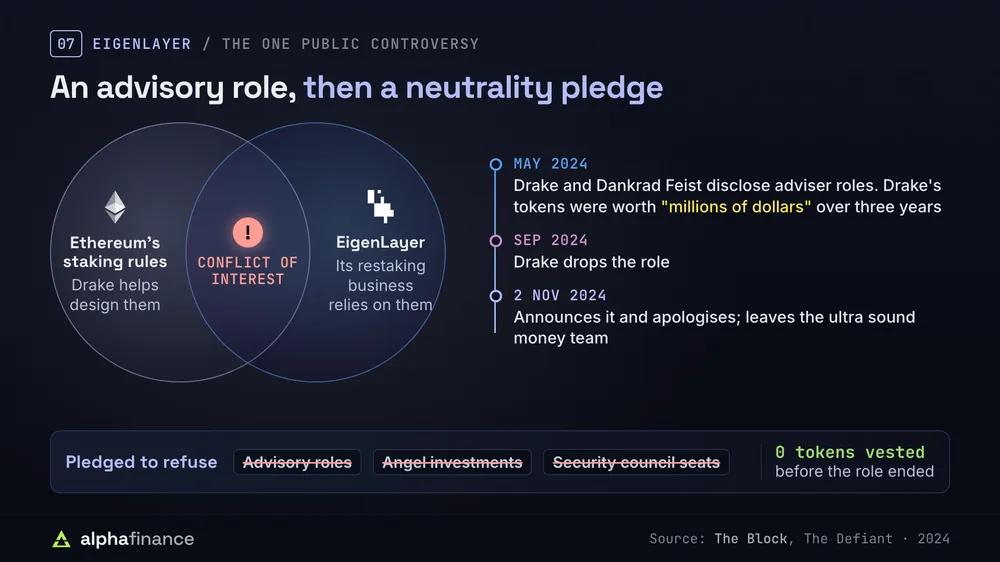
Drake's paid advisory work led to the one public controversy of his career, and it ended with him giving up his outside positions.
In May 2024, Drake and fellow researcher Dankrad Feist disclosed advisory roles at EigenLayer, a restaking protocol. Restaking allows Ether already staked on Ethereum to be pledged again to secure other services. The Block reported that Drake had described his token allocation as worth "millions of dollars", to be released gradually over three years.
Because he helps design the staking rules on which EigenLayer's business depends, the arrangement raised conflict-of-interest questions. On 2 Nov 2024, Drake announced that he had left the role in September and apologised to the Ethereum community and his Foundation colleagues. He also left the team behind the ultra sound money tracker.
His neutrality pledge rules out future advisory roles and angel investments, along with seats on security councils, the committees that can upgrade rollups. None of his EigenLayer tokens had vested when the agreement ended, The Defiant reported.
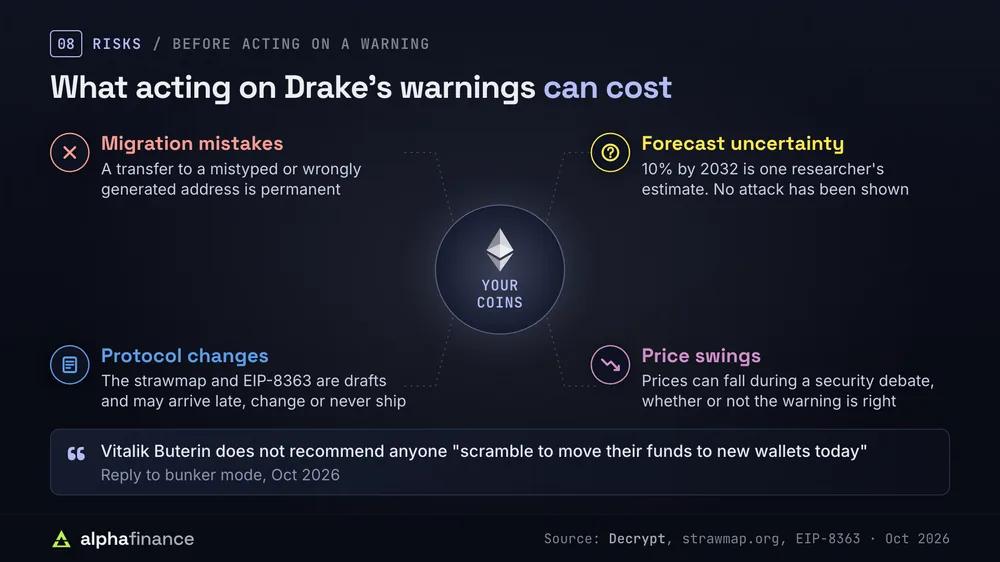
Drake's forecasts are estimates, and acting on them can cost money.
Not investment advice
This article explains market data. Nothing on this page is a recommendation to buy, sell or leverage any asset. Digital assets are volatile and you can lose everything you put in. If you are unsure whether a trade is appropriate for you, a licensed adviser in your jurisdiction is the right next step.


Fact checked by
Verifies every figure against primary sources before publication. Meet the team
Justin Drake researches upgrades to Ethereum's base protocol at the Ethereum Foundation. He is known for ultra sound money, the Beam Chain and lean Ethereum proposals, and the strawmap draft roadmap. In October 2026, he called for bunker mode. Drake studied mathematics at Cambridge and joined the Foundation in 2017.
Drake can propose changes but cannot impose them. Upgrades ship only when the independent teams building Ethereum's software agree on them. The strawmap he helps maintain describes itself as a draft. It notes competing views among the 100 members of the Foundation's protocol group.
Bunker mode is Drake's term for moving coins into addresses that have never sent a transaction. These addresses reveal only a hash of the public key, adding protection if the signature scheme is ever broken. He presented the advice as a personal recommendation and told holders not to rush.
There is no demonstrated attack on ECDSA, the signature scheme used by Bitcoin and Ethereum. Drake warned about a possible future break. Coinbase's head of cryptography said there is no evidence that one is close, and Ethereum.org says users need to do nothing for now.
Ultra sound money describes the possibility of Ether's supply shrinking over time. Ethereum destroys part of every transaction fee. When that amount exceeds the new Ether paid to validators, supply falls. Drake suggested the phrase in August 2020.
Published on 25 Feb 2026, the strawmap outlines seven Ethereum upgrades by 2029. The draft seeks faster confirmation and higher capacity, alongside quantum-resistant signatures and built-in privacy. Four Foundation researchers maintain it, including Drake and Vitalik Buterin.